Birth in Anfu
Born into a scholarly clan in Anfu, Jizhou, showing early poetic brilliance.
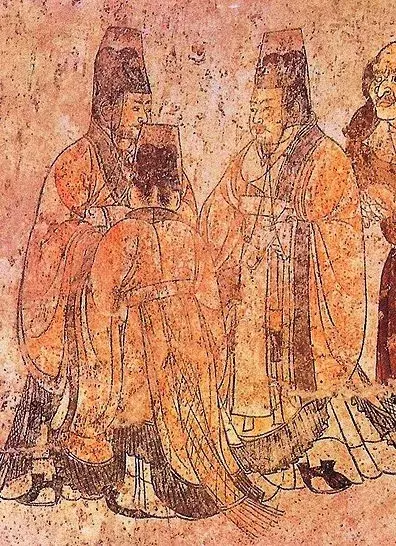
王庭珪
Wang Tinggui (1079–1171), courtesy name Minbo, styled himself Master Luxi, was a native of Anfu in Jizhou (modern Anfu, Jiangxi). He was an outstanding patriotic poet, scholar, and unbending Confucian loyalist across the Northern and Southern Song transition, renowned for his moral rectitude and living to the venerable age of ninety-three. Passing the imperial examination in 1118 as Merit Gentleman, Wang was appointed…
Wang Tinggui (1079–1171), courtesy name Minbo, styled himself Master Luxi, was a native of Anfu in Jizhou (modern Anfu, Jiangxi). He was an outstanding patriotic poet, scholar, and unbending Confucian loyalist across the Northern and Southern Song transition, renowned for his moral rectitude and living to the venerable age of ninety-three. Passing the imperial examination in 1118 as Merit Gentleman, Wang was appointed Assistant Magistrate of Chaling County, where he promoted education and reformed corrupt exactions. Disgusted by the venality of late Northern Song politics, he resigned after five years and retired to Luxi in Anfu, devoting three decades to teaching. During the early Shaoxing era, Grand Councilor Qin Gui pursued craven appeasement with the Jurchen Jin, executing Yue Fei and suppressing resistance. When Compiler Hu Quan submitted a memorial demanding the execution of Qin Gui and was banished to Guangdong, fearful courtiers shunned him. Wang alone hosted a public farewell for Hu, presenting him with a soaring poem containing the iconic line: "Foolish children cannot manage dynastic affairs; a true man must work wonders for the whole empire!" Enraged, Qin Gui stripped Wang of his status and subjected him to Administrative Exile in Chenzhou (bianguan) in western Hunan for seven years. Following Qin's death and the accession of Emperor Xiaozong, Wang was summoned to court at age eighty-seven to advise on dynastic recovery, receiving imperial honors and appointment as Recorder of the Directorate of Education. His collected works in fifty volumes, Luxi Ji, were celebrated by Zhou Bida and Yang Wanli.
Born into a scholarly clan in Anfu, Jizhou, showing early poetic brilliance.
Passed the jinshi examination in Kaifeng as Merit Gentleman, appointed Assistant Magistrate of Chaling.
Refused to flatter corrupt superiors, resigning his post to retire to Luxi in Anfu.
Remained in his home village during the Jingkang Incident, teaching Confucian ethics.
Penned the famous farewell poem celebrating Hu Quan, arousing Qin Gui's deadly hatred.
Targeted in Qin Gui's literary inquisitions, stripped of rank and subjected to Administrative Exile in Chenzhou.
Qin Gui died; Wang was released from seven years of frontier exile at age seventy-eight.
Summoned to the Southern Song capital Lin'an by Emperor Xiaozong, appointed Recorder of the Directorate of Education.
Passed away peacefully at his Luxi retreat at the age of ninety-three.
Wang Tinggui was born into an esteemed scholarly clan in Anfu, Jizhou. Enrolling in the Imperial University in Kaifeng, he mastered the Confucian classics and ancient literature. In 1118, Wang passed the imperial jinshi examination, receiving appointment as Merit Gentleman and Assistant Magistrate of Chaling County in Hengzhou.
In Chaling, Wang served with spotless integrity, cracking down on corrupt clerks, equalizing corvée labor, and establishing community academies. However, during the closing years of Emperor Huizong's reign, the capital was dominated by the corrupt clique of Cai Jing and Tong Guan. When Wang's prefectural superiors demanded extortionate tax levies, Wang refused to compromise his principles, resigning his office in 1123. He returned to Anfu, building a thatched study along the Luxi river, styling himself "Master Luxi", and resolving to devote his life to teaching and scholarship.
Following the fall of Northern Song in the Jingkang Incident, the court fled south. During the Shaoxing era, Emperor Gaozong and Grand Councilor Qin Gui pursued appeasement with the Jurchen Jin, murdering Yue Fei and purging patriotic statesmen.
In 1138, Compiler in the Bureau of Military Affairs Hu Quan submitted an impassioned memorial urging resistance and demanding that Qin Gui be executed for treason. Infuriated, Qin Gui stripped Hu of rank and banished him to remote Xinzhou. As Hu journeyed south through Jizhou, civil and military officials fled from him in terror. Only Wang Tinggui stepped forward, organizing a public farewell banquet outside the city and presenting Hu with powerful verses, including: "Foolish children cannot manage dynastic affairs; a true man must work wonders for the whole empire! A thousand-year destiny must overcome this catastrophe; a single clap of thunder will rouse the sleeping dragon."
The poem circulated across the empire, thrilling patriotic hearts. Qin Gui harbored a bitter grudge for a decade, waiting for an opportunity to strike. In 1149, Qin's agents used a poetic colophon Wang had written for imperial clansman Zhao Boying to fabricate charges of slandering the court. Wang, already seventy years old, was cashiered, stripped of his credentials, and marched under armed escort to Administrative Exile in Chenzhou (modern Yuanling, Hunan).
Living in destitute exile in Chenzhou for seven years, Wang remained serene. He opened a school in his rustic hut, teaching classical literature to local youths and recording the customs of the indigenous Miao peoples. Following Qin Gui's death in late 1155, the court lifted the proscriptions, and Wang returned home to Jiangxi in the spring of 1156 at age seventy-eight.
In 1165, the reform-minded Emperor Xiaozong sought out venerable loyalists. Hearing that the heroic poet who had defied Qin Gui was still alive, Xiaozong issued an imperial summons. At the extraordinary age of eighty-seven, Wang traveled to Lin'an and walked into the imperial hall. Xiaozong praised his unyielding loyalty and sought his counsel on recovering the northern central plains. Wang urged the emperor to recruit upright men and discipline the military. Deeply impressed, Xiaozong conferred the title Recorder of the Directorate of Education and bestowed generous gifts.
Wang passed away peacefully at his Luxi residence in 1171 at the age of ninety-three. Southern Song Grand Councilor Zhou Bida personally composed his spirit-way inscription.
Wang Tinggui's most celebrated historical achievement was his fearless defiance of Qin Gui's dictatorship. At a time when the entire empire was paralyzed by fear, Wang, an ordinary commoner, dared to declare that Qin Gui was a petulant "foolish child" ruining the state, while praising Hu Quan as a transcendent hero.
His poem served as a clarion call for patriotic resistance throughout the Southern Song. Enduring seven years of harsh exile in western Hunan without a single word of regret, Wang stood as an immortal symbol of the unbending moral backbone of the Song literati.
During his thirty years of teaching at Luxi, Wang founded the "Luxi School" of Confucian thought. Rejecting vacuous metaphysical speculation, he advocated pragmatic statecraft and moral integrity. His academy nurtured an entire generation of patriotic scholars and statesmen, including Hu Quan and Liu Yifeng. His fifty-volume collection, Luxi Ji, preserves invaluable primary documents on the political struggles and social history of the Gaozong and Xiaozong reigns.
During his seven years in Chenzhou, Wang's verse achieved supreme aesthetic maturity. Moving beyond the lighter melodies of his youth, his frontier poems captured the rugged landscapes of western Hunan with deep moral pathos and historical weight. Southern Song literary giant Zhou Bida praised his verse as "flowing forth like an inexhaustible spring", while Yang Wanli revered him as an immortal elder of Song poetry.
FIGURES ASSOCIATED WITH THIS DYNASTY