Birth in Wanping
Born in Beijing where his father served as an Imperial Academy of Medicine physician, studying canons early.
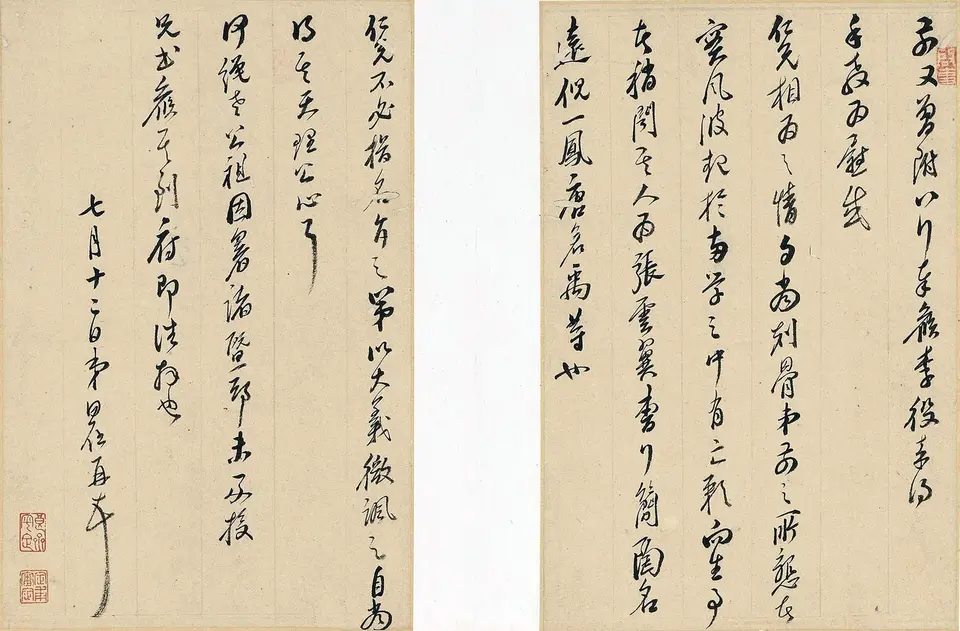
王思任
Wang Siren (王思任, 1575–1646), courtesy name Jizhong and art name Suidong, was a native of Shanyin County, Shaoxing Prefecture, Zhejiang. He was a distinguished late Ming literatus, supreme master of the personal essay (xiaopinwen), dramatist, and martyred loyalist official. Endowed with exceptional intellect from youth, Wang earned his jinshi degree in 1595 (23rd year of Wanli) at age twenty-one. He served successively as…
Wang Siren (王思任, 1575–1646), courtesy name Jizhong and art name Suidong, was a native of Shanyin County, Shaoxing Prefecture, Zhejiang. He was a distinguished late Ming literatus, supreme master of the personal essay (xiaopinwen), dramatist, and martyred loyalist official. Endowed with exceptional intellect from youth, Wang earned his jinshi degree in 1595 (23rd year of Wanli) at age twenty-one. He served successively as Magistrate of Dangtu in Zhili, Fuping in Shaanxi, Qingpu in South Zhili, and Jinxian in Jiangxi, eventually rising to Surveillance Vice Commissioner of the Jiujiang Military Defense Circuit. In regional administration, Wang was incorruptible, legally discerning, and fiercely protective of the populace, noted for using trenchant humor and satire to defuse crises and confound extortionate tax-collecting court eunuchs, earning the affectionate folk moniker "the weeping infant magistrate." In late-Ming literary history, Wang achieved equal stature alongside Yuan Hongdao and Zhang Dai as a foremost master of the expressive xiaopin essay. His unconstrained, pungent prose employed vibrant colloquial vernacular to delineate worldly society and mountain landscapes, elevating late-Ming personal essay art to its absolute zenith. When Qing armies crossed the Yangtze and took Nanjing, Grand Secretary Ma Shiying and Ruan Dacheng abandoned the capital to flee to Zhejiang. Indignant at their treachery, Wang composed his famous Denunciation of Ma Shiying (Xi Ma Shiying Shu), widely circulated across the empire. When Zhu Yihai, Prince of Lu, proclaimed his regency in Shaoxing, he appointed Wang Right Vice Minister of Rites. In 1646, when Qing forces forced the Qiantang River defenses and captured Shaoxing, Wang steadfastly refused to shave his hair or surrender, withdrawing to a solitary Buddhist retreat on Mount Qinwang and starving himself for seven days until his death at age seventy-two.
Born in Beijing where his father served as an Imperial Academy of Medicine physician, studying canons early.
Ranked seventh in the Shuntian provincial examinations, gaining early fame across the capital.
Passed the metropolitan examinations at age twenty-one, appointed Magistrate of Dangtu in Zhili.
Defied corrupt tax eunuch Xing Long in Dangtu, using wit and humor to avert exactions.
Served as Magistrate of Fuping, Qingpu, and Jinxian, rectifying judicial errors and loved by commoners.
Disillusioned by factional strife, resigned to reside by the lakes of Shanyin, authoring personal essays.
Recalled to office as Military Defense Vice Commissioner of Jiujiang, strengthening river defense.
Following Nanjing's fall, penned a blistering denunciation of Ma Shiying; named Vice Minister of Rites by Prince of Lu.
When Shaoxing fell, refused to shave his hair and starved himself to death on Mount Qinwang at age seventy-two.
Wang Siren was born in 1575 in Wanping County, Shuntian Prefecture (Beijing). His family hailed from Shanyin County, Shaoxing Prefecture, Zhejiang, and practiced medicine across generations. His father Wang Donghai was an official physician in the Imperial Academy of Medicine, well-versed in historical chronicles. Raised in an intellectually stimulating family, Wang displayed extraordinary intellect from early childhood, reciting poetic rhapsodies at age six and reading Zuo Zhuan, Shiji, and Hanshu at age ten.
Alongside his agile mind, Wang developed an uninhibited, witty, and aloof personality. In 1594, twenty-year-old Wang took the Shuntian provincial examination, ranking seventh as a juren. The following spring, he passed the metropolitan palace examinations as a jinshi at the youthful age of twenty-one, winning renown across Beijing and Nanjing. He was commissioned as Magistrate of Dangtu in Zhili.
Entering officialdom, Wang served successively as magistrate of four counties: Dangtu, Fuping, Qingpu, and Jinxian. During the Wanli reign, the emperor dispatched eunuch mine and tax commissioners across Jiangnan prefectures to extort trade taxes from merchants and farmers. When court eunuch Xing Long arrived in Dangtu, local bureaucrats knelt before him, while Wang Siren alone met him with effortless humor. Confronted with Xing Long's arrogant demands, Wang used sharp, satirical barbs and legal reasoning to confound the eunuch, shaming him into abandoning his extortion schemes in Dangtu and sparing the populace from ruin.
During his tenures in Qingpu and Jinxian, Wang showed extraordinary judicial discernment, eradicating local criminal syndicates while maintaining personal frugality. He personally surveyed water conservancy works and land tax rosters, preventing corrupt clerks from pocketing public revenues. Confronting unreasonable demands from superior provincial inspectors, he defused pressure through witty irony, winning the affectionate folk title "the weeping infant magistrate." However, his proud sarcasm alienated superiors and eunuch agents. After serving for over a decade across four counties, Wang grew weary of bureaucratic corruption and resigned his seals, returning to Shanyin in Shaoxing.
Living in retirement in Shaoxing, Wang witnessed the golden age of the late-Ming xiaopin essay movement. He constructed a residence named "Suidong" (Leaning East), forming close friendships with regional literary titans including Zhang Dai, Qi Biaojia, Ni Yuanlu, and followers of Xu Wei. Blessed with a generous, satirical nature, Wang indulged his passions for sightseeing, drama, and wine.
He traveled extensively across scenic wonders including the Yandang Mountains, Huangshan, Mount Lu, the Fuchun River, and West Lake, composing personal travel essays after every excursion. Breaking with the archaist conventions of classical imitation, he employed lively street vernacular and incisive satire to articulate authentic feelings. His essays, celebrated for their unconstrained dynamism, spread throughout the empire. Zhang Dai praised his prose in Dream Recollections of Tao'an, comparing his style to "a wild steed breaking its reins, kicking up dust beyond pursuit." During this period, he also edited multi-volume miscellaneous collections such as Yishi Lianggui and Zahong Zabai Ji.
In 1642, facing national crisis, the court recalled Wang as Surveillance Vice Commissioner of the Jiujiang Military Defense Circuit. Wang drilled garrison troops along the Yangtze River; however, in 1644, Beijing fell. In the south, the Hongguang regime was established in Nanjing, where Grand Secretaries Ma Shiying and Ruan Dacheng monopolized power, selling offices and persecuting upright scholars. In May 1645, Qing armies crossed the Yangtze, Nanjing collapsed, and Ma Shiying fled to Hangzhou and Shaoxing.
Gazing upon the ruin of the realm and the cowardly flight of the chancellor, Wang took up his brush and composed his celebrated Denunciation of Ma Shiying. Wang denounced him: "In all antiquity, never has national catastrophe been so deep as today! As premier grand secretary, you brought ruin to the state and people; heaven and earth cannot tolerate you, and ten thousand deaths could not expiate your crimes! You should slit your throat immediately to apologize to the realm!" The text circulated widely, eliciting universal praise from troops and commoners.
In the intercalary sixth month of 1645, Zhu Yihai, Prince of Lu, proclaimed his regency in Shaoxing, appointing Wang Right Vice Minister of Rites. Wang contributed his personal savings to recruit volunteers to defend the Qiantang River front. In May 1646, Qing forces forced the river crossing and captured Shaoxing, forcing Prince Lu to flee by sea to Zhoushan. Qing commanders urged Wang to surrender with promises of high rank, but Wang refused to submit to the razor. In June, after an attempt to poison himself failed, he withdrew to a solitary monastery below Mount Qinwang in Shaoxing, starving himself for seven days without taking water. Before dying, he composed his final verse: "All my life I loved reading ancient books; only in death do I know I did not betray them!" He starved to death as a loyalist martyr at age seventy-two.
Wang Siren holds a unique and preeminent position in Ming literary history as one of the most distinctive masters of the late-Ming xiaopin essay movement.
His prose cast aside the rigid stylistic formulas of the Tang-Song and Archaising schools, championing the aesthetic ideal of "expressing native sensibility without formal constraint." His essays featured sharp, witty, and satirical diction, utilizing vibrant folk vernacular to mock late-Ming bureaucratic corruption and social hypocrisy through landscape descriptions. Celebrated pieces like Record of Traveling the Famous Sights of the Western Mountains, Record of Traveling Qishan, and Records of Traveling the Sights of Our Yue painted scenery with vivid brilliance, praised by literary historians as the supreme examples of late-Ming prose, deeply inspiring masters such as Zhang Dai and Li Yu.
Beyond essays, Wang achieved distinction in late-Ming dramatic theory and vernacular sanqu lyrics.
Versed in southern musical meters and stage performance, Wang championed Tang Xianzu's Linchuan School, rejecting Shen Jing's strict, narrow preoccupation with phonetic rules. He argued that drama must move audiences through authentic feeling: "Where deep emotion reaches, the melody harmonizes itself." His dramatic commentaries and northern and southern songs featured colorful vernacular diction beloved by urban theatergoers, making unique theoretical contributions to late-Ming performance literature.
Wang Siren's most powerful political legacy is his celebrated polemic Denunciation of Ma Shiying (Xi Ma Shiying).
Written as the Hongguang regime crumbled and Ma Shiying fled southward, Wang utilized his pen to provide an unsparing indictment of Ma's catastrophic governance. The essay resounded with monumental moral outrage, condemning Ma for welcoming invaders and destroying dynastic altars, electrifying southern resistance morale and standing alongside Luo Binwang's ancient Denunciation of Wu Zhao as one of the greatest political manifestos in Chinese history.
Although celebrated as a witty, playful literatus, Wang revealed unyielding moral courage when confronting national catastrophe.
When Qing armies swept across Jiangnan and high officials surrendered, seventy-two-year-old Wang steadfastly rejected all collaboration, refused to shave his hair, and starved himself for seven days in an isolated monastery. Embodying his dying verse that he had not betrayed the books of the ancients, his martyrdom resonated deeply across the late-Ming intellectual world, remembered as an eternal model of Chinese scholar-official integrity.
History of Ming (Ming Shi, Volume 276, Biographies, Biography of Wang Siren) records: "Siren was ingenious and fond of humor, delighting in his literary talent. His prose was unconstrained and uninhibited, establishing an independent school. When Ma Shiying fled to eastern Zhejiang, Siren sent him a letter fiercely denouncing him, its words intensely passionate, circulated and recited across the realm. When Shaoxing fell, he refused food and died."
Late Ming master essayist Zhang Dai praised him in Dream Recollections of Tao'an: "Master Wang Jizhong's prose resembles flying immortals and swordsmen, unconstrained and surging, never bound by convention. He was witty and resourceful, yet in moments of moral crisis, his resolve could not be shaken; truly he was an extraordinary man across all generations!"
Qing compilers noted in Annotated Catalog of the Complete Imperial Library (Siku Quanshu Zongmu Tiyao): "Siren was spirited throughout his life; his writing was sweeping and unhindered, using humor to convey sharp satire. In his final martyrdom for the Ming, his upright heroism matched his solitary loyalty, ensuring that his prose will endure forever."
FIGURES ASSOCIATED WITH THIS DYNASTY