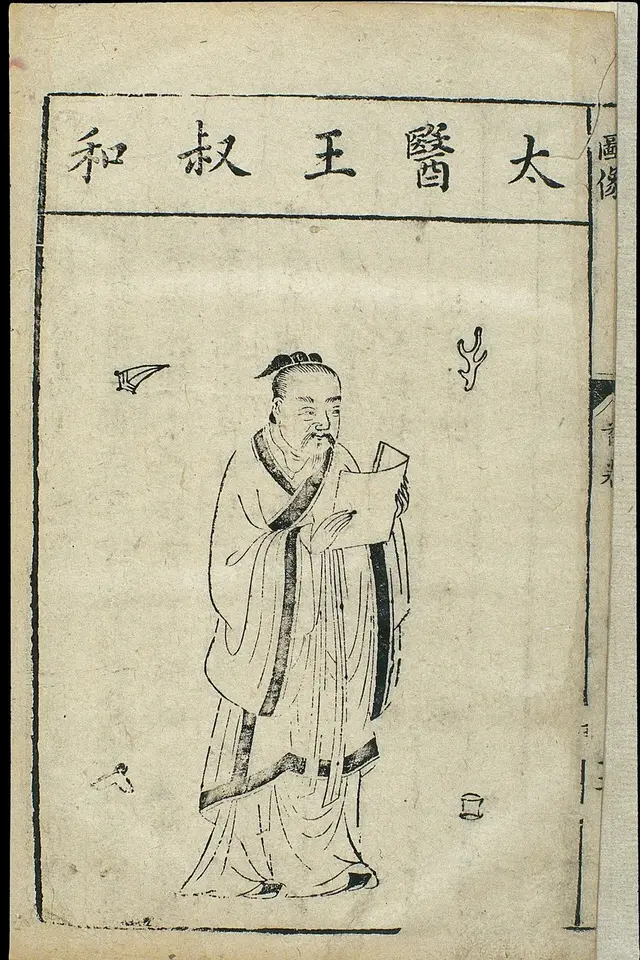
Life and Career
Early Deprivation and Study of Ancient Medicine
Wang Shuhe was born in Gaoping during the war-torn twilight of the Eastern Han dynasty. Experiencing poverty and hardship during his early years, he developed a contemplative, diligent, and persevering character. Drawn early to the healing arts, he immersed himself in surviving ancient texts including the Huangdi Neijing (Yellow Emperor's Inner Canon), the Nanjing (Classic of Difficult Issues), and the clinical traditions of Bian Que. He became profoundly captivated by the diagnostic potential of the pulse as a window into the state of internal organs and vital qi circulation.
Lacking ancestral wealth, the youthful Wang Shuhe wore coarse clothing and carried his medical pouch across the Central Plains and both banks of the Yellow River. Providing care to destitute communities while frequently lacking food and shelter, he cultivated deep compassion alongside acute clinical observation. He scrutinized the subtle variations beneath his fingertips during pulse examinations, constantly comparing classical pulse theory with actual patient presentations.
During this period of unending warfare, infectious epidemics devastated northern China. Wang Shuhe noted that many contemporary practitioners either relied on isolated pulse readings without clinical context or blindly adhered to antiquated maxims, leading to frequent misdiagnoses. He resolved to create a standardized, practical diagnostic framework. By successfully resolving numerous chronic and intractable ailments through precise pulse-taking and tailored herbal remedies, his reputation spread from rural villages to the imperial capital of Luoyang.
Imperial Appointment and Archival Research
During the Zhengshi era of the Cao Wei dynasty, Wang Shuhe's exceptional diagnostic acumen and scrupulous character led to his appointment as Prefect of the Grand Physicians within the Imperial Privy. As the empire's senior technical official overseeing medical services and palace physicians, this appointment granted him rare access to the vast imperial library.
Within the imperial archives of the Wei palace were preserved countless ancient medical manuscripts, bamboo slips, and proven clinical recipes collected since the Han dynasty. Wang Shuhe seized this invaluable scholarly opportunity, reading late into the night. He examined the legacies of Bian Que, Chunyu Yi, Hua Tuo, and late Han master Zhang Zhongjing, categorizing scattered pulse treatises and pharmacological formulas.
In collating these archives, Wang Shuhe paid close attention to the variations in transmission among regional lineages, including the traditions of the Wang, Ruan, Fu, Dai, Wu, and Ge families. By corroborating theoretical manuscripts with his daily clinical observations at the imperial court, he constructed an empirical foundation for his future theoretical syntheses.
Codification of the Pulse Classic
Throughout decades of clinical practice and textual collation, Wang Shuhe recognized that traditional sphygmology suffered from fragmentation and obscurity. While Bian Que had popularized pulse examination and early canons discussed meridian vessels, ancient methodology relied primarily on the "three regions and nine indicators" (Sanbu Jiuhou) technique. This cumbersome procedure required physicians to palpate arteries across the head, hands, and feet, causing immense clinical inconvenience and widespread confusion beneath the fingertips. Many practitioners dismissed pulse diagnosis as esoteric divination, causing severe diagnostic failures.
Confronting these deficiencies, Wang Shuhe devoted decades of research to compiling the ten-volume Maijing (The Pulse Classic). Comprising ninety-eight chapters and over one hundred thousand characters, the text systematically integrated all prior pulse literature. He defined twenty-four canonical pulse patterns—including floating, deep, slow, rapid, slippery, rough, wiry, tight, and surging—delineating the precise tactile sensations experienced by the physician and connecting them directly with internal pathological mechanisms of exterior, interior, cold, heat, deficiency, and excess.
Most significantly, Wang Shuhe innovated the standardized "exclusive examination of the radial artery" (Diqu Cunkou). By dividing the wrist pulse into cun, guan, and chi sections and aligning them with the five zang and six fu viscera, he transformed pulse diagnosis from an arcane craft into a standardized, scientific diagnostic system.
Salvaging the Teachings of Zhang Zhongjing
Alongside the composition of the Maijing, Wang Shuhe undertook the historic mission of preserving the clinical heritage of Zhang Zhongjing. Zhang's Shanghan Zabing Lun was the foundational masterpiece of pattern-based herbal differentiation. However, due to the turmoil of the Three Kingdoms wars and the fragile medium of bamboo slips and silk scrolls, the text had become severely fragmented and was on the verge of complete loss following Zhongjing's death.
Aware of the transformative efficacy of Zhongjing's formulas, Wang Shuhe was deeply pained by the text's dilapidation. Leveraging his authority as Prefect of the Grand Physicians, he dispatched inquiries across the realm, collecting scattered drafts and private family copies from scholars and rural healers. Over decades of patient collection, textual criticism, and structural reordering, he systematically restored the scattered bamboo slips.
Wang Shuhe compiled the sections on external febrile conditions into the Shanghan Lun (Treatise on Cold Damage Diseases), formally articulating the six-meridian pattern differentiation system—Taiyang, Yangming, Shaoyang, Taiyin, Shaoyin, and Jueyin—and preserving immortal classic formulas such as Cinnamon Twig Decoction, Ephedra Decoction, White Tiger Decoction, and Order the Qi Decoctions. Retained as Prefect of the Grand Physicians following the Western Jin takeover, Wang Shuhe passed away in Luoyang in 280 CE at the age of seventy-one, leaving an enduring legacy of clinical systematization and philological preservation.
Major Accomplishments
Composition of the Foundational Pulse Classic
Wang Shuhe's ten-volume Maijing is the earliest extant comprehensive treatise on pulse diagnosis in Chinese medical history, establishing the diagnostic core of traditional practice.
Divided into ten volumes and ninety-eight chapters, the work incorporated essential excerpts from the Inner Canon, Classic of Difficult Issues, and treatises by Bian Que and Hua Tuo. Wang Shuhe classified complex arterial sensations into twenty-four fundamental pulse patterns, offering vivid tactile metaphors such as "a floating pulse is like wood floating on water" and "a deep pulse is like a stone sinking in water," establishing objective standards for clinical evaluation.
Standardization of Cunkou Palpation and Visceral Alignment
In the Maijing, Wang Shuhe instituted a revolutionary technical innovation by promoting exclusive radial pulse diagnosis.
Ancient methods required examining arterial pulsations across the head, neck, hands, and feet, requiring patients to disrobe and impeding prompt emergency diagnosis. Drawing upon principles from the Classic of Difficult Issues, Wang Shuhe refined radial artery palpation at the wrist into three distinct sectors: cun, guan, and chi. He mapped the left cun to the heart, left guan to the liver and gallbladder, left chi to the kidney, right cun to the lung, right guan to the spleen and stomach, and right chi to the gate of vitality. This anatomical schema has remained the universal standard of Chinese medicine for nearly two millennia.
Integration of Pulse, Syndrome, and Therapeutics
Wang Shuhe did not treat pulse signs in isolation, but embedded them within a coherent therapeutic triad linking pulse patterns, clinical symptoms, and medicinal formulations.
He synthesized principles of mutual corroboration between pulse and syndrome, detailing scenarios where a physician must prioritize symptoms over pulses or vice versa. In febrile illnesses, he explicitly identified which pulse qualities indicated diaphoretic therapy, purgation, or warming tonification, transforming pulse reading into direct guidance for herbal prescription.
Philological Rescue of the Shanghan Lun
Wang Shuhe's greatest historic service to medical science was salvaging Zhang Zhongjing's Shanghan Zabing Lun from wartime extinction.
Traveling extensively to collect surviving bamboo fragments, he applied rigorous textual criticism to reconstruct the text into the Shanghan Lun. The imperial editions published by the Song Dynasty Bureau for Editing Medical Treatises were based directly on Wang Shuhe's recension. Without his dedicated editorial preservation, the clinical principles and classic formulas of Zhang Zhongjing would have been lost to civilization.
Dietary and Lifestyle Hygiene Principles
Beyond clinical therapy, Wang Shuhe advocated an enlightened philosophy of preventative hygiene focused on moderate diet and seasonal harmony.
In the Maijing, he noted that food intake should not be excessively mixed and warned against overeating rich, fatty foods, observing that digestive accumulation precipitates acute diseases. He highlighted the physiological stress caused by the transition from summer heat to autumn cold, urging people to align with natural seasonal rhythms to prevent illness before its onset.