Born into Eminent Lineage
Born on the thirteenth day of the eighth lunar month in Taicang, South Zhili, as the grandson of Grand Academician Wang Xijue.
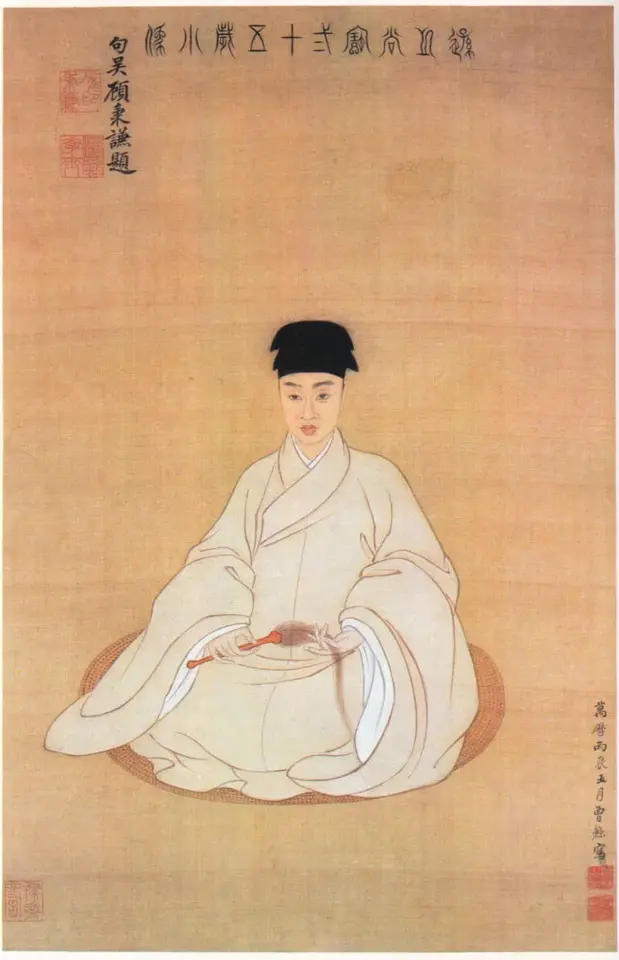
王时敏
Wang Shimin (王时敏, September 18, 1592 – July 12, 1680), original name Wang Zanyu, courtesy name Xunzhi, and art names Yanke, Ouxie Daoren, and Xilu Laoren, was a native of Taicang, Suzhou Prefecture, South Zhili. He was the grandson of Grand Academician Wang Xijue and the son of Hanlin Senior Compiler Wang Heng. Wang was an eminent literati landscape painter, connoisseur, and art theorist active during the late Ming and early…
Wang Shimin (王时敏, September 18, 1592 – July 12, 1680), original name Wang Zanyu, courtesy name Xunzhi, and art names Yanke, Ouxie Daoren, and Xilu Laoren, was a native of Taicang, Suzhou Prefecture, South Zhili. He was the grandson of Grand Academician Wang Xijue and the son of Hanlin Senior Compiler Wang Heng. Wang was an eminent literati landscape painter, connoisseur, and art theorist active during the late Ming and early Qing transition. In Qing art history, he was venerated as the premier figure among the "Six Masters of the Early Qing" and the foremost of the celebrated "Four Wangs" (Wang Shimin, Wang Jian, Wang Hui, and Wang Yuanqi), serving as the principal leader and artistic beacon of the orthodox landscape tradition revered by the imperial court and literati elite alike. Wang Shimin hailing from a prominent and affluent Jiangnan official clan, was cultivated from his youth under the direct care of his grandfather. Early in life, he received systematic training in painting, calligraphy, and poetry from artistic titans Dong Qichang and Chen Jiru, establishing an enduring foundation in orthodox literati aesthetics. Entering the civil bureaucracy through ancestral privilege, he served as Assistant Director and then Director of the Seals Office, eventually advancing to Junior Director of the Court of Imperial Sacrifices during the Chongzhen reign while retaining his supervisory role over royal seals. Official missions across various provinces provided him with rich opportunities to observe grand natural scenery and examine treasured private collections of ancient masterpieces. In 1632, weary of factional friction, Wang resigned from office on the pretext of poor health and retired to his Xitian Villa in Taicang to devote himself to painting. Following the dynastic transition of 1644, he lived as an eremitic scholar, refining ancient painterly methods and mentoring brilliant successors such as Wang Hui, Wu Li, and his grandson Wang Yuanqi. Wang Shimin championed the doctrine that "imitating the ancients is the paramount principle of painting." Anchoring his practice on the structural discipline of Yuan master Huang Gongwang and synthesising the brushwork of Dong Yuan, Juran, and Wang Meng, he emphasised mellow brushwork, rigorous composition, balanced harmony, and spiritual vitality. His artistic paradigm effectively checked the erratic and eccentric mannerisms of late Ming painting, codifying the orthodox aesthetic standards of the early Qing and establishing the Loudong School, which dominated Chinese landscape painting for generations.
Born on the thirteenth day of the eighth lunar month in Taicang, South Zhili, as the grandson of Grand Academician Wang Xijue.
His father Wang Heng passed away; Wang Shimin suffered lung ailments from deep grief and turned his solace to the arts.
Received imperial hereditary privilege and was appointed Assistant Director of the Seals Office, guarding imperial insignia.
Sent as imperial emissary to Yizhou in Shandong, inspecting historic relics and viewing regional literati collections.
Elevated to Director of the Seals Office; frequently discussed art theory with Dong Qichang and expanded his private holdings.
Disenchanted with turbulent bureaucratic life, resigned on grounds of illness and built Xitian Villa in Taicang for artistic contemplation.
Reappointed as Junior Director of the Court of Imperial Sacrifices while continuing to oversee the Seals Office.
Dispatched on an official commission to Huguang and Jiangnan, observing ancient masterpieces owned by connoisseur Yuan Shu in Henan.
Returned to the capital, surrendered his credentials, and formally retired from court duties on medical grounds.
Ming rule collapsed and Qing forces secured Jiangnan; Wang preserved his clan by submission and withdrew entirely from public life.
Rebuilt and expanded Xitian Villa, hosting celebrated scholars and refining his painterly style into deep, vigorous maturity.
His eighth son Wang Yan and grandson Wang Yuanqi passed the imperial metropolitan examinations simultaneously, bringing immense honour.
Died peacefully at his residence in Taicang on the seventeenth day of the sixth lunar month at the age of eighty-eight.
Wang Shimin was born in 1592 into one of the most prominent scholar-gentry lineages in Taicang. His grandfather Wang Xijue had held the supreme administrative position of Senior Grand Secretary under Emperor Wanli, while his father Wang Heng achieved second place in the imperial civil examination of 1601 and served as Senior Compiler in the Hanlin Academy. Gifted with sharp intellect and cultivated taste, Wang Shimin was especially cherished by his grandfather and lived in his quarters as a child, immersing himself in the classics, geography, and philology. The Taicang Wang family possessed an immense repository of ancient calligraphy and paintings spanning the Jin, Tang, Song, and Yuan dynasties. Daily exposure to pristine works by master painters such as Li Cheng, Fan Kuan, Dong Yuan, and Juran nurtured young Wang's keen discernment.
Recognising his grandson's unusual talent and passion for the brush, Wang Xijue invited Dong Qichang, the preeminent arbiter of late Ming aesthetics, along with the celebrated man of letters Chen Jiru, to tutor Wang Shimin. Dong Qichang instructed him comprehensively in the philosophy of the Southern School of literati painting, emphasising that artistic mastery began with the rigorous imitation of Song and Yuan masters. Under Dong's guidance, Wang focused intensively on Huang Gongwang, internalising that master's blend of expansive simplicity and profound structure. Guided by these illustrious masters, Wang achieved early acclaim throughout Jiangnan for his disciplined and sophisticated brushwork.
In 1609, when Wang Shimin was eighteen years of age, his father Wang Heng died prematurely. Overcome with filial sorrow during the period of mourning, Wang Shimin contracted a lung condition that caused him to spit blood, leaving his constitution permanently fragile. This bereavement deepened his detachment from worldly ambition and solidified his dedication to literati arts, scholarship, and landscape painting.
Under Ming dynasty statutes, descendants of meritorious ministers were entitled to enter the civil service without sitting for imperial examinations. In 1614, at twenty-three years of age, Wang Shimin was granted the hereditary appointment of Assistant Director of the Seals Office, taking responsibility for the imperial seals and tallies. In 1624, he rose to become Director of the Seals Office. During the Tianqi reign, as court politics became poisoned by eunuch factionalism, Wang maintained a detached and upright posture, fulfilling his administrative duties faithfully while focusing his leisure hours on connoisseurship and painting.
During his tenure at the Seals Office, Wang was repeatedly sent on official inspection tours across the empire. In 1618, he carried imperial decrees to Yizhou in Shandong. In the Chongzhen era, he undertook long administrative missions to Huguang, Jiangxi, and Fujian, travelling all the way to the Nanling mountain range. These extended travels exposed him to dramatic landforms, craggy peaks, and expansive river systems, immeasurably widening his imaginative horizons while enabling him to meet fellow connoisseurs across the empire.
In Suiyang, Henan, Wang formed a deep friendship with Yuan Shu, the son of Minister of War Yuan Keli. The Yuan family held the finest collection of early Chinese painting north of the Yangtze River, including extraordinary scrolls by Dong Yuan and Juran. Visiting Yuan Shu's residence, Wang was able to study genuine works by Li Cheng, Mi Fu, Jing Hao, Guan Tong, and Dong Yuan for days on end. This profound visual encounter transformed his painterly technique, elevating it to higher conceptual sophistication.
In 1632, weary of bureaucratic routines and court intrigue, Wang cited poor health and retired to Taicang, constructing the tranquil Xitian Villa south of the walled city. Although recalled in 1636 as Junior Director of the Court of Imperial Sacrifices while continuing his oversight of the Seals Office, he formally tendered his final resignation in 1640 upon concluding his mission to Huguang, turning his back permanently on administrative life.
In 1644, the Ming dynasty collapsed under domestic peasant rebellion and the Manchu invasion. By the summer of 1645, Qing armies under Prince Dodo swept across the Jiangnan region. Faced with catastrophe, the Taicang Wang clan opted for surrender to prevent slaughter and the destruction of ancestral heritage. Thereafter, Wang Shimin maintained the dignified posture of a Ming loyalist recluse, adamantly refusing to take office under the new dynasty and spending the remaining thirty-five years of his life in seclusion at Xitian Villa.
During this long retirement, Wang avoided political entanglements, dedicating himself to painting, classical poetry, and the study of ancient bronzes, stone rubbings, and musical instruments. His villa became a renowned gathering place for Jiangnan literati and artists. His close compatriot, the poet Wu Weiye, celebrated his preeminence in the famous poem "Song of the Nine Friends in Painting," placing Wang alongside Dong Qichang, Wang Jian, Li Liufang, Yang Wencong, Zhang Xuezeng, Cheng Jiasui, Bian Wenyu, and Shao Mi.
By 1651, when Wang celebrated his sixtieth birthday and completed extensive renovations on Xitian Villa, his artistic manner had evolved from the delicate, translucent precision of his youth into a rich, dense, and deeply textured monumentality that reflected total mastery of ancient paradigms.
In his later decades, Wang Shimin devoted substantial energy to cultivating younger artistic talent and overseeing the education of his descendants. When he encountered Wang Hui, an impoverished youth from Changshu with extraordinary talent, Wang welcomed him into his household as an honoured guest for several years. He opened his entire private collection of ancient masterpieces for Wang Hui to copy, introduced him to influential patrons, and refined his brushwork, propelling Wang Hui to national renown as an artistic giant. He similarly supported and advised Wu Li, another local master who would later blend indigenous literati art with Western influences.
Wang Shimin managed his extensive household with Confucian rectitude. He had nine sons, all of whom became accomplished scholars and men of letters; several, including Wang Kui, Wang Zhuan, Wang Chi, Wang Bian, and Wang Shu, were celebrated members of the literary group known as the "Ten Masters of Loudong." His eighth son, Wang Yan, passed the civil examination in 1670 and ultimately rose to Senior Grand Secretary and Minister of Rites under Emperor Kangxi.
Wang Shimin took immense pride in his grandson Wang Yuanqi. Tutored personally by Wang Shimin from childhood, Wang Yuanqi also passed the imperial examination in 1670. He won the favour of Emperor Kangxi, served in the Southern Study, and supervised the compilation of the imperial art compendium Peiwenzhai Shuhuapu. Wang Yuanqi carried forward his grandfather's principles, becoming the foremost court painter of the high Qing era.
On July 12, 1680, Wang Shimin died peacefully at his Taicang estate at the age of eighty-eight. His long life and consummate dedication established him as an enduring pillar of classical Chinese landscape painting.
In the late Ming period, Chinese painting had splintered into opposing extremes: the degenerate offshoots of the Zhe School had lapsed into coarse and exaggerated theatricality, while late followers of the Wu School had degenerated into delicate and effete triviality. Firmly adhering to Dong Qichang's literati doctrine, Wang Shimin championed the "Orthodox Lineage of Painting," forcefully rejecting chaotic experimentation in favour of strict adherence to classical discipline. He maintained that artistic integrity lay in mastering historical models while striving for balance, serenity, and natural ease.
Through decades of rigorous practice, Wang transformed Dong Qichang's conceptual theories into a tangible, systematic artistic method. Taking Huang Gongwang's structural discipline as a skeleton and enriching it with the textured hemp-fiber brushstrokes of Dong Yuan and Juran alongside the dense coloration of Wang Meng, he established a cohesive aesthetic vocabulary characterized by stacked mountain ranges, continuous spatial flow, and resonant tonal harmony. This elegant, dignified style satisfied the early Qing scholar-official class's longing for cultural order and spiritual stability, ultimately becoming the accepted orthodox standard of the imperial court.
Together with his townsman Wang Jian, his protégé Wang Hui, and his grandson Wang Yuanqi, Wang Shimin stood as the premier figure of the "Four Wangs." Centered around their native Taicang (historically known as Loudong), this group formed the influential Loudong School of Painting. Among the four, Wang Shimin was universally recognized as the founding patriarch by virtue of his seniority, impeccable lineage, social prestige, and scholarly erudition.
The Loudong School married deep classical scholarship with precise imitation of Song and Yuan masters, quickly attracting a wide following of literati painters across China and achieving absolute hegemony within the Qing imperial court. Both Emperor Kangxi and Emperor Qianlong revered Wang Shimin's landscape aesthetic as the apex of civilized taste, establishing it as the standard for court academies and official anthologies. The dominance of the Loudong School dictated the direction of mainstream Chinese landscape painting for more than two centuries.
Inheriting vast collections from his grandfather Wang Xijue and acquiring significant treasures during his travels, Wang Shimin possessed one of the finest private collections of ancient paintings in southeastern China. His extraordinary connoisseurship and profound grasp of brushwork evolution earned him imperial and literati recognition as an supreme arbiter of artistic authenticity during the Ming-Qing transition.
Throughout his career, Wang composed extensive colophons on masterpieces he inspected or copied. These insightful reflections were posthumously compiled into volumes such as Yanke Tiba and Wang Yanke Ji. His commentary offered acute analyses of the compositional methods, brush techniques, and historical lineages of masters such as Li Cheng, Mi Fu, Dong Yuan, Huang Gongwang, and Wang Meng, providing invaluable source material for modern art historians exploring classical Chinese aesthetic theory.
Wang Shimin possessed a generous and magnanimous disposition, always eager to nurture emerging talent without regard to social standing. When he recognized the brilliance of Wang Hui, a humble commoner, Wang welcomed him into his household, gave him unrestricted access to rare Song and Yuan scrolls, and facilitated his connections with eminent patrons and artists. Under this sustained patronage, Wang Hui reached the summit of artistic achievement.
Furthermore, Wang Shimin imparted his deepest aesthetic insights directly to his grandson Wang Yuanqi, instilling in him rigorous compositional discipline and dynamic brush control. Wang Yuanqi's subsequent rise as an imperial favorite and court master ensured that Wang Shimin's orthodox legacy remained vibrant and authoritative throughout the high Qing era.
FIGURES ASSOCIATED WITH THIS DYNASTY