Birth in Taicang
Born into a scholarly official family; his father Wang Yu served as Censor inspecting Zhili.
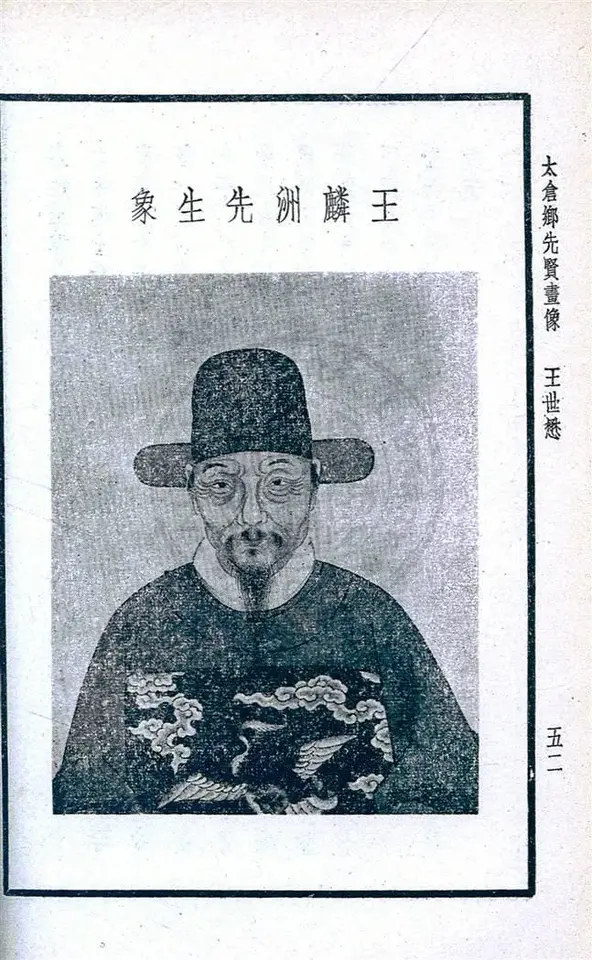
王世懋
Wang Shimao (王世懋, 1536–1588), courtesy name Jingmei, art names Linzhou, Sunzhai, and Master of Qingluo Studio (Qingluo Guan Zhu), was a native of Taicang, Suzhou Prefecture, South Zhili (modern Taicang, Jiangsu). He was a distinguished mid-to-late Ming literary figure, historian, and horticultural scholar, the younger brother of literary leader Wang Shizhen, with whom he was celebrated in Jiangnan as the "Two Wangs." Born…
Wang Shimao (王世懋, 1536–1588), courtesy name Jingmei, art names Linzhou, Sunzhai, and Master of Qingluo Studio (Qingluo Guan Zhu), was a native of Taicang, Suzhou Prefecture, South Zhili (modern Taicang, Jiangsu). He was a distinguished mid-to-late Ming literary figure, historian, and horticultural scholar, the younger brother of literary leader Wang Shizhen, with whom he was celebrated in Jiangnan as the "Two Wangs." Born into an eminent aristocratic lineage, Wang Shimao demonstrated precocious erudition from childhood, mastering ancient prose and historical institutions. In 1559, when his father, Supreme Commander of Jiliao Wang Yu, was framed and executed by the treacherous grand secretary Yan Song and his son Yan Shifan, Wang Shimao joined his elder brother Wang Shizhen in prostrating themselves outside the Forbidden City in freezing blizzards, begging to die in their father's place. Following the collapse of Yan's faction under Emperor Muzong, the family was fully exonerated. In 1565 (44th year of Jiajing), Wang passed the imperial examinations as a jinshi, serving successively as Secretary in the Bureau of Operations of the Ministry of War, Director in the Bureau of Ceremonies of the Ministry of Rites, Assistant Surveillance Commissioner of Jiangxi, Vice Surveillance Commissioner and Education Intendant of Fujian, Right Assistant Administration Commissioner of Jiangxi, Vice Minister of the Court of the Imperial Stud, and Vice Minister of the Court of Imperial Sacrifices in Nanjing. In administration, he was incorruptible and uncompromising, promoting water conservancy and eradicating entrenched corruption. In literature, although counted among the "Latter Seven Masters," he rejected blind archaism and plagiarism, advocating sincere self-expression through refined, lucid prose and poetry. In applied science, his horticultural masterpiece Miscellaneous Records of Learning Gardening (Xuepu Zashu) codified the cultivation and landscape arrangement of Jiangnan flora, recognized as a milestone in traditional agricultural and garden design science. He passed away in office in Nanjing in 1588 at fifty-three.
Born into a scholarly official family; his father Wang Yu served as Censor inspecting Zhili.
Studied Tang and Song classical prose under elder brother Wang Shizhen, earning local poetic renown.
When his father was framed by Yan Song, traveled to the capital to prostrate at court offering his life.
Passed the metropolitan examinations as a jinshi, appointed Secretary in the Ministry of War's Bureau of Operations.
With the fall of Yan Song, successfully memorialized Emperor Muzong to restore his father's rank and honors.
Appointed Education Intendant of Fujian, inspecting Quanzhou and Zhangzhou while mentoring impoverished scholars.
Served as Assistant Administration Commissioner in Jiangxi, reforming post stations and curbing gentry extortion.
Promoted to Vice Minister of the Court of the Imperial Stud, managing border horse breeding and procurement.
Transferred to Vice Minister of the Court of Imperial Sacrifices in Nanjing, regularizing state rituals.
Died of chronic lung illness in his official residence in Nanjing at age fifty-three; Wang Shizhen composed his epitaph.
Wang Shimao was born in 1536 in Taicang, Suzhou Prefecture, South Zhili. His family was an eminent bureaucratic clan of Jiangnan: his great-grandfather Wang Fu and grandfather Wang Zhuo held high office, while his father Wang Yu rose to Supreme Commander of Jiliao and Right Censor-in-Chief, commanding northern armies. Though physically frail in childhood, Wang Shimao displayed sharp intellect. His elder brother Wang Shizhen, ten years his senior, doted upon his younger brother, personally tutoring him in pre-Qin classical prose and Han-Tang poetry.
In 1559, Senior Grand Secretary Yan Song and his son Yan Shifan held absolute sway over the court. Because Wang Yu refused to compromise with Yan's faction during northern border defense campaigns, Yan conspired with the Eastern Depot to fabricate charges that Wang Yu had neglected border defenses. The Jiajing Emperor ordered Wang Yu arrested and imprisoned in the Embroidered Uniform Guard dungeons. Twenty-four-year-old Wang Shimao and Wang Shizhen galloped day and night to Beijing, kneeling in freezing snow outside the palace gates, knocking their heads against the stones until they bled, begging to be executed in their father's stead. However, Yan Song blocked their memorials, and Wang Yu was executed at Xishi. Drowned in grief, the brothers escorted their father's coffin thousands of miles back to Taicang, where Wang Shimao slept upon straw and vowed to dedicate his life to removing the traitors and vindicating his father.
In 1567, Emperor Muzong ascended the throne, launching a thorough purge of Yan Song's faction, executing Yan Shifan and confiscating family estates. Wang Shimao and Wang Shizhen traveled north to Beijing, submitting detailed documentation to court. Deeply moved by Wang Yu's innocence, Emperor Muzong issued an imperial edict completely clearing Wang Yu's name, restoring his titles, and conferring posthumous honors.
With family honor restored, Wang Shimao passed the metropolitan examinations in the spring of 1565 as a jinshi, beginning his bureaucratic career. He was initially appointed Secretary in the Bureau of Operations of the Ministry of War, where he reviewed border fortifications, military registries, and strategic geography, earning accolades for his defensive proposals. Subsequently transferred to the Bureau of Ceremonies in the Ministry of Rites, he administered palace rituals and metropolitan examination quotas with strict impartiality, rejecting all nepotistic solicitations.
In 1573, Wang Shimao was appointed Vice Surveillance Commissioner and Education Intendant of Fujian. While literary culture was prominent in southeastern Fujian, scholarly morals had deteriorated through rampant bribery, cheating, and gentry favoritism. Traveling with minimal retinue, Wang inspected prefectures and counties, personally setting examination questions to eliminate impersonation. For impoverished scholars who studied diligently, he extended special stipends and purchased classical texts for local academies with his personal salary. During his three-year tenure, he mentored future statesmen including Grand Secretary Li Tingji, entirely transforming academic discipline throughout Fujian, prompting local scholars to erect shrines in his honor. Simultaneously, he inspected coastal garrisons and foreign trade networks, authoring valuable geographical surveys.
In 1581, Wang was appointed Right Assistant Administration Commissioner of Jiangxi. Situated at the junction of northern and southern water routes, Jiangxi suffered under burdensome courier station taxes and corvée levies extorted by local bullies and eunuch agents. Arriving in office, Wang audited station financial ledgers, curtailed excessive corvée, and punished corrupt clerks. When local officials sought to erect a lavish guesthouse to entertain visiting imperial eunuchs, Wang sternly halted the expenditure, saving commoners tens of thousands of silver taels annually. In his leisure hours, he mounted the Pavilion of Prince Teng to host literati tea gatherings, tasting rare spring waters and debating the I Ching.
In 1586, recognized for stellar governance, Wang was elevated to Vice Minister of the Court of the Imperial Stud in Beijing, directing dynastic equine administration. Facing acute shortages of cavalry warhorses along the northern frontier and corruption among imperial stables, Wang memorialized several urgent reforms, eliminating embezzlement, standardizing breeding protocols, and barring palace eunuchs from intercepting fodder allowances.
In 1587, Wang was appointed Vice Minister of the Court of Imperial Sacrifices in Nanjing. In this southern capital post, he reviewed early Ming Hongwu dynastic statutes, rectifying imperial ancestral temple music, sacrificial vessels, and suburban altar ceremonies to correct long-standing ritual corruptions.
However, the physical exhaustion of his early struggles to save his father and decades of bureaucratic labor aggravated a chronic pulmonary illness, resulting in worsening hemoptysis. In the early winter of 1588, Wang's health deteriorated rapidly in his official Nanjing quarters, and he passed away on the seventeenth day of the eleventh lunar month at fifty-three. Rushing from Taicang to Nanjing, his elder brother Wang Shizhen wept over the coffin, lamenting the loss of an indispensable companion and drafting a moving epitaph, while the court granted standard imperial funeral rites.
In Ming literary history, Wang Shimao and his elder brother Wang Shizhen were co-celebrated as the "Two Wangs," holding high prestige across late-Ming cultural circles.
Although Wang Shimao was early categorized among the "Latter Seven Masters" led by Li Panlong and Wang Shizhen, he was never a passive imitator. Observing that late followers of the school degenerated into hollow imitation of Qin-Han prose and High Tang poetry, Wang was among the earliest critics to demand reform. He championed the principle that "literature evolves with the era and style springs from the heart," insisting that poetic creation must be rooted in genuine human emotion and contemporary life. He formulated the poetic dictum that "poetry must embody the self; unless it is my poetry, I will not compose," forging a style noted for crystalline elegance and dignified grace. Contemporary literatus Tu Long praised his verse as "pure as layered ice and accumulated snow, untainted by a speck of dust." His surviving thirty-two-volume collection Qingluo Guan Ji is celebrated as a landmark of Wanli literature.
Wang Shimao's most original contribution to Chinese scientific history was authoring the celebrated botanical and horticultural classic Miscellaneous Records of Learning Gardening (Xuepu Zashu).
Structured into sections on flowers, fruits, trees, and vegetables, the work systematically categorized dozens of Jiangnan flora, detailing grafting techniques, soil preferences, pruning, fertilization, and pest control. Beyond treating traditional favorites such as peonies, herbaceous peonies, camellias, orchids, and Chinese roses, it recorded cultivation methods for fruits including grapes, citrus, lychees, and bayberries, and documented early Chinese cultivation of newly introduced New World crops such as peanuts (luohuasheng). Integrating agricultural mechanics with the aesthetic principles of scholar gardens, it discussed how planting configurations harmonize with rockeries and pools. Extensively cited in Li Shizhen's Bencao Gangmu and Xu Guangqi's Nongzheng Quanshu, it is recognized internationally as one of sixteenth-century China's finest horticultural treatises.
Wang Shimao was an accomplished historical researcher and epigrapher who meticulously collected local records during his official postings.
While serving in Fujian, he explored the province's geography, authoring the survey Minbu Shu, which documented administrative evolutions, mountain fortifications, coastal garrisons, customs, and maritime junk trade routes through Yuegang in southern Fujian, providing primary source materials for studying late-Ming maritime commerce and coastal defense. Furthermore, works such as Eryou Zhuiyi, Dongzhou Zazu, and Sunzhai Zalu drew upon wide classical sources to analyze Tang-Song governmental structures, official titles, and philology, pioneering the evidential scholarship that flourished in the late Ming.
As an imperial minister, Wang Shimao embodied the moral courage expected of classical scholar-officials.
In the Bureau of Operations, he resisted aristocratic interference in troop rosters, repeatedly memorializing on border readiness; in Jiangxi and Fujian, he shielded local merchants and peasants from extortionate mine tax eunuchs. Throughout his career, he maintained spotless personal frugality, departing each post with only his manuscripts and clothes. This integrity, paired with his youthful filial heroism in attempting to die for his father, won him lasting reverence across the late-Ming intellectual world.
History of Ming (Ming Shi, Volume 287, Biographies of Literary Figures, Biography of Wang Shizhen with appended Biography of Wang Shimao) records: "Shimao, courtesy name Jingmei, loved study from youth, excelling in poetry and prose. Sharing equal fame with his brother Shizhen, they were known as the 'Two Wangs.' While Shizhen led the Latter Seven Masters, Shimao prized pure elegance, refusing to adhere strictly to archaism, forming an independent school. He served as Secretary in the Ministry of War, Vice Commissioner of Fujian, Assistant Commissioner of Jiangxi, and ended his career as Vice Minister of the Court of Imperial Sacrifices in Nanjing. He authored Qingluo Guan Ji and Xuepu Zashu."
His elder brother Wang Shizhen lamented in his epitaph: "My younger brother Jingmei was alert and lofty in natural talent, pure and upright in conduct. In literary composition, his words were aloof and pristine, purging all vulgar ornament; in official posts, he stood severe as ice and snow, enforcing the law like a mountain. Alas, that in my old age I should lose this brother, mentor, and companion—how vast the heavens, how profound the grief!"
Qing compilers observed in Annotated Catalog of the Complete Imperial Library (Siku Quanshu Zongmu Tiyao): "Though Shimao's writings moved within the bounds of the Latter Seven Masters, his structural bones were moist and graceful, pure and mellow, casting aside stiff imitation to establish an independent tenor during the Wanli reign."
FIGURES ASSOCIATED WITH THIS DYNASTY