Birth in Bianjing
Born into the prestigious founding military lineage of Taiyuan, showing early erudition and artistic gift.
王诜
Wang Shen (王诜, 1048–1104), courtesy name Jinqing, was an ancestral native of Taiyuan (modern Taiyuan, Shanxi) and a permanent resident of the Northern Song imperial capital Bianjing (modern Kaifeng, Henan). He was a distinguished aristocratic statesman, preeminent landscape painter, poet, calligrapher, and premier art collector of the mid-Northern Song period. Descended from Wang Quanbin, a founding general of the dynasty,…
Wang Shen (王诜, 1048–1104), courtesy name Jinqing, was an ancestral native of Taiyuan (modern Taiyuan, Shanxi) and a permanent resident of the Northern Song imperial capital Bianjing (modern Kaifeng, Henan). He was a distinguished aristocratic statesman, preeminent landscape painter, poet, calligrapher, and premier art collector of the mid-Northern Song period. Descended from Wang Quanbin, a founding general of the dynasty, Wang Shen combined martial heritage with classical scholarship, excelling in poetry, qin, calligraphy, and painting. In 1069, Wang Shen married Princess Shuguo (later titled Princess Bao'an), the second daughter of Emperor Yingzong, receiving the noble title Commandant-Escort and subsequent posts as Defense Commissioner of Lizhou and Surveillance Commissioner of Dingzhou. Detesting the idle extravagance typical of high nobility, he built the Western Garden and Baohui Hall at his capital estate, turning them into the premier salon where titans like Su Shi, Huang Tingjian, Mi Fu, Li Gonglin, Chao Buzhi, and Qin Guan gathered. In 1079, during the Crow Terrace Poetry Trial, Wang was stripped of noble rank for warning Su Shi and concealing Su's satirical poems; shortly after the princess died in 1080, he was further demoted and banished to Junzhou. Restored upon Emperor Huizong's accession, he perfected a revolutionary style blending the blue-and-green gold-outlined technique of Li Sixun with the ink-wash literati idiom of Wang Wei and Li Cheng, producing immortal treasures like Fisher Village in Light Snow and Misty River and Piled Peaks. The Western Garden Gathering he hosted remains an eternal symbol of Song literati elegance.
Born into the prestigious founding military lineage of Taiyuan, showing early erudition and artistic gift.
Married Princess Shuguo, daughter of Emperor Yingzong; appointed Commandant-Escort and Left Guard General.
Built the Baohui Hall and Western Garden villa; Su Shi composed the commemorative Record of Baohui Hall.
Warned Su Shi of the poetry trial and concealed satirical verses; stripped of noble rank and demoted.
Princess Bao'an passed away; accused of indulging concubines, Wang was banished to Junzhou as Administrative Assistant.
Restored to rank under Empress Dowager Gao's regency; hosted the celebrated Western Garden Gathering.
Factional purges resumed under the New Policies; banished from the capital as Prefect of Kaiping Army.
Emperor Huizong ascended the throne and patronized literati; Wang was recalled to Kaifeng as Surveillance Commissioner of Dingzhou.
Passed away at his residence in Bianjing at age fifty-seven; posthumously granted the honorary title Specially Advanced.
Wang Shen was born into a premier military founding lineage of the Northern Song, descended directly from Wang Quanbin, the illustrious general who conquered the Later Shu regime for Emperor Taizu. Raised in martial glory yet deeply devoted to Confucian canons and belles-lettres, Wang possessed extraordinary intellectual acumen, excelling in literary composition, calligraphy, and fine brushwork, quickly becoming the most celebrated youth among the capital aristocracy.
In 1069, Emperor Shenzong arranged the marriage of his younger sister Princess Shuguo (second daughter of Emperor Yingzong and Empress Dowager Gao, later Princess Bao'an) to Wang Shen. Endowed with talent, grace, and illustrious heritage, Wang was appointed Commandant-Escort, Left Guard General, and Defense Commissioner of Lizhou. Princess Bao'an was gentle, virtuous, and filial toward her mother-in-law, earning universal admiration from both the court and the public.
Despite his exalted imperial connections, Wang Shen despised the frivolous pastimes of the high nobility. At his residence in Bianjing, he designed an expansive landscape retreat named the Western Garden and erected the Baohui Hall as an art gallery. Leveraging imperial privileges and family resources, he amassed the finest collection of Jin and Tang dynasty paintings, calligraphic masterworks, and bronze antiquities in the capital.
Wang threw open the gates of his Western Garden, welcoming the finest scholars of the empire. He forged an unbreakable bond of brotherhood with literary giant Su Shi, who composed the famous Record of Baohui Hall at Wang's request, warning scholars to enjoy worldly objects without becoming enslaved by them. Luminaries including Huang Tingjian, Qin Guan, Mi Fu, and Li Gonglin spent days and nights composing verses and painting in the garden, transforming it into the beating heart of the Northern Song literary renaissance.
In 1079, the Crow Terrace Poetry Trial erupted, as censorate officials Li Ding and Shu Dan sought to frame Su Shi for treasonous criticism of the New Policies. While other courtiers retreated in fear, Wang Shen risked his life to dispatch a secret rider overnight to Huzhou to alert Su Shi, enabling him to burn sensitive correspondence. When censorate investigators discovered that Wang harbored numerous uncirculated satirical poems by Su, the court charged him with leaking state secrets and consorting with traitors, stripping him of all noble titles.
In 1080, Princess Bao'an fell critically ill from grief and sorrow. On her deathbed, she tearfully pleaded with Emperor Shenzong to pardon her husband, which Shenzong granted. However, following the princess's demise, her wet nurse reported that Wang had indulged disruptive concubines during the illness. Enraged, Shenzong ordered the concubines beaten and exiled, while Wang was stripped of office once more and banished to remote Junzhou as Administrative Assistant, later transferred to Yingzhou.
In 1086, Emperor Zhezong ascended the throne with Empress Dowager Gao acting as regent, ushering in the Yuanyou restoration. Wang Shen received a full pardon, regained his noble title as Commandant-Escort, and was appointed Surveillance Commissioner of Dingzhou.
That spring, Wang hosted the immortal Western Garden Gathering, bringing together sixteen cultural titans including Su Shi, Su Zhe, Huang Tingjian, Qin Guan, Chao Buzhi, Zhang Lei, Chen Shidao, Li Gonglin, Mi Fu, Wang Qinchen, Liu Jing, Chao Chongzhi, the Buddhist monk Yuantong, and the Daoist Chen Bixu. Li Gonglin brushed the celebrated painting The Western Garden Gathering, while Mi Fu inscribed its famous prose record, establishing an archetypal model for Chinese literati life. In 1094, Wang suffered brief demotion to Kaiping under the Shaosheng regime, but was recalled to court by Emperor Huizong in 1101. In 1104, Wang passed away in Bianjing at age fifty-seven, receiving the posthumous title Specially Advanced.
Wang Shen occupies an epoch-making position in the history of Chinese landscape painting. Prior to his work, Tang blue-and-green landscape painting had largely degenerated into rigid artisanal craft, lacking literati poetic sensibility, while monochrome ink-wash painting avoided mineral pigment altogether. Drawing upon his profound literary refinement and extensive collection of masterpieces, Wang combined the expansive horizontal composition of Li Cheng and the towering monumental bones of Fan Kuan with the opulent mineral pigments and gold outlining of Li Sixun.
Emperor Huizong praised his brushwork in the Xuanhe Catalogue of Paintings, observing that Wang drew upon Li Cheng's texturing while deploying mineral blues, greens, and gold to forge an unprecedented personal style. By integrating rich lapis, malachite, and gold leaf into atmospheric ink washes, Wang harmonized aristocratic splendor with transcendent literati serenity, directly inspiring Southern Song masters Zhao Lingzhi, Zhao Boju, and Zhao Bosu, as well as Yuan dynasty master Qian Xuan.
Two surviving masterpieces by Wang Shen are celebrated worldwide. The first, Fisher Village in Light Snow (preserved in the Palace Museum, Beijing), is an ink-and-color handscroll depicting a riverside village and pine groves following an early winter snowfall. Using dry, fractured brushwork for rock structures and white pigment droplets for falling flakes, it captures the serene solitude of fishermen steering skiffs, thoroughly realizing the poetic atmosphere of Wang Wei.
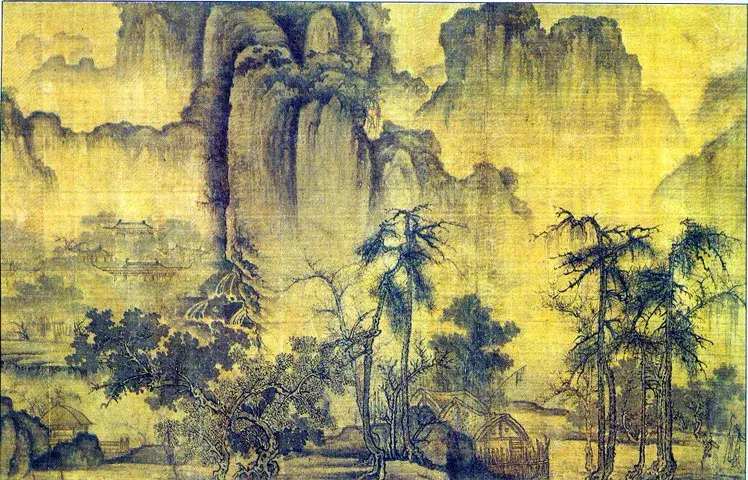
The second masterpiece is Misty River and Piled Peaks (preserved in the Shanghai Museum). The scroll portrays monumental crags rising out of vast, misty waters. Su Shi was so moved upon viewing it that he composed a celebrated long poem, to which Wang replied with rhyming verses; their four rounds of poetic exchange became one of the most radiant dialogues of poetry and painting in Chinese history.
The Western Garden Gathering hosted by Wang Shen stands alongside Wang Xizhi's Orchid Pavilion Gathering as the supreme embodiment of cultivated scholar-official life in Chinese cultural history.
Within the scenic waters and groves of the Western Garden, sixteen eminent scholars painted, inscribed verses on stone, played the zither, played chess, and meditated on Chan philosophy without worldly restraint. With boundless magnanimity and devotion to genius, Wang Shen created an idyllic sanctuary where cultural masters, buffeted by political storms, could freely commune and create.
FIGURES ASSOCIATED WITH THIS DYNASTY