Birth in Kunshan
Born into a scholarly family in Kunshan County, displaying precocious intellectual gifts in both literature and painting.
王履
Wang Lv (王履, 1332–1391), courtesy name Andao (安道), who adopted the pseudonyms Jishou (畸叟), Baodu Laoren (抱独老人), and Fenweng (奋翁), was a native of Kunshan in Suzhou Prefecture (present-day Kunshan, Jiangsu Province) and an eminent physician, landscape painter, and poet of the late Yuan and early Ming dynasties. In his youth, Wang studied medicine under Zhu Danxi, one of the Four Great Masters of the Jin-Yuan Era, thoroughly…
Wang Lv (王履, 1332–1391), courtesy name Andao (安道), who adopted the pseudonyms Jishou (畸叟), Baodu Laoren (抱独老人), and Fenweng (奋翁), was a native of Kunshan in Suzhou Prefecture (present-day Kunshan, Jiangsu Province) and an eminent physician, landscape painter, and poet of the late Yuan and early Ming dynasties. In his youth, Wang studied medicine under Zhu Danxi, one of the Four Great Masters of the Jin-Yuan Era, thoroughly assimilating the Yin-nourishing school of internal medicine. He later served for over a decade as the Chief Medical Director in the princely establishment of Zhu Shuang, the Prince of Qin, in Xi'an. In the realm of medicine, Wang authored the seminal treatise Yijing Suhui Ji (Tracing the Stream of Medical Canons), in which he pioneered the foundational diagnostic principle that warm diseases must never be conflated with cold damage disorders, and systematically differentiated between genuine stroke and stroke-like internal syndromes, establishing himself as a paramount theoretical forerunner of the Ming-Qing Warm Disease school. In the field of art, Wang broke decisively with conventional academic imitation by ascending Mount Hua in 1383, producing the landmark forty-leaf on-site masterwork Huashan Tu Ce (Album of Mount Hua) and formulating the profound aesthetic doctrine that the artist mind learns from the eyes and the eyes learn from Mount Hua, profoundly revolutionizing the trajectory of Chinese landscape painting and art theory.
Born into a scholarly family in Kunshan County, displaying precocious intellectual gifts in both literature and painting.
Traveled to Zhejiang to study clinical medicine directly under the renowned master Zhu Danxi, mastering the principles of Yin-enrichment.
Synthesized decades of clinical reflections and textual analyses to complete his epoch-making treatise Yijing Suhui Ji.
Recruited into imperial service at Xi'an as Chief Medical Director of the Prince of Qin Princely Establishment, managing princely healthcare.
At age fifty-two, personally scaled the precipitous peaks of Mount Hua over three days to produce forty on-site landscape leaves.
Died in his native Kunshan at the age of sixty; his clinical methods were preserved by his son Wang Bicheng and disciples.
Wang Lv was born in the third year of the Zhishun reign (1332) in Kunshan County, south of the Yangtze River. His ancestral roots traced back to the Weibobo region in northern China before his lineage established itself in Jiangnan. From early youth, Wang demonstrated extraordinary perceptual sensitivity and scholarly dedication. He not only immersed himself in the classical Confucian canon, historical annals, and literary anthologies, but also developed an intense fascination with brush-and-ink painting and poetry. Witnessing widespread social disintegration, catastrophic warfare, and rampant epidemics during the collapse of the Yuan dynasty, Wang realized the fragility of human existence and chose to master the healing arts to save lives.
During his early adulthood, hearing of the eminent Zhejiang physician Zhu Danxi, who had established the celebrated Yin-nourishing school, Wang undertook a long journey to Wuzhou to seek formal discipleship. Zhu Danxi recognized the young scholar's exceptional intellect and upright character, instructing him without reservation. Under Zhu's meticulous guidance, Wang systematically scrutinized foundational classics including the Huangdi Neijing (Inner Canon of the Yellow Emperor), the Nanjing (Classic of Difficult Issues), and Zhang Zhongjing's Shanghan Zabing Lun (Treatise on Cold Damage and Miscellaneous Diseases). Wang absorbed Zhu's core philosophy of clearing internal heat and enriching essence, while developing a rigorous, independent critical spirit that resisted unquestioning dogmatism.
Throughout the turbulent transition from the Yuan to the Ming dynasty, Wang practiced medicine extensively across Jiangnan, accumulating vast clinical experience with epidemic fevers and acute afflictions. In the first year of the Hongwu reign (1368), upon the establishment of the Ming dynasty, Wang compiled his clinical observations and analytical commentaries into a unified work entitled Yijing Suhui Ji. In this work, he boldly critiqued erroneous commentaries by previous generations of scholars, offering innovative interpretations regarding cold damage, wind-strike, and epidemic febrile disorders that established his authoritative reputation throughout the realm. He subsequently compiled extensive specialized medical treatises, including Baibing Gouxuan (Uncovering the Mysteries of All Diseases) in twenty volumes and Yiyun Tong (Unified Compendium of Medical Rhymes) in one hundred volumes.
In 1371, Zhu Shuang, the second son of Emperor Taizu (Zhu Yuanzhang), was enfeoffed as the Prince of Qin and established his princely residence in Chang'an (modern Xi'an). Seeking elite physicians from across the empire, the imperial court appointed Wang Lv as the Chief Medical Director of the Prince of Qin Princely Establishment. In this prestigious post, Wang oversaw the medical administration and healthcare of the princely household for more than a decade. His prudent clinical management earned the deep respect of the imperial nobility. Furthermore, his prolonged residence in Shaanxi provided him with unprecedented opportunities to explore the dramatic topography of northwestern China, which fundamentally transformed his artistic vision.
In 1383, at the age of fifty-two, feeling the creeping physical infirmities of age and illness, Wang determined to fulfill his lifelong aspiration to witness the grandest natural marvels under heaven. Accompanied by his young attendant Zhang Yi, his friend's grandson Shen Sheng, and local guides, he embarked on a demanding ascent of Mount Hua. Refusing to be deterred by sheer vertical cliffs, he navigated the perilous passages of the Thousand-Foot Precipice and Hundred-Foot Gorge with a wooden walking stick. Over three days, he climbed the West Peak, South Peak, and East Peak, spending a memorable night atop the Jade Maiden Peak. Immersed in dramatic seas of clouds, granite cliffs, and ancient pines, he painted directly from nature at every breathtaking vantage point, experiencing a transformative spiritual epiphany.
Following his descent, Wang discarded the repetitive formulas that dominated the painting academies of his era. Over several painstaking years, despite frequent bouts of debilitating dizziness that forced him to pause and close his eyes between brushstrokes, he completed the monumental forty-leaf Huashan Tu Ce, accompanied by sixty-six textual items including personal memoirs, prefaces, and more than one hundred and fifty poems. In his twilight years, Wang adopted the studio names Baodu Laoren and Jishou, returning to his beloved hometown in Kunshan. He transmitted his medical knowledge to his son Wang Bicheng and his son-in-law Shen Zhongshi. In 1391, Wang passed away at home at the age of sixty.
In the historiography of Chinese medicine, physicians from the Han through the Song dynasties routinely subsumed all acute febrile diseases under Zhang Zhongjing's category of cold damage. When confronting febrile epidemic outbreaks occurring in spring and summer, practitioners typically applied pungent, warm, diaphoretic decoctions suitable for external chills, which frequently led to disastrous patient dehydration and exhaustion. In Yijing Suhui Ji, Wang Lv put forward the groundbreaking thesis that warm diseases must never be conflated with cold damage.
Wang dissected the underlying pathological mechanics, demonstrating that cold damage arises from external pathogenic cold contracting the body during winter, representing an external pathogen that transforms into heat internally. Its treatment legitimately demands pungent, warm diaphoresis to release exterior cold. In stark contrast, warm diseases originate from deep accumulated internal heat or seasonal epidemic miasmas, progressing from the interior outward. Because severe heat consume fluid from the onset, treating warm conditions with pungent, warming diaphoretics causes catastrophic injury to bodily fluids. Instead, Wang argued that warm diseases demand cooling, bitter, and clearing herbal strategies. This vital conceptual breakthrough dismantled centuries of diagnostic confusion and directly inspired the theoretical emergence of the Warm Disease school during the Ming and Qing eras, establishing Wang as an indispensable pioneer of Chinese epidemiology.
Addressing sudden syncope, coma, and hemiplegia—afflictions that medical literature since the Tang and Song dynasties had attributed almost exclusively to external wind invasions—Wang Lv formulated a rigorous clinical boundary between genuine stroke and stroke-like conditions in his essay Zhongfeng Bian (Discrimination of Wind-Strike).
Wang elucidated that true wind-strike occurs only when severe climatic wind directly invades the exterior body. Conversely, the overwhelming majority of clinical cases involving sudden collapse, facial paralysis, and speech impairment in elderly or debilitated individuals do not involve external wind at all. Instead, they stem from internal debility, yin deficiency, ascending liver hyperactivity, internal heat, and blood dysfunction. Wang formally classified these internal catastrophic events as wind-like syndromes. He prohibited the dangerous administration of dispersing wind remedies in such cases, demonstrating that treatment must focus strictly on replenishing qi, nourishing blood, anchoring interior fire, and soothing the liver. This profound differentiation vastly improved the safety and efficacy of emergency treatments for neurological emergencies.
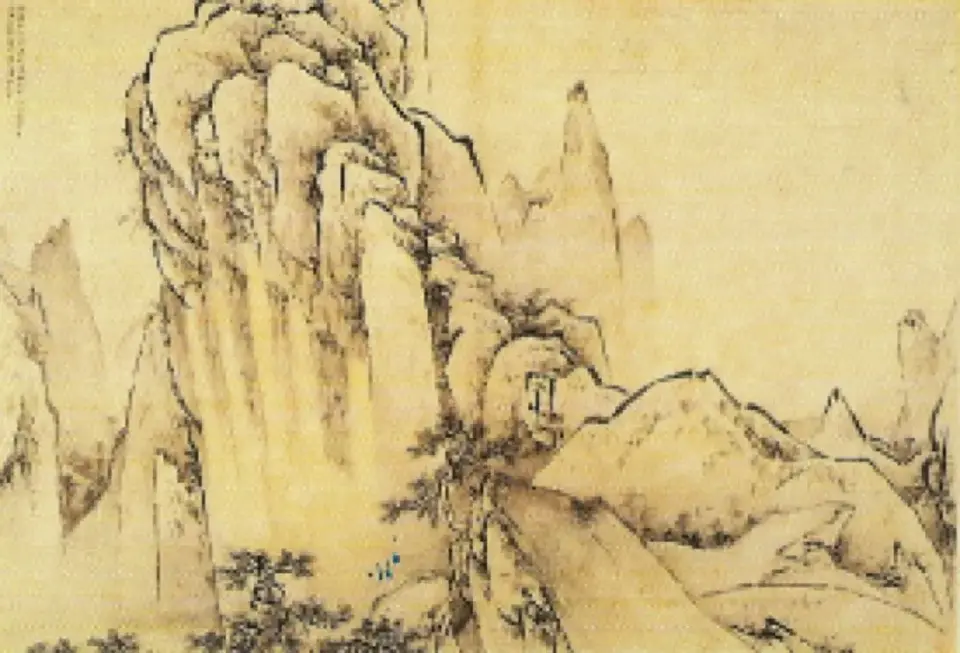
At a time when early Ming artists were trapped in sterile imitation of Yuan masters like Huang Gongwang and Ni Zan, the fifty-two-year-old Wang executed the extraordinary forty-leaf Huashan Tu Ce directly from life (now preserved in the Palace Museum in Beijing and the Shanghai Museum). Employing sweeping axe-cut and folded-ribbon brush strokes, he captured the sheer verticality, granite geometry, and tempestuous mist of Mount Hua with raw visceral power, creating one of the earliest and greatest sustained cycles of on-site landscape painting in world art history.
More critically, Wang articulated his immortal aesthetic philosophy in the accompanying prefaces: "My mind takes its inspiration from the eyes, and my eyes take their instruction from Mount Hua." He vigorously attacked painters who relied solely on paper and silk traditions to replicate archaic styles, proclaiming that art achieves divine excellence not through blind imitation of past masters, but through direct encounters with living nature. Formulating the doctrine that form and spirit must completely integrate with inner conception overflowing outward form, he asserted that artistic natural laws reside in nature itself rather than in conventional academies. Wang's revolutionary emphasis on sketching from life and expressing genuine inner perception reshaped the evolution of the Wu school of painting, influenced master Shitao, and permanently transformed classical Chinese landscape aesthetics.
FIGURES ASSOCIATED WITH THIS DYNASTY