Lineage Birth
Born into the premier Langya Wang clan as the fifth son of Wang Xizhi.
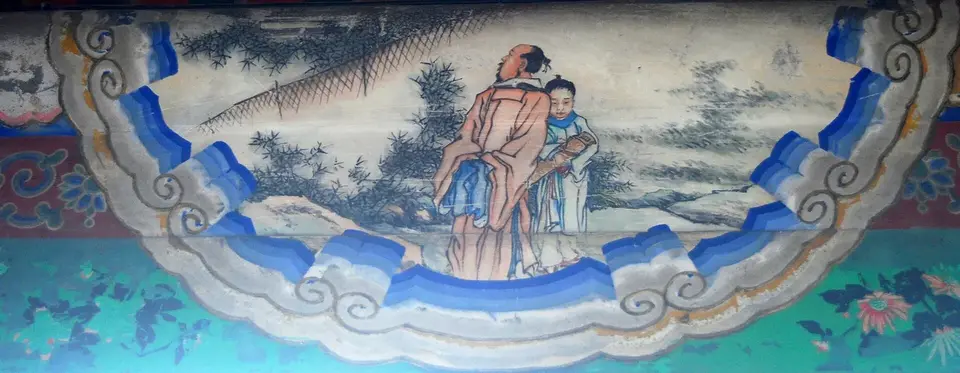
王徽之
Wang Huizhi (338–386), courtesy name Ziyou, was a native of Linyi County, Langya Commandery (modern Linyi, Shandong Province). He was the grand-nephew of Eastern Jin Chancellor Wang Dao, the fifth son of "Sage of Calligraphy" Wang Xizhi, and the elder brother of paramount calligrapher Wang Xianzhi. A celebrated calligrapher, cultural icon, and scholar-recluse of the Eastern Jin dynasty, Wang Huizhi stood as the supreme…
Wang Huizhi (338–386), courtesy name Ziyou, was a native of Linyi County, Langya Commandery (modern Linyi, Shandong Province). He was the grand-nephew of Eastern Jin Chancellor Wang Dao, the fifth son of "Sage of Calligraphy" Wang Xizhi, and the elder brother of paramount calligrapher Wang Xianzhi. A celebrated calligrapher, cultural icon, and scholar-recluse of the Eastern Jin dynasty, Wang Huizhi stood as the supreme archetype of Wei-Jin spontaneity (rendan) and aesthetic individualism. Descending from the aristocratic Langya Wang clan, Wang Huizhi was trained from childhood in classical letters and running-cursive calligraphy. Entering official life through hereditary privilege, he served as Cavalry Counselor to Huan Chong and Military Counselor to Grand Marshal Huan Wen. Aloof, uninhibited, and indifferent to administrative formality, he treated military paperwork with disdain, generating numerous famous anecdotes of literati detachment. Promoted to Attendant Gentleman of the Yellow Gates close to the throne, he soon grew weary of court constraints, resigning his seals to retire in Shanyin, Kuaiji, living amidst mountains and bamboo groves. Wang Huizhi's life choices embodied natural authenticity, immortalized in cultural idioms such as "visiting Dai on a snowy night" (traveling on impulse and returning when the impulse expired), his devotion to bamboo ("how could one live a single day without this gentleman?"), and his impromptu musical encounter with general Huan Yi. In calligraphy, he preserved his father's dynamic momentum, earning the critical verdict that "Huizhi acquired his father's force." In 386, following the premature death of his beloved brother Wang Xianzhi, Wang Huizhi attended the funeral in stoic silence, broke the strings of his brother's zither, and collapsed in grief, crying that "both the man and his zither are gone." An old back affliction erupted, and he died a month later at the age of forty-nine.
Born into the premier Langya Wang clan as the fifth son of Wang Xizhi.
Participated in the Orchid Pavilion Gathering alongside his father; composed two classical poems.
Appointed Military Counselor to Grand Marshal Huan Wen, dressing casually and disregarding bureaucracy.
Served under Huan Chong as Cavalry Counselor, displaying uninhibited wit regarding administrative equine records.
Elevated to Attendant Gentleman of the Yellow Gates; resigned office shortly after to settle in Shanyin.
Rowed all night to visit Dai Kui on a snowy evening, turning back at the gate upon exhausting his spontaneous impulse.
Mourned the death of brother Wang Xianzhi; died of grief and illness at age forty-nine.
Wang Huizhi was born into the preeminent emigrant aristocratic clan of Eastern Jin, the Langya Wang lineage. His grandfather Wang Kuang served as Administrator of Huainan, and his father Wang Xizhi was celebrated empire-wide as the Sage of Calligraphy. Among his talented siblings, Wang Huizhi was the most unconstrained in spirit, internalizing calligraphic mastery and Neo-Daoist metaphysics while pursuing spiritual communion with nature.
In 353, Wang Huizhi accompanied his father and cultural luminaries including Xie An and Sun Chuo to the sacred purification ritual at the Orchid Pavilion in Shanyin. At age sixteen, seated beside the winding stream, he composed two elegant poems in four-syllable and five-syllable meters, displaying the effortless elegance that came to characterize his generation.
Entering public service through clan prerogative, Wang Huizhi was initially appointed Military Counselor on the staff of paramount general Huan Wen. In a disciplined headquarters crowded with operational paperwork, Wang Huizhi walked with disheveled hair and loose robes, completely indifferent to official correspondence. Huan Wen admired his family pedigree and recognized his rare genius, treating him with indulgent forbearance.
Subsequently reassigned as Cavalry Counselor to General of Chariots and Cavalry Huan Chong, Wang Huizhi maintained his carefree ways. When Huan Chong inquired which department he supervised, Wang Huizhi replied: "I am uncertain; I frequently observe horses being led back and forth, so I presume it is either the Cavalry or Equine Bureau!" When asked the number of horses under his command, he retorted: "That question should be directed to the stable grooms; how could I know the total?" When Huan Chong pressed regarding how many horses had died of disease, Wang Huizhi impassively replied: "Since I do not know the number of the living, how could I know the number of the dead?"
On another occasion, while traveling in Huan Chong's cavalry escort, a torrential thunderstorm erupted. Observing Huan Chong seated alone inside a carriage, Wang Huizhi dismounted and climbed inside, joking: "How can the commander ride alone? I have come to accompany you!" When the rain ceased, he thanked Huan Chong and resumed his ride, leaving fellow officers astonished by his lack of pretense.
Promoted alongside his brothers to Attendant Gentleman of the Yellow Gates, Wang Huizhi served close to the throne. However, scorning court intrigue and administrative routine, he resigned his seals and returned east to reside in Shanyin, Kuaiji.
During his reclusion, Wang Huizhi elevated spontaneous living into an aesthetic art. One winter midnight, awakening after heavy snowfall to a moonlit sky of pristine white, he drank wine and recited Zuo Si's Poem on Beckoning the Recluse. Suddenly remembering his friend, the reclusive scholar-artist Dai Kui who resided dozens of miles away in Shan County, Wang Huizhi boarded a small boat, traveling all night through frozen waters.
Arriving at Dai Kui's gate at dawn, Wang Huizhi paused and instructed the boatman to row home without knocking. When his bewildered servants asked why he returned without entering, Wang Huizhi smiled: "I traveled on the spur of the moment; once the impulse was exhausted, I returned. Why must I see Dai?" This supreme manifestation of aesthetic spontaneity became an enduring cultural paradigm in Chinese literary history.
Throughout his life, Wang Huizhi was passionately enamored of bamboo. Even when lodging temporarily in another's residence for a few days, he insisted on planting fresh bamboo groves, declaring: "How could one live a single day without this gentleman?" Once, passing through Wuzhong, he entered a local magistrate's private bamboo grove without invitation, whistling and reciting poetry for hours before departing, delighting the host with his untamed charm.
In 386, Wang Huizhi and his younger brother, Director of the Imperial Secretariat Wang Xianzhi, fell gravely ill. Xianzhi died first. Sensing the silence of his attendants, Huizhi remarked: "There is no news of Zijian; he must have passed away!" Without weeping, he ordered a carriage to attend the funeral.
Entering the mourning hall, Wang Huizhi sat beside the bier, taking up Xianzhi's cherished zither to play. As the strings produced discordant, unraveling tones, Wang Huizhi cast the instrument to the ground, weeping in anguish: "Zijian! Zijian! Both the man and his zither are gone!" He collapsed in convulsions. The emotional shock ruptured a chronic back ailment, and Wang Huizhi died a month later at the age of forty-nine.
Wang Huizhi stands as the foremost historical embodiment of Wei-Jin aesthetic spontaneity (rendan). Embodying the philosophical ideal of transcending ritual conventions to follow nature, he transformed everyday existence into performance art. From his ironic detachment toward bureaucratic routine to his nocturnal journey on the snowy river, he dismantled utilitarian calculation, demonstrating that true freedom resides in the authenticity of immediate aesthetic experience.
In cultural semiotics, Wang Huizhi pioneered the personification of bamboo as the spiritual companion of the literatus. His famous exclamation, "How could one live a single day without this gentleman?" elevated bamboo from garden vegetation into an emblem of moral rectitude, resilience, and unyielding virtue. His sentiment established a profound aesthetic tradition, deeply influencing subsequent cultural figures such as Su Shi and Zheng Xie.
Trained directly by his father Wang Xizhi, Wang Huizhi was praised by contemporaries as having inherited the dynamic momentum (shi) of his father's brushwork. His calligraphy was celebrated for its unrestrained grace and natural vitality. In the Song dynasty catalogue Xuanhe Calligraphy Manual, his work was praised as possessing "spontaneous spiritual charm." His surviving work, the Tang tracing of New Moon Letter (Xinyue Tie) preserved in the Liaoning Provincial Museum, exhibits flowing running-cursive brushwork, standing as an irreplaceable treasure of early medieval Chinese calligraphy.
FIGURES ASSOCIATED WITH THIS DYNASTY