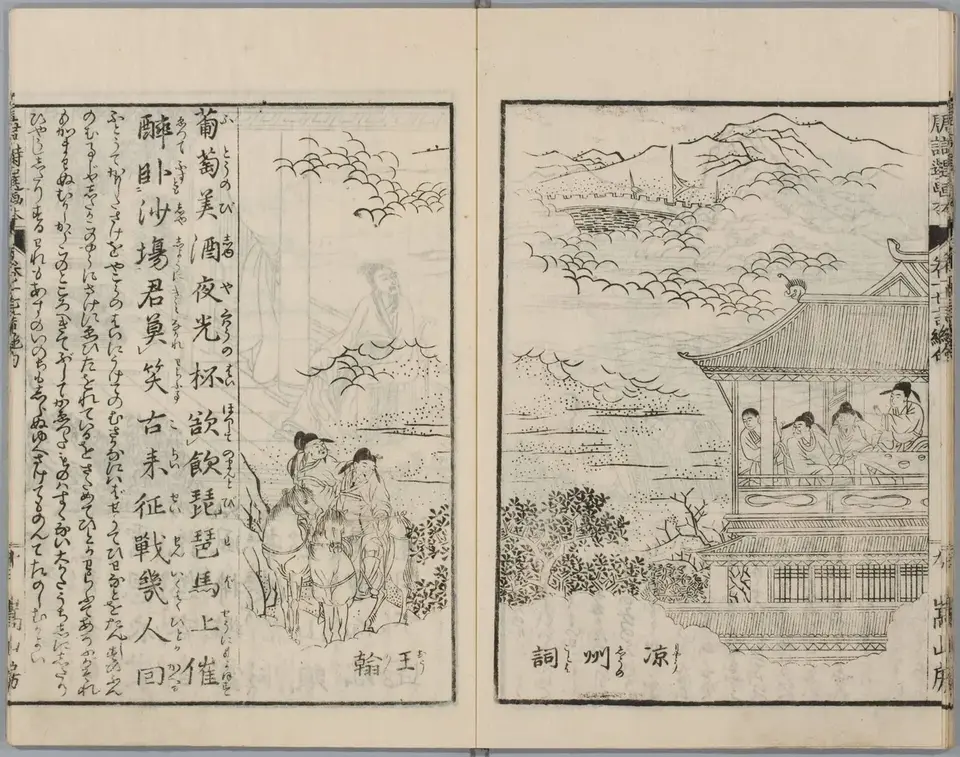
PROFILE
Wang Han (王翰, 687–735), courtesy name Ziyu (子羽), was a native of Jinyang in Bingzhou (present-day Taiyuan, Shanxi) and a celebrated frontier poet of the High Tang dynasty. Originating from an affluent aristocratic clan of Taiyuan, Wang was celebrated from youth for his chivalric magnanimity, swift literary imagination, and bold temperament. In the first year of the Jingyun era (710) under Emperor Ruizong, Wang passed the imperial examinations, earning the Jinshi degree. In the early Kaiyuan era, Chancellor Zhang Yue served as regional commander of Bingzhou; deeply admiring Wang's literary brilliance and heroic disposition, Zhang invited him to join his secretarial staff, treating him with exceptional deference. Upon returning to the capital as Chief Chancellor, Zhang recommended Wang to the throne; Wang was summoned to Chang'an as Proofreader in the Palace Library, subsequently holding appointments as Hanlin Academician, Receptionist in the Chancellery, and Vice Director in the Bureau of Equipment, attaining nationwide renown.
Possessing an untrammeled and unconventional character, Wang indulged in wine, poetry, equestrian hunting, and falconry, maintaining dancing musicians at his residence and holding nightly banquets, which provoked intense envy and moral condemnation from conservative court factions. Following Chancellor Zhang Yue's political downfall during factional struggles, Wang suffered severe purges, successively demoted to Marshal of Ruzhou, Marshal of Xianzhou, and finally Marshal of Daozhou. In the twenty-third year of the Kaiyuan era (735), Wang passed away in exile at his Daozhou yamen at the age of forty-nine. In Chinese literary history, Wang Han was an essential founding master of the High Tang frontier poetry school. His seven-character quatrain Song of Liangzhou—famed for the lines "Fine wine of grapes in cups that glow by night; about to drink, the pipa urges us on horseback. Do not laugh if we lie drunk on the battlefield; since ancient times, how many return from war?"—remains an immortal classic, hailed by Ming and Qing critics as the crowning masterpiece of Tang seven-character quatrains.
- Courtesy Name
- Ziyu (子羽)
- Date of Birth
- 687 (Tang Dynasty, 3rd year of Chuigong)
- Date of Death
- 735 (Tang Dynasty, 23rd year of Kaiyuan)
- Age at Death
- 49
- Ancestral Home
- Jinyang, Bingzhou (present-day Taiyuan, Shanxi)
- Highest Office
- Vice Director in the Bureau of Equipment (Jiabu Yuanwailang)
- Identity
- Renowned High Tang frontier poet, Jingyun Jinshi scholar, and Vice Director in the Bureau of Equipment
BIOGRAPHY
Chronology
- 687 (Tang Dynasty, 3rd year of Chuigong) | Birth in Taiyuan | Born into a distinguished aristocratic family in Jinyang, Bingzhou, studying classics and excelling in martial arts and poetry.
- 710 (Tang Dynasty, 1st year of Jingyun) | Earning the Jinshi Degree | Traveled to Chang'an and passed the imperial examinations, earning wide acclaim across Taiyuan and the two capitals.
- 714 (Tang Dynasty, 2nd year of Kaiyuan) | Joining Zhang Yue's Staff | Chancellor Zhang Yue inspected Bingzhou, recognized Wang's literary talents, and recruited him to his military staff.
- 721 (Tang Dynasty, 9th year of Kaiyuan) | Summoned to the Capital | Accompanied Zhang Yue to Chang'an, appointed Proofreader in the Palace Library, Hanlin Academician, and Vice Director of Equipment.
- 726 (Tang Dynasty, 14th year of Kaiyuan) | Chivalric Revelry in Chang'an | Entertained scholars and equestrian youths with lavish banquets and private musicians, provoking impeachment from imperial censors.
- 727 (Tang Dynasty, 15th year of Kaiyuan) | Demotion to Ruzhou | Implicated in the factional purge following Zhang Yue's dismissal, demoted to Marshal of Ruzhou and later transferred to Xianzhou.
- 730 (Tang Dynasty, 18th year of Kaiyuan) | Exile to Daozhou | Demoted to Marshal of distant Daozhou in the deep south, maintaining his heroic defiance amid political adversity.
- 735 (Tang Dynasty, 23rd year of Kaiyuan) | Passing in Daozhou | Passed away in office at his official residence in Daozhou at the age of forty-nine, deeply mourned by literati across the empire.
Life Course
Aristocratic Lineage and Chivalric Youth in Jinyang
Wang Han was born in the third year of the Chuigong era (687) in Jinyang, Bingzhou (present-day Taiyuan, Shanxi). Situated along the northern frontier, Bingzhou was renowned for its martial traditions and heroic ethos. The Wang clan had been an affluent aristocratic house in Taiyuan across generations. Naturally spirited and courageous, Wang immersed himself in the Confucian classics and ancient philosophers during his youth, while embracing the chivalric spirit of the Han and Wei eras, excelling in swordsmanship, archery, and equestrian hunting.
Wang achieved early prominence in his native province, squandering gold to entertain traveling knights and impoverished scholars. His mansion gates remained open day and night, filled with guests sharing wine, verse, and zither music. Unlike ordinary wealthy playboys, Wang concealed ambitious statecraft aspirations beneath his carefree exterior. His verse possessed the soaring vitality characteristic of the emerging High Tang, circulating widely across Hedong Province and establishing him as the leading scholar of Bingzhou.
Examination Triumph and Patronage under Zhang Yue
In the first year of the Jingyun era (710), twenty-four-year-old Wang traveled west to Chang'an to sit for the national Jinshi examinations. In the examination hall, he distinguished himself through muscular prose and original policy treatises, achieving the Jinshi degree in the highest tier. Proud and disdaining flattery, Wang declined to solicit appointments from capital dignitaries, returning instead to Jinyun to enjoy his chivalric life in the countryside.
In the early Kaiyuan era, Chief Chancellor and literary titan Zhang Yue was assigned as Prefect of Bingzhou and Military Commander of the Tianbing Army following court realignments. Understanding that Bingzhou was a crucial border defense stronghold, Zhang actively sought exceptional frontier talent. Hearing of Wang's renown, Zhang issued an invitation. Meeting Wang in person, Zhang was astonished by his sweeping literary genius and magnanimous personality, praising him as an "extraordinary talent of the realm," immediately recruiting him to his military staff. In Bingzhou, Zhang treated Wang as an honored companion, the two men gathering daily to write poetry and debate frontier defense, providing Wang with profound intellectual mentorship and firsthand experience for his later frontier verse.
Capital Prominence and Chivalric Extravagance
In the ninth year of the Kaiyuan era (721), Emperor Xuanzong recalled Zhang Yue to Chang'an as Chief Chancellor to direct executive governance. Zhang strongly recommended Wang's literary brilliance to the throne. The emperor summoned Wang, appointing him Proofreader in the Palace Library (Mige Zhengzi), subsequently naming him Hanlin Academician to draft confidential state decrees, followed by promotions to Receptionist in the Chancellery and Vice Director in the Bureau of Equipment. As Vice Director in the Ministry of War supervising national relay posts and imperial transport, Wang entered the inner corridors of executive power.
In Chang'an, Wang retained his untamed disposition. Utilizing imperial favor and generous stipends, he purchased dozens of fine steeds and hunting hounds, hosting daily salons for literati and adventurous youths after leaving the morning court. Furthermore, Wang maintained dozens of performing musicians at his private estate, playing nomadic flutes and pipas while hosting nightly celebrations. While his unrestrained lifestyle reflected the boundless vigor of High Tang intellectuals, it aroused intense resentment among conservative court bureaucrats and imperial censors, who submitted frequent impeachments denouncing him for flouting ritual decorum.
Succession of Demotions and Passing in Daozhou
After the fourteenth year of Kaiyuan (726), fierce factional strife erupted within the Tang court. Chancellor Zhang Yue was targeted by coalitions led by Yuwen Rong and Li Linfu, ultimately forced from the premiership. With his primary patron removed, Wang, who had accumulated numerous political enemies, became an immediate target of bureaucratic retribution.
In the fifteenth year of Kaiyuan (727), Wang was stripped of his central office and expelled from Chang'an as Marshal of Ruzhou. Shortly afterward, court enemies secured his transfer to even more remote Xianzhou. Undaunted by exile, Wang continued to travel with wine, ascend hills, and play the zither in Xianzhou. Enraged by his unbroken spirit, political opponents banished him in 730 to malarial Daozhou (present-day Dao County, Hunan) in the far south.
During several years of isolation in Daozhou, southern humidity and the exhaustion of displacement undermined his health. Yet confronting wild mountains, Wang unsheathed his sword, composing moving verses reflecting upon his life and sympathizing with peasant burdens. In the twenty-third year of the Kaiyuan era (735), Wang passed away at his Daozhou residence at the age of forty-nine. The most chivalric and heroic poet of the High Tang was laid to rest in southern exile, leaving an indelible historical legacy.
Major Achievements
Song of Liangzhou and the Summit of High Tang Frontier Spirit
Wang Han's crowning achievement in Chinese literary history is his celebrated seven-character quatrain Song of Liangzhou (the first of two poems). The work is universally acclaimed by critics as one of the supreme artistic pinnacles of Tang poetry, capturing the essence of the High Tang spirit.
The poem reads: "Fine wine of grapes in cups that glow by night; about to drink, the pipa urges us on horseback. Do not laugh if we lie drunk on the battlefield; since ancient times, how many return from war?" Opening with vivid imagery of exotic grape wine and glowing luminous cups from the Western Regions, the poem instantly established the opulent, festive atmosphere of a frontier banquet held before marching into battle. The second line intertwined the rapid rhythms of equestrian pipas with the soldiers' eager drinking, driving the celebratory gathering to an emotional climax.
The concluding couplet delivered an immortal philosophical breakthrough: "Do not laugh if we lie drunk on the battlefield; since ancient times, how many return from war?" Confronting the brutal realities of frontier combat and the fragility of mortal existence, Tang warriors exhibited none of the mournful lamentations characteristic of earlier dynasties. Instead, they faced life and death with transcendent laughter and intoxicating revelry. Fusing tragic solemnity with joyful defiance, the poem embodied the monumental courage of Tang soldiers defending the realm.
Ming critic Wang Shizhen praised the work in Yiyuan Zhiyan as a divine masterpiece, highlighting the muscular gravity of its closing couplet. Qing anthologist Shen Deqian crowned it as the definitive seven-character quatrain of the Tang dynasty. Over centuries, the poem has endured as an exalted artistic symbol of Chinese national courage.
Innovations in Music Bureau Verse and Melodic Integration
Wang Han's structural contribution to classical poetry lay in his bold expansion of Han-Tang music bureau verse (yuefu) and his creative adaptation of foreign musical rhythms. During the High Tang, as the Silk Road flourished, Central Asian court and popular melodies flooded the Central Plains. Translating the energetic pulse of foreign music into the prosodic beauty of Chinese verse was an essential aesthetic mission for contemporary poets.
Having lived along the frontier in Bingzhou, Wang was intimately familiar with military music played on nomadic flutes, pipas, and waist drums. In works such as Song of Liangzhou, Flying Swallow, and Watering Horses at the Great Wall, he deployed shifting syntactical structures, cascading repetition, and interlocking rhymes, imbuing his lines with the percussive momentum of galloping warhorses and dynamic strings.
Wang's music bureau poetry broke free from the static imitation of Han-Wei models, injecting the real frontier storms, ethnic fusion, and authentic emotions of Tang soldiers into ancient musical titles. His elevated vocal register and opulent diction provided indispensable guidance for the flourishing frontier ballads of Cen Shen and Gao Shi.
Flying Swallow and Long Seven-Character Ballads
Beyond celebrated quatrains, Wang made enduring contributions to long seven-character ballads, exemplified by his widely praised work Flying Swallow.
Drawing thematic material from the legendary life of Empress Zhao Feiyan during the Han dynasty, the poem depicted the extravagant splendor of imperial palaces alongside the tragic mutability of female fortune. Wang deployed extensive parallel cataloging and luminous diction to portray gold-plated halls and Feiyan's ethereal dance, before shifting abruptly in the conclusion to depict Emperor Cheng's sudden death and the ruin of the Zhao clan, conveying profound meditation on the transience of worldly glory.
The ballad circulated widely in the early Kaiyuan era, with Zhang Yue praising its dynamic movement and refined melody. Through this sprawling composition, Wang demonstrated his mastery over monumental narrative structures, marking a vital milestone in the maturation of seven-character ancient ballads.
Chivalric Persona and Literary Historical Stature
Wang was not only an exceptional poet, but also the quintessential embodiment of the High Tang chivalric intellectual (youxia). In classical Chinese literature, few writers integrated personal chivalric daring with solemn poetic power so seamlessly.
Wang's life illustrated the fierce self-respect, cultural confidence, and passion for individual freedom that defined literati during Emperor Xuanzong's golden age. Disdaining pedestrian social conventions, he defied court grandees, finding spiritual kinship in warhorses, wine, and frontier beacons, transmuting his authentic life experience into the unstoppable force of his verse.
Although his uncollected writings were largely lost during the Five Dynasties conflicts, his single masterpiece Song of Liangzhou ensured his permanent presence alongside Li Bai, Wang Changling, and Gao Shi atop the High Tang literary pantheon.
Related Figures
- Zhang Yue: Chief Chancellor and literary leader of the High Tang; discovered Wang in Bingzhou, treating him as an intimate friend and recommending him to the central court.
- Emperor Xuanzong of Tang: Tang emperor who appointed Wang Proofreader in the Palace Library, Hanlin Academician, and Vice Director of Equipment upon Zhang Yue's recommendation.
- Wang Changling: Celebrated High Tang master of seven-character quatrains; shared aesthetic resonance with Wang Han in frontier poetry.
- Li Qi: Prominent High Tang poet; maintained close artistic exchanges with Wang Han in the development of seven-character verse.
- Gao Shi: Master of the frontier poetry school; drew profound inspiration from Wang Han's heroic and expansive frontier style.
Historical Evaluations
- Old Book of Tang, Biographies of Literary Figures II: "Wang Han was heroic and bold in youth, relying on high spirits and wine, born into wealth and generous to guests and scholars. Zhang Yue highly praised his genius, calling him an extraordinary instrument of the realm."
- New Book of Tang, Biographies of Literary Figures II: "Wang Han spoke without constraint and wrote with astonishing speed, drinking daily and maintaining musicians. His poetry was heroic and sweeping, celebrated across the empire."
- Wang Shizhen: "Among the quatrains of the Kaiyuan era, Wang Han's Song of Liangzhou is preeminent; its tone is muscular and its sentiment generous, an achievement possible only in the High Tang." (Yiyuan Zhiyan)
- Shen Deqian: "'Do not laugh if we lie drunk on the battlefield; since ancient times, how many return from war?' This is the authentic heroic spirit of the High Tang, which later poets could never replicate." (Tangshi Bieji)
- Shi Buhua: "Composing tragic and heroic verse depends entirely on bone vigor; without bone vigor, poetry degenerates into pathetic lamentation. Wang Han's Song of Liangzhou crowns the genre precisely because of its monumental bone vigor." (Xianyong on Poetry)
Related Entries
- Song of Liangzhou
- Frontier Poetry School
- Zhang Yue
- Wang Changling
- Kaiyuan Golden Age
FIGURES ASSOCIATED WITH THIS DYNASTY