Birth in the North
On February 27, Lady Wang was born to Wang Chaocai, a military officer serving as an Embroidered Uniform Guard company commander.
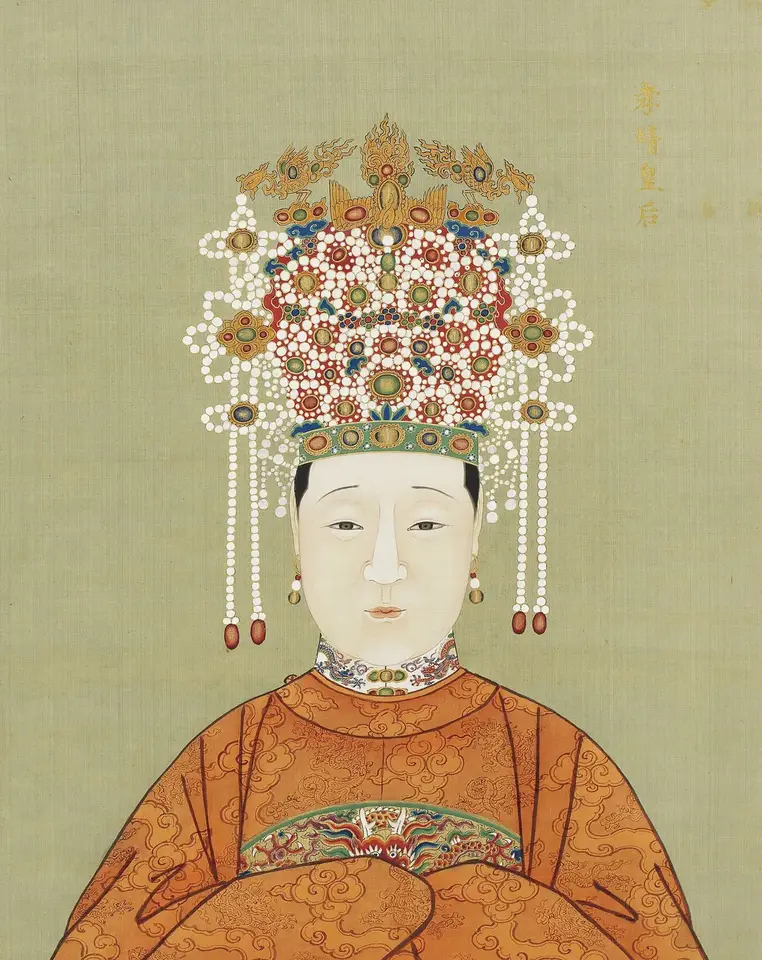
王恭妃
Consort Gong Wang (王恭妃, February 27, 1565 – October 18, 1611), known posthumously as Empress Xiaojing (孝靖皇后), was an Imperial Noble Consort of the Wanli Emperor (Zhu Yijun), the birth mother of the Taichang Emperor (Zhu Changluo), and the grandmother of both the Tianqi Emperor (Zhu Youxiao) and the Chongzhen Emperor (Zhu Youjian). Born into an officer's household in Daxing, Shuntian Prefecture, she entered the Forbidden City…
Consort Gong Wang (王恭妃, February 27, 1565 – October 18, 1611), known posthumously as Empress Xiaojing (孝靖皇后), was an Imperial Noble Consort of the Wanli Emperor (Zhu Yijun), the birth mother of the Taichang Emperor (Zhu Changluo), and the grandmother of both the Tianqi Emperor (Zhu Youxiao) and the Chongzhen Emperor (Zhu Youjian). Born into an officer's household in Daxing, Shuntian Prefecture, she entered the Forbidden City during the palace beauty selections of 1578. Failing to achieve the top three concubinage ranks, she was assigned to the Cining Palace as a palace maid serving Empress Dowager Xiaoding (Empress Dowager Li), the emperor's mother. In the winter of 1581, the nineteen-year-old Wanli Emperor favored her in private, leading to her pregnancy, which the emperor initially attempted to conceal until Empress Dowager Li verified the event in the Imperial Diary of Activity and Repose. In 1582, Lady Wang was formally invested as Consort Gong and gave birth to the Wanli Emperor's eldest son, Zhu Changluo. However, she was soon eclipsed by Noble Consort Zheng, who gave birth to the emperor's third son, Zhu Changxun, and dominated the monarch's affections. When the emperor sought to bypass the eldest son in favor of Zhu Changxun, the court erupted into the fifteen-year Guoben Controversy. Staunchly defended by civil ministers and Empress Dowager Li on the principle of agnatic primogeniture, Zhu Changluo was eventually designated Crown Prince in 1601, but Consort Gong remained strictly confined to the desolate Jingyang Palace, enduring systematic mistreatment, surveillance, and material deprivation that eventually caused her to go blind. In 1606, following the birth of her grandson Zhu Youxiao, she was nominally elevated to Imperial Noble Consort, yet her confinement continued unabated. In October 1611, while terminally ill, she was visited by the Crown Prince, who was forced to break through the locked palace doors with an axe. Weeping over her son in total blindness, she died that afternoon at age forty-six. After the brief reign of the Taichang Emperor and the accession of the Tianqi Emperor, her memory was fully vindicated. She was posthumously honored as Empress Xiaojing, and her remains were transferred from her humble initial burial ground to be interred alongside the Wanli Emperor in the underground palace of the Dingling Mausoleum of the Ming Dynasty.
On February 27, Lady Wang was born to Wang Chaocai, a military officer serving as an Embroidered Uniform Guard company commander.
Entered the imperial palace following imperial beauty selections; assigned as a palace maid in the Cining Palace serving Empress Dowager Li.
In winter, privately favored by the Wanli Emperor in the Cining Palace, resulting in pregnancy which the emperor initially denied.
Invested as Consort Gong on July 5; gave birth to the emperor's eldest son Zhu Changluo on August 28, prompting a general imperial amnesty.
Noble Consort Zheng gave birth to Zhu Changxun and was elevated to Imperial Noble Consort, triggering fifteen years of fierce factional debate over succession.
Consort Zheng fabricated charges against Zhu Changluo; Consort Gong tearfully proved she had slept beside her son for thirteen years to prevent foul play.
Succumbing to unified ministerial pressure and Empress Dowager Li's stern rebuke, the Wanli Emperor reluctantly named Zhu Changluo Crown Prince.
Nominally promoted to Imperial Noble Consort following the birth of her grandson Zhu Youxiao, though remaining locked inside the Jingyang Palace.
On October 18, terminally ill and blind, she was visited by the Crown Prince who broke through locked doors, dying hours later at age forty-six.
Successively honored by the Taichang and Tianqi emperors as Empress Xiaojing, her coffin was transferred to be interred inside Dingling Mausoleum.
Consort Gong Wang was born on February 27, 1565, during the final year of the Jiajing reign. She hailed from a respectable northern military family; her father, Wang Chaocai, was a military graduate who served as a company commander in the Embroidered Uniform Guard with the nominal rank of sixth-grade military officer. In 1568, during the Longqing reign, the household relocated from the garrison of the Left Guard of Wanquan in Xuanfu to the capital prefecture of Shuntian. Raised in a disciplined military household, Lady Wang was noted from childhood for gentle decorum, modesty, and filial piety.
In early 1578, when the Wanli Emperor reached fifteen years of age, the Ming court initiated a nationwide beauty selection to choose an empress and secondary consorts. Lady Wang passed through the rigorous municipal screenings administered by metropolitan officials, entering the final palace selections. However, she was not selected among the top three candidates. The first-ranking maiden, Lady Wang Xijie, was invested as Empress Xiaoduanxian, while the other two finalists were ennobled as Consort Zhao and Consort Yi.
Under Ming dynastic regulations, qualified maidens who were not selected for imperial concubinage were either repatriated with gifts or retained within the Forbidden City as inner-court palace attendants. On March 10, 1578, the fourteen-year-old Lady Wang was assigned to the Cining Palace to serve as an attendant to Empress Dowager Xiaoding (Empress Dowager Li), the birth mother of the Wanli Emperor. Empress Dowager Li maintained strict discipline in her palace quarters, and Lady Wang's quiet humility, meticulous diligence, and obedient temperament quickly earned the dowager's deep affection and trust.
In the winter of 1581, the nineteen-year-old Wanli Emperor visited the Cining Palace to pay his formal morning respects to his mother. While Empress Dowager Li was changing her robes in the rear apartments, the young monarch waited in an adjacent chamber, where his eyes fell upon Lady Wang, who was serving imperial tea. Attracted by her youthful charm, the emperor privately favored her on the spot. In the normal course of Ming palace administration, when an emperor favored a palace woman, duty eunuchs from the Document Registry were required to record the date, hour, and any gifts presented in the Imperial Diary of Activity and Repose to establish definitive evidence of future paternity. However, out of youthful embarrassment and regarding Lady Wang as a lowly servant, the emperor neither bestowed gifts nor disclosed the encounter.
Several months later, Lady Wang's pregnancy became physically noticeable. In the perilous environment of the inner palace, an unrecorded pregnancy could result in execution for illicit conduct, and Lady Wang lived in silent terror. In the spring of 1582, Empress Dowager Li observed the physical changes and questioned Lady Wang in private. Kneeling beside the dowager's bed, Lady Wang broke down in tears and recounted the circumstances of the emperor's visit. Rather than expressing anger, the aging dowager rejoiced, yearning for an imperial grandchild to ensure dynastic continuity.
Soon after, when the Wanli Emperor arrived for an imperial luncheon, Empress Dowager Li brought up the matter. Blushing with shame, the emperor attempted to deny the incident entirely. Expecting his evasion, the dowager summoned imperial attendants to present the court's daily logs. Confronted with the unalterable written records of his past movements, the emperor had no choice but to admit the truth, though he muttered dismissively that Lady Wang was merely an ordinary servant. Empress Dowager Li reprimanded him sternly, reminding him that she herself had once been a palace maid and that dynastic law recognized children by maternal virtue rather than humble origin. Under the dowager's firm direction, the emperor issued an edict on July 5, 1582, creating Lady Wang as Consort Gong. On August 28, she gave birth to the emperor's eldest son, Zhu Changluo, prompting imperial proclamations and widespread rejoicing throughout the empire. In 1584, she gave birth to her second child, Princess Yunmeng (Zhu Xuanyuan).
Despite bearing the emperor's eldest son and daughter, Consort Gong never enjoyed imperial favor. The Wanli Emperor became infatuated with Noble Consort Zheng, a charming and witty concubine who treated the monarch with intimate familiarity. In February 1586, Consort Zheng gave birth to the emperor's third son, Zhu Changxun. In direct violation of dynastic precedent, the emperor elevated Consort Zheng to Imperial Noble Consort, positioning her directly beneath the childless Empress Wang Xijie. It soon became obvious that the emperor and Consort Zheng intended to displace the eldest son and designate Zhu Changxun as heir apparent.
This design precipitated the bitter Guoben Controversy, the longest and most destructive succession struggle of the Ming dynasty. Based on classical Confucian primogeniture, which dictated that in the absence of a legitimate son from the empress, the eldest son must inherit the throne, the entire civil bureaucracy, led by Grand Secretaries Shen Shixing, Wang Jiaping, and Wang Xijue, vehemently petitioned the throne to confirm Zhu Changluo as Crown Prince. The emperor resisted obstinately for fifteen years, purging four senior grand secretaries and subjecting over three hundred protesting censors and officials to flogging, dismissal, and exile.
Throughout this vicious political warfare, Consort Gong and her son served as the direct targets of Noble Consort Zheng's hostility. The emperor effectively imprisoned Consort Gong within the remote and dilapidated Jingyang Palace, severing all contact between her and external court officials. The emperor repeatedly postponed the Prince's formal classical education in a calculated effort to render him illiterate and unfit for rule. Terrified that her son would be poisoned or assassinated by Zheng's agents, Consort Gong never left his side, sharing the same bedchamber with Zhu Changluo until he reached thirteen years of age. In 1594, when Consort Zheng falsely alleged that the prince had engaged in improper relations with palace maids, the emperor dispatched examiners to verify his purity. Consort Gong wept bitterly before the inquisitors, recounting how she had guarded her son day and night for thirteen years to prevent such deceit, successfully preserving his innocence.
In October 1601, Empress Dowager Li intervened with fury, slamming her staff on the ground and rebuking the emperor for disparaging palace maid origins when he himself had been born of one. Supported by unyielding ministerial resistance, the emperor finally relented, officially investing nineteen-year-old Zhu Changluo as Crown Prince while enfeoffing Zhu Changxun as Prince of Fu. Nevertheless, the emperor's resentment toward Consort Gong only intensified. She remained locked inside the Jingyang Palace, forbidden from seeing her son for an entire decade.
During her decades of solitary confinement in the Jingyang Palace, Consort Gong endured appalling deprivation. Archaeological excavations in the twentieth century confirmed the stark squalor of her daily life: an unadorned silver pitcher recovered from her coffin had been manufactured in 1582 upon her initial investiture as Consort Gong, bearing signs of continuous repair and use for nearly thirty years, while a gilded silver plate was riddled with holes and patches. These utilitarian objects were inferior even to goods owned by common affluent households, offering concrete archaeological proof of the systematic cruelty inflicted upon her by the inner court.
Living in perpetual dread and shedding tears in darkness, Consort Gong's physical health deteriorated completely. She suffered from chronic respiratory and gastrointestinal illnesses, and prolonged weeping rendered her entirely blind in both eyes. In 1606, when Crown Prince Zhu Changluo's consort gave birth to his eldest son Zhu Youxiao (the future Tianqi Emperor), the Wanli Emperor, celebrating the birth of his first grandson, nominally promoted Lady Wang to Imperial Noble Consort. However, this title brought no material relief; she remained isolated without proper food or medical care.
On October 18, 1611, the forty-six-year-old Imperial Noble Consort fell into critical condition. Receiving word that his mother was dying, Crown Prince Zhu Changluo knelt outside the Qianqing Palace, begging the emperor for permission to bid her farewell. When the prince reached the Jingyang Palace, he found the gates barred with rusty chains. Overcome with grief and fury, the prince ordered attendants to break through the locks with an axe.
Entering the dark, damp bedchamber, the prince threw himself beside his dying mother. Blind and emaciated, Lady Wang reached out with trembling hands to touch her son's face and silk robes, weeping: "Now that you have grown to manhood, I can die without regret." Historical records indicate that agents dispatched by Consort Zheng stood watching outside the window; fearful of endangering her son, Lady Wang whispered: "Zheng's people are watching outside; take care what you say." Mother and son wept together in silence. At five in the afternoon, Lady Wang drew her last breath, passing away after thirty years of unceasing torment in the Forbidden City.
Following her death, the Wanli Emperor treated her funeral with cold indifference, attempting to bury her hastily with minimal rites. Senior Grand Secretaries Ye Xianggao and Shen Yiguan submitted urgent memorials arguing that as the mother of the heir apparent, her funeral should follow the elevated standards accorded to imperial mothers. The emperor stalled for ten months, leaving her coffin unburied during the sweltering summer heat until her remains severely decomposed. On August 13, 1612, she was finally interred in a modest tomb at Mount Tianshou under the posthumous title Imperial Noble Consort Wensu Duanjing Chunyi.
The emperor refused to assign permanent tomb guards or provide sacrificial funds. Only after the sensational Wooden Staff Assault Case in May 1615, when an assassin infiltrated the Crown Prince's palace under the instigation of Consort Zheng's eunuchs, did the emperor grant thirty tomb households and sacrificial farmlands to pacify widespread public outrage.
In August 1620, the Wanli Emperor died, and Zhu Changluo ascended the throne as the Taichang Emperor. His first imperial decree posthumously elevated his mother to Empress Dowager, expressing profound remorse for his inability to care for her in life. Tragically, the Taichang Emperor died twenty-nine days later during the Red Pill Case. In September 1620, his son Zhu Youxiao ascended the throne as the Tianqi Emperor. Fulfilling his late father's wishes and heeding memorials denouncing Consort Zheng's atrocities, the Tianqi Emperor officially conferred upon his grandmother the posthumous title Empress Xiaojing and Empress Dowager Xiaojing. In October 1620, her coffin was exhumed from its humble grave and reinterred alongside the Wanli Emperor and Empress Xiaoduanxian in the magnificent underground palace of Dingling Mausoleum, granting her eternal rest beside the dynastic ancestors.
Within the turbulent political history of the late Ming dynasty, Consort Gong played an indispensable role by securing the dynastic succession. During the early Wanli reign, the lack of an imperial heir in the primary bedchamber caused deep anxiety among court ministers and imperial clansmen. Consort Gong's unexpected pregnancy and the birth of Zhu Changluo in 1582 provided the empire with its legitimate successor.
Under the Ancestral Injunctions of the Ming dynasty, agnatic primogeniture held absolute constitutional legitimacy in the absence of an empress's biological son. Zhu Changluo's existence served as the unassailable legal foundation that allowed the civil bureaucracy, inner-court grand secretaries, and Empress Dowager Li to withstand the Wanli Emperor's arbitrary attempts to elevate the son of Noble Consort Zheng. Consort Gong's endurance and maternal sacrifice served as the bulwark preserving the constitutional stability of the Ming monarchy against tyrannical favoritism.
Throughout more than three decades of precarious palace existence, Consort Gong exhibited extraordinary moral discipline and heroic maternal dedication. Fully aware of her vulnerable social background and lacking the emperor's affection, she exercised absolute prudence, avoiding any word or action that could be exploited by political rivals. She showed unswerving deference to Empress Dowager Li and Empress Xiaoduanxian, earning their protective goodwill.
Her greatest achievement was the preservation of her son's life in the face of continuous palace conspiracies. In the damp isolation of the Jingyang Palace, surrounded by hostile eunuchs and concubines who sought to orchestrate fatal accidents or frame the young prince, Consort Gong guarded Zhu Changluo day and night for over thirteen years, inspecting every meal and sleeping in the same chamber. Her relentless maternal vigilance defeated multiple slanderous plots, ensuring that the heir apparent survived to reach manhood and claim his lawful position as Crown Prince.
Consort Gong's tragic life reflected the institutional paralysis and moral decay that engulfed the late Ming court. As the innocent victim at the center of the Guoben Controversy, her suffering was directly tied to the escalating conflict between autocratic imperial will and bureaucratic resistance. The emperor used her neglect as a weapon to punish the protesting civil officials, subjecting her to calculated physical and psychological torment.
The fifteen-year controversy over her son's succession polarized the Ming government, leading to the resignation of senior grand secretaries, the rise of the Donglin movement, and fierce factional warfare that paralyzed the state apparatus. Furthermore, the persistent efforts of the Zheng faction to eliminate her lineage directly triggered the Three Great Cases of the Late Ming: the Wooden Staff Case, the Red Pill Case, and the Palace Relocation Case. Consort Gong's silent ordeal in the Jingyang Palace stands as an enduring historical symbol of the tragedy of imperial autocracy in late imperial China.
Between 1956 and 1958, Chinese archaeologists excavated the Dingling Mausoleum of the Ming Dynasty, marking the only imperial tomb scientifically excavated in modern Chinese history. Within the central and rear chambers of the subterranean stone palace, the crimson lacquered coffin of Empress Xiaojing was found positioned alongside those of the Wanli Emperor and Empress Xiaoduanxian, providing concrete material confirmation of her posthumous elevation and tragic life.
Among the funerary treasures recovered from her burial chamber were masterworks of late Ming decorative art, most notably the Twelve Dragons and Nine Phoenixes Crown and the Three Dragons and Two Phoenixes Crown. The Twelve Dragons and Nine Phoenixes Crown, standing thirty-two centimeters high and adorned with 121 precious rubies and sapphires alongside 3,588 natural pearls set amidst delicate kingfisher feather inlay and gold filigree, is officially designated as a first-class national treasure prohibited from international exhibition. Additionally, archaeologists uncovered the famous Hundred Children Robes, featuring intricate silk embroideries depicting one hundred playing boys, symbolizing imperial fertility.
Conversely, the discovery of her personal silver pitcher and patched tableware substantiated the historical reality of her deprivation while alive, contrasting sharply with the opulent ceremonial regalia manufactured for her posthumous reburial. The iron-strapped funerary stele found beside her coffin rectified several longstanding errors in the History of Ming regarding the dates of her investiture and death, providing scholars with irreplaceable primary physical evidence for the study of late Ming court history and imperial burial institutions.
FIGURES ASSOCIATED WITH THIS DYNASTY