Five Marquises on One Day
Enfeoffed as Marquis of Quyang with several thousand households of taxable estate.
王根
Wang Gen (王根, ? – 6 BCE), a native of Yuancheng, Wei Commandery (present-day east of Daming, Hebei Province), was a prominent consort kin minister of the late Western Han dynasty. He was the seventh son of Wang Jin (Marquis Qing of Yangping), a younger half-brother of Empress Dowager Wang Zhengjun, a maternal uncle of Emperor Cheng of Han, and a paternal uncle of Wang Mang, the founder of the Xin dynasty. Posthumously titled…
Wang Gen (王根, ? – 6 BCE), a native of Yuancheng, Wei Commandery (present-day east of Daming, Hebei Province), was a prominent consort kin minister of the late Western Han dynasty. He was the seventh son of Wang Jin (Marquis Qing of Yangping), a younger half-brother of Empress Dowager Wang Zhengjun, a maternal uncle of Emperor Cheng of Han, and a paternal uncle of Wang Mang, the founder of the Xin dynasty. Posthumously titled Marquis Yang, he is recorded in history as Marquis Yang of Quyang. In the historical trajectory of the late Western Han where the imperial consort Wang clan usurped court authority, Wang Gen occupied a pivotal bridging position. In 27 BCE (the 2nd year of the Heping era), Emperor Cheng simultaneously enfeoffed five maternal uncles as full marquises on the same day. Wang Gen received the title of Marquis of Quyang, joining Wang Tan, Wang Shang, Wang Li, and Wang Fengshi as one of the legendary "Five Marquises of the Wang Clan." In 12 BCE (the 2nd year of the Yuanyan era), following the demise of Grand Marshal Wang Shang, Wang Gen succeeded him as Grand Marshal, General of Agile Cavalry, and Intendant of the Masters of Writing, concentrating supreme military and civil executive authority in his hands. During his tenure, the Wang clan's dominance reached its zenith. Wang Gen lived in extreme extravagance that exceeded prescribed sumptuary ranks, constructing lavish estates, diverting river waters to create private pleasure pools, and erecting artificial earthen hills and elevated sky-bridges imitating imperial palace complexes. At the critical turning point of imperial dynastic succession, Wang Gen accepted immense bribes from Consort Dowager Fu, grandmother of Liu Xin (the King of Dingtao). In collusion with Emperor Cheng's favored Consort Zhao Hede, Wang Gen tirelessly persuaded the emperor to appoint Liu Xin as Crown Prince (the future Emperor Ai). In his declining years, stricken by illness and seeking retirement, Wang Gen was deceived by the outward modesty and filial piety displayed by his nephew Wang Mang. He petitioned Emperor Cheng repeatedly to appoint Wang Mang as his successor to the post of Grand Marshal, catapulting the thirty-eight-year-old Wang Mang into supreme regency and clearing the definitive path for the eventual usurpation of the Han throne. Wang Gen passed away in 6 BCE. His corruption, extravagance, and fateful political patronage directly accelerated the downfall of the Western Han dynasty.
Enfeoffed as Marquis of Quyang with several thousand households of taxable estate.
Built lavish private mansions in Chang'an and diverted river channels to build elevated corridors.
Bribed by Consort Dowager Fu to successfully persuade the emperor to designate Liu Xin as Crown Prince.
Resigned due to illness and passionately endorsed Wang Mang to succeed him as Grand Marshal.
Emperor Cheng died suddenly; Liu Xin ascended the throne as Emperor Ai, leaving Wang Gen marginalized.
Died of chronic illness at his private residence in Chang'an and received the pejorative posthumous title "Yang".
Impeached by imperial censors for historical crimes and treasonous arrogance; his son Wang She was stripped of his marquisate.
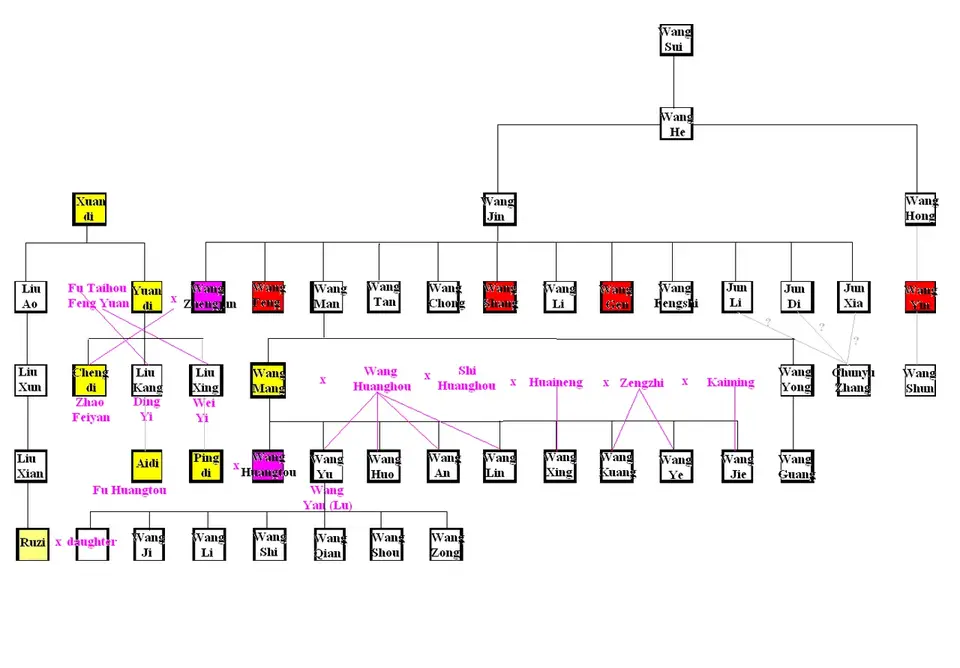
Wang Gen originated from the influential Wang clan of Yuancheng, Wei Commandery. His father Wang Jin was enfeoffed as Marquis Qing of Yangping after his eldest daughter Wang Zhengjun entered the imperial palace and was elevated to Empress by Emperor Yuan of Han. Wang Jin sired eight sons, of whom Wang Gen was the seventh, being a half-brother of Empress Wang Zhengjun. When Emperor Cheng ascended the throne, Empress Dowager Wang took residence in Changle Palace, and the Wang brothers quickly amassed formidable administrative and military control over the imperial court.
In 27 BCE (the 2nd year of the Heping era), Emperor Cheng issued an imperial edict granting marquisates to five maternal uncles simultaneously on a single day: Wang Tan was created Marquis of Ping'a, Wang Shang Marquis of Chengdu, Wang Li Marquis of Hongyang, Wang Gen Marquis of Quyang, and Wang Fengshi Marquis of Gaoping. This event became known in Chinese historiography as the "Five Marquises Enfeoffed in One Day."
The concurrent rise of the five marquises established unparalleled prestige and patronage. They competed fiercely in constructing monumental mansions, and their gates were perpetually blocked by the carriages of regional governors and commandery inspectors seeking political advancement through bribery. While his eldest brother General-in-Chief Wang Feng held dictatorial control over civil administration, Wang Gen, as a younger brother, initially indulged in immense luxury and comfortable privilege without bearing direct administrative burdens.
In 12 BCE (the 2nd year of the Yuanyan era), Grand Marshal Wang Shang passed away due to severe illness. Backed by the collective influence of the consort kin faction and endorsed by Empress Dowager Wang Zhengjun, Emperor Cheng formally appointed Wang Gen as Grand Marshal, General of Agile Cavalry, and Intendant of the Masters of Writing, vesting him with supreme leadership over the empire's civil bureaucracy and armed forces.
Under Wang Gen's regency, the arrogance and overreach of the consort kin reached unprecedented levels. Prone to sensual indulgence and extravagant architectural projects, Wang Gen dramatically enlarged his private residential compounds across multiple city wards in the capital of Chang'an. He commandeered corvee laborers and artisans to redirect the waters of the Wei River directly into his residential rear gardens, carving out artificial lakes, raising ornamental earthen hills, and sailing aboard private dragon-prowed pleasure barges. Furthermore, he decorated interior pillars with fine brocade and constructed elevated sky-bridges and double walkways that directly replicated the architectural prerogatives reserved exclusively for the son of heaven at Weiyang Palace.
Upright officials at court voiced profound apprehension over Wang Gen's unbridled excesses. However, Emperor Cheng was thoroughly enthralled by the beauty of Consorts Zhao Feiyan and Zhao Hede, delegating daily governance entirely to his maternal uncles. Wang Gen's proteges and partisans saturated the central ministries and provincial commanderies. Censors who dared to present critical memorials were promptly demoted or dismissed, leaving court officials intimidated into silence.
Emperor Cheng had reigned for over two decades without producing a surviving male heir. By 8 BCE (the 1st year of the Suihe era), the thirty-eight-year-old emperor's health declined precipitously, making imperial succession the paramount dilemma confronting the dynasty. The two qualified candidates among the imperial princes were Liu Xin, King of Dingtao (son of Emperor Cheng's half-brother Prince Gong of Dingtao), and Liu Xing, King of Zhongshan.
Consort Dowager Fu, the grandmother of the King of Dingtao, was an exceptionally astute and resourceful strategist. Determined to secure the crown for her grandson, she exhausted decades of royal treasury reserves from Dingtao and dispatched emissaries bearing thousands of catties of gold and rare jewels to Chang'an. Recognizing that core power was monopolized by the consort kin and inner palace favorites, Consort Dowager Fu lavished lavish gifts upon Grand Marshal Wang Gen and Emperor Cheng's preeminent favorite, Consort Zhao Hede.
Enticed by tremendous bribery, Wang Gen forged an enduring political alliance with Zhao Hede. Together they orchestrated a coordinated lobbying effort, persistently praising Liu Xin's sagacity, erudition, and broad benevolence before the emperor. Persuaded by their concerted pressure, Emperor Cheng issued an imperial edict in the third month of 8 BCE formally establishing Liu Xin as Crown Prince, while rewarding Wang Gen handsomely for his advisory role.
Once the succession was resolved, Wang Gen felt aged and enfeebled by chronic illnesses, and repeatedly submitted memorials pleading for retirement. The selection of a successor to the Grand Marshal post became a critical concern for preserving the Wang family's dynastic hegemony. Most second-generation Wang descendants were dissolute and arrogant; only Wang Mang, son of Wang Gen's deceased second elder brother Wang Man, maintained an outward appearance of austere rectitude, filial piety, and humility. While Wang Gen lay bedridden, Wang Mang personally administered medicine and attended to his uncle's needs day and night without loosening his robes.
Deeply touched by this apparent devotion, Wang Gen became convinced that Wang Mang was the sole virtuous talent capable of sustaining the clan. From his sickbed, Wang Gen submitted passionate memorials to Emperor Cheng, vigorously endorsing Wang Mang: "My nephew Wang Mang is upright, benevolent, frugal, scholarly, and uniquely qualified to bear profound state responsibilities. I humbly pray that Your Majesty grant him the seals of Grand Marshal to stabilize the altars of state!" Emperor Cheng acceded to his uncle's earnest petition, and in the eleventh month of 8 BCE, the thirty-eight-year-old Wang Mang was invested as Grand Marshal. This fateful sponsorship delivered supreme authority directly into Wang Mang's ambitious hands.
In the third month of 7 BCE (the 2nd year of the Suihe era), Emperor Cheng collapsed and died abruptly in the palace of Zhao Hede, and Crown Prince Liu Xin assumed the imperial throne as Emperor Ai. Upon his accession, Emperor Ai honored his grandmother Consort Dowager Fu as Imperial Grand Empress Dowager and his birth mother Consort Ding as Empress Dowager. The newly ascendant Fu and Ding consort clans clashed bitterly with the entrenched Wang clan for supreme court control.
Grand Marshal Wang Mang was forced to resign and retreat from office, while the retired Wang Gen watched apprehensively as political tides turned hostile. In 6 BCE (the 1st year of the Jianping era), Wang Gen succumbed to prolonged illness at his residence in Chang'an amidst escalating political anxiety. The imperial court bestowed upon him the pejorative posthumous title of "Yang" (defined in posthumous canon as one who is dissolute in inner affairs, negligent in governance, and oppressive to the populace).
Merely months after Wang Gen's demise, in 5 BCE (the 2nd year of the Jianping era), Emperor Ai and the Fu faction unleashed a sweeping political purge against the Wang clan. Director of Retainers Xie Guang and Vice Director of the Masters of Writing presented detailed impeachment memorials exposing Wang Gen's historical transgressions. They formally indicted Wang Gen for despotic arrogance, sumptuary violations in replicating imperial palace architecture, receiving illicit bribes from Dingtao to manipulate the dynastic succession, and deceiving the late emperor. Emperor Ai decreed the immediate revocation of the Quyang marquisate, stripping Wang Gen's heir Wang She of his noble status and expelling Wang Gen's remaining partisans from the capital.
In 27 BCE, Wang Gen received the title of Marquis of Quyang alongside four of his brothers, inaugurating the unprecedented political phenomenon of the "Five Marquises of the Wang Clan." Relying on this unique consort pedigree and working in close alignment with his elder brothers Wang Feng and Wang Shang, Wang Gen systematically dismantled the traditional cabinet system of senior chancellors and imperial secretaries. This transformed the governance of the Western Han into the private hegemony of the Yuancheng Wang family, permanently eroding the constitutional checks and balances of the imperial state.
Wang Gen's elevation to Grand Marshal and Intendant of the Masters of Writing in 12 BCE marked the absolute pinnacle of his personal career. Throughout his three years of supreme regency, he failed to introduce constructive administrative reforms, instead steering consort power toward extreme corruption and material ostentation. By building elevated bridges and diverting major rivers for private recreation, he trampled the foundational sumptuary codes of the Han dynasty, corrupting metropolitan officialdom and hastening the breakdown of social order.
During the succession crisis precipitated by Emperor Cheng's lack of heirs, Wang Gen compromised the security of the dynasty for private enrichment. Blinded by the exorbitant bribes offered by Consort Dowager Fu of Dingtao, he conspired with Consort Zhao Hede to maneuver Liu Xin onto the imperial throne. This political transaction triggered destructive internecine warfare between the rival Fu, Ding, and Wang consort clans under Emperor Ai, dissipating the remaining institutional authority and prestige of the Han imperial house.
The most enduring and ruinous consequence of Wang Gen's political life was his recommendation of Wang Mang during his final retirement. Seduced by Wang Mang's calculated displays of filial piety and humility, Wang Gen squandered his formidable prestige to install Wang Mang as Grand Marshal. This pivotal endorsement provided Wang Mang with the essential institutional leverage to control child emperors, execute political rivals, and ultimately usurp the throne to establish the Xin dynasty.
FIGURES ASSOCIATED WITH THIS DYNASTY