Birth in Linjing
Born to a landed lineage in Anding Commandery; suffered social exclusion due to his mother's concubine status
王符
Wang Fu, courtesy name Jiexin, was a celebrated philosopher, critical political essayist, and literatus of the middle-to-late Eastern Han dynasty hailing from Linjing in Anding Commandery. Living through the reigns of Emperors He, An, Shun, Huan, and Ling, he witnessed firsthand the deepening structural crises of the Eastern Han state: consort-clan despotism, palace eunuch corruption, aristocratic land engrossment, and…
Wang Fu, courtesy name Jiexin, was a celebrated philosopher, critical political essayist, and literatus of the middle-to-late Eastern Han dynasty hailing from Linjing in Anding Commandery. Living through the reigns of Emperors He, An, Shun, Huan, and Ling, he witnessed firsthand the deepening structural crises of the Eastern Han state: consort-clan despotism, palace eunuch corruption, aristocratic land engrossment, and military collapses on the northwestern frontier. Despite broad erudition that won him the enduring admiration of intellectual luminaries like Ma Rong, Zhang Heng, and Dou Zhang during his youth in Luoyang, Wang Fu was severely marginalized in local society because he was born to a concubine of lowly background. Unwilling to curry favor with the powerful or engage in factional sycophancy, he was repeatedly passed over for bureaucratic elevation. Renouncing official ambitions, he chose lifelong reclusehood in his rural homeland, dedicating decades to authoring Qianfulun (Discourses of a Recluse) in ten volumes and thirty-six chapters. Writing under the moniker "Qianfu" (the hidden man) to conceal personal vanity, Wang Fu delivered incisive, comprehensive critiques of official venality, economic parasitism, fraudulent selection protocols, and frontier mismanagement, earning an exalted place in Chinese intellectual history.
Born to a landed lineage in Anding Commandery; suffered social exclusion due to his mother's concubine status
Studied classical literature in the imperial capital; forged intimate friendships with Ma Rong, Zhang Heng, and Dou Zhang
Refusing to flatter corrupt elites or participate in bribery networks, he withdrew from bureaucratic candidacy
Settled into rural retirement in Linjing, compiling thirty-six profound essays on institutional decay and governance into Qianfulun
General Huangfu Gui returned to Anding; scorning corrupt officials, he hurried out in inverted slippers to welcome the cloistered Wang Fu with highest honors
Passed away peacefully at home in Anding, leaving behind an immortal corpus of social philosophy
Wang Fu was born into an affluent clan in the northwestern frontier commandery of Anding. However, because his mother was a concubine of modest lineage, Wang Fu endured sharp social prejudice and condescension from clan elders and local elites. In a status-conscious Han society dominated by aristocratic birth and legitimate inheritance, this alienation fostered in him an independent, austere disposition and a profound sensitivity to human suffering.
Gifted with formidable intellect and lofty ideals, Wang Fu immersed himself in the Confucian classics and ancient philosophers. In his youth, he traveled to the imperial capital of Luoyang to pursue advanced learning at the National University (Taixue). His towering erudition, razor-sharp analytical powers, and powerful rhetorical style quickly won him the deep respect of the foremost intellectual figures of the age, including Ma Rong, Zhang Heng, and Dou Zhang, who embraced him as a peerless intellectual comrade.
During the reigns of Emperors An and Shun, imperial governance fell under the control of predatory consort clans such as the Dangs, Yans, and Liangs, alternating with rapacious palace eunuchs. The imperial recruitment system—the civil recommendation protocol of Filial and Incorrupt (Xiaolian)—degenerated into an engine of nepotism and bribery. Disdainful of fawning over court grandees and refusing to purchase recommendation through intermediaries, Wang Fu was systematically shut out of official promotions.
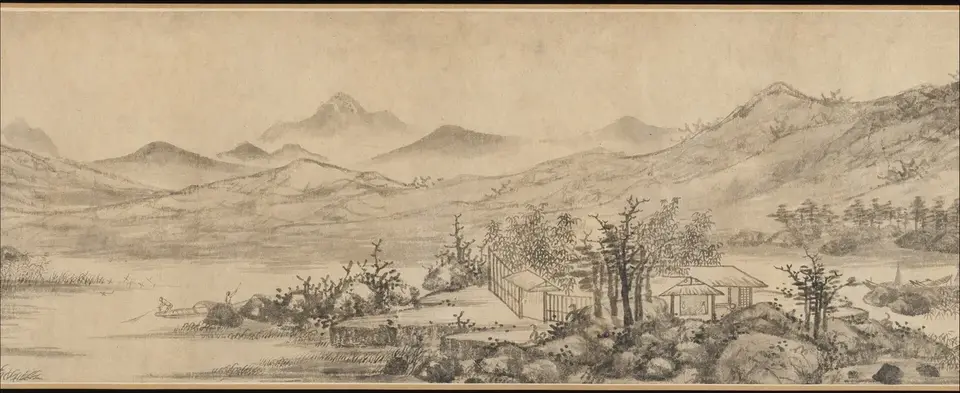
Confronting the systemic decadence of the Han court and realizing that true statesmanship was unattainable through official channels, Wang Fu severed all ties with bureaucratic ambition. He returned to the northwestern frontier, constructing a humble homestead in Linjing where he sustained himself through rural labor and continuous scholarly inquiry. He lived in strict seclusion, refusing to darken the doors of government yamens while observing state and society with unsparing intellectual rigor.
Over several decades of rural isolation, Wang Fu channeled his encyclopedic knowledge and moral outrage into systematic political treatises. Refusing to trade his writings for fame or patronage, he described himself as a "Qianfu"—a hidden recluse buried in obscurity—and titled his work Qianfulun (Discourses of a Recluse). Spanning ten volumes and thirty-six chapters, the work covers cosmic philosophy, administrative institutional reform, agrarian economics, social morality, and frontier defense.
In chapters such as Advancing Learning and Focusing on the Root, he championed agriculture and education as the twin pillars of human order. In Insight and Blindness, Assessing Performance, and Cherishing Worthies, he unleashed biting condemnations against the sale of offices, court favoritism, and bureaucratic indolence. In Curtailing Luxury, he laid bare the ruinous consequences of aristocratic land grabbing and wasteful conspicuous consumption. In Relieving the Frontier and Frontier Deliberations, he drew upon his intimate knowledge of the northwestern marches to refute defeatist policies that sought to abandon Liangzhou, advocating robust military-agricultural colonies and proactive border stewardship.
In 162, the renowned general Huangfu Gui resigned his military commission as General Who Crosses the Liao and returned to his home commandery of Anding after pacifying the Western Qiang uprisings. Local magistrates, commandery administrators, and wealthy landowners thronged his estate, bearing extravagant presents and seeking influence. Disgusted by their venal flattery, Huangfu Gui remained secluded in his inner chambers, refusing to grant them audience.
When gatekeepers announced that "Wang Jiexin has arrived," Huangfu Gui leapt up in joy. In his haste to greet the philosopher, he rushed into the courtyard wearing his slippers backwards, taking the plainly dressed Wang Fu warmly by the hand and seating him in the place of highest honor. Huangfu Gui toasted him with deep deference, listening intently to his discourses on statecraft while the assembled officials looked on in mortified silence. This episode of welcoming a cloistered scholar with inverted slippers became an enduring emblem of the primacy of virtue over official rank. Shortly thereafter, Wang Fu passed away at his ancestral home.
In the essay Insight and Blindness (Ming'an), Wang Fu profoundly dissected the essential mechanisms of dynastic rise and fall. He argued that order and chaos depend fundamentally upon whether the sovereign listens broadly or selectively: "To listen partially brings darkness; to listen comprehensively brings illumination." If a ruler remains cloistered in deep palace chambers, heeding only the flattery of eunuchs and consort favorites, his ears and eyes will be blinded, driving the state into ruinous darkness. Conversely, if he opens wide the avenues of speech, inquires into popular suffering, and solicits candid counsel from common scholars, potential perils can be transformed into lasting tranquility.
In Cherishing Worthies and Foundations of Governance, Wang Fu further posited that national strength rests not upon mountain fortresses or population size, but entirely upon commanding men of true statesmanship. He severely castigated the contemporary practice of treating bureaucratic posts as private family property bought and sold through venality, affirming: "Governing the realm takes worthiness as the root." Employing a single virtuous minister can purify an entire commandery, while appointing a single corrupt flatterer inflicts devastation upon thousands of innocent lives.
In Assessing Performance and Substantive Tribute, Wang Fu addressed the degeneration of the civil recommendation system into hollow formalities, advancing a comprehensive theory of official evaluation. He noted that officials throughout the realm exhibited a total contradiction between name and reality: nominally acclaimed as "Filial and Incorrupt" or "Abundant Talent," they were frequently illiterate and morally bankrupt charlatans whose hypocrisy corrupted public mores.
Wang Fu championed the strict principle of "verifying reality according to name." He demanded that official evaluations resemble weighing goods on scales or measuring lengths with yardsticks, assessing administrative performance solely through empirical achievements: agricultural land reclamation, water conservation, equitable tax collection, swift litigation settlement, and suppression of banditry. Rejecting clan nepotism and sycophantic peer recommendations, he called for enduring institutional audits to ensure that the capable hold office, the mediocre step down, and the corrupt face severe statutory penalties.
Reared in the frontier commandery of Anding, Wang Fu detested the oppressive ethnic policies executed by the Eastern Han state against northwestern tribes. In Relieving the Frontier and Frontier Deliberations, he demonstrated with incontrovertible facts that the uprisings of the Western Qiang were not born of inherent rebelliousness, but were sparked by the ruthless extortion, enslavement, and arbitrary slaughter inflicted by predatory Han border officials. Corrupt commanders provoked rebellions, only to embezzle military relief supplies and fabricate combat reports, perpetuating decades of war.
To break this vicious cycle, Wang Fu proposed a holistic border strategy. Administratively, local commanders abusing tribal populations must face capital punishment, while virtuous, compassionate officials knowledgeable in local customs must be appointed to border posts. Militarily and economically, he adamantly rejected passive evacuation, advocating unified soldier-peasant agricultural colonies where garrison troops farmed in peacetime and defended the frontier in war, eliminating burdensome long-distance grain shipments while permanently securing ancestral borderlands.
In an Eastern Han society saturated with apocryphal omenology, Wang Fu manifested an extraordinary rationalist and materialist perspective. In Divination and Shamans and Exorcisms, he rigorously dismantled occult deceptions. He observed that from imperial grandees to peasant households, subjects confronting disease and misfortune spent fortunes hiring sorcerers for prayers rather than seeking medical assistance, often bankrupting households and hastening deaths.
Wang Fu called for the absolute prohibition of licentious cults and sorcery, reaffirming Confucius's dictum to "revere spiritual beings while keeping them at a distance." He maintained that natural meteorological phenomena and celestial cycles operate according to objective laws, while human fortunes and national destinies depend strictly upon human endeavor and moral statutes rather than supernatural spirits. Only through advancing medicine, disseminating knowledge, and enforcing statutory laws could society dispel superstitious darkness.
In Advancing Learning, Wang Fu identified education and ethical scholarship as the foundational paths for personal moral integrity and societal progress. He argued that although human nature possesses latent seeds of goodness, without rigorous study and moral cultivation, it resembles uncarved jade or unrefined ore, incapable of becoming a pillar of state.
Wang Fu emphasized that authentic study is never a stepping-stone to official wealth, but a discipline to realize the Way and elevate righteousness. He condemned students who memorized empty classical phrases merely to pass civil examinations, promoting holistic learning connected directly to societal realities—an educational vision that profoundly influenced later academy pedagogical movements.
In chapters such as Focusing on the Root, Enriching the People, and Curtailing Luxury, Wang Fu articulated the paramount importance of agriculture as the foundation of the state. He advanced the celebrated premise that "the substance of Heaven and Earth takes life from agriculture," recognizing agricultural labor as the sole generator of authentic societal wealth. He classified occupations into "root" (agriculture and weaving) and "branch" (commercial speculation, frivolous crafts, and luxury trade).
Confronting late Han conditions where landed magnates monopolized arable fields and forced peasants into vagrancy, Wang Fu demonstrated that merchant hoarders created no new wealth but actively crippled rural production. He urged the state to prioritize agriculture over commerce, restrict magnate privileges, lighten peasant labor duties, and protect farming time to restore state finances and social vitality.
Wang Fu lived in an age of unchecked aristocratic extravagance, where imperial in-laws and eunuchs erected opulent palaces and expended fortunes on banquets and lavish burials. In Curtailing Luxury, he bitterly noted that the food consumed at a single aristocratic feast could sustain dozens of impoverished farming families for months, while jade burial shrouds and monumental mausoleums depleted civilian wealth and incited tomb robberies.
Wang Fu passionately advocated austere frugality, elevating thrift from private virtue to vital statecraft. He demanded that the sovereign and ministers set personal examples of moderation, establishing rigid sumptuary codes governing chariots, apparel, and funerals to redirect precious national resources toward agricultural production and famine relief.
Wang Fu provided incisive analyses of the fatal corruptions infecting the Han civil selection system. In Insight and Blindness, Assessing Performance, Cherishing Worthies, and Eliminating Factions, he attacked the systemic sale of offices and widespread nepotism, showing that official recruitment rewarded venal flattery while leaving true statesmen to languish in poverty.
To rectify governance, Wang Fu formulated an exacting "Performance Assessment Protocol." He insisted on verifying real administrative outcomes rather than accepting hollow reputations, rewarding magistrates who improved farming, increased households, and curbed crime while ruthlessly punishing negligent parasites. Furthermore, he urged breaking clan pedigree barriers to recruit brilliant statesmen directly from the common populace.
During the middle-to-late Eastern Han, Western Qiang uprisings engulfed the Guanzhong region. Inept court ministers repeatedly proposed abandoning Liangzhou to cut military expenditures, forcibly evacuating border residents into the interior. As an Anding native, Wang Fu was infuriated by these capitulation proposals.
In Relieving the Frontier and Frontier Deliberations, Wang Fu marshaled unassailable strategic arguments to refute abandonment: Liangzhou formed the defensive throat of Guanzhong; abandoning it would imperil the capital passes and leave Luoyang defenseless. Territorial surrender was both a treasonous betrayal of ancestral heritage and an invitation to massive nomadic invasions. He proposed self-sustaining military colonies and localized tribal governance that became the strategic blueprint for northwestern defense through the Three Kingdoms era.
From the founding of the Later Han, imperial orthodoxy relied heavily on apocryphal divination charts (chenwei), subordinating state policy to superstitious omens and astrological auguries. In Divination and Shamans and Exorcisms, Wang Fu displayed extraordinary philosophical rationalism.
Wang Fu declared: "Auspiciousness and calamity arise from human agency, not from spirits." He exposed shamanic deception and demonstrated that national fortunes depend strictly upon administrative justice and popular welfare rather than cosmic portents, establishing an illustrious milestone in the history of Chinese philosophical enlightenment.
In literary theory, Wang Fu adamantly resisted ornate formalism and superficial aestheticism. He criticized contemporary writers who indulged in empty parallel prose merely to display superficial ingenuity, regarding substance-free rhetoric as a societal poison.
Wang Fu demanded that literature serve the Way and cultivate moral righteousness, asserting that poetry and rhapsodies should praise virtue and articulate popular sorrow and joy. Practicing what he preached, his Qianfulun addressed burning societal contradictions with rigorous logic, razor-sharp eloquence, and vivid metaphors, standing as one of the supreme monuments of classical Han political prose.
FIGURES ASSOCIATED WITH THIS DYNASTY