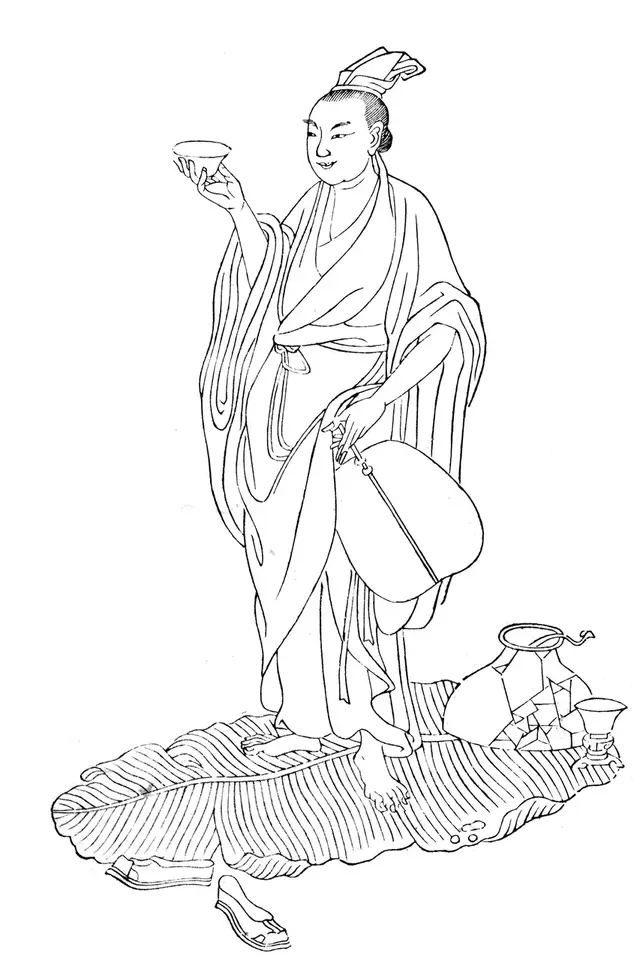
PROFILE
Wang Bo (王勃, 650–676), courtesy name Zi'an (子安), was a native of Longmen in Jiangzhou (present-day Hejin, Shanxi) with ancestral origins in Qi County of Taiyuan, and an eminent literary figure and poet of the Tang dynasty, universally celebrated alongside Yang Jiong, Lu Zhaolin, and Luo Binwang as the Four Eminent Writers of the Early Tang, holding the preeminent position among them. Born into the illustrious Longmen Wang lineage, he was the grandson of the late-Sui Confucian master Wang Tong (Master Wenzhong). Precocious from childhood, Wang was celebrated as a prodigy, composing refined prose at age six and authoring Pointing Out Flaws at age nine to correct errors in Yan Shigu's commentary on the Book of Han. Passing the imperial examination at age sixteen, he was appointed Gentleman for Court Dispersion and Editor in the household of Prince Pei (Li Xian), with literati admiring his swift literary brilliance. Later, having composed the playful prose Declaration of War against the Prince of Ying's Cock, he incurred the wrath of Emperor Gaozong and was expelled from the princely establishment, subsequently wandering through the rivers and mountains of Sichuan to expand his creative vision.
During the Xianheng era, Wang returned to the capital region and was appointed Administrative Officer of Guozhou. Implicated in sheltering and subsequently executing an escaped government slave named Cao Da to prevent discovery, he was sentenced to death, escaping execution through a general imperial amnesty; however, his father Wang Fushi was demoted to Magistrate of Jiaozhi in distant northern Vietnam. In the autumn of the second year of the Shangyuan era (675), Wang traveled south to visit his father, stopping at Hongzhou (present-day Nanchang, Jiangxi) where Governor Yan Boyu hosted an autumn banquet celebrating the renovation of Tengwang Pavilion. Wang composed the immortal Preface to the Pavilion of Prince Teng on the spot, its famous line "Sunset clouds fly alongside a solitary wild duck; autumn waters merge with the vast sky in a single hue" stunning generations of readers. In the summer of 676, while crossing the sea toward Jiaozhi, Wang drowned in a sudden ocean tempest at the age of twenty-seven. Throughout his brief yet dazzling life, he dismantled the effeminate palace style of the Six Dynasties, establishing the expansive, robust, and harmonious aesthetic of High Tang poetry and parallel prose.
- Courtesy Name
- Zi'an (子安)
- Date of Birth
- 650 (Tang Dynasty, 1st year of Yonghui)
- Date of Death
- 676 (Tang Dynasty, 3rd year of Shangyuan)
- Age at Death
- 27
- Ancestral Home
- Longmen, Jiangzhou (present-day Hejin, Shanxi)
- Highest Office
- Administrative Officer of Guozhou (Guozhou Canjun)
- Identity
- Foremost of the Four Eminent Writers of the Early Tang, genius writer, and poet
BIOGRAPHY
Chronology
- 650 (Tang Dynasty, 1st year of Yonghui) | Birth of a Prodigy | Born into the distinguished Longmen Wang scholarly clan, receiving early education in classical philosophy and literature.
- 659 (Tang Dynasty, 4th year of Xianqing) | Writing Flaw-Finder | At age nine, studied Yan Shigu's commentary on the Book of Han, authoring the ten-volume Pointing Out Flaws to correct scholarly errors.
- 666 (Tang Dynasty, 1st year of Qianfeng) | Appointment before Adulthood | Passed imperial examinations at sixteen, appointed Gentleman for Court Dispersion and Editor in the household of Prince Pei.
- 668 (Tang Dynasty, 1st year of Zongzhang) | The Cockfighting Misfortune | Composed the satirical Declaration of War against the Prince of Ying's Cock; Emperor Gaozong was enraged and expelled him from the princely estate.
- 669 (Tang Dynasty, 2nd year of Zongzhang) | Travels in Sichuan | Wandered through the mountains and waterways of Sichuan for three years, composing celebrated landscape verse and regulated poetry.
- 673 (Tang Dynasty, 4th year of Xianheng) | Office and Calamity in Guozhou | Appointed Administrative Officer of Guozhou; condemned to death for executing a fugitive slave, spared by a general amnesty.
- 675 (Tang Dynasty, 2nd year of Shangyuan) | Preface at Tengwang Pavilion | Attended the Double Ninth banquet at Tengwang Pavilion in Hongzhou, composing the immortal preface that astonished all guests.
- 676 (Tang Dynasty, 3rd year of Shangyuan) | Tragedy in the South Sea | Drowned in a sudden storm while sailing across the South China Sea to visit his father in Jiaozhi, dying at age twenty-seven.
Life Course
Illustrious Heritage and Child Prodigy Acclaim
Wang Bo was born in the first year of the Yonghui era (650) in Longmen, Jiangzhou (present-day Hejin, Shanxi). His clan belonged to the prominent Hedong gentry. His grandfather was the celebrated late-Sui Confucian master Wang Tong (Master Wenzhong), whose disciples included founding Tang chancellors Fang Xuanling and Du Ruhui; his father Wang Fushi served as Doctor of Imperial Sacrifices and Magistrate of Jiaozhi. All six brothers in the household were celebrated for literary refinement, with Wang Bo displaying extraordinary precocity.
From early childhood, Wang manifested astonishing literary perception. According to the Old Book of Tang, he composed elegant prose at the age of six, exhibiting natural flow without artificial craftsmanship. At age nine, while studying the Han-dynasty historian Ban Gu's Book of Han with Yan Shigu's standard commentary, Wang scrutinized historical facts and linguistics, producing the ten-volume treatise Pointing Out Flaws (Zhi Xia), correcting dozens of errors in Yan's annotations, earning universal acclaim as an authentic child prodigy.
Early Office and the Cockfighting Calamity
In the first year of the Qianfeng era (666), sixteen-year-old Wang sat for the imperial Yousu examinations in Chang'an. Demonstrating brilliant eloquence and classical depth, he passed with honors, receiving appointment as Gentleman for Court Dispersion (Chaosanlang), becoming one of the youngest officials in Tang history. Recognized for his swift literary imagination, he was assigned to serve as Editor and Imperial Reader in the household of Prince Pei (Li Xian). Within the princely residence, Wang enjoyed deep favor, his literary reputation spreading throughout capital aristocratic circles.
During this period, whenever Wang prepared to write, he was accustomed to grinding several pints of ink and sleeping with a blanket covering his face; rising abruptly, he would write continuously without pausing for corrections, leading contemporaries to marvel at his mental draft composition. However, youthful success fostered an aloof pride unsuited to court intrigue. In 668, Prince Pei and Prince Ying (the future Emperor Zhongzong) staged a lavish cockfighting contest. To amuse the assembly, Wang composed the satirical parallel-prose text Declaration of War against the Prince of Ying's Cock. Reading the text, Emperor Gaozong was furious, rebuking Wang for sowing discord between imperial brothers, summarily stripping him of rank and expelling him from the capital.
Travels in Shu and Landscape Transformation
Cast out from the capital, Wang packed his zither and books, journeying to Sichuan in the second year of the Zongzhang era (669). Over nearly three years, he wandered through Mount Qingcheng, the Jianmen Pass, the Yangtze Gorges, and Zizhou. During this period, he befriended local poets including Xue Hua, traversing mountain villages and absorbing the rugged grandeur of the southwestern borderlands.
Surrounded by the mist-shrouded peaks of Sichuan, Wang's verse shed its earlier palace court artificiality, acquiring expansive natural vitality. He composed numerous five-character regulated poems and travel ballads, including Ninth Day in Shu, In the Mountains, and Parting from Xue Hua. The dramatic landscapes of Sichuan broadened his emotional vision, guiding his poetry toward heroic scale and providing essential groundwork for his maturation of regulated verse.
The Guozhou Disaster and Imperial Pardon
In the third year of the Xianheng era (672), Wang returned from Sichuan to Chang'an. Through friends' recommendations, he was appointed Administrative Officer of Guozhou. In Guozhou, Wang met with catastrophe. An escaped government slave named Cao Da sought shelter under his roof. Moved by pity, Wang hid him; but as officials intensified their search, Wang panicked and executed Cao Da to prevent discovery. The crime was uncovered, and Wang was arrested and condemned to death under Tang penal statutes.
Fortunately, in the first year of the Shangyuan era (674), Emperor Gaozong issued an empire-wide amnesty upon inaugurating a new reign title, sparing Wang from execution. Stripped of official status, he was released as a commoner. However, his father Wang Fushi was punished for paternal negligence, demoted from a central office to Magistrate of Jiaozhi in distant northern Vietnam. Stricken with guilt for bringing ruin upon his father, Wang resolved to travel south to attend his father in exile.
Preface at Tengwang Pavilion and Death at Sea
In the autumn of the second year of the Shangyuan era (675), Wang traveled south on his journey to Jiaozhi, arriving in Hongzhou (present-day Nanchang, Jiangxi) around the Double Ninth Festival. Military Governor Yan Boyu had just completed renovations on Tengwang Pavilion, hosting an elaborate banquet for regional dignitaries. The governor intended to showcase a pre-composed preface written by his son-in-law Wu Zizhang, politely offering brush and paper to the guests, expecting customary refusals.
While other guests declined out of etiquette, the youthful Wang accepted the brush without hesitation, spreading paper and preparing ink. Displeased, Governor Yan retreated into an inner pavilion, ordering attendants to report each line as it was written. Wang penned the opening lines "Ancient prefecture of Yuzhang, new seat of Hongzhou," to which the governor sneered; as attendants recited "Stars divided between Wing and Chariot, land connecting Heng and Lu," the governor showed surprise; upon hearing the immortal couplet "Sunset clouds fly alongside a solitary wild duck; autumn waters merge with the vast sky in a single hue," the governor slapped his table in amazement, declaring Wang a true immortal genius whose work would endure forever.
Leaving this literary triumph behind, Wang continued south, embarking on an ocean vessel from Guangzhou to reach Jiaozhi. In the summer of the third year of Shangyuan (676), a violent storm struck the open sea, capsizing the vessel. Although rescued by sailors, Wang suffered severe exposure and trauma from near-drowning, dying shortly afterward at the age of twenty-seven. The brightest star of Early Tang literature was extinguished in its youth, mourned by intellectuals across the empire.
Major Achievements
Overthrowing Six Dynasties Decadence and Reforming Poetry
Wang Bo's greatest historical contribution was his pioneering role in overthrowing the decadent, effeminate palace-style verse of the Six Dynasties, establishing a vigorous aesthetic for the golden age of High Tang poetry. During the early Tang, court poetry was dominated by the delicate, formalist "Shangguan style," obsessed with artificial symmetry, phonetic games, and boudoir themes, alienated from broad social reality. Wang broke free from this decadence through his peerless creative genius.
Wang insisted that literature must mirror authentic human emotion, natural landscapes, and civic duty. His five-character regulated poetry achieved consummate maturity and expansive vigor. His celebrated masterpiece Seeing Off Du Shaofu to His Post in Shuzhou opened with the lines: "The citadel walls are girdled by the three Qin domains; through wind and mist one gazes toward the five river fords. Sharing this parting sorrow, we are both traveling officials. If you have an intimate friend within the four seas, the distant horizon feels like a neighboring yard. Do not weep at the crossroads, soaking handkerchiefs like sentimental youths." Sweeping away the mournful sentimentality of earlier farewell verse, he opened with the vast panorama dividing Chang'an from Sichuan; the middle couplet achieved philosophical transcendence, expressing spiritual companionship across distance in natural, resonant language, recognized as the definitive masterpiece establishing the maturity of five-character regulated verse.
Furthermore, landscape poems composed during his Sichuan travels, such as In the Mountains and Gathering Lotuses, integrated natural vitality with structural discipline. Perfecting regulated forms, his work inspired High Tang masters including Wang Wei, Meng Haoran, and Gao Shi, serving as the essential bridge connecting the Early Tang to the High Tang.
Preface to the Pavilion of Prince Teng as the Pinnacle of Parallel Prose
Wang Bo's crowning masterpiece is his celebrated Preface to the Pavilion of Prince Teng (originally titled Preface to the Autumn Gathering Ascending the Prince of Teng's Pavilion in Hongzhou). Within the history of classical parallel prose (pianwen), the work is acclaimed as an unrivaled pinnacle, representing the highest expressive capacity of classical Chinese.
The composition possessed majestic structural rhythm, transitioning from regional geography to architectural splendor, from banquet festivities to surrounding rivers and mountains, and from natural panoramas to philosophical contemplations on mortality and cosmic order. His landscape descriptions reached absolute perfection, epitomized by the couplets "Residual waters recede and cold pools clear; misty vapors condense and evening peaks turn purple" and "Sunset clouds fly alongside a solitary wild duck; autumn waters merge with the vast sky in a single hue," fusing light, shadow, motion, and stillness into unified cosmic music. Tradition records that when Emperor Gaozong read the couplet years later, he sighed three times in admiration, lamenting that such genius had perished prematurely.
Crucially, Wang redeemed parallel prose from the superficiality that plagued Six Dynasties writing. In the latter half of the text, he transformed personal misfortune and unrewarded genius into universal meditation: "The heavens are high and the earth vast, awakening one to the infinity of the cosmos; when joy reaches its zenith, sorrow arrives, recognizing that fullness and decline have their allotted numbers." Proclaiming the heroic motto "Though elderly, one should grow all the more vigorous—how could white hairs change one's resolve? Though impoverished, one must become all the more resolute, never relinquishing one's soaring aspirations," he embodied the unyielding spirit of Tang intellectuals.
Innovations in Rhapsodies and Classical Literary Forms
Beyond regulated verse and parallel prefaces, Wang displayed astonishing versatility across classical rhapsodies (fu). Inheriting the monumental architecture of Han rhapsodies while incorporating the lyrical subtlety of the Songs of Chu, he authored celebrated works including Rhapsody on Spring Thoughts, Rhapsody on Gathering Lotuses, Long Autumn Night, and Ascending Heights on the Ninth Day.
In Rhapsody on Spring Thoughts and Rhapsody on Gathering Lotuses, Wang deployed luminous diction to celebrate seasonal change and Jiangnan customs, balancing opulent imagery with melodic grace; in Long Autumn Night, his poignant verse lamented the transience of time and unfulfilled ideals. His rhapsodies injected deep personal lyricism and philosophical introspection into a genre that had ossified into decorative cataloging, directly anticipating the song-style rhapsodies of the High Tang.
In public proclamations and manifestos, Wang demonstrated unmatched verbal dexterity. Although his early Declaration of War against the Prince of Ying's Cock provoked imperial disfavor, its brilliant satire and effortless parallel prose showcased virtuoso control over classical military rhetoric. Across poetry, rhapsodies, prefaces, and essays, Wang expanded the expressive possibilities of classical Chinese literature.
Theoretical Foundation of Classical Literary Reform
Wang was an essential pioneer of classical prose reform and literary theory. Among the Four Eminent Writers of the Early Tang, he was the first to systematically condemn Six Dynasties formalist decadent verse. In works such as Letter to Vice Minister Pei of the Ministry of Personnel, he criticized contemporary letters for producing luxuriant spring blossoms without autumn fruit, sacrificing moral substance for prosodic trivialities, urging literature to reclaim the robust vigor of Han-Wei Jian'an writing.
In his classical prose compositions, Wang broke away from rigid parallelism, utilizing succinct narration and penetrating argumentation. His early work Pointing Out Flaws in the Book of Han deployed rigorous philological methods to correct Yan Shigu's commentary, demonstrating elite textual scholarship. Rooted in the Confucian heritage of his grandfather Wang Tong, Wang maintained that literature must convey moral principles and serve human governance.
Following his death, his close companion Yang Jiong composed the famous Preface to the Collected Works of Wang Bo, praising his swift eloquence and honoring him as the revolutionary standard-bearer who eradicated Six Dynasties affectation. Ming theorist Hu Yinglin acclaimed Wang as possessing the richest literary brilliance and most expansive creative power among the Four Eminent Writers of the Early Tang; Qing critic Wang Shizhen praised his elevated opening tones and solemn conclusions. Wang Bo remains permanently etched in the pantheon of world literature.
Related Figures
- Wang Tong: Late-Sui Confucian master (Master Wenzhong); Wang Bo's grandfather who founded the Longmen school, providing foundational family scholarship.
- Wang Fushi: Tang official; Wang Bo's father who served as Doctor of Imperial Sacrifices and Magistrate of Jiaozhi, suffering demotion to Vietnam following Wang Bo's legal crisis.
- Yang Jiong: One of the Four Eminent Writers of the Early Tang; intimate friend of Wang who composed the landmark Preface to the Collected Works of Wang Bo.
- Li Xian: Crown Prince Zhanghuai under Emperor Gaozong (formerly Prince Pei); an early patron who appointed Wang Editor in his princely household.
- Yan Boyu: Tang Military Governor of Hongzhou; renovated Tengwang Pavilion and presided over the Double Ninth banquet where Wang composed his immortal preface.
Historical Evaluations
- Emperor Gaozong of Tang: "Sunset clouds fly alongside a solitary wild duck; autumn waters merge with the vast sky in a single hue—this is true genius that shall endure forever! What a tragedy that he died before his time." (Tang Zhiyan)
- Yang Jiong: "Zi'an possessed swift intellect; taking up the brush, he completed compositions immediately, his diction steep as sheer cliffs. That he stands as foremost of the Four Eminent Writers of the Early Tang is truly beyond question." (Preface to the Collected Works of Wang Bo)
- Du Fu: "Wang, Yang, Lu, and Luo created the style of their time, yet superficial critics mock them without end. You critics will perish along with your names, while their glory endures like great rivers flowing eternally." (Playful Quatrains)
- Hu Yinglin: "Wang Bo possessed lofty talent and surging energy; his Preface to the Pavilion of Prince Teng exhausted the possibilities of musical resonance and visual color, unequaled by any work of the Four Eminent Writers of the Early Tang." (Shisou)
- Lu Xun: "Among the Four Eminent Writers of the Early Tang, Wang Bo possessed the richest literary brilliance; his five-character regulated verse and parallel prose were monumental and elegant, opening the source of High Tang poetic vigor." (An Outline History of Chinese Literature)
Related Entries
- Preface to the Pavilion of Prince Teng
- Seeing Off Du Shaofu to His Post in Shuzhou
- Four Eminent Writers of the Early Tang
- Yang Jiong
- Lu Zhaolin
- Luo Binwang