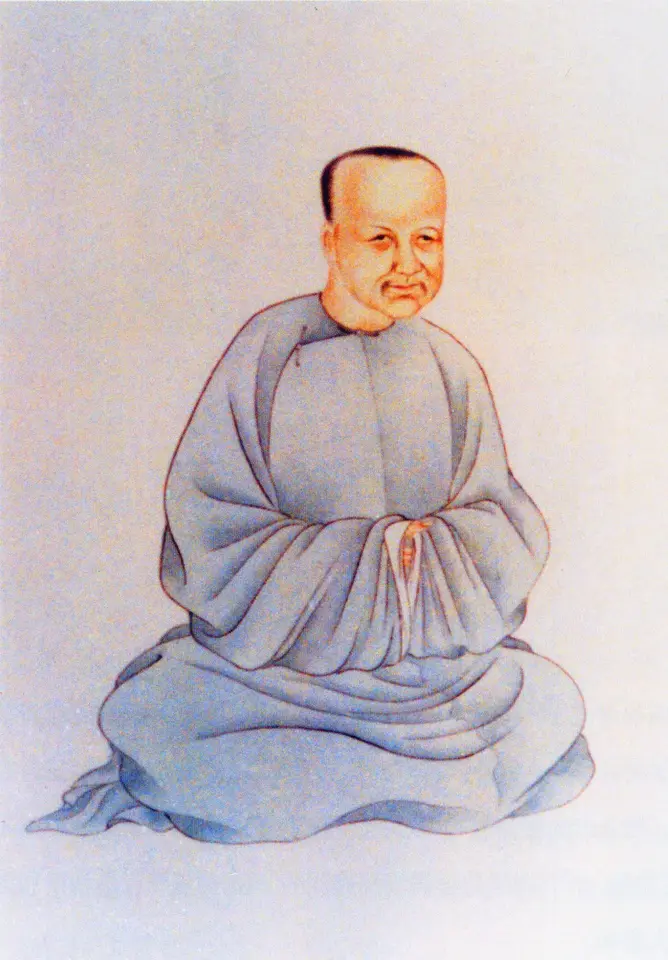
Life and Career
Lineage Tradition and Tutelage under Huang Zongxi
Wan Sitong was born on March 9, 1638, in Yin County, Shaoxing Prefecture, Zhejiang (present-day Haishu District, Ningbo). The Wan family was an esteemed lineage in eastern Zhejiang; his grandfather Wan Bangfu had served as an imperial brigade general during the Ming, possessing profound insight into military strategy. His father, Wan Tai, passed the provincial examination during the Chongzhen era and joined the Restoration Society to advocate national regeneration. Following the fall of Beijing in 1644 and the subsequent Qing conquest of southern China, Wan Tai led his sons to join local resistance armies, sacrificing family wealth for the loyalist cause. Following their military defeat, Wan Tai retired into seclusion, strictly forbidding his descendants from serving the conquest dynasty. Among Wan Tai's eight sons, Wan Sichang, Wan Sixuan, Wan Sida, and Wan Sitong all excelled in classical scholarship, earning wide renown as the Eight Dragons of the Wan Family.
From early childhood, Wan Sitong displayed extraordinary mental agility and an uninhibited temperament. At the age of eight, during a formal family banquet, he was said to have recited the entire text of Yang Xiong's Fayan without omitting a single character. Disdainful of mechanical examination drills, he frequently read informal dynastic records and historical miscellanies from the family library. Consequently, his father once locked him in a study room to enforce moral reflection. Yet this confinement became his intellectual sanctuary: over several years, he read through thousands of volumes, mastering the standard dynastic histories and cultivating an enduring passion for Ming institutional history.
In 1656, at the age of nineteen, Wan Sitong and his elder brother Wan Sida formally became disciples of Huang Zongxi, the supreme master of the Eastern Zhejiang School. Huang emphasized evidential veracity and pragmatic governance, instructing that classical studies must be grounded in historical reality and guided by the moral rigor of the Spring and Autumn Annals. Recognizing Wan Sitong's penetrating intellect and lofty character, Huang systematically instructed him in the comparative study of the Twenty-One Dynastic Histories and Ming non-official writings. Under Huang's rigorous guidance, Wan established formidable evidentiary standards and resolved to dedicate his life to producing a truthful history of the Ming dynasty.
Archival Mastery at Tianyi Pavilion and Refusal of Imperial Office
To gather comprehensive primary documentation on the Ming dynasty from its founding under the Hongwu Emperor to its demise under Chongzhen, around 1661 Wan Sitong secured special permission from the descendants of the Fan lineage to study within the renowned Tianyi Pavilion in Ningbo. Founded during the Jiajing era by Fan Qin, Tianyi Pavilion housed a peerless collection of Ming court diaries, metropolitan examination registers, frontier defense records, imperial veritable records, and private literary collections, most of which were unique surviving manuscripts.
Wan spent several years in seclusion within the library. Working under cold lamplight from morning to night, he meticulously transcribed and collated imperial edicts, cabinet memoranda, fiscal revenues, nine-frontier garrison dispositions, and intense ministerial debates. This prolonged archival immersion granted him an exhaustive command of Ming institutional regulations, administrative precedents, and biographical details. Whenever a historical event or official appointment was mentioned, he could recite its exact circumstances, establishing an unparalleled evidentiary reservoir for his future historiographical work.
In 1678, seeking to conciliate southern scholar-gentry elites and Ming loyalists, the Kangxi Emperor issued an edict proclaiming the Boxue Hongci special examination. Provincial governors were ordered to nominate prominent independent scholars for imperial appointments. High-ranking provincial officials repeatedly visited Wan's residence, urging him to travel to Beijing and attempting to register his name. Wan remained steadfast in his loyalist convictions, declaring that he would never submit as a subject of the Qing court. He feigned severe illness, shut his doors to visitors, and firmly declined all official overtures, earning immense reverence among contemporary literati for his unyielding moral integrity.
Entering the Capital as a Commoner and Commanding the Historiographical Bureau
In 1679, the Qing court formally instituted the Bureau of Ming History, appointing Chancellor of the Hanlin Academy Xu Yuanwen as Chief Director. Xu recognized that while the imperial bureau was staffed by numerous Hanlin academicians, most excelled only in ornate parallel prose and examination essays, lacking comprehensive command of institutional history. Without an authoritative master to supervise the compilation, the resulting history would be superficial and chaotic. Xu therefore wrote urgent personal letters to Wan Sitong, entreating him to travel to Beijing to take charge of the project.
Wan was acutely aware that the compilation of Ming history directly concerned the memory of loyalist martyrs and the authentic record of three centuries of governance. If left to superficial court scholars, the historical truth would be distorted or erased. After careful consultation with his mentor Huang Zongxi, Wan resolved to shoulder this historical burden. Before departing, however, he insisted upon three rigid conditions: first, he would accept no official rank or Qing imperial honors; second, his name would not appear on the official register of compilers; third, he would refuse every copper of government stipend. He insisted upon serving solely as a private guest of Xu Yuanwen, overseeing the historiographical bureau as an independent commoner. Xu revered his lofty virtue and wholeheartedly consented.
In May 1679, forty-two-year-old Wan arrived in Beijing and took up residence in Xu's estate. In the historiographical bureau, where scores of Manchu and Han scholars frequently clashed over differing perspectives and formats, Xu placed all editorial authority in Wan's hands. Wan established his writing table in the bureau's eastern hall, where he sat every morning reviewing drafts submitted by individual compilers. When scholars encountered chronological contradictions, conflicting nomenclature, or confused bureaucratic structures, they sought Wan's counsel. Wan would resolve the problem from memory, citing the exact volume and page of the relevant source; upon verification, his citations proved unfailingly precise. Astonished and humbled, the bureau scholars submitted entirely to his editorial leadership.
Steadfast Perseverance and Drafting the Five-Hundred-Volume Manuscript
In 1690, Xu Yuanwen was dismissed from his high ministerial post amid partisan political strife and departed Beijing. The historiographical bureau fell into administrative disarray, and many participating compilers disbanded. Undeterred by political turmoil, Wan accompanied Xu to a rural retreat outside Beijing, continuing his tireless collation of historical manuscripts under austere conditions.
In 1694, Xu passed away in the south, once again threatening the continuation of the project. Wang Hongxu, the newly appointed chief director who understood Wan's indispensable role, warmly invited Wan to reside in his Beijing residence. Wang established a dedicated archival studio in his eastern hall, furnishing books, paper, and ink to support Wan's compilation. By this time, Wan was approaching sixty years of age. Decades of intensive reading by candlelight and harsh northern winters had severely impaired his eyesight, while severe rheumatism in his right arm made holding a brush excruciatingly painful.
Despite these physical afflictions, Wan pressed forward, sustained by a sacred sense of historical duty. He directed his disciples, such as Qian Mingshi, to retrieve archival documents while he dictated editorial revisions and weighed every phrase. He synthesized imperial veritable records, court diaries, ministerial memorials, frontier military accounts, and hundreds of private memoirs across thirteen Ming reigns, reconciling contradictions and rectifying errors. Through heroic perseverance, he independently produced the monumental five-hundred-volume Draft History of Ming (Ming Shi Gao). Encompassing basic annals, treatises, tables, and biographies, this monumental draft established the indispensable foundation of the final official history.
Demise at the Desk and Interment at Chunhu
In the spring of 1702, sixty-five-year-old Wan grew increasingly frail, yet he raced against time to execute final editorial polishes on the biographies and institutional treatises of his draft. In early April, exhausted by lifelong labor, he collapsed from acute illness. Even while drifting in and out of feverish delirium, his hands continued to mimic the motion of writing and collating manuscripts.
On the morning of May 4, 1702 (Eighth day of the fourth lunar month), this peerless historiographical giant passed away at his desk in Wang Hongxu's Beijing residence at the age of sixty-five. News of his death caused profound mourning across the capital. Hundreds of court ministers, Hanlin scholars, and literati clad in plain mourning robes gathered to lament his passing. Supported by colleagues like Wang Hongxu, his coffin was conveyed south and buried at Chunhu in Yin County (present-day Fenghua District, Ningbo). Accomplishing the monumental task of compiling a dynastic history as a commoner, Wan's uncompromising integrity and faithful brush remain forever celebrated in Chinese historiography.
Major Achievements
Composing the Five-Hundred-Volume Draft History of Ming as the Core Foundation
Wan Sitong's foremost scholarly monument was his independent compilation of the five-hundred-volume Draft History of Ming (Ming Shi Gao), which provided the essential structural framework and intellectual soul for the History of Ming (Ming Shi), universally regarded as the finest among the Twenty-Four Dynastic Histories.
The official compilation of the History of Ming spanned more than six decades and involved hundreds of imperial academicians, yet early drafts were fragmented, superficial, and plagued by inconsistent standards. Upon entering the bureau, Wan established three supreme guiding principles: editorial formats must emulate the classical rigor of Sima Qian's Shiji and Ban Gu's Han Shu; historical facts must be verified through the mutual collation of official and private archives; and moral evaluations must adhere to objective public consensus. Working under grueling conditions, he personally drafted all five hundred volumes. In particularly contentious sections regarding late Ming factional struggles, the Liaodong military catastrophe, and the Chongzhen Emperor's martyrdom, he painstakingly recovered historical truth. The final three-hundred-and-thirty-six-volume official text of the History of Ming directly inherited Wan's draft, prompting later master historian Qian Daxin to observe that Wan possessed the reality of chief compilation without its nominal titles.
Formulating the Evidential Historiographical Method of Mutual Collation
Throughout his decades of editorial leadership, Wan pioneered and formalized a scientific methodology of documentary collation that profoundly advanced Chinese historical criticism.
Prior to Wan, Ming historiography was polarized: imperial officials placed blind faith in the official Ming Veritable Records (Ming Shilu), while southern loyalist scholars relied uncritically on private memoirs. Wan incisively noted that while the Veritable Records preserved court archives, they were repeatedly altered and redacted by late Ming grand secretariats and eunuchs, concealing numerous historical truths. Conversely, private writings, though vivid, were often tainted by hearsay and partisan grudges. Wan formulated the evidential maxim: "Take the veritable records as the skeleton, flesh them out with private literary collections, and calibrate them through mutual verification." Systematically cross-referencing rare documents from Tianyi Pavilion against court gazettes and private anthologies, he rectified hundreds of chronological inversions and factual errors, establishing a model for empirical scholarship.
Impartial Historiographical Evaluation of Late Ming Warfare and Factional Strife
The intense political warfare surrounding the Donglin Academy, the eunuch dominance under Wei Zhongxian, and the catastrophic frontier campaigns against the Later Jin in Liaodong were historically contentious issues clouded by intense partisan rancor. In composing the late Ming biographies, Wan demonstrated extraordinary objectivity and insight.
He resolutely discarded factional prejudices: he did not conceal the political miscalculations of Donglin partisans merely because they were persecuted, nor did he minimize the battlefield valor of military commanders simply because they fell under imperial disfavor. In his accounts of the Liaodong campaigns, he conducted meticulous analyses of the strategic successes and blunders of commanders such as Xiong Tingbi, Sun Chengzong, and Yuan Chonghuan, investigating grain transport logistics and local civilian loyalties. He systematically overturned fraudulent verdicts concocted by eunuch cliques, uncovering the institutional causes of the Ming border collapse. His balanced historical judgments are recognized by later scholars as the most authoritative and fair accounts of late Ming history.
Compiling the Comprehensive Lidai Shibiao for Institutional Chronology
Beyond his preeminence in Ming history, Wan made seminal contributions to dynastic institutional chronology through his monumental compilation Lidai Shibiao (Chronological Tables of Successive Dynasties).
Spanning tens of volumes, the work mapped the complex evolution of reign titles, imperial genealogies, prime ministers, military commanders, and administrative geography from the Three Dynasties, Spring and Autumn period, and Warring States through the Qin, Han, and down to the end of the Ming dynasty into rigorous horizontal matrices. Emulating the genius of Sima Qian's ten chronological tables, Wan organized two millennia of dynastic transitions and bureaucratic appointments into a lucid, precise spatiotemporal grid. This systematic reference work eradicated the confusion inherent in scattered historical narratives, serving as an indispensable handbook for generations of institutional historians.
Inheriting and Elevating the Statecraft Tradition of the Eastern Zhejiang School
As the premier disciple of Huang Zongxi, Wan fully inherited and developed the core philosophy of the Eastern Zhejiang School: practical statecraft and unyielding historiographical ethics.
Wan adamantly opposed the late Ming trend among Neo-Confucian thinkers who engaged in vacuous metaphysical speculation while neglecting concrete administrative realities. He insisted that historical scholarship must address the vital affairs of the empire and serve realistic state governance. In his historiographical drafts, he placed supreme emphasis on socio-economic developments, land taxation systems, canal grain transportation, and northern frontier defense, organizing comprehensive draft treatises on food and money, river conservancy, and military affairs. Furthermore, he upheld the sacred moral responsibility of the historian, refusing to flatter current rulers by suppressing truth. His ideas directly inspired later masters such as Quan Zuwang and Zhang Xuecheng, cementing the Eastern Zhejiang School as a pillar of Qing intellectual history.
Lecturing at Baiyun Manor and Zhenren Academy to Nurture Scholarly Lineages
Before moving to Beijing, Wan spent decades lecturing at his ancestral estate Baiyun Manor in Ningbo and at the Zhenren Academy founded by Huang Zongxi, exerting a profound spiritual and intellectual influence on younger generations.
Alongside his elder brothers Wan Sixuan and Wan Sida, Wan Sitong conducted lectures on Confucian classics, advocating rigorous empirical inquiry, broad learning, and ethical practice while condemning hollow pedantry. He instructed students with gentle patience, tailoring his teaching to individual aptitudes and attracting devoted scholars from across the Jiangnan region. Baiyun Manor became both a sanctuary for loyalist ideals and an incubator for practical statecraft, providing deep intellectual impetus for the transition from Song-Ming Neo-Confucianism to Qing evidential research.
Authoring Gengshen Xiaoxia Lu and Philological Monographs
In the brief respites from his grueling historiographical labor, Wan authored numerous monographs on epigraphy, bibliography, and classical philology.
His celebrated work Gengshen Xiaoxia Lu meticulously recorded and critically appraised hundreds of rubbings, stone inscriptions, calligraphy scrolls, and rare colophons that he examined in Beijing. Approaching artifacts with a historian's analytical rigor, Wan scrutinized dates, bureaucratic titles, and social networks to corroborate historical texts. He additionally authored works such as Ming Jianglue (Biographical Sketches of Ming Generals), Rulin Zongpai (Lineages of Confucian Scholars), Qunshu Yibian (Critical Inquiries into Ancient Books), and Shiyuan Wenji (Collected Works of Shiyuan), fully reflecting his encyclopedic erudition.