Imperial Birth
Born in the Eastern Palace of Pingcheng; deeply cherished by his grandfather Emperor Taiwu as the legitimate imperial heir.
拓跋濬
Tuoba Jun (拓跋濬, August 4, 440 – June 20, 465), courtesy name Wulei (乌雷), was a member of the Xianbei Tuoba clan from Pingcheng, Dai Commandery (modern Datong, Shanxi Province). He reigned as the fifth emperor of the Northern Wei Dynasty (Emperor Wencheng, temple name Gaozong). He was the grandson of Emperor Taiwu (Tuoba Tao) and the eldest son of Crown Prince Jingmu (Tuoba Huang) and Empress Gong (née Yujiulü). Celebrated in…
Tuoba Jun (拓跋濬, August 4, 440 – June 20, 465), courtesy name Wulei (乌雷), was a member of the Xianbei Tuoba clan from Pingcheng, Dai Commandery (modern Datong, Shanxi Province). He reigned as the fifth emperor of the Northern Wei Dynasty (Emperor Wencheng, temple name Gaozong). He was the grandson of Emperor Taiwu (Tuoba Tao) and the eldest son of Crown Prince Jingmu (Tuoba Huang) and Empress Gong (née Yujiulü). Celebrated in childhood for his sharp intellect and resolute bearing, he was doted upon by Emperor Taiwu and hailed as the "Direct Imperial Heir-Grandson." In 452, following the assassinations of Emperor Taiwu and the interim sovereign Tuoba Yu by the treacherous eunuch Zong Ai, senior loyalist generals Lu Li and Changsun Kehou staged a palace coup to enthrone the thirteen-year-old Tuoba Jun. Immediately upon taking the throne, Tuoba Jun executed Zong Ai and eradicated his clique. Throughout his fourteen-year reign, Emperor Wencheng reversed the harsh legalism and relentless militarism of Taiwu's twilight years, implementing a policy of "resting the army and nourishing the people." He reduced taxes, restructured bureaucratic administration, reformed penal codes to limit capital punishment, provided social care for the elderly, and issued sumptuary edicts. Culturally, he repealed the anti-Buddhist decrees of his grandfather, restored religious institutions, and commissioned the monk Tan Yao to carve the monumental Yungang Grottoes at Pingcheng. Militarily, he personally led an expedition into the Gobi Desert that decisively routed the Rouran Khaganate. He died at Taihua Palace in 465 at age twenty-six and was interred at Jinling in Yunzhong, leaving a legacy of political stabilization and cultural splendor.
Born in the Eastern Palace of Pingcheng; deeply cherished by his grandfather Emperor Taiwu as the legitimate imperial heir.
Following Zong Ai's regicide, loyalist ministers enthroned Tuoba Jun; he immediately eradicated Zong Ai's faction.
Issued imperial decrees rescinding the proscription of Buddhism, permitting monastic ordination and temple construction.
Crushed a rebellion by Tu'ge tribal forces in Longxi and executed the conspirator Du Yuanbao.
Personally commanded 100,000 cavalry in an expedition across the Gobi Desert, defeating Rouran and carving an inscription on Mount Luyuan.
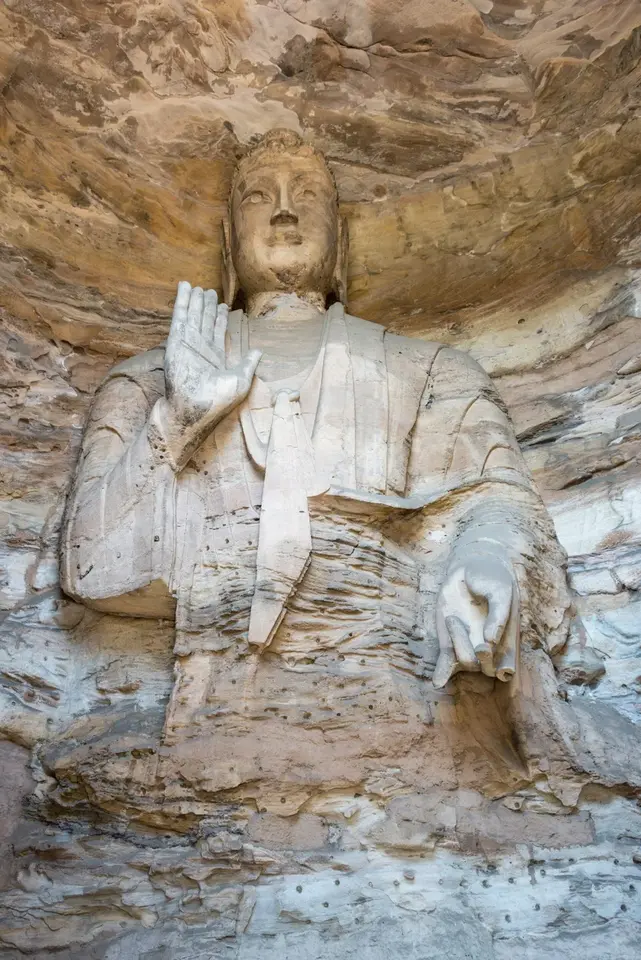
Commissioned Buddhist Master Tan Yao to begin excavation of the iconic Yungang Grottoes at Wuzhoushan.
Died in Taihua Hall at age twenty-six; posthumously honored as Emperor Wencheng with the temple name Gaozong.
Tuoba Jun was born on August 4, 440, in the Eastern Palace at Pingcheng. His father, Crown Prince Tuoba Huang, possessed an astute administrative temperament. From early childhood, Tuoba Jun displayed striking poise and sharp intelligence. Emperor Taiwu was extraordinarily fond of him, frequently seating him on his lap during state councils, having him accompany royal hunting parties, and publicly praising him before imperial princes as possessing the true demeanor of a Son of Heaven.
In 451, the powerful palace eunuch Zong Ai falsely accused the Crown Prince's inner circle, driving Tuoba Huang to death from acute distress. When Emperor Taiwu subsequently recognized his son's innocence, he was consumed by grief and invested his full affection in Tuoba Jun. In the second month of 452, terrified of imperial retribution, Zong Ai murdered Emperor Taiwu in his bedchamber and enthroned the pliable Prince of Nan'an, Tuoba Yu. Zong Ai arrogated supreme military and administrative power. In the tenth month of that year, when Tuoba Yu attempted to assert independence, Zong Ai orchestrated a second regicide.
With the imperial court in extreme jeopardy, Palace Guard Commander Changsun Kehou, Minister Lu Li, and general Yuan He orchestrated a counter-coup. Lu Li and Yuan He led palace troops to secure the inner courts while Changsun Kehou escorted the thirteen-year-old Tuoba Jun into the Yong'an Palace. On October 31, 452, Tuoba Jun ascended the imperial throne and proclaimed the Xing'an era. The young emperor moved swiftly: he ordered the immediate arrest of Zong Ai and Jia Zhou, subjecting them to the five punishments and executing their entire clans, instantly reestablishing monarchical authority.
Upon taking power, Emperor Wencheng confronted severe social exhaustion. While Emperor Taiwu had unified northern China through decades of relentless warfare, ongoing conscription and draconian legal codes had strained the empire's agrarian base to the breaking point. Emperor Wencheng made the strategic decision to transition governance toward peaceful consolidation, adopting the guiding ethos of "pacifying internal affairs and nourishing the population."
To heal royal rifts, the emperor rehabilitated his late father, posthumously honoring him as Emperor Jingmu, and granted his nursemaid Lady Chang the title of Dowager Protector. Concurrently, he crushed factional subversion: in late 452, he dispatched forces to eliminate the Tu'ge rebel Wang Jingwen in Longxi, and in early 453, he swiftly uncovered and executed Grand Tutor Du Yuanbao and Prince Tuoba Chong before their plotted insurrection could materialize.
To alleviate popular distress, Emperor Wencheng repeatedly waived grain levies in drought-stricken commanderies, distributed state grain reserves to impoverished communities, and prohibited unauthorized requisitioning by regional magnates. He promulgated an elder-care decree exempting one adult son from military conscription in households with members aged eighty or above. To curb litigation and feuds among the Xianbei aristocracy, he implemented strict prohibitions against excessive alcohol consumption.
Troubled by the brutal penal practices of the preceding reign, Emperor Wencheng directed legal officers to moderate the dynastic statutes. He instituted supervisory imperial inspectors (houguan) to curtail official embezzlement, while reforming capital judicial procedures. He decreed that unless an offender had committed treason, rebellion, or murder, death sentences should generally be commuted to penal servitude at border frontier garrisons, preserving civilian labor while fortifying frontier defenses.
Administratively, Emperor Wencheng dismantled archaic tribal military oversight over civil jurisdictions. He abolished hereditary tribal protectorates, replacing them with standard commandery governorships (taishou) subject to triennial performance evaluations. Within the central Department of State Affairs, he established specialized ministries—the Ministry of Communications and the Ministry of Adjudication—advancing the institutional regularization of the Northern Wei state.
In cultural policy, Emperor Wencheng achieved his most enduring historical legacy by repealing the devastating anti-Buddhist persecution launched by Emperor Taiwu. During the Taiping Zhenjun era, imperial edicts had ordered the demolition of temples, burning of scriptures, and execution of clergy across northern China, generating profound resentment among both Xianbei and Han subjects.
In the twelfth month of 452, Emperor Wencheng issued the historic Edict on the Restoration of the Dharma, acknowledging the moral efficacy of Buddhist teachings in fostering ethical harmony. He permitted all willing subjects to enter the monastic order and authorized commanderies across the empire to construct monasteries and pagodas.
In 460, the emperor appointed the eminent monk Tan Yao as Controller of the Monks (Shamentong). Tan Yao proposed carving five colossal cave temples into the sandstone cliffs of Wuzhoushan, west of Pingcheng, to house monumental Buddha statues dedicated to imperial ancestors. Emperor Wencheng allocated extensive state revenues and skilled artisans to the project, inaugurating the creation of the world-famous Yungang Grottoes. The initial "Five Caves of Tan Yao" (Caves 16 through 20) combined Hellenistic Gandharan, Central Asian, and Chinese sculptural traditions. The monumental seated Buddhas, whose facial features symbolized the divine power of Northern Wei monarchs, stood as a testament to the ideological fusion of imperial kingship and Buddhist soteriology.
In external military strategy, Emperor Wencheng abandoned destructive southern offensives against the Liu Song Dynasty, adopting a posture of peaceful border coexistence in the south while concentrating defensive resources against the northern steppe. The nomadic Rouran Khaganate had grown increasingly aggressive, staging recurrent raids along Northern Wei's northern borders.
In the eighth month of 458, Emperor Wencheng launched a preemptive campaign to secure the frontier. Personally commanding 100,000 elite horsemen, he advanced north of Yanmen Pass into the Gobi Desert. Alarmed by the disciplined speed of the Northern Wei strike columns, the Rouran Khagan fled deep into the wilderness. Northern Wei vanguard forces pursued the nomads across several hundred li, capturing thousands of tribal retainers and hundreds of thousands of livestock. Upon reaching Mount Luyuan, Emperor Wencheng ordered a triumphal stele carved into the cliff face before withdrawing his victorious army. This decisive operation deterred Rouran aggression for decades.
By 465, Emperor Wencheng's fourteen years of benevolent rule had revitalized the Northern Wei state, yielding social tranquility and full granaries. However, afflicted by chronic ailments stemming from rigorous early military life, his health deteriorated rapidly. On June 20, 465, the emperor passed away in Taihua Hall at the youthful age of twenty-six.
His sudden death plunged the realm into deep grief. His consort, Empress Feng, was so devastated that during the cremation of his imperial garments she attempted to immolate herself upon the pyre, saved only by the intervention of royal guards. In the eighth month, Emperor Wencheng was interred at Jinling in Yunzhong. He was succeeded by his eldest son, Emperor Xianwen (Tuoba Hong), under the ultimate regency of Empress Dowager Feng, setting the stage for the transformative Xiaowen sinicization reforms.
Tuoba Jun's decisive action upon his accession in 452 preserved the Northern Wei Dynasty from internal disintegration. The regicide of Emperor Taiwu and Tuoba Yu by Zong Ai had paralyzed the central government and brought the empire to the brink of military anarchy. Though only thirteen years old, Tuoba Jun worked alongside loyalist veterans to eradicate the eunuch conspiracy in a single day, permanently eliminating the first major eunuch crisis in northern dynastic history and restoring monarchical legitimacy.
Emperor Wencheng's fourteen-year reign served as the crucial turning point from conquest militarism to civil administrative consolidation. While Emperor Taiwu had expanded the realm through conquest, continuous mobilization had depleted the empire's resources. Emperor Wencheng halted expansionist warfare against Southern Liang and Liu Song, shifting imperial policy toward domestic rehabilitation. By lowering taxes, protecting elderly citizens, reducing harsh penalties, and encouraging agriculture, he allowed displaced populations to repopulate northern lands, providing the economic foundation for the later prosperity of the Northern Wei golden age.
The restoration of Buddhism and the commissioning of the Yungang Grottoes represent Emperor Wencheng's greatest contribution to world heritage. By lifting the religious ban and partnering with Master Tan Yao, he transformed Buddhism into a cornerstone of Northern Wei statecraft. The Yungang stone carvings established a distinctive Buddhist aesthetic that harmonized Central Asian, Indian, and Chinese sculptural traditions, providing an enduring physical monument to medieval Asian cultural exchange.
FIGURES ASSOCIATED WITH THIS DYNASTY