Birth in Yin County
Born into an esteemed scholar-gentry family in Yin County, demonstrating brilliant intellect and memory from youth.
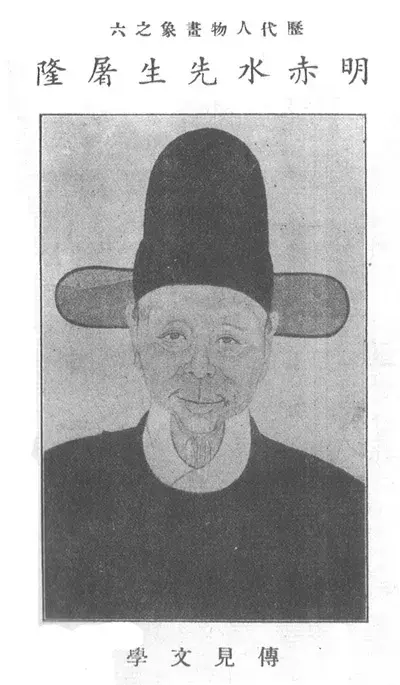
屠隆
Tu Long (屠隆, 1543–1605), courtesy names Changqing and Weizhen, art name Chishui, and aliases Honglu Xianke and Mingliaozi, was a native of Yin County, Ningbo Prefecture. He was an eminent dramatist, literary writer, bibliophile, and founding master of late Ming literati life aesthetics. He obtained the jinshi degree in 1577 during the Wanli reign of Emperor Shenzong. In his early official career, Tu served as Magistrate of…
Tu Long (屠隆, 1543–1605), courtesy names Changqing and Weizhen, art name Chishui, and aliases Honglu Xianke and Mingliaozi, was a native of Yin County, Ningbo Prefecture. He was an eminent dramatist, literary writer, bibliophile, and founding master of late Ming literati life aesthetics. He obtained the jinshi degree in 1577 during the Wanli reign of Emperor Shenzong. In his early official career, Tu served as Magistrate of Yingshang County and Qingpu County in South Zhili, advancing to Secretary and Vice Director in the Ministry of Rites. Erudite and uninhibited, he was renowned for his expansive poetry and passionate embrace of music and landscape arts. Dismissed from bureaucratic office in his late years, he retired to his native region to focus on literary creation. In theatrical composition, Tu was a master of Ming chuanqi drama, authoring celebrated plays such as Tanhua Ji, Xiuwen Ji, and Caihao Ji, whose grandeur and lyrical elegance profoundly influenced late Ming theater. In the realm of material culture and lifestyle aesthetics, his four-volume Kaopan Yushi systematically codified literati lifestyle paradigms encompassing calligraphy, painting, zither, incense, tea, flower arrangement, and studio design, standing alongside Gao Lian's Zunsheng Bajian as twin pinnacles of ancient Chinese lifestyle aesthetics. He also authored Mingliaozi You and Baiyu Ji.
Born into an esteemed scholar-gentry family in Yin County, demonstrating brilliant intellect and memory from youth.
Passed the Zhejiang provincial examination, gaining widespread literary fame across southern China.
Passed the imperial palace examination with honors, appointed Magistrate of Yingshang County.
Transferred to Magistrate of Qingpu County, dredging regional canals, developing water conservancy, and benefiting locals.
Promoted to Secretary and then Vice Director in the Ministry of Rites, associating with prominent scholars in Beijing.
Impeached by conservative censors for his unconstrained lifestyle, dismissed from office and returned to Zhejiang.
Completed the four-volume masterpiece of literati lifestyle aesthetics, Kaopan Yushi, at his mountain retreat.
Dedicated himself to dramatic writing, producing celebrated chuanqi plays including Tanhua Ji and Caihao Ji.
Passed away peacefully at his ancestral residence in Yin County at the age of sixty-three.
In 1543 (the twenty-second year of the Jiajing reign), Tu Long was born into an illustrious lineage in Yin County, Ningbo Prefecture, Zhejiang. Precociously gifted, Tu possessed photographic reading speed, achieving mastery not only of Confucian classics and histories, but also of astronomy, geography, music, chess, calligraphy, painting, and Buddhist-Daoist philosophies. In his youth, he possessed a gallant spirit and radiant literary eloquence, achieving wide acclaim among southeastern literati.
In 1573, at age thirty, Tu passed the Zhejiang provincial examination. In 1577, he traveled to Beijing to participate in the metropolitan and palace examinations, receiving the jinshi degree in the second class. Following graduation, the Ministry of Personnel appointed him Magistrate of Yingshang County in South Zhili, and in 1578 transferred him to govern Qingpu County in modern Shanghai.
Governing Qingpu, Tu demonstrated remarkable administrative energy. Addressing the dense water network and catastrophic siltation that afflicted the county, he surveyed local waterways and mobilized tens of thousands of corvee laborers to dredge tributaries of the Huangpu River, leveling dikes and transforming waterlogged lowlands into vast tracts of fertile farmland. He reformed land surveys and balanced labor levies, winning the deep affection of the populace, who erected a shrine in his honor during his lifetime.
In 1581, on account of his outstanding regional administrative performance, Tu was exceptionally promoted to Secretary in the Ministry of Rites, soon advancing to Vice Director of the Bureau of Ceremonies. Overseeing dynastic rituals, educational examinations, and diplomatic protocols, the post represented one of the most prestigious positions in the central bureaucracy.
During his years in Beijing, Tu reached the peak of his social and artistic prominence. Naturally expansive and contemptuous of bureaucratic pettiness, he took delight in entertaining scholars, poets, and eccentric talents from across the empire. At his metropolitan estate, he maintained a private theatrical troupe, hosting musical banquets daily and associating with masters such as Xing Dong, Wu Guolun, disciples of Wang Shizhen, and foreign Buddhist monks. His poetry was bold and imaginative, his calligraphy vigorous, and his renown echoed across the capital as a rare literary prodigy.
However, Tu's uninhibited, bohemian lifestyle deeply offended puritanical, conservative Neo-Confucian censors at court. In 1584, an imperial censor submitted an impeachment memorial accusing him of unorthodox behavior and indulgence in worldly pleasures. Proud and unyielding, Tu disdained to offer bureaucratic excuses, accepting dismissal from the official rolls and returning home to Zhejiang.
Following his dismissal, Tu shed all worldly ambitions of office, enjoying the serenity of mountain landscapes between the Baiyulin forest of Ningbo, West Lake, and Mount Tiantai, adopting the art names Mingliaozi and Honglu Xianke. Residing in his mountain retreat, he amassed over ten thousand volumes of rare books and focused on composing dramatic plays and aesthetic treatises, achieving an effortless synthesis of art and life. In 1605, Tu passed away peacefully at his residence in Yin County at the age of sixty-three.
Tu Long's most foundational and enduring contribution to Chinese culture was his authorship of the four-volume Kaopan Yushi. This work is widely recognized as the classic encyclopedia of daily life aesthetics, material culture, and interior space design for traditional literati.
Divided into more than twenty categories—including studio implements, calligraphic rubbings, paintings, paper, ink, writing brushes, inkstones, zithers, incense, tea, floral arrangements, and potted landscapes—Tu systematically evaluated the utensils, furnishings, gardens, and aesthetic pastimes of scholar-officials. He investigated the materials, craftsmanship, and authentication of Xuande incense burners, Ge kiln ceramics, Xuan paper, and Duan inkstones, while articulating a deep philosophy wherein scholars cultivate their spiritual independence and transcend mundane vulgarity through harmonious engagement with exquisite objects and nature. Kaopan Yushi synthesized late Ming aesthetic ideals, directly inspiring Wen Zhenheng's Treatise on Superfluous Things (Zhangwu Zhi) and Li Yu's Sketches of Idle Pleasure (Xianqing Ouji), remaining a primary guide for studying traditional Chinese aesthetics.
In dramatic literature, Tu Long was a foremost master of late Ming chuanqi drama. His surviving masterworks include Tanhua Ji, Xiuwen Ji, and Caihao Ji.
His magnum opus, Tanhua Ji, is a fifty-four-scene drama depicting the spiritual pilgrimage and renunciation of Tang general Pei Du, harmonizing Confucian statecraft with Buddhist-Daoist spiritual liberation through dramatic suspense and grand narrative architecture. His Caihao Ji drew upon the tumultuous life of Tang poet Li Bai, celebrating Li's poetic genius and defiance of corrupt court authority. Characterized by elegant diction, musical clarity, and theatrical vitality, Tu's dramas achieved supreme distinction both in stage performance and reading appreciation, exerting a powerful catalyst on the Ming dramatic world.
Beyond aesthetics and theater, Tu Long achieved profound philosophical elevation in prose literature. His late-life masterpiece, Mingliaozi You, synthesized allegorical fables with philosophical dialogues to envision a spiritual realm of transcendental freedom beyond the constraints of time, mortality, and worldly ambition.
In this text, he fused the egalitarian philosophy of Zhuangzi with the intuitive awakening of Chan Buddhism, condemning the vanity of chasing riches and status while advocating a return to natural purity and cosmic harmony. Written in ethereal, flowing prose, the work reflects the ultimate spiritual aspiration of classical Chinese literati.
FIGURES ASSOCIATED WITH THIS DYNASTY