Birth in Liaodong
Born into a preeminent military family in Fushun; eldest son of Minister Tong Tulai.
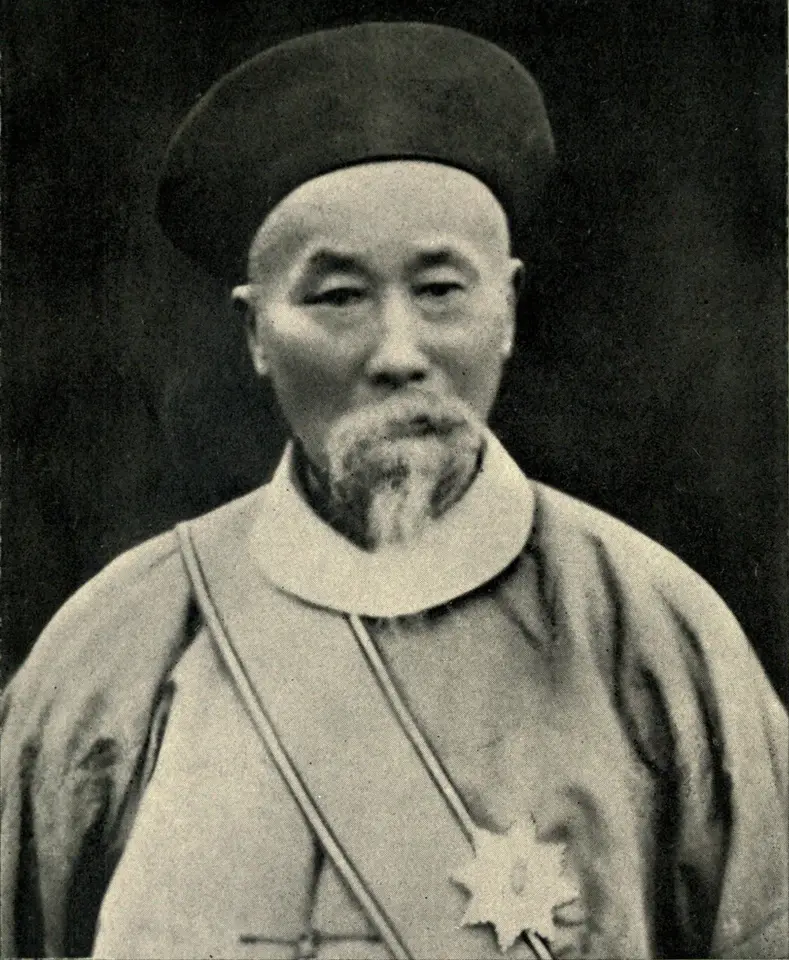
佟国纲
Tong Guogang (佟国纲, died September 3, 1690), of the Tunggiya clan, native of Fushun, Liaodong, belonging to the Manchu Bordered Yellow Banner, was an eminent statesman, imperial kinsman, and senior military commander during the early Qing dynasty. He was the eldest son of Grand Tutor Tong Tulai, elder brother of Empress Xiaokangzhang, and maternal uncle to the Kangxi Emperor. Entering court service under the Shunzhi Emperor as…
Tong Guogang (佟国纲, died September 3, 1690), of the Tunggiya clan, native of Fushun, Liaodong, belonging to the Manchu Bordered Yellow Banner, was an eminent statesman, imperial kinsman, and senior military commander during the early Qing dynasty. He was the eldest son of Grand Tutor Tong Tulai, elder brother of Empress Xiaokangzhang, and maternal uncle to the Kangxi Emperor. Entering court service under the Shunzhi Emperor as an Imperial Bodyguard of the First Class, Tong advanced rapidly upon his nephew's accession in 1662, inheriting the noble title of Viscount and receiving appointment as Senior Chamberlain of the Imperial Bodyguard. In 1677, the emperor elevated him to Duke of the First Class in honour of his maternal lineage, and subsequently placed him in command of the elite artillery divisions. In 1688, Tong successfully petitioned the throne to recognize his clan's Jurchen roots, transferring his family branch from the Chinese-martial banners to the Manchu Bordered Yellow Banner under the ancestral surname Tunggiya. In 1689, Tong served as deputy plenipotentiary alongside Songgotu in the imperial diplomatic mission sent across the Siberian wilderness to negotiate the Treaty of Nerchinsk with the Tsardom of Russia. Demonstrating immense courage by personally swimming across flooding mountain torrents to inspire the troops, Tong actively directed Jesuit translators and maintained an unyielding diplomatic stance that compelled the Russian delegation under Fedor Golovin to sign China's first formal international border treaty, safeguarding territorial sovereignty throughout the Amur River basin. In 1690, when Galdan Boshugtu Khan of the Dzungar Khanate invaded Inner Mongolia, the Kangxi Emperor launched a punitive northern expedition. Tong volunteered for frontline service, commanding the left vanguard. At the climactic Battle of Ulan Butung, the Dzungars formed an impenetrable fortified defensive perimeter of ten thousand bound camels reinforced with wet wool and musketry, known as the Camel Wall. Tong personally led his vanguard infantry in a desperate uphill assault against the fortified position, where he was fatally struck by musketry and died heroically on the battlefield. Deeply grieved, the Kangxi Emperor personally composed his memorial tablet, conferring the posthumous title Zhongyong, and the Yongzheng Emperor later posthumously bestowed the honor of Grand Tutor.
Born into a preeminent military family in Fushun; eldest son of Minister Tong Tulai.
Appointed Imperial Bodyguard of the First Class, serving in the inner palace.
Inherited noble rank upon his sister becoming Empress Dowager; promoted to Senior Chamberlain.
Appointed General of Anbei to suppress Prince Burni's rebellion, garrisoning Xuanfu.
Elevated to Duke of the First Class in honor of the Kangxi Emperor's maternal house.
Appointed Commander of the Bordered Yellow Banner, overseeing the imperial firearms divisions.
Reclaimed the ancestral clan name Tunggiya, transferring his branch into the Manchu Bordered Yellow Banner.
Co-led the diplomatic embassy to Nerchinsk, concluding the historic border treaty with Tsarist Russia.
Joined the Kangxi Emperor's expedition against Galdan as commander of the left vanguard.
Slain by enemy musketry while personally leading the assault on the Dzungar Camel Wall.
Posthumously bestowed the exalted rank of Grand Tutor by the Yongzheng Emperor.
Tong Guogang was born in Fushun into one of the most powerful military lineages of early modern East Asia. His grandfather, Tong Yangzhen, surrendered to Nurhaci during the early campaigns in Liaodong, rendering vital services in founding the Qing dynasty. His father, Tong Tulai, served as Minister of Rites and Grand Tutor, commanding the Chinese-martial banners. Tong Guogang was Tulai's eldest son, and his younger sister entered the imperial court as a consort to the Shunzhi Emperor, giving birth in 1654 to the future Kangxi Emperor, Xuanye. Gifted with an imposing physical presence and thorough training in horsemanship, archery, and tactical command, Tong entered imperial service as an Imperial Bodyguard of the First Class during the mid-Shunzhi period.
Following the death of the Shunzhi Emperor in 1661, the eight-year-old Kangxi Emperor ascended the throne, honoring his biological mother as Empress Dowager Cihe (posthumously Empress Xiaokangzhang). In 1662, Tong inherited his father's noble rank of Viscount and was elevated to Senior Chamberlain of the Imperial Bodyguard, entering the supreme inner circle of civil and military administration. In 1669, the emperor transferred Tong's family branch from the Plain Blue to the Bordered Yellow Banner, appointing him banner commander to oversee regional administration.
In 1675, amidst the widespread imperial crisis triggered by the Revolt of the Three Feudatories in southern China, Prince Burni of the Chahar Mongols staged an opportunistic revolt along the northern frontiers, threatening the Great Wall approaches to Beijing. Acting decisively, the Kangxi Emperor commissioned Tong as General of Anbei, dispatching him alongside Generalissimo Prince Eji to suppress the uprising. Tong advanced with heavy forces to garrison Xuanfu, fortifying the strategic mountain passes and deterring nomadic flanking maneuvers until the rebellion was utterly crushed.
In 1677, Tong's niece (daughter of his younger brother Tong Guowei, later Empress Xiaoyi Ren) was inducted into the imperial harem as an Imperial Noble Consort. To express profound gratitude toward his maternal ancestors, the Kangxi Emperor issued an imperial rescript posthumously ennobling Tong Tulai as Duke of the First Class, conferring the hereditary dukedom upon Tong Guogang. In 1681, Tong was appointed commander of the Bordered Yellow Banner artillery corps, supervising the drilling of advanced musket and cannon regiments. In April 1688, Tong submitted an exhaustive genealogical memorial demonstrating that his lineage originated among the ancient Tunggiya Jurchens of Mount Changbai before adopting Chinese habits during late Ming border commerce. The Kangxi Emperor approved the request, formally incorporating Tong's immediate branch into the Manchu Bordered Yellow Banner under the ancestral clan name Tunggiya, inaugurating the era of immense political dominance known colloquially as "Tong Half-the-Court."
Throughout the mid-seventeenth century, Tsarist Russian Cossack expeditions expanded aggressively into the Amur River basin, constructing fortified wooden stockades at Albazin and Nerchinsk and terrorizing local Daur and Solon populations. After imperial armies repulsed Russian incursions during the two sieges of Albazin, the Russian crown agreed to direct border negotiations. In May 1689, the Qing court dispatched a grand diplomatic mission across the Mongolian steppes to Nerchinsk. Grand Chamberlain Songgotu headed the embassy as chief commissioner, while Tong Guogang served as senior deputy plenipotentiary.
The arduous trans-Baikal journey tested the limits of endurance. When heavy downpours transformed the Wenda River into a raging mountain torrent, sweeping away horses and baggage, many diplomatic officials wavered. Recognizing that hesitation would compromise morale, Tong Guogang spurred his warhorse directly into the roaring rapids, swimming safely across to the opposite bank. Inspired by his reckless bravery, the entire imperial escort crossed without further delay. Upon arriving outside Nerchinsk, Russian ambassador Fedor Golovin attempted to delay proceedings, hoping autumn frosts would force the Qing army to retreat. Tong urged Songgotu to cross the river and establish forward battle lines, declaring: "The Russians rely on the river barriers and the arrival of winter to exhaust us. If we display fearless resolve by crossing directly into their perimeter, their arrogance will instantly collapse." Adopting Tong's advice, the Qing embassy crossed the river, compelling Golovin to return to the negotiating table. Throughout intense debates, Tong instructed Jesuit interpreters Thomas Pereira and Jean-François Gerbillon to remain steadfast, warning that the Qing would never depart without a binding treaty. On September 7, 1689, the historic Treaty of Nerchinsk was formally ratified, demarcating the Stanovoy Mountains as the northern border and securing lasting sovereignty over the Amur basin.
In the summer of 1690, Galdan Boshugtu Khan, supreme ruler of the Dzungar Oirat confederacy, launched an invasion across the Gobi Desert with thirty thousand heavy horse archers, crushing the Khalkha Mongols and penetrating to Ulan Butung in Inner Mongolia, merely two hundred miles north of Beijing. The Kangxi Emperor resolved to command the imperial forces in person, deploying a two-pronged offensive under Prince Fuquan. Eager to defend the realm, the aging Duke Tong volunteered for combat, taking command of the left wing vanguard equipped with field artillery and assault cavalry.
On September 3, 1690, the imperial army engaged Galdan at Ulan Butung. Capitalizing on heavily forested terrain, Galdan lashed ten thousand camels to the earth in a sprawling crescent formation, reinforcing their saddles with wet quilts and heavy timber palisades to create an improvised fortress known as the Camel Wall. Concealed behind this bastion, Dzungar marksmen fired Russian-manufactured muskets, stalling Qing frontal assaults. Seeing the battle stall, Tong removed his heavy ceremonial armor, drew his battle sword, and led his vanguard warriors in a desperate charge directly into the camel fortifications. Charging at the very front of the battle line, Tong urged his soldiers forward with roaring battle cries. Just as Qing shock troops reached the palisades, a devastating volley of musket balls tore through the smoke, striking Tong in the face and chest. He fell from his horse and died instantly on the field. Enraged by the death of the emperor's uncle, the Qing artillery divisions concentrated continuous cannonades to pulverize the Camel Wall, before imperial infantry broke into the lines, completely shattering the Dzungar army and sending Galdan fleeing into the western desert.
Upon learning of his uncle's death, the Kangxi Emperor wept bitterly and suspended court audiences for three days. The monarch ordered the imperial princes and cabinet ministers to receive Tong's casket in Beijing, bestowing the posthumous title Zhongyong and personally composing an imperial stele inscription celebrating his sacrifice. In 1723, the Yongzheng Emperor posthumously elevated Tong to the supreme rank of Grand Tutor.
Tong's tactical boldness and diplomatic firmness at Nerchinsk in 1689 were essential to securing the first international treaty in modern Chinese history. By demonstrating absolute military readiness and managing cross-cultural negotiations through Jesuit intermediaries, Tong defended dynastic territorial integrity, ensuring Qing supremacy over the Russian frontier for more than a century.
As commander of the Bordered Yellow Banner artillery, Tong pioneered the integration of European and Chinese firearms technologies. His emphasis on combined-arms doctrine—uniting mobile field cannons, musket volleys, and shock cavalry—provided the technological margin of victory that allowed imperial forces to decisively defeat nomadic cavalry hosts across Central Asia.
Tong's self-sacrifice at Ulan Butung stood as a rare example of elite imperial leadership. Eschewing the safety of high aristocratic privilege, the emperor's senior uncle died leading from the front against formidable defensive fortifications. His death galvanized the imperial army to total victory and established an enduring symbol of military fidelity in Qing dynastic history.
FIGURES ASSOCIATED WITH THIS DYNASTY