Birth in Dengzhou
Born in Dengzhou, Henan into a Sinicized Semu family, displaying early intellectual acuity and moral resolve.
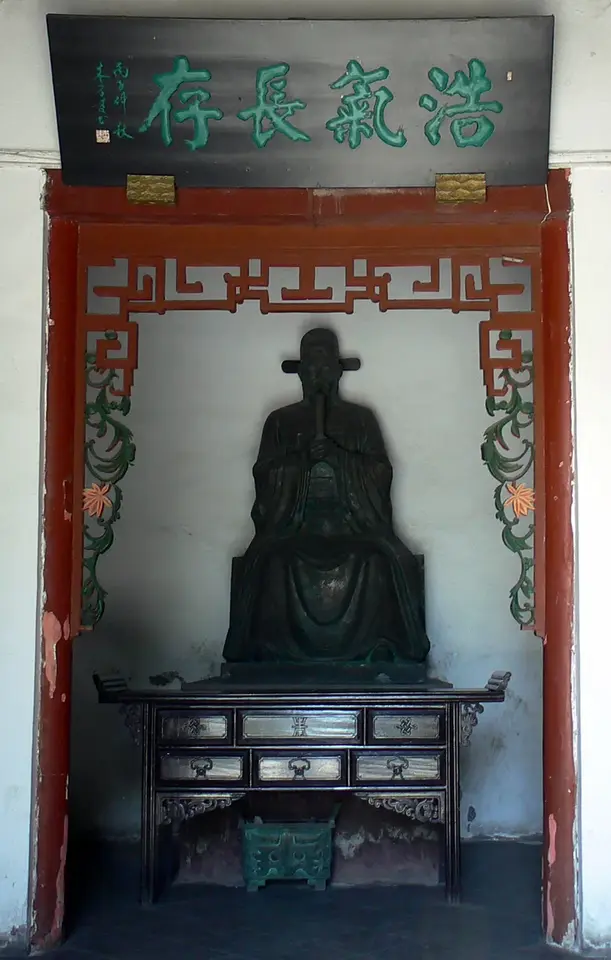
铁铉
Tie Xuan (1366–1402), courtesy name Dingshi, was a native of Dengzhou, Henan (modern Dengzhou City), of Semu descent. He was an outstanding military strategist, loyal minister, and indomitable pillar of the Jianwen court in the early Ming dynasty. Emerging from the National University, Tie Xuan was initially appointed Supervising Secretary in the Ministry of Rites and later transferred to Judge in the Chief Military…
Tie Xuan (1366–1402), courtesy name Dingshi, was a native of Dengzhou, Henan (modern Dengzhou City), of Semu descent. He was an outstanding military strategist, loyal minister, and indomitable pillar of the Jianwen court in the early Ming dynasty. Emerging from the National University, Tie Xuan was initially appointed Supervising Secretary in the Ministry of Rites and later transferred to Judge in the Chief Military Commission. His extraordinary legal discernment and prompt resolution of long-standing lawsuits won the profound admiration of Emperor Taizu of Ming (Zhu Yuanzhang), who personally bestowed upon him the courtesy style "Dingshi" (meaning anchor stone). Upon the accession of the Jianwen Emperor (Zhu Yunwen), he was promoted to Administration Vice-Commissioner of Shandong, managing provincial defense and logistics for northern military expeditions. In 1399 (the first year of the Jianwen era), Zhu Di, Prince of Yan, launched the Jingnan Campaign. In April of the following year, when imperial commander Li Jinglong suffered a catastrophic collapse at the Baigou River and northern garrisons disintegrated, Zhu Di led one hundred thousand elite troops to besiege the provincial capital Jinan. At this desperate juncture, Tie Xuan rushed post-haste to Jinan, forged a blood covenant with Regional Commander Sheng Yong, assembled dispersed troops, and swore to defend the isolated stronghold to the death. Throughout the three-month siege, Tie Xuan continually thwarted the besiegers: he returned an arrow-borne treatise titled On the Duke of Zhou Assisting King Cheng to assert political legitimacy; engineered a portcullis trap at the western gate that nearly crushed Zhu Di on horseback; and hung Emperor Taizu's portraits and spirit tablets upon the ramparts to paralyze the enemy's artillery barrage. Frustrated and exhausted, Zhu Di was forced to lift the siege and retreat, never daring to advance through Jinan again. Following the relief of Jinan, Tie Xuan was promoted to Provincial Administration Commissioner of Shandong and granted the rank of Minister of War. Coordinating closely with Sheng Yong, he recaptured Dezhou and achieved a monumental victory at the Battle of Dongchang, where the imperial army routed the Yan forces and killed their foremost general, Zhang Yu. In 1402 (the fourth year of the Jianwen era), the Yan army altered strategy, bypassed Jinan, and executed a surprise assault that breached Nanjing, allowing Zhu Di to usurp the throne. Captured after fighting to the last in Huainan, Tie Xuan was escorted to Nanjing. Hauled before Zhu Di, he turned his back to the throne, hurled relentless denunciations at the usurper, and remained unyielding through gruesome tortures, being slowly sliced to death at the age of thirty-seven. Deeply moved by his valor, the citizens of Jinan revered him as their tutelary "City God," establishing shrines to honor his immortal spirit throughout the Ming and Qing dynasties.
Born in Dengzhou, Henan into a Sinicized Semu family, displaying early intellectual acuity and moral resolve.
Selected from the National University as Supervising Secretary; named Judge in the Chief Military Commission and granted the style Dingshi by Emperor Taizu.
Jianwen Emperor ascended the throne, promoting Tie Xuan to Administration Vice-Commissioner of Shandong.
The Jingnan rebellion erupted; Tie Xuan took charge of grain and munitions transportation for Li Jinglong's northern expedition.
After the Baigou River rout in April, rushed to Jinan to join Sheng Yong; withstood a three-month siege and repelled Zhu Di.
In September the Yan siege collapsed; Jianwen elevated Tie Xuan to Provincial Administration Commissioner of Shandong concurrently Minister of War.
Assisted Sheng Yong in trapping Yan forces at Dongchang, decimating the enemy vanguard and killing general Zhang Yu.
Yan army bypassed Jinan and captured Nanjing in June; Zhu Di ascended the throne as the Yongle Emperor.
Conducted rearguard resistance in Huainan; captured when provisions ran out and escorted to Nanjing.
Refused to look upon Zhu Di, hurled furious invectives at the court, and suffered dismemberment at age 37.
Southern Ming Emperor An rehabilitated Jianwen martyrs, granting Tie Xuan the posthumous title of Grand Protector and name "Zhongxiang."
Qianlong Emperor honored his supreme loyalty, conferring the posthumous name "Zhongding"; shrines at Lake Daming maintained imperial sacrifices.
Tie Xuan was born in 1366 (the twenty-sixth year of the Zhizheng era under the Yuan dynasty) in Dengzhou, Henan Province, into a prominent Semu lineage that had settled in the Central Plains for generations, deeply absorbing Confucian classical culture. From early childhood, Tie Xuan displayed extraordinary intellectual acuity, firm resolve, and remarkable administrative speed. During his studies at the National University (Guozijian) in the imperial capital, he applied himself diligently to Confucian classics, history, and statutory jurisprudence, graduating at the top of his class and earning wide esteem among metropolitan scholars.
Upon completing his education, Tie Xuan was selected from the academy to serve as Supervising Secretary in the Ministry of Rites. Owing to his exceptional efficiency, he was soon transferred to Judge in the Chief Military Commission. The commission was responsible for managing imperial military registries and arbitrating major military judicial disputes, handling intricate and volatile cases. Facing piles of complicated, unresolved lawsuits accumulated over many years, Tie Xuan investigated facts impartially, resolving disputes with such fairness that both commanders and soldiers submitted without dissent. His razor-sharp legal acumen and incorruptible character caught the attention of Emperor Taizu of Ming (Zhu Yuanzhang). Emperor Taizu summoned Tie Xuan to the imperial desk, tested his knowledge of judicial precedents, and was so pleased with his decisive judgment that he personally bestowed upon him the courtesy style "Dingshi" (meaning anchor stone), symbolizing a steadfast pillar of state.
In 1398 (the thirty-first year of the Hongwu era), the Jianwen Emperor (Zhu Yunwen) succeeded to the throne. Recognizing Tie Xuan's unwavering loyalty and administrative talent, the young sovereign promptly elevated him to Administration Vice-Commissioner of Shandong, entrusting him with provincial finance, food reserves, and garrison logistics, establishing him as a key official guarding the northeastern approaches to the empire.
In July 1399 (the first year of the Jianwen era), Zhu Di, Prince of Yan, revolted in Beiping under the slogan of "clearing evil ministers from the sovereign's court," initiating the Jingnan Campaign. The Jianwen Emperor appointed Li Jinglong, Duke of Cao, as supreme commander to lead five hundred thousand troops north, while Tie Xuan was charged with directing the transportation of grain and munitions for the expeditionary armies. Tie Xuan organized supply lines efficiently, sustaining frontline garrisons with uninterrupted provisions. However, Li Jinglong proved incompetent, suffering a catastrophic defeat at the Battle of the Baigou River in April 1400 (the second year of the Jianwen era), which led to the collapse of imperial forces in Hebei and northern Shandong.
In late April 1400, Zhu Di led one hundred thousand victorious Yan cavalry south, surrounding the provincial capital of Jinan. At that time, Jinan was defended only by the depleted forces of Regional Commander Sheng Yong, leaving the city undermanned and vulnerable. While overseeing supply lines outside the city, Tie Xuan learned of Jinan's peril and rushed through the night with his logistics guard to the scene. Braving enemy lines, he entered the city, met Sheng Yong on the shores of Lake Daming, and made a blood covenant to defend the city to the last breath.
In June, Zhu Di ordered arrows carrying letters of capitulation shot into the city, promising Tie Xuan princely enfeoffment if he opened the gates. Tie Xuan read the letter with contempt, penned an essay titled On the Duke of Zhou Assisting King Cheng, and shot it back into the Yan camp. In the essay, Tie Xuan cited historical precedents, rebuking Zhu Di for violating loyalty and reminding him that as an imperial uncle, he was duty-bound to assist the young emperor rather than cause devastation through rebellion. Humiliated and furious, Zhu Di ordered siege towers erected and ditches filled, launching day-and-night assaults against the walls. Clad in armor with sword drawn, Tie Xuan stood on the battlements, fighting alongside his men through three grueling months while repelling wave after wave of attackers.
Failing to breach the walls through direct assault, Zhu Di devised a plan to cut the river dikes, intending to divert the waters of the Luo River to submerge Jinan. With floodwaters threatening the city and its hundreds of thousands of residents, Tie Xuan feigned surrender to lure Zhu Di into a fatal ambush.
Tie Xuan instructed his men to conceal a heavy iron portcullis weighing thousands of pounds inside the western gate (Luoyuan Gate), while ordering soldiers and civilians to weep atop the walls, pretending that the rising waters had broken their spirits. He then sent senior village elders to the Yan camp to sue for peace, claiming: "The court was led astray by evil ministers, forcing Your Highness into war. You are Emperor Taizu's own son, and we are his subjects who wish to submit. Yet our people fear military pillage; we beg Your Highness to withdraw your army five miles and enter alone to accept our submission and reassure the populace!" Worn down by months of siege, Zhu Di believed the ruse, withdrew his main army, and rode toward the western gate under a yellow silk canopy accompanied by only a few bodyguards.
The city gates swung open. Just as Zhu Di's horse crossed beneath the gate arch, the defenders shouted "Long live the Prince!" and released the portcullis. However, the suspension cable snapped a fraction of a second late, and the iron gate crashed down onto the horse's head instead of the rider. Sensing the trap, Zhu Di leaped clear, mounted a spare horse, and fled under pursuit.
Furious at his narrow escape, Zhu Di brought up heavy artillery, bombarding the city walls until several ramparts began to crumble. In this crisis, Tie Xuan had artists paint large portraits of Emperor Taizu, mounting them upon the crumbling battlements, while personally inscribing dozens of ancestral wooden spirit tablets of the late founder and posting them along the crenels. Confronted with the portraits and spirit tablets of their founder, the Yan soldiers dared not fire their cannons for fear of committing sacrilege against the dynastic progenitor. Meanwhile, Tie Xuan launched night raids on the Yan encampments, spreading confusion among the besiegers. On September 4, on the advice of his advisor Yao Guangxiao, Zhu Di abandoned the siege and retreated to Beiping, never daring to attack Jinan again.
The lifting of the siege of Jinan revitalized the loyalist cause. Delighted by the victory, the Jianwen Emperor dispatched envoys with gold and silver to reward the defenders, immediately elevating Tie Xuan to Provincial Administration Commissioner of Shandong and granting him the rank of Minister of War, appointing him Military Counselor alongside Sheng Yong to lead counter-offensive operations. Grateful for their deliverance, the citizens of Jinan hailed Tie Xuan as the city's tutelary "City God."
In December 1400, the Yan army advanced toward Dongchang (modern Liaocheng, Shandong). Tie Xuan and Sheng Yong prepared an ambush, drawing the enemy into an encircling trap. When Zhu Di charged the center with his elite cavalry, Sheng Yong cut off their retreat with rows of firearms and war wagons, while Tie Xuan led Shandong infantry to strike from the flanks. The imperial army routed the enemy, killing tens of thousands and slaying Zhang Yu, Zhu Di's foremost general and chief strategist. Zhu Di barely escaped with his life. The victory at Dongchang was the greatest military triumph achieved by the Jianwen court throughout the entire war.
However, in 1402 (the fourth year of the Jianwen era), Zhu Di altered his operational plan, bypassing fortified provincial centers such as Jinan. The Yan army marched south through Dong'e and Wenshang, defeated the main imperial forces at Lingbi, crossed the Yangtze, and captured Nanjing through the treachery of the Jinchuan Gate defenders. Following the fall of the capital, Tie Xuan led surviving units in guerrilla resistance across Huainan until, exhausted and outnumbered, he was captured and brought to Nanjing in chains.
Zhu Di personally interrogated Tie Xuan in the palace. Brought before the usurper, Tie Xuan turned his back to the throne, refusing to cast a single glance at Zhu Di despite being beaten by palace guards, loudly rebuking Zhu Di for treason. Incensed, Zhu Di ordered his ears and nose sliced off and cooked, forcing them into Tie Xuan's mouth and mockingly asking: "Is the flesh sweet?" Spitting the flesh in Zhu Di's face, Tie Xuan roared: "How could the flesh of a loyal son and righteous subject not be sweet!" In uncontrollable rage, Zhu Di ordered Tie Xuan slowly dismembered alive. Tie Xuan maintained his defiance until his final breath, dying a martyr's death at thirty-seven.
Following his death, Zhu Di inflicted brutal reprisals upon Tie Xuan's family: his eighty-year-old parents, Tie Zhongming and Lady Xue, were banished to Hainan; his eldest son Tie Fu'an was exiled, while his younger son Tie Kang'an was worked to death in the saddle workshops; and his wife Lady Yang and two young daughters were consigned to the official pleasure quarters as state bondservants. Tie Xuan's daughters resisted all violation, and Zhu Di, moved by their fortitude, eventually pardoned and married them to scholars.
Tie Xuan's foremost military achievement was rescuing the collapsing imperial position in the wake of Li Jinglong's disastrous rout at the Baigou River in 1400. With imperial garrisons crumbling and terror sweeping the empire, Tie Xuan entered the fray without external reinforcements, coordinating with Sheng Yong to orchestrate an extraordinary defensive campaign.
During the defense of Jinan, Tie Xuan employed integrated urban defensive doctrines, combining civilian militias with regular troops, clearing the countryside, and fortifying the moats. His defense combined psychological warfare with operational trickery: he countered surrender demands with classical treatises on legitimacy, lured Zhu Di into a portcullis ambush at the western gate, and deployed Emperor Taizu's portraits and spirit tablets as an impenetrable psychological barrier against artillery fire. Holding Jinan for three months, Tie Xuan shattered the aura of invincibility surrounding Zhu Di and shielded the southern empire from immediate conquest.
Following the defense of Jinan, Tie Xuan pursued retreating enemy units, recaptured Dezhou, and severed the enemy's logistical routes. In December 1400, he provided essential logistical organization and flank coordination during the decisive Battle of Dongchang.
At Dongchang, Tie Xuan ensured supply flows while assisting Sheng Yong in deploying layered wagon barricades and firearms. The imperial army crushed the Yan cavalry, killing thousands and slaying Zhang Yu, Zhu Di's most trusted commander. Zhang Yu's death dealt a severe blow to Zhu Di's forces, stabilizing the northern front. Dongchang stood as the most significant military triumph for the Jianwen court, and Tie Xuan was widely praised for his role in the victory.
Tie Xuan's final moments remain an enduring testament to moral courage in Chinese history. While many officials capitulated when Nanjing fell, Tie Xuan fought until his capture. Brought before the throne, he sat with his back to the usurper, treating Zhu Di's claims with utter scorn.
Enduring mutilation and torture, Tie Xuan continued his defiance to the end, asserting that "the flesh of a loyal son and righteous subject" would always be sweet. Sacrificing his life at the age of thirty-seven, his steadfast spirit awed his persecutors and earned him lasting reverence across generations, making the name "Tie Dingshi" synonymous with unyielding loyalty.
FIGURES ASSOCIATED WITH THIS DYNASTY