Birth
Born into a prominent military bannerman lineage in Beijing, dedicating himself early to Confucian letters
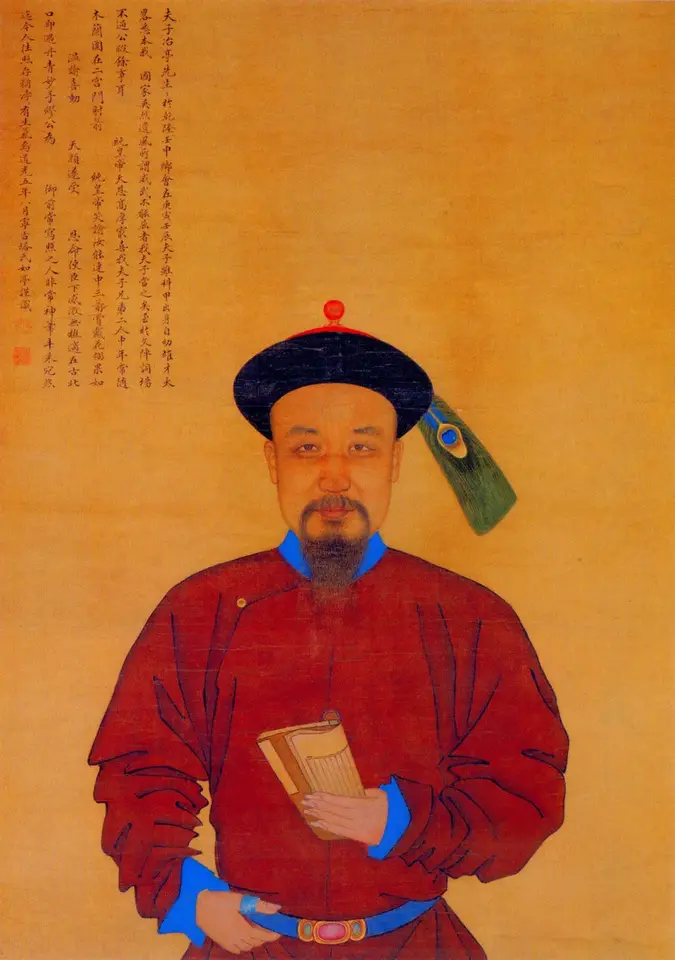
铁保
Tiebao (铁保; 1752–1824), courtesy name Yeting and art name Mei'an, belonged to the Donggo clan of the Manchu Plain Yellow Banner. He was a distinguished high-ranking official, provincial viceroy, master calligrapher, and literary compiler across the Qianlong, Jiaqing, and Daoguang reigns of the Qing Dynasty. Obtaining the Jinshi degree in 1772 at the age of twenty-one, he served through ministerial posts including…
Tiebao (铁保; 1752–1824), courtesy name Yeting and art name Mei'an, belonged to the Donggo clan of the Manchu Plain Yellow Banner. He was a distinguished high-ranking official, provincial viceroy, master calligrapher, and literary compiler across the Qianlong, Jiaqing, and Daoguang reigns of the Qing Dynasty. Obtaining the Jinshi degree in 1772 at the age of twenty-one, he served through ministerial posts including Secretary of the Board of Civil Office, Vice Minister of Rites, and Academician of the Grand Secretariat. During the Jiaqing reign, he was entrusted with supreme provincial commands, serving as Governor of Shandong, Viceroy of Liangjiang, Director-General of Grain Transport, and Minister of Personnel. He directed hydraulic projects along the Yangtze and Huai rivers, reinforcing the monumental Gaojiayan stone dykes and safeguarding Grand Canal transport. Renowned for his prose and calligraphic virtuosity, he synthesized the monumental poise of Yan Zhenqing with the fluid dynamism of Wang Xizhi and Huaisu, standing alongside Prince Yongxing, Liu Yong, and Weng Fanggang as one of the Four Masters of Qing Dynasty Calligraphy. He compiled the 56-volume anthology Classics of the Eight Banners (Baqi Wen Jing), integrating bannerman intellectual culture into the classical Chinese canon. He died in 1824 and was posthumously honored with the name Wenmin.
Born into a prominent military bannerman lineage in Beijing, dedicating himself early to Confucian letters
Earned the Jinshi degree at age twenty-one and was assigned to the Ministry of Personnel
Promoted to Vice Minister of Rites and served as chief examiner for metropolitan examinations
Appointed Governor of Shandong, suppressing White Lotus remnants and clearing judicial backlogs
Promoted to Viceroy of Liangjiang, directing hydraulic engineering along the Huai River
Banished to Xinjiang following a reservoir breach, but soon pardoned and appointed Transport Director
Elevated to Minister of Personnel, standardizing civil official audits
Directed the completion of the 56-volume Classics of the Eight Banners
Retired upon the Daoguang Emperor's accession, residing in Beijing to write and practice calligraphy
Died in Beijing at the age of seventy-three, awarded the posthumous name Wenmin
Tiebao belonged to the noble Donggo clan of the Manchu Plain Yellow Banner, an ancestral family that had produced renowned generals and brigade commanders for generations. While his father Chengtai expected his son to inherit martial command, Tiebao was drawn to classical prose, poetry, and calligraphic art from an early age. When questioned on whether he preferred martial arms or brushcraft, he resolutely chose the scholarly path. Entering the National Academy (Guozijian) at age sixteen, he studied Confucian texts day and night.
In 1772, at only twenty-one years of age, Tiebao passed the metropolitan examinations and was granted the Jinshi degree, entering the Board of Civil Office as a Secretary. His unbending integrity and administrative diligence attracted the admiration of Grand Secretary Agui, who was heading the ministry. Recognizing his extraordinary talents, Agui repeatedly memorialized the throne on his behalf. Tiebao rose to Secretary of Revenue, Reader of the Hanlin Academy, and Sub-Chancellor of the Grand Secretariat. In 1789, he was made Vice Minister of Rites and presided over the imperial metropolitan examinations with scrupulous fairness.
In 1799, as the Jiaqing Emperor assumed direct rule, Tiebao was appointed Governor of Shandong. The province was destabilized by the peripheral White Lotus rebellions, and the yamen was clogged with unredressed lawsuits. Tiebao conducted covert investigations, cashiered corrupt underlings, fortified local defense, and pardoned coerced civilians. He also donated personal funds to renovate provincial academies and public schools, profoundly elevating civil culture across the province.
In 1805, Tiebao was elevated to Viceroy of Liangjiang. Liangjiang was the commercial heart of the empire, where the convergent waters of the Yellow and Huai rivers constantly threatened the Grand Canal. Investigating the Gaojiayan dyke at Hongze Lake, Tiebao found the stone embankments dilapidated and vulnerable to overflow. Defying administrative inertia, he directed the construction of dozens of miles of heavy masonry dykes and cut drainage channels toward the sea, ensuring uninterrupted canal grain transport and safeguarding millions of acres of farmland.
In 1809, a reservoir dyke burst during torrential storms, inundating low-lying districts. Censured for administrative oversight, Tiebao was dismissed and banished to Ili in Xinjiang. Bearing his misfortune with scholarly equanimity, he spent his exile copying classical rubbings, writing poetry, and engaging in intellectual study. Recognizing his long record of devoted service, the Jiaqing Emperor pardoned him the following year and appointed him Director-General of Grain Transport.
In 1814, Tiebao was elevated to Minister of Personnel. In this high central office, he conducted official appraisals strictly on merit and integrity, suppressing sycophancy. Concurrently, he was commanded to compile the Classics of the Eight Banners (Baqi Wen Jing) in fifty-six volumes. Spanning years of meticulous collation, he gathered the finest prose and poetry composed by Manchu bannermen since the founding of the dynasty, establishing an invaluable record of ethnic integration and literary accomplishment.
In 1821, upon the accession of the Daoguang Emperor, Tiebao retired from active service. In his final years, he lived quietly in Beijing, surrounded by ancient rubbings. His brushwork was celebrated throughout China for its profound vigor, architectural strength, and expressive freedom, making him one of the four greatest masters of the era. He passed away in 1824 at seventy-three years of age and was conferred the posthumous name Wenmin.
Directing Liangjiang and national grain transport, Tiebao oversaw the fortification of the Gaojiayan stone dykes and constructed flood-diversion channels that protected Grand Canal navigability and millions of farming households.
Tiebao served as chief compiler of the monumental 56-volume Baqi Wen Jing, assembling works from over two hundred bannermen scholars and providing an indispensable archival monument of Qing intellectual history.
Integrating the monumental gravitas of Yan Zhenqing with the expressive cadence of the Two Wangs, Tiebao stood as one of the Four Masters of Qing Dynasty Calligraphy, shaping the aesthetic transition toward monumentality.
Tiebao achieved profound depth in literary composition and critical theory. In poetics, he championed the doctrine that 'conception is master, vitality is commander' (yi wei zhu, qi wei shuai), fiercely repudiating the mechanical, ornamental imitation prevalent in mid-Qing verse. He insisted that true poetry must emanate directly from authentic personal emotion. During his penal exile to Ili in Xinjiang, confronting harsh desert storms and the austere fortitude of border garrisons, Tiebao composed over one hundred frontier poems distinguished by sorrowful, muscular gravitas and unvarnished realism.
Tiebao possessed extraordinary discernment as a collector and scholar of ancient stone rubbings and calligraphy. His studio, Weiqing Zhai, housed priceless Song rubbings of Han-Wei stelae and authentic Tang-Song masterworks. In his calligraphic theory, he prioritized structural tension and muscular bone-strength, advocating that students master the solemn discipline of regular script before exploring the dynamic freedom of running and cursive scripts. Renowned for generosity toward younger talent, he mentored numerous Manchu and Han scholars, including the prominent cultural figure Fashiyan.
FIGURES ASSOCIATED WITH THIS DYNASTY