Birth in Qiantang
Born into a prominent scholarly lineage in Hangzhou, mastering classics and poetry from youth.
田汝成
Tian Rucheng (田汝成, 1503–1557), courtesy name Shuhe, art name Yuyang, a native of Qiantang County, Hangzhou Prefecture, Zhejiang Province (modern-day Hangzhou), was a prominent writer, historical geographer, and scholar of southwestern frontier ethnography during the middle Ming Dynasty. The Qiantang County Gazetteer praised him: "Among Hangzhou scholars since the Hongzhi and Zhengde eras who achieved renown in the literary…
Tian Rucheng (田汝成, 1503–1557), courtesy name Shuhe, art name Yuyang, a native of Qiantang County, Hangzhou Prefecture, Zhejiang Province (modern-day Hangzhou), was a prominent writer, historical geographer, and scholar of southwestern frontier ethnography during the middle Ming Dynasty. The Qiantang County Gazetteer praised him: "Among Hangzhou scholars since the Hongzhi and Zhengde eras who achieved renown in the literary forest, Tian Rucheng was preeminent." Born into an esteemed scholar-official family, Tian obtained his jinshi degree in 1526 during the Jiajing reign. He served as Secretary in the Ministry of Justice in Nanjing and Vice Director in the Ministry of Rites in Beijing, formulating the liturgical protocols for the Jiajing Emperor's southern suburban solstice sacrifices, royal agricultural plowing, and sericulture rites. In 1531, when the emperor released animals in the imperial hunting parks to pray for an heir, Tian submitted a remonstrance requesting imperial mercy and pardon for prisoners in the imperial jail, which enraged the emperor and precipitated his demotion. Over the subsequent decade, Tian served across southern borderlands as Assistant Education Intendant of Guangdong, Magistrate of Chuzhou, and Assistant Surveillance Commissioner of Guizhou. As Left Assistant Administration Commissioner of Guangxi stationed along the Zuo River, he collaborated with Commander Weng Wanda to devise an ambush that executed rebellious native chieftains Zhao Kai and Li Huan, crushing the Longzhou-Pingxiang uprising and checking the infiltration of Mac Dang Dung's Annam (Vietnam) forces. He subsequently assisted in pacifying the Dateng Gorge Yao rebellions, earning promotion to Vice Education Intendant of Fujian. In 1541, Tian retired due to chronic illness, spending the rest of his life beneath the hills of West Lake in Hangzhou, refusing further public office to concentrate on historical research. His voluminous writings encompassed over 160 fascicles. His core masterpieces include Xihu Youlan Zhi (Gazetteer of West Lake Excursions) in twenty-four volumes, Xihu Youlan Zhi Yu (Sequel to the Gazetteer of West Lake Excursions) in twenty-six volumes detailing Southern Song institutional history and Hangzhou urban customs, and Yan Jiao Jiwen (Chronicles of the Scorching Frontiers) in four volumes, which systematically recorded southwestern tribal customs, native chieftain lineages, and frontier defense strategies. His works combined empirical geography, historical criticism, and social ethnography, establishing an enduring legacy in Ming historical geography and frontier studies.
Born into a prominent scholarly lineage in Hangzhou, mastering classics and poetry from youth.
Passed the metropolitan examination to earn his jinshi degree; appointed Secretary in the Nanjing Ministry of Justice.
Promoted to Vice Director in the Bureau of Ceremonies, drafting protocols for suburban solstice rites and imperial plowing.
Demoted and docked two months' salary after petitioning for prisoner pardons during the imperial park animal release; transferred to Director of Sacrifices.
Exiled to Guangdong as Assistant Education Intendant, investigating southern Cantonese customs.
Appointed Magistrate of Chuzhou in Southern Zhili, promoting agriculture and local education.
Promoted to Assistant Surveillance Commissioner in Guizhou, inspecting military garrisons in Sinan and Shiqian.
Elevated to Left Assistant Administration Commissioner of Guangxi, sailing south to oversee border defense along the Zuo River.
Coordinated with general Weng Wanda to lure and capture rebel chieftains Zhao Kai and Li Huan, thwarting Vietnamese infiltration.
Helped pacify the Dateng Gorge Yao rebellion; promoted to Vice Education Intendant of Fujian for military merits.
Resigned from office due to chronic illness, retiring permanently to Hangzhou to research local and frontier history.
Finalized Xihu Youlan Zhi and Xihu Youlan Zhi Yu in fifty volumes, documenting Hangzhou's historical landscape.
Died at his residence in Hangzhou at age fifty-five; his frontier manuscripts were printed the following year as Yan Jiao Jiwen.
Tian Rucheng was born in 1503 (the 16th year of the Hongzhi reign) in Qiantang County, Hangzhou Prefecture, Zhejiang Province. The Qiantang Tian family was a celebrated lineage of scholars and officials. Endowed with acute intellect and deep literary sensitivity, Tian immersed himself in historical literature and classical poetry from childhood. By early manhood, his essays and poetry were celebrated across Jiangnan literary societies, and his verses were later gathered in prominent Ming anthologies such as Huang Ming Cilin and Ming Shi Zong.
In 1526 (the 5th year of the Jiajing reign), twenty-four-year-old Tian passed the triennial metropolitan examinations to earn his jinshi degree. He received his first assignment as Secretary in the Nanjing Ministry of Justice, where he earned a reputation for resolving complicated legal disputes and overturning unjust verdicts. Recognizing his deep erudition in classical ritual codes, the imperial court transferred him to the Ministry of Rites in Beijing, elevating him to Vice Director of the Bureau of Ceremonies. Following the Great Rites Controversy, the Jiajing Emperor sought to overhaul state rituals. In this role, Tian was tasked with drafting the liturgical procedures for the imperial solstice sacrifices in the southern suburbs, royal spring plowing rites, the empress's silkworm ceremonies, and agricultural inspections in the Western Park. His meticulous research and classical citations won the warm commendation of the sovereign.
In 1531, anxious over his lack of male heirs, the Jiajing Emperor sought divine blessings by releasing birds and animals kept in the Western Park. Seizing the occasion, Vice Director Tian Rucheng submitted an outspoken memorial arguing that while showing benevolence to animals was commendable, displaying mercy toward human subjects suffering in imperial dungeons was far more pressing. He urged the emperor to pardon and release prisoners detained on ambiguous charges. The Jiajing Emperor was infuriated by the rebuke, accusing Tian of grandstanding, docking two months' salary, and demoting him to Director in the Bureau of Sacrifices.
This confrontation permanently derailed Tian's bureaucratic ascent. In 1534, he was transferred away from the capital as Assistant Education Intendant of Guangdong, and in 1535 was demoted to Magistrate of Chuzhou in Southern Zhili. Emulating the famous eleventh-century scholar Ouyang Xiu, who had governed the same prefecture, Tian governed with benevolence, reforming local schools and encouraging farming. In 1536, he was promoted to Assistant Surveillance Commissioner of Guizhou, responsible for inspecting the military garrisons and civil administrations of Sinan and Shiqian. Stationed amid the mountainous terrain of the southwest, Tian conducted extensive investigations of Miao villages, examining the practical administration of native chieftains (tusi) versus civilian magistrates (liuguan).
In 1538, while on leave in his hometown, Tian received urgent orders appointing him Left Assistant Administration Commissioner of Guangxi, assigned to the Zuo River Circuit based in Nanning. The frontier region was in turmoil: native chieftains Zhao Kai of Longzhou and Li Huan of Pingxiang had murdered hereditary leaders to usurp command, fortifying mountain redoubts in open rebellion. Concurrently, across the border in Annam, general Mac Dang Dung had usurped the Le throne; Mac sought secret alliances with Zhao and Li, attempting to absorb the border districts under Vietnamese authority.
While many metropolitan ministers demanded massive military invasions, Commissioner Tian Rucheng and Right Assistant Censor-in-Chief Weng Wanda realized that frontal assaults in dense jungle terrain would incur catastrophic casualties and drive the rebels into direct military alliance with Annam. Tian devised a strategic trap of deceptive conciliation: feigning formal confirmation of their hereditary status to lower their defenses, he invited Zhao Kai and Li Huan to provincial headquarters for festive negotiations. In 1539, when the two rebel chieftains arrived at the designated pavilion, Tian's concealed guards sprang forth, executing Zhao and Li on the spot. Leaderless, the rebel forces disintegrated, and Tian reorganized the frontier defenses under civilian oversight, completely neutralizing Vietnamese designs on Chinese border territory. Commander-in-Chief Mao Bowen lauded Tian as "a scholar who masters military expediency." Tian subsequently helped Weng Wanda suppress Yao insurgencies in Dateng Gorge, receiving promotion to Vice Education Intendant of Fujian in 1540.
In 1541, plagued by malaria and chronic illnesses contracted in the southern subtropical climate, thirty-nine-year-old Tian Rucheng resigned his commission and retired to his native Hangzhou, resolving never to seek office again.
During his sixteen years of retirement, Tian resided on the shores of West Lake, dedicating himself to research. He explored scenic peaks, temples, and waterways, transcribing hundreds of stone steles and Song-Yuan manuscripts. In 1547, he completed the twenty-four-volume Xihu Youlan Zhi and its twenty-six-volume companion Xihu Youlan Zhi Yu, creating the definitive historical geography of Hangzhou. Concurrently, he organized his Southwestern field notes, which were published by his colleague Chen Xizhai in 1558 under the title Yan Jiao Jiwen. In 1557, Tian passed away peacefully at his lakeside residence at age fifty-five, leaving an enduring intellectual monument in Chinese geographical literature.
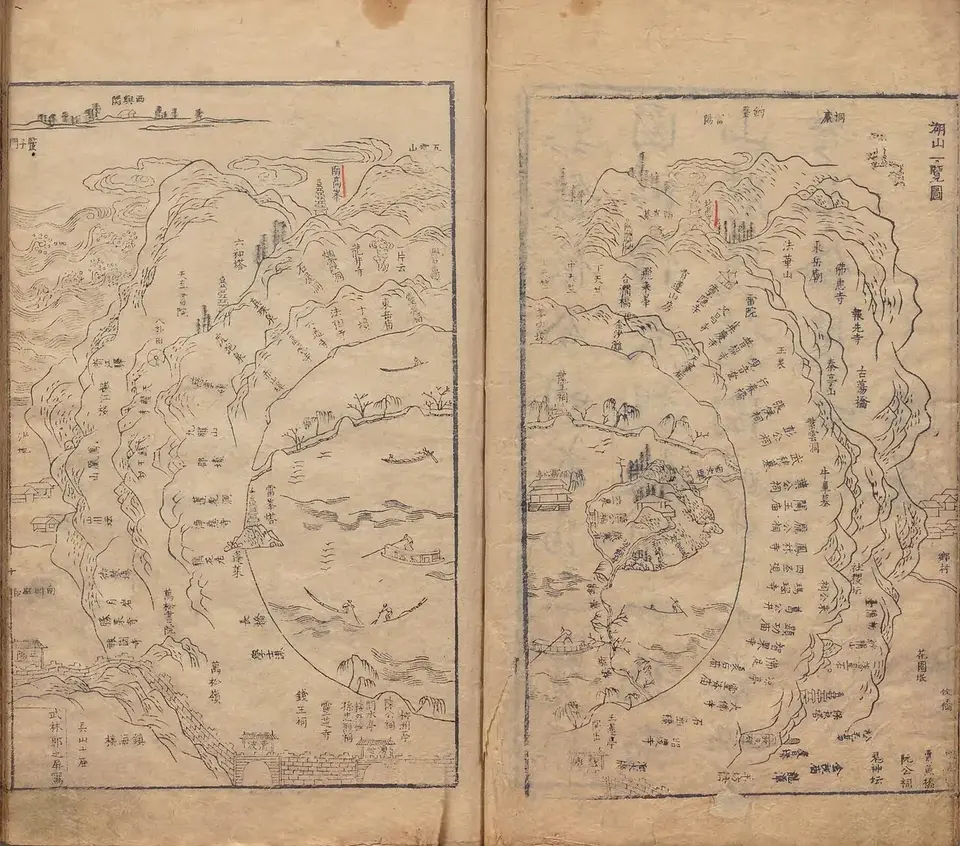
Tian Rucheng's crowning historical contribution was the compilation of Xihu Youlan Zhi (twenty-four volumes) and Xihu Youlan Zhi Yu (twenty-six volumes), spanning fifty volumes in total. While Hangzhou possessed Song-era gazetteers by Zhou Cong and Qian Shuoyou, they were bureaucratic compilations focusing on administrative subdivisions rather than the cultural landscape.
Tian pioneered an innovative structural approach, organizing chapters by physical terrain: South Mountain, North Mountain, Solitary Hill, and West Lake Waterways. Adhering to the principle of "attaching historical deeds to geographical landmarks," he investigated the physical origins, Song-Yuan anecdotes, and literary inscriptions for every landmark. Its companion work, Xihu Youlan Zhi Yu, explored political transitions, court intrigues, and urban folklore, offering penetrating reflections on the demise of the Southern Song dynasty. Classical editors of the Siku Quanshu praised it as an essential documentary foundation for Song and Ming historical geography.
Tian's four-volume treatise Yan Jiao Jiwen (Chronicles of the Scorching Frontiers) stands as an indispensable foundational work in Chinese frontier ethnography and native chieftain studies. Written during his five years of service in Guizhou and Guangxi, the work was grounded in direct field observation rather than hearsay.
Tian documented the dialects, marital customs, mourning rituals, clothing, and religious beliefs of numerous ethnic groups, including the Zhuang, Miao, Yao, Yi, and Dong. He traced the genealogies and rivalries of powerful chieftain lineages (such as the Cen, Mo, Zhao, and Li clans) and appended a specialized study of Sino-Vietnamese diplomacy (Annan Kao). The work provided late Ming policy-makers with balanced models of flexible frontier governance and remains a vital primary source for modern anthropologists and ethnohistorians.
In 1539, Tian's suppression of the Longzhou and Pingxiang rebellion exemplified classical frontier crisis management. Recognizing that open warfare would push native chieftains into the arms of the Mac regime in Vietnam, Tian orchestrated a coordinated diplomatic trap that eliminated the rebel leaders without large-scale bloodshed.
His decisive action preserved the integrity of the southern frontier, neutralized foreign encroachment, and pacified the Zuo River corridor. His subsequent governance proposals for Dateng Gorge illustrated his capacity to combine civilian Confucian ethics with pragmatic military strategy.
FIGURES ASSOCIATED WITH THIS DYNASTY