Birth in Binzhou
Born into a prominent scholar-official family in Xinping, Binzhou; grandson of late-Tang poet Tang Yanqian.
陶谷
Tao Gu (陶谷, 902–970), originally surnamed Tang (唐) and renamed Tao to observe the imperial name taboo of Emperor Gaozu of Later Jin, styled Xiushi (秀实), hailed from Xinping, Binzhou (present-day Binzhou, Shaanxi Province). Grandson of prominent late-Tang poet Tang Yanqian and son of Prefect Tang Huan, Tao Gu was a distinguished civil minister, scholar, calligrapher, and naturalist who served across four successive dynasties:…
Tao Gu (陶谷, 902–970), originally surnamed Tang (唐) and renamed Tao to observe the imperial name taboo of Emperor Gaozu of Later Jin, styled Xiushi (秀实), hailed from Xinping, Binzhou (present-day Binzhou, Shaanxi Province). Grandson of prominent late-Tang poet Tang Yanqian and son of Prefect Tang Huan, Tao Gu was a distinguished civil minister, scholar, calligrapher, and naturalist who served across four successive dynasties: Later Jin, Later Han, Later Zhou, and the Northern Song. Renowned for his prodigious memory, literary fluency, and mastery of classics, history, and clerical calligraphy, he was particularly expert in institutional rites and historical precedents. During the Later Jin, Tao Gu served as Military Judge of Shanzhou, Censor, and Drafter of Imperial Edicts, managing state decrees; under the Later Han, he was appointed Policy Review Official; under the Later Zhou, he won the deep confidence of Emperor Shizong, presenting the Frontier Pacification Strategy (Pingbian Ce) to advocate southern military campaigns against Southern Tang, rising to Vice Minister of War and Chief Academician of the Hanlin Academy. In 960, during the Chenqiao Mutiny, Tao produced a pre-drafted abdication edict from his sleeve to facilitate Emperor Taizu's accession. Entering the Song, he served as Minister of Rites, Minister of Justice, and Minister of Revenue while retaining the rank of Chief Academician of the Hanlin Academy, directing the formulation of the Northern Song southern suburban-sacrifice rites. Although his literary talents were celebrated, his political ambition, opportunism, and jealousy drew the contempt of Emperor Taizu, who mocked his drafts as "painting a gourd according to the model," barring him from ever reaching the premiership. He passed away in 970 at age sixty-eight and was posthumously granted the rank of Right Vice Director of the Department of State Affairs. In cultural history, Tao Gu made enduring contributions through his encyclopedic miscellany Clear Record of the Strange (Qingyilu) in two volumes, which categorized hundreds of items spanning astronomy, geography, dining, tea lore, and material culture across the Tang, Five Dynasties, and early Song, pioneering the field of historical material culture studies, supplemented by his tea classic Record of Tea (Chuanming Lu).
Born into a prominent scholar-official family in Xinping, Binzhou; grandson of late-Tang poet Tang Yanqian.
Avoided the imperial taboo name of Shi Jingtang by changing his surname to Tao; served as Military Judge of Shanzhou.
Recommended by Grand Councilor Li Song to the Hanlin Academy, appointed Drafter of Imperial Edicts to manage court proclamations.
Khitans invaded Kaifeng and coerced Tao north; escaped in disguise to join Liu Zhiyuan, appointed Policy Review Official.
Appointed Right Policy Advisor under Emperor Taizu of Later Zhou, serving as an elder scholar-official in the inner court.
Accompanied Emperor Shizong on campaign and submitted the Frontier Pacification Strategy, urging the conquest of the Huai River basin.
Elevated to Vice Minister of War and Chief Academician of the Hanlin Academy, composing court praises and agrarian edicts.
Provided the pre-drafted abdication edict during the Chenqiao Mutiny; appointed Minister of Rites and Chief Academician of the Hanlin Academy.
Presided over the codification of the Northern Song southern suburban-sacrifice rites, serving successively as Minister of Justice and Revenue.
Commanded to supervise ministerial appointments in the Ministry of Personnel and direct the metropolitan civil service examinations.
Passed away in his Kaifeng residence at age sixty-eight; Emperor Taizu suspended court audiences and posthumously conferred Right Vice Director of the Department of State Affairs.
Tao Gu belonged to an eminent late-Tang scholar-official family of Xinping, Binzhou (present-day Binzhou, Shaanxi Province). His grandfather Tang Yanqian served as Prefect of Ci, Jiang, and Li prefectures and was celebrated as a master poet of the late Tang; his father Tang Huan held office as Prefect of Yizhou before being murdered by warlord Yang Chongben during regional warfare. Reared by his mother, Lady Liu, who remarried into the Yang household, young Tao Gu absorbed rich literary instruction from childhood, composing refined classical essays by his early teens while exploring dynastic chronicles and astronomical divination.
Following the establishment of the Later Jin Dynasty, Tao Gu entered bureaucratic service, initially appointed Collator and subsequently Military Judge of Shanzhou. Discontented with provincial obscurity, Tao Gu presented an extensive self-recommendation memorial to Grand Councilor Li Song. Impressed by his intellectual eloquence, Li Song recommended him to Emperor Gaozu of Later Jin, who promoted him to Assistant Editorial Director and Subeditor of the Academy of Scholarly Worthies. Because Emperor Gaozu's personal name was Shi Jingtang, all subjects bearing the surname Tang were legally mandated to observe the imperial name taboo; Tao Gu altered his surname from Tang to Tao based on phonetic resonance. Promoted successively to Censor and Drafter of Imperial Edicts, he was granted exclusive control over the drafting of inner and outer court proclamations in 940 when Gaozu temporarily suspended the Hanlin Academy.
In 944, Tao Gu rose to Director of the Bureau of Granaries, but fell into bitter conflict with the powerful warlord An Shenxin of Yanzhou. An Shenxin impeached him, and the court, appeasing military commanders, demoted Tao to Vice Minister of the Court of Imperial Sacrifices. In this judicial post, observing rampant delays and superficial investigations in the censorate, Tao submitted comprehensive reform memorials establishing strict procedural deadlines, which were fully adopted by the court, earning him elevation to Secretariat Drafter.
In 947, Emperor Taizong of Liao invaded central China, overthrowing the Later Jin Dynasty and sacking Kaifeng. When northern resistance compelled the Liao monarch to withdraw, Khitan cavalry coerced Tao Gu and fellow courtiers to accompany the retreating host north. While traversing Hebei, Tao Gu disguised himself in coarse hemp robes, seeking sanctuary inside a Buddhist monastery as a novice monk, yet he was discovered and dragged north under sword-point. Fortunately, in the fourth month of 947, the Liao emperor died abruptly at Shahu Forest near Luancheng. Seizing upon the ensuing panic, Tao Gu escaped under cover of darkness, trekking south across the Yellow River to join Liu Zhiyuan, who had proclaimed the Later Han Dynasty in Taiyuan, and was appointed Policy Review Official.
In 951, Emperor Taizu Guo Wei founded the Later Zhou, appointing Tao Gu Right Policy Advisor. Following the accession of Emperor Shizong Chai Rong in 954, Tao accompanied the imperial campaign against Northern Han at Gaoping. In 955, Emperor Shizong convened over twenty inner court ministers, commanding each to submit strategic treatises on governance and imperial pacification. While most courtiers offered conventional platitudes urging moral virtue, Tao Gu, along with Dou Yi, Wang Pu, and Yang Zhaojian, presented the incisive Frontier Pacification Strategy (Pingbian Ce), demonstrating that the empire's supreme priority was to launch immediate amphibious campaigns across the Huai River to conquer the southern circuits of Southern Tang, financing future northern campaigns. Emperor Shizong enthusiastically adopted Tao Gu's strategic analysis, confirming the invasion policy.
In 956, Tao was promoted to Vice Minister of War and Chief Academician of the Hanlin Academy. When Shizong commissioned wooden carvings of farmers and sericulture maidens in the palace to remind the throne of agricultural toil, Tao composed official hymns commemorating imperial benevolence. In 959, he was reassigned as Vice Minister of Personnel, directing official civil appointments.
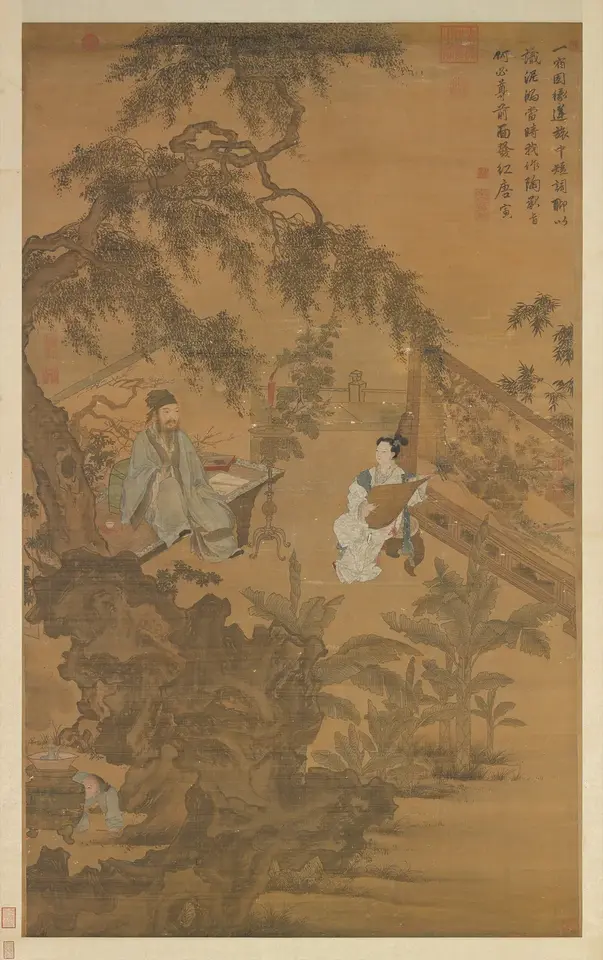
During the Later Zhou campaigns against Southern Tang, Tao Gu was dispatched on an imperial diplomatic embassy to Jinling. Arriving as the envoy of the northern hegemon, Tao behaved with haughty arrogance, treating the Southern Tang sovereign and ministers with unbending condescension. Perceptive Southern Tang Chancellor Han Xizai recognized that Tao Gu's severe outward demeanor masked inner vanity, arranging for the renowned singing courtesan Qin Ruolan to disguise herself as a humble post-station maiden in coarse dress and bamboo hairpin, sweeping the courtyard outside Tao's quarters daily. Enamored by her beauty and delicate charm, Tao succumbed to her advances, inviting her into his chamber and composing the romantic lyric Chunguanghao ("Good Spring Days") in his own hand as a token of love.
Days later, Southern Tang ruler Li Jing hosted a lavish banquet in Tao Gu's honor in Chengxin Hall. Tao assumed his customary austere, unsmiling posture. During the banquet, Li Jing commanded musicians to step forward, whereupon Qin Ruolan emerged holding a pipa and sang Tao Gu's romantic verses before the assembled court. Humiliated beyond measure, Tao attempted to conceal his mortification by gulping goblet after goblet of wine until he collapsed in drunken sickness before the dais. Following his return to Kaifeng, news of the diplomatic scandal swept through northern and southern courts, severely undermining his moral prestige and permanently blunting his political advancement.
In early 960, Zhao Kuangyin staged the Chenqiao Mutiny to seize the throne from the Later Zhou. Returning to the palace, imperial commanders discovered that grand councilors had fled without drafting an abdication proclamation. Having anticipated the dynastic transition, Tao Gu calmly pulled a pre-drafted abdication edict of the young Emperor Gong of Later Zhou from his robe sleeve, remarking: "This paramount state ceremony has already been prepared by your subject." Zhao Kuangyin assumed the throne, founding the Song Dynasty, and appointed Tao Minister of Rites while confirming him as Chief Academician of the Hanlin Academy.
Between 960 and 963, Tao Gu led the court in establishing the northern capital's official southern suburban-sacrifice rites, standardizing ritual sacrifice, ancestral temple shrines, imperial carriages, and court regalia. In 964, he supervised ministerial civil selections and directed the metropolitan examinations. However, Tao was politically jealous and constantly schemed for the grand councilorship, allying with Zhao Pu to block rival Dou Yi. Emperor Taizu despised his opportunism and remembered the Qin Ruolan affair with disdain. When courtiers recommended Tao for premier, Taizu mocked him: "The Hanlin academicians merely copy past drafts and swap names, simply painting a gourd according to the model—hardly the mark of a grand councilor!" Learning of the imperial rebuke, Tao composed a self-deprecating verse acknowledging that he merely painted gourds year after year, further alienating the sovereign. In 970, Tao passed away in Kaifeng at age sixty-eight, receiving the posthumous title of Right Vice Director of the Department of State Affairs.
Tao Gu's contribution to the Frontier Pacification Strategy (Pingbian Ce), submitted in 955, was a foundational text in tenth-century geopolitical strategy. Resisting vague philosophical rhetoric, Tao articulated a rigorous geopolitical roadmap: recognizing that the northern Khitans and Northern Han occupied impregnable fortifications that would exhaust northern armies, he urged the Later Zhou court to strike southward first. Conquering the fertile Huai River basin would strip Southern Tang of immense agrarian tax revenues, enrich the imperial treasury, and secure the strategic northern banks of the Yangtze. This geopolitical analysis served as the operational masterplan for the campaigns of Emperor Shizong and the ultimate unification strategies executed by Song Taizu.
During the early Jianlong and Qiande eras, the newly established Song court faced fragmented ceremonial systems inherited from the warlord anarchy of the Five Dynasties. Leveraging his mastery of ancient ritual precedents, Tao Gu directed the formulation of the Song dynasty's southern suburban-sacrifice rites. He systematized the dimensional proportions of the round sacrificial altar, codified ancestral co-sacrifices with Heaven and Earth, and regulated ritual jade, silk, vessels, and court processions. This ceremonial synthesis established the celestial legitimacy of the Song monarchy, elevating the dynastic state from a regional military regime into a civilized imperial order that endured for centuries.
Tao Gu's enduring intellectual legacy rests upon his authorship of the encyclopedic miscellany Clear Record of the Strange (Qingyilu) in two volumes, alongside his tea classic Record of Tea (Chuanming Lu). A passionate collector of ancient calligraphy, paintings, and bronzes, Tao categorized 648 anecdotes spanning thirty-seven distinct domains, including astronomy, geography, flora, fauna, implements, cuisine, tea brewing, and scholarly accoutrements across the Tang, Five Dynasties, and early Song. The work provides irreplaceable primary documentation regarding the evolution of daily material culture, culinary inventions, and social customs, pioneering the methodology of cultural and material philology in Chinese historiography.
FIGURES ASSOCIATED WITH THIS DYNASTY