Birth in Shuzhou
Born into a renowned medical lineage in Jinyuan, immersing himself in family medical compendia from youth.
唐慎微
Tang Shenwei (c. 1056–1093), courtesy name Shenyuan, was a native of Jinyuan County in Shuzhou (modern Chongzhou, Sichuan), who later settled in Huayang County, Chengdu. He was the most celebrated pharmaceutical scholar and clinical physician of the Northern Song dynasty, revered as the great synthesizer of ancient Chinese pharmacopeia. Born into an ancestral lineage of medical practitioners, Tang inherited deep clinical…
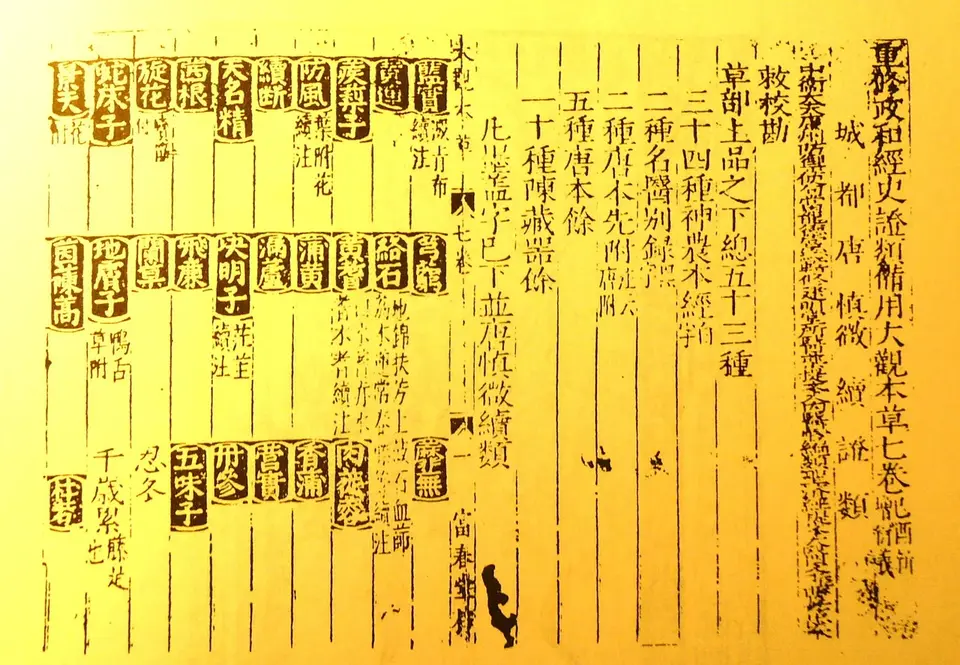
Tang Shenwei (c. 1056–1093), courtesy name Shenyuan, was a native of Jinyuan County in Shuzhou (modern Chongzhou, Sichuan), who later settled in Huayang County, Chengdu. He was the most celebrated pharmaceutical scholar and clinical physician of the Northern Song dynasty, revered as the great synthesizer of ancient Chinese pharmacopeia. Born into an ancestral lineage of medical practitioners, Tang inherited deep clinical mastery of classical formulas. Invited to Chengdu by regional military commissioner Li Duanbo, he treated patients regardless of wealth or social rank. Exceptionally, when scholars sought his medical care, Tang refused financial fees, asking only for transcripts of rare medical prescriptions, drug origins, and herbal folklore discovered in ancient classical literature. Through decades of exhaustive collation, Tang compiled the monumental thirty-two-volume treatise Classified Emergency Materia Medica from Classics and Histories (Jingshi Zhenglei Beiji Bencao, commonly known as Zhenglei Bencao). Documenting 1,746 distinct medicinal substances, this masterwork introduced the revolutionary method of pairing pharmacological descriptions directly with clinical formulas, preserving countless lost ancient texts and serving as the foundational blueprint for Li Shizhen's Ming-era Bencao Gangmu.
Born into a renowned medical lineage in Jinyuan, immersing himself in family medical compendia from youth.
Deeply mastered the Shennong Bencao Jing and Tang-era Xinxiu Bencao, excelling in pulse diagnosis and clinical therapy.
Invited by Sichuan Regional Commissioner Li Duanbo to practice medicine in Chengdu, rapidly gaining fame across Shu.
Treated scholar-officials free of charge in exchange for unrecorded medicinal passages from classical literature.
Withdrew from public life to synthesize medicinal data across 247 classical texts into an innovative pharmacological format.
Completed the thirty-two-volume Zhenglei Bencao, documenting over 1,700 medicinal substances with over 900 illustrations.
Succumbed to chronic exhaustion in Chengdu at age thirty-eight, leaving a peerless medical legacy mourned across Sichuan.
Tang Shenwei was born into an established medical lineage on the Chengdu plain. His family had practiced healing arts for generations, amassing substantial collections of medical scrolls. Quiet, reflective, and observant by nature, Tang showed an early affinity for herbal studies, memorizing foundational classics such as the Huangdi Neijing (Inner Canon of the Yellow Emperor), Shanghan Zabing Lun (Treatise on Cold Damage Diseases), and Shennong Bencao Jing (Divine Farmer's Classic of Materia Medica).
Unlike conventional book-bound physicians, Tang spent his youth exploring the mountains and river basins of Sichuan and Shaanxi. He accompanied herbalists into rugged peaks, closely observing ecological habitats, seasonal harvesting practices, and authentic processing techniques. This blend of empirical botanical investigation and textual study laid the bedrock of his pharmacological scholarship.
During the Yuanyou era of Emperor Zhezong, the eminent official Li Duanbo was assigned to command Chengdu. Having heard of Tang Shenwei's diagnostic prowess, Li formally invited Tang to practice in the provincial capital. Tang established his clinic in Huayang County, on Chengdu's outskirts.
Tang's reputation rested not only on clinical effectiveness but on exemplary medical ethics. He treated all patients with identical compassion, whether they were high-ranking provincial dignitaries, destitute peddlers, or indentured servants. Whenever an urgent call for help arrived, Tang grabbed his medical kit and walked out immediately, unhindered by severe storms or midnight hours. For impoverished households, he routinely waived treatment costs and distributed expensive medications without charge.
To assemble the most comprehensive pharmaceutical library in the empire, Tang devised an ingenious compact with the literati: he declined all consultation gifts, requesting instead that whenever scholars encountered forgotten medical prescriptions, herbal names, or clinical anecdotes while reading classics, dynastic histories, philosophers, or poetry collections, they transcribe and share them with him. Grateful for his medical care, Sichuan scholars eagerly contributed transcriptions, funneling vast troves of uncatalogued medical lore into Tang's archive.
Drawing upon ten years of intensive research, Tang synthesized ancient compendia—including Tao Hongjing's Bencao Jing Jizhu, the Tang government's Xinxiu Bencao, and Northern Song court revisions—while integrating excerpts from 247 non-medical canonical works.
In 1092, he completed the draft of Jingshi Zhenglei Beiji Bencao (Zhenglei Bencao). Exhausted by decades of unrelenting clinical service and late-night archival research, Tang Shenwei fell gravely ill and passed away in 1093 at the premature age of thirty-eight.
Tang Shenwei's Zhenglei Bencao stands as one of the twin peaks of traditional Chinese pharmacopeia alongside Li Shizhen's later work. The encyclopedic work listed 1,746 distinct medicinal substances, incorporating more than 600 newly documented herbs and mineral remedies previously omitted by court pharmacopeias.
Structurally, Tang revolutionized pharmaceutical writing by creating the "Formula Follows Substance" framework. Under each herbal entry, he systematically provided standard botanical descriptions, classical citations, preparation methods, and over 3,000 clinically validated therapeutic formulas. Furthermore, the work incorporated 933 detailed woodblock illustrations, establishing an indispensable visual and clinical reference for doctors across East Asia.
Because of recurring wars and the destruction of imperial libraries during the Jurchen invasions, numerous Han, Wei, Six Dynasties, and Tang medical treatises completely vanished in their original editions. Tang Shenwei's rigorous philological discipline—always faithfully quoting sources without arbitrary editorial truncations—safeguarded irreplaceable fragments of lost masterpieces such as Mingyi Bielu, Leigong Paozhi Lun, and Bencao Shiyi.
Four centuries later, when Ming pharmacologist Li Shizhen undertook the composition of Bencao Gangmu (Compendium of Materia Medica), he relied directly upon Tang Shenwei's Zhenglei Bencao as his primary structural and textual foundation. In his preface, Li Shizhen celebrated Tang's contribution with profound gratitude, proclaiming that "the preservation of ancient materia medica and individual prescriptions down through a thousand years without vanishing is entirely due to Tang Shenwei."
FIGURES ASSOCIATED WITH THIS DYNASTY