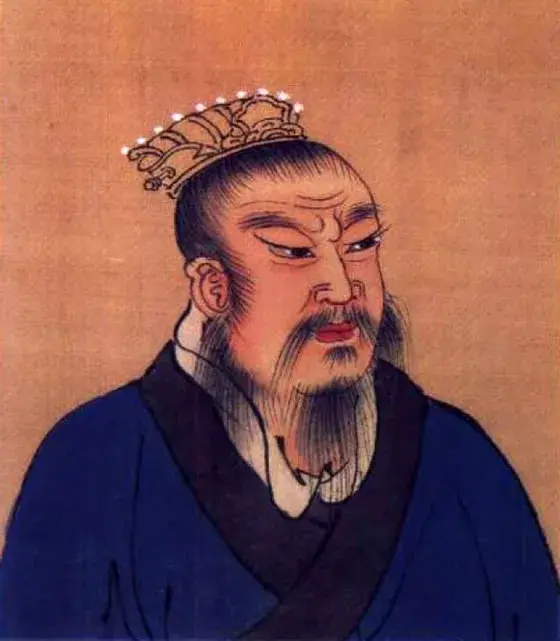
Biography
Imperial Consort and Musical Confidante of the Founder
Lady Tangshan lived during the founding era of the Western Han Dynasty. While her precise birth and death dates are unrecorded in dedicated dynastic biographies, Eastern Han scholar Fu Qian noted in his commentary on the Book of Han: "Tangshan was a consort of Emperor Gaozu." The Three Kingdoms historian Wei Zhao likewise specified: "Tangshan is a compound surname." During the pre-Qin and early Han eras, families bearing the surname Tangshan were distributed across the borderlands between the Central Plains and the Chu cultural sphere.
In the early Han Dynasty, inner court ranks were largely modeled upon Qin precedents. According to the "Biographies of Imperial In-Laws" in the Book of Han, the emperor's mother was titled Empress Dowager, the grandmother Grand Empress Dowager, the lawful wife Empress, and primary consorts were styled "Lady" (furen), outranking secondary consorts such as Beauties, Good Ladies, and Ladies of the Eighth Rank. Lady Tangshan held a status alongside Lady Qi, Lady Bo (mother of Emperor Wendi), and Lady Guan, reflecting her elevated position within the inner court.
Emperor Gaozu (Liu Bang) originated from Peixian in Chu and retained a lifelong passion for Chu culture, language, and dance. When the emperor composed the famous Song of the Wild Geese in his twilight years, he instructed Lady Qi to dance while he sang in the Chu mode. Lady Tangshan was revered not merely for her royal poise, but primarily for her profound understanding of Chu acoustics, poetic metrics, and modal orchestration. Capable of weaving the dramatic rhythms of southern song into the austere solemnity of northern ceremonial hymns, she became the founding emperor's foremost musical interlocutor.
Imperial Commission and the Chamber Sacrificial Hymns
Upon unifying China in 202 BCE, Emperor Gaozu commissioned the scholar Shusun Tong to formulate imperial court etiquette, establishing order among the civil and military nobility. However, the fledgling dynasty still lacked dedicated liturgical hymns for the imperial ancestral temples and inner sacrificial chambers to proclaim that the Han had received the Mandate of Heaven.
In classical antiquity, ancestral temple music was regarded as a sacred instrument of state legitimacy. Emperor Gaozu maintained that just as the ancient Zhou Dynasty possessed the martial and civil music of Kings Wen and Wu along with the virtuous chamber songs of the Classic of Poetry, the Han dynasty required solemn hymns to comfort the spirits of ancestral emperors. Recognizing Lady Tangshan's rare literary erudition and musical skill, Emperor Gaozu issued an imperial decree charging her with the creation of the Chamber Sacrificial Hymns.
Accepting the mandate, Lady Tangshan dedicated years to researching classical liturgies and composing the comprehensive seventeen-movement suite. Rejecting the private, sentimental themes of traditional women's poetry, she adopted an imperial perspective centered upon cosmic mandate, imperial unification, filial devotion to royal ancestors, and the universal pacification of the four quarters.
Stylistically, she blended the irregular, cascading meters of Chu poetry with the archaic four-character diction of the Classic of Poetry. Her lyrics resonated with cosmological imagery of vast oceanic waters and cosmic order, while preserving the austere gravitas demanded of ancestral sacrifice. Upon auditing the performance, Emperor Gaozu was deeply impressed, decreeing that her compositions be officially adopted as the permanent ancestral liturgical music of the imperial house.
Orchestration with Pipes and Renaming as Anshi Music
In the fourth lunar month of 195 BCE, Emperor Gaozu died in the Changle Palace, and Crown Prince Liu Ying ascended the throne as Emperor Huidi. Following Gaozu's passing, Empress Dowager Lü launched ruthless purges against favored consorts, executing Lady Qi and poisoning the Prince of Zhao. However, because Lady Tangshan had devoted herself strictly to ancestral liturgies and never engaged in political factionalism or succession rivalries, and because her sacrificial hymns had become enshrined as sacred ancestral statutes, she remained unharmed, living out her later years in serene palace seclusion.
In 193 BCE, the Han court undertook a comprehensive standardization of national ritual music. Director of the Music Bureau Xiahou Kuan was instructed by Emperor Huidi to augment Lady Tangshan's original score with an imperial orchestration.
Preserving the melodic elegance of the original Chu modes, Xiahou Kuan integrated transverse flutes, panpipes, tuned bells, and lithophones, enriching the harmonies and imbuing the suite with profound ceremonial resonance. To celebrate universal peace and pray for the eternal tranquility of the imperial lineage, Emperor Huidi issued an edict renaming the work Anshi Music ("Music of Peaceful Epochs"). Henceforth, Anshi Music became a core liturgical suite performed during imperial ancestral ceremonies and state banquets throughout the Western and Eastern Han dynasties.
Literary Stature and Critical Acclaim Across Dynasties
During the Eastern Han period, historian Ban Gu transcribed the complete text of Lady Tangshan's seventeen hymns into the "Treatise on Rites and Music" in the Book of Han, entitling them Chamber Songs of Anshi. This inclusion ensured their survival into the post-classical era. Subsequent anthologists, including Shen Yue in the Book of Song, Guo Maoqian in the Collected Yuefu Poetry, and Shen Deqian in the Source of Ancient Poetry, placed Lady Tangshan's songs at the very vanguard of their collections.
In traditional Chinese literary criticism, Lady Tangshan's poetic achievement drew extraordinary praise. The late Ming critic Zhong Xing observed in Anthology of Poetry by Eminent Women: "The poetry of women often suffers from excessive softness and seductive delicacy; yet Lady Tangshan's verse is classical, profound, and severe, echoing the archaic tones of the Three Dynasties. It effortlessly commands the respect of the finest male literati! That state sacrificial anthems of this caliber originated from the inner quarters of the early Han compels men across centuries to bow in admiration."
Qing Dynasty scholar Wang Xianqian remarked in his annotations to the Book of Han that Lady Tangshan harmonized Chu melodies with the canonical rectitude of the Greater Odes, preserving the emotional energy of southern song while projecting the majesty of a unified empire. As the first female author in Chinese history whose name is verified and whose complete liturgical hymns are preserved in standard dynastic histories, Lady Tangshan holds an irreplaceable position in classical Chinese literature and musicology.
Major Achievements
Blending Chu Melodies to Create Imperial Sacrificial Hymns
At the founding of the Han Dynasty, when state rituals were in disarray, Lady Tangshan undertook the vital task of formulating imperial ancestral liturgies.
Drawing upon southern Chu rhythms and metric structures, she composed the monumental seventeen-hymn suite Chamber Sacrificial Hymns, establishing the definitive textual and melodic model for imperial ancestral sacrifices.
Elevated Elegance and Reinterpreting the Greater Odes
Lady Tangshan's compositions departed completely from the conventional themes of domestic melancholy and romantic longing that characterized early female verse.
Her hymns celebrated celestial authority, ancestral reverence, and imperial consolidation, capturing the solemn majesty of the Classic of Poetry's Greater Odes while establishing the grand aesthetic tone of early Han imperial literature.
Orchestration of Court Music and Institutionalization in Yuefu
In 193 BCE, under Emperor Huidi, Music Bureau Director Xiahou Kuan orchestrated her compositions with flutes and pipes, renaming the suite Anshi Music.
Her work stood as the cornerstone of imperial ancestral ceremonies, initiating the institutional practice of the Music Bureau in collecting folk melodies, arranging them with court instruments, and elevating them to official state anthems.
Monumental Female Authorship in Classical Epigraphy
Preserved intact within Ban Gu's Book of Han, Lady Tangshan's hymns constitute the only complete body of state liturgical poetry authored by a woman in the Twenty-Four Dynastic Histories.
By crafting official hymns for the Son of Heaven, she dismantled the patriarchal monopoly over ritual literature and established a monumental landmark in Chinese female intellectual history.