Birth in Jiangxia
Born into a theatrical family in Dalu Village, Jiangxia County, Wuchang Prefecture, Hubei.
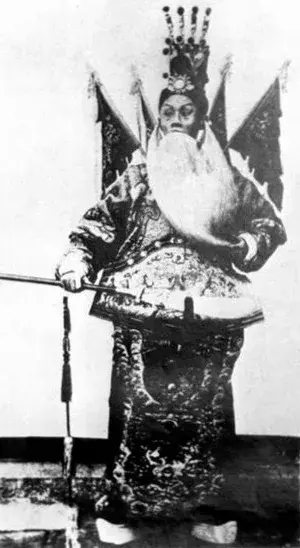
谭鑫培
Tan Xinpei (April 23, 1847 – May 10, 1917), originally named Jinfu, courtesy name Wangzhong, stage name Xiao Jiaotian, was a native of Jiangxia County, Wuchang Prefecture, Hubei. He was a monumental theatrical innovator in the history of Peking Opera, founder of the seminal Tan School of elderly male roles (Laosheng), and widely acclaimed across China as the "King of Actors." Born into a hereditary theatrical family, Tan…
Tan Xinpei (April 23, 1847 – May 10, 1917), originally named Jinfu, courtesy name Wangzhong, stage name Xiao Jiaotian, was a native of Jiangxia County, Wuchang Prefecture, Hubei. He was a monumental theatrical innovator in the history of Peking Opera, founder of the seminal Tan School of elderly male roles (Laosheng), and widely acclaimed across China as the "King of Actors." Born into a hereditary theatrical family, Tan moved to Beijing with his father in childhood, initially training in martial male (Wusheng) and female roles before shifting to elder male roles. Synthesizing the vocal and stage conventions of masters such as Cheng Changgeng, Yu Sansheng, and Zhang Erkui, he founded the Tan School, the first systematized school of Laosheng in Peking Opera history. Tan's vocal delivery was noted for melodic sweetness, subtle emotional shading, and crisp diction, completely transforming earlier stiff and monochromatic styles. His stage deportment seamlessly united martial agility with scholarly dignity, igniting an empire-wide craze summarized by the contemporary dictum "No tune is sung that does not follow Tan." In 1890, he was recruited into the Qing palace's Shengping Department as an imperial court entertainer, earning unprecedented favor from Empress Dowager Cixi and the Guangxu Emperor. In 1905, he starred in China's very first motion picture, The Battle of Dingjunshan, inaugurating Chinese cinematic history. His direct lineage sustained Peking Opera across seven generations, nurturing legends including Mei Lanfang and Yang Xiaolou. He died in Beijing in 1917 at age seventy-one.
Born into a theatrical family in Dalu Village, Jiangxia County, Wuchang Prefecture, Hubei.
Relocates to Beijing with his father, enrolling in the Jinshengzhi training troupe to study martial and civil acting.
Performs in the Xiaotianxi and Sanqing troupes, receiving direct artistic guidance from troupe master Cheng Changgeng.
Synthesizes traditions of Cheng, Yu, and Zhang, establishing the celebrated Tan School in Beijing's commercial theaters.
Recruited into the Qing palace Shengping Department, giving command performances for the Empress Dowager and the Emperor.
Films The Battle of Dingjunshan at Beijing's Fengtai Photography Studio, inaugurating Chinese cinema.
Undertakes six celebrated performance tours to Shanghai's Danrui Tea Garden and New Stage, causing massive regional sensations.
Compelled by military authorities to perform Hongyang Cave while gravely ill; passes away shortly thereafter at age seventy-one.
Tan Xinpei was born on April 23, 1847, in Dalu Village, Jiangxia County, Wuchang Prefecture, Hubei. His father, Tan Zhidao, was a renowned itinerant performer who played both elderly male and female roles under the stage name Jiaotian, admired across the middle Yangtze for his penetrating vocal range.
In 1853, as the Taiping Rebellion ravaged the central provinces, Tan Zhidao fled north with six-year-old Xinpei, eventually settling in Beijing. Immersed in the capital's thriving theatrical culture, Tan Xinpei entered the Jinshengzhi theatrical training troupe at age ten under the apprentice name Xiao Jiaotian. He initially studied acrobatic clowning and martial Dan roles before concentrating on martial male roles. Training in the guild was grueling: in freezing winter and searing summer, Tan rose before dawn to practice leg stretching, back flips, somersaults, and mock weapon combats, forging extraordinary muscular agility. After graduating in the early Tongzhi period, Tan performed with the Xiaotianxi troupe before joining the prestigious Sanqing Troupe led by the legendary Cheng Changgeng. Recognizing Tan's innate intelligence and martial grace, Cheng urged him to expand into civil Laosheng roles while strictly counseling him against self-indulgence, laying the unshakeable foundation for his future mastery.
During the Tongzhi-Guangxu transition, Peking Opera was undergoing its critical transition from regional Anhui and Hubei opera hybridization into an autonomous, refined theatrical form.
The elderly male category was then dominated by the "Three Masters": Cheng Changgeng, Yu Sansheng, and Zhang Erkui. Cheng was renowned for solemn resonance, Yu for delicate melodic modulation, and Zhang for unadorned directness. Tan Xinpei received personal instruction from Yu Sansheng and Cheng Changgeng, but adamantly refused to imitate any single predecessor. When his vocal cords changed during adolescence, resulting in a narrower vocal range, Tan innovatively adapted his vocal method. He combined the nuanced phrasing and micro-tonal flexibility of Yu Sansheng with the commanding stage gravity of Cheng Changgeng and the athletic poise of martial star Yang Yuelou. Integrating Huguang and Zhongzhou phonetic registers, Tan developed a breath-driven singing technique that transformed traditional harsh declamation into an emotionally fluid, hauntingly melodic style. By the early Guangxu reign, Tan's performances in dramas such as Catching and Releasing Cao Cao, Mount Wujia, and Colliding with the Stele captivated Beijing, formally giving birth to the Tan School.
In the sixteenth year of the Guangxu reign (1890), the Qing palace Shengping Department summoned premier commercial actors to provide palace entertainment; Tan was selected as an imperial court entertainer.
During his years in the imperial court, Tan won the boundless admiration of both Empress Dowager Cixi and the Guangxu Emperor. Cixi was especially fond of Tan's combined civil-martial performances, repeatedly scheduling private command rehearsals at the Deheyuan Grand Theater in the Summer Palace and Changyin Pavilion in the Forbidden City. Overwhelmed by his transcendent virtuosity, Cixi showered him with silk robes, court treasures, and an imperial Yellow Riding Jacket; in 1908, the Emperor granted him an unprecedented personal reward of sixty taels of silver. Revering his supreme mastery, the Beijing theatrical fraternity crowned him the "King of Actors." In the autumn of 1905, coinciding with Tan's sixtieth birthday, Ren Jingfeng, proprietor of the Fengtai Photography Studio in Beijing, procured French camera equipment and invited Tan to make a motion picture. Performing on outdoor red felts in the studio courtyard, Tan donned full general's armor to execute the iconic sword-fighting and spear-waving sequences from The Battle of Dingjunshan. This short film marked the birth of Chinese cinema, securing Tan's immortal place in global film history.
During the early Republic, Tan Xinpei's artistic authority was universally acknowledged, with opera troupes across China adopting Tan School conventions as standard repertoire.
Between the late Qing and early Republic, Tan made six celebrated performance trips to Shanghai, headlining at the Danrui Tea Garden and New Stage to thunderous acclaim. He served as a generous mentor to younger masters including Mei Lanfang, Yang Xiaolou, and Yu Shuyan, imparting stage blocking and vocal breathing techniques without reserve. In the spring of 1917, warlord authorities and Beijing politicians arranged a high-level charitable theatrical gala, where President Li Yuanhong insisted that the bedridden Tan perform his signature tragic role in Hongyang Cave. Knowing his health was failing, yet unable to resist military intimidation, Tan took the stage in sheer agony. Portraying General Yang Yanzhao, his heartrending delivery of the aria lamenting a lifetime of ceaseless labor for the nation brought the audience to tears. Upon returning home, his exhaustion proved fatal; he passed away on May 10, 1917, at his residence in Chunshu Lane outside Xuanwumen, deeply mourned by the entire nation.
Tan Xinpei's paramount contribution to Chinese theatrical history was creating the Tan School, the first fully codified and universally influential performance lineage for elderly male roles.
Prior to Tan, Laosheng singing was characterized by blunt, declamatory, and physically rigid routines. Drawing upon his exquisite musical intuition, Tan absorbed the ornamental brilliance of Han opera, Hui opera, Kunqu, and northern narrative ballads, creating a novel aesthetic balance between feminine melodic sweetness and masculine heroic vigor. He introduced subtle syncopations, sudden dynamic drops, and micro-ornamentations, prioritizing crisp textual diction over raw vocal volume. The maturation of the Tan School signaled Peking Opera's evolution from rustic folk spectacle into a sophisticated classical dramatic tradition. His stylistic innovations dominated late Qing and Republican theater, establishing the historical consensus that "no tune is sung without following Tan," directly birthing subsequent schools founded by Yu Shuyan, Yan Jupeng, Gao Qingkui, and Ma Lianliang.
As an all-around theatrical prodigy, Tan Xinpei revolutionized the physical movement and characterization conventions of Peking Opera Laosheng.
Leveraging his extensive early training in martial roles, Tan transformed the depiction of military patriarchs such as Huang Zhong in the Three Kingdoms and Qin Qiong in the Tang dynasty. He pioneered the seamless integration of dynamic martial flag flourishes and horsewhip choreography with the stately demeanor of civil officials. In The Battle of Dingjunshan, his portrayal of aged general Huang Zhong featured effortless lightness, lightning-fast stage pivots, and immaculate spear handling; in Beating the Drum and Cursing Cao Cao, his bare-chested drum performance captured literati defiance with explosive rhythmic intensity; in Selling the Horse and The Empty City Ruse, his nuanced glances and delicate stage strides conveyed the profound tragic solitude of heroic figures. Tan Xinpei possessed unparalleled technical virtuosity, demonstrated by demanding acrobatics such as the airborne back flip in Silang Visits His Mother, the tiger vault in Battle of Taiping, the severed arm fall in The Eight Sledgehammers, and casting off armor in Li Ling Stele, executing each maneuver with weightless precision. His Zhuge Liang embodied refined literati composure, while his Huang Zhong radiated commanding martial valor, establishing canonical paradigms that endured for over a century.
Beyond his pioneering venture into motion pictures, Tan Xinpei bequeathed indispensable acoustic treasures to the early history of Chinese sound recording.
In 1912, the French recording enterprise Pathe Records offered an unprecedented fee to record Tan's celebrated performances. In Beijing, Tan recorded seven and a half shellac 78rpm discs, capturing iconic arias from Selling the Horse, Colliding with the Stele, Catching and Releasing Cao Cao, Abandoning the Son in the Mulberry Garden, The Black Basin, Silang Visits His Mother, Hongyang Cave, and The Battle of Taiping. These historic recordings faithfully captured the golden age of Tan School vocal delivery and subtle diction, transcending regional boundaries and accelerating the national spread of the Tan style. Renowned musician Chen Yanheng subsequently transcribed and published these recordings into the three-volume Tan Xinpei Vocal Collection, establishing the primary acoustic documentation for twentieth-century Peking Opera research.
Demonstrating bold artistic curiosity, Tan Xinpei inaugurated Chinese modern media and film culture at the dawn of the twentieth century.
In autumn 1905, Ren Jingfeng, founder of Beijing's Fengtai Photography Studio, recognized the growing fascination with Western moving images and conceived the vision of capturing indigenous opera on film. Tan Xinpei willingly agreed to perform before the camera. Utilizing natural sunlight in the studio's courtyard, Tan performed iconic combat postures and sword dances from The Battle of Dingjunshan before the lens. This short celluloid reel represented both the first domestically produced motion picture in Chinese history and the earliest global instance of adapting classical East Asian opera to the silver screen, establishing the foundational milestone for Chinese cinematic heritage.
Tan Xinpei's enduring legacy was manifested not only in his personal triumphs, but in his generous cultivation of successors and the miraculous seven-generation continuation of his family's art.
As a senior master, Tan was a devoted patron to emerging talent. When a young Mei Lanfang was establishing his reputation, Tan co-starred with him in Silang Visits His Mother, providing personal coaching on facial expressions and musical pacing. Martial titan Yang Xiaolou was Tan's adoptive son, inheriting his stage footwork and sword choreography. Furthermore, Tan's lineage established an unprecedented phenomenon in global performing arts: from Tan Zhidao and Tan Xinpei, down through Tan Xiaopei, Tan Fuying, Tan Yuanshou, Tan Xiaozeng, and seventh-generation artist Tan Zhengyan, the Tan family has sustained seven unbroken generations of Laosheng actors specializing in the Tan repertoire, standing as a living monument of Chinese traditional culture.
Late Qing and Republican theatrical commentators declared: "All dramatic arts under heaven find their culmination in Tan Xinpei. From his appearance, the vocal conventions of Laosheng underwent an epochal transformation. His diction was perfect, his melodies fluid and graceful; the entire realm followed him, singing no tune that did not derive from Tan, honoring him as the supreme monarch of the acting fraternity."
Philosopher and drama scholar Wang Guowei remarked: "Tan Xinpei's position in Peking Opera resembles Du Fu's standing in classical poetry: synthesizing all preceding masters, forging magnificent new expressions, excelling across every genre, and inaugurating a new era for generations."
Theater theorist Qi Rushan observed: "Tan Xinpei's martial foundations were immaculate down to the smallest gesture; his Laosheng vocal delivery flowed like passing clouds and running water, naturally sublime. In over a century of opera history, he stands absolutely alone."
Modern theater historians regard Tan Xinpei as the indispensable architect who elevated Peking Opera into its mature classical, systematic, and literati-infused aesthetic form. The Tan School not only established the canonical vocal and choreographic standards for elderly male roles, but gave Chinese theater a world-class performing methodology; furthermore, his pioneering performance in The Battle of Dingjunshan makes him a dual forefather of both Chinese classical opera and Chinese cinematic history.
FIGURES ASSOCIATED WITH THIS DYNASTY