Birth into Central Indian Artisan Family
Born in Central India; lost his father at age six and entered the monastic order under Dharmayasas with his mother's consent.
昙无谶
Dharmaksema (昙无谶, 385–433 CE), known in Chinese as Tanwuchan or Tanmochen, and translated semantically as Fafeng or Fahu, was a native of Central India (Madhyadesa). He was an illustrious Buddhist translation master of the Sixteen Kingdoms period, a Central Indian Tripitaka preceptor, and the founding father of the Nirvana doctrinal school in Chinese Buddhism. Endowed with extraordinary intellectual acumen from early…
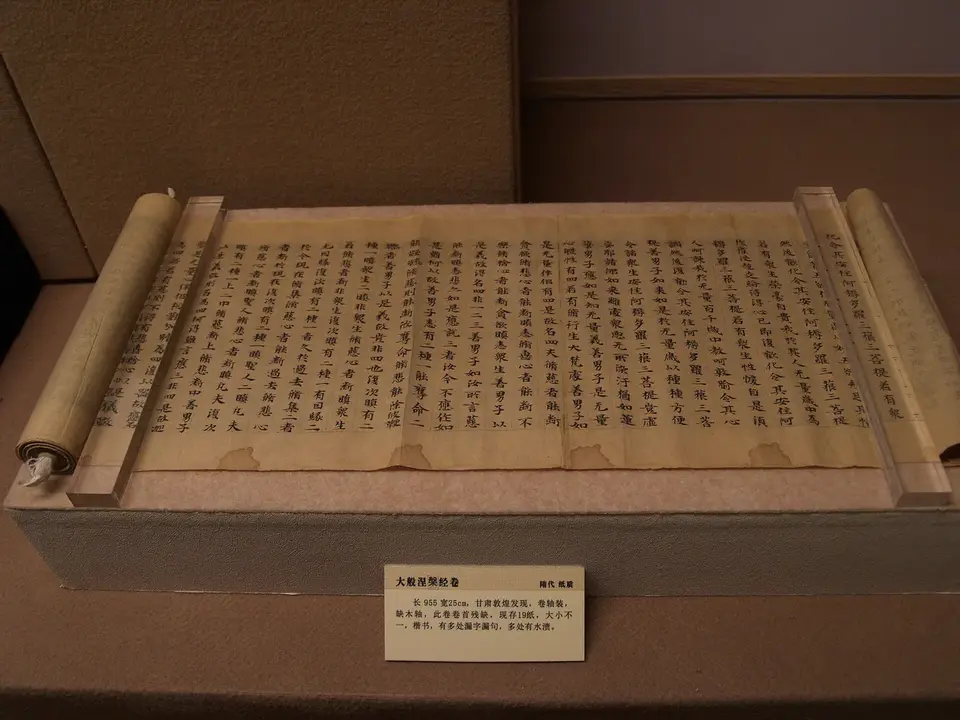
Dharmaksema (昙无谶, 385–433 CE), known in Chinese as Tanwuchan or Tanmochen, and translated semantically as Fafeng or Fahu, was a native of Central India (Madhyadesa). He was an illustrious Buddhist translation master of the Sixteen Kingdoms period, a Central Indian Tripitaka preceptor, and the founding father of the Nirvana doctrinal school in Chinese Buddhism. Endowed with extraordinary intellectual acumen from early childhood, he initially studied Hinayana teachings. Upon encountering the White-Haired Chan Master and receiving a birch-bark manuscript of the Mahaparinirvana Sutra, he converted decisively to the Mahayana path, mastering tens of thousands of scriptural verses across both traditions. Highly skilled in esoteric dharanis and divination, he was venerated across the oasis kingdoms of Central Asia as the "Great Master of Dharani." Carrying Sanskrit manuscripts of the Mahaparinirvana Sutra and Bodhisattva precept scriptures, Dharmaksema crossed the Pamir Mountains and traversed the Taklamakan Desert, traveling through Kucha and Dunhuang. In 421 CE (the tenth year of the Xuanshi era of Northern Liang), Juqu Mengxun, the King of Hexi, invited him to the capital city of Guzang (present-day Wuwei, Gansu) and invested him as State Preceptor. Because his original Sanskrit text was incomplete, Dharmaksema braved perilous journeys across Central Asia to Khotan to acquire missing manuscripts. Assisted by Chinese monks Huisong as scribe and Daolang as doctrinal editor, he translated the landmark forty-volume Northern edition of the Mahaparinirvana Sutra. The text's proclamation that "all sentient beings possess Buddha-nature, even icchantikas can achieve Buddhahood, and Nirvana possesses permanence, bliss, selfhood, and purity" transformed Chinese Buddhist philosophy, giving rise to the Nirvana School and shaping the later Tiantai and Huayan traditions. During his years in the Hexi Corridor, Dharmaksema translated eleven major Mahayana corpora comprising one hundred and twelve volumes, including the Mahasamnipata Sutra, Suvarnaprabhasa Sutra (Golden Light Sutra), Karunapundarika Sutra, Upasaka-sila Sutra, and Bodhisattvabhumi. These translations established the Liangzhou Model of Buddhist art and textual scholarship. In his later years, Emperor Taiwu of Northern Wei repeatedly demanded his presence at the northern capital of Pingcheng. Torn between fear of Wei military invasion and dread that Dharmaksema's magical arts would benefit his rivals, Juqu Mengxun became deeply paranoid. In 433 CE (Yihe 3), when Dharmaksema requested permission to travel westward once more to seek the final portion of the scripture, Juqu Mengxun suspected him of defecting to Northern Wei and sent assassins to murder him at Sishilibao outside Guzang. The great translator died at the age of forty-nine, leaving behind an enduring legacy of scriptural eloquence and doctrinal depth.
Born in Central India; lost his father at age six and entered the monastic order under Dharmayasas with his mother's consent.
Memorized hundreds of verses daily; debated the White-Haired Chan Master for one hundred days before embracing the Nirvana Sutra.
Buried his executed cousin in defiance of royal bans, moving the monarch through his courage and gaining palace patronage.
Carried the Nirvana Sutra across the Pamirs to Kucha; finding Kucha devoted to Hinayana, proceeded onward to Dunhuang.
Translated the Bodhisattva Precepts at Dunhuang, conferring the precepts upon Daojin and establishing Mahayana ordination in Hexi.
Welcomed to Guzang by King Juqu Mengxun and named State Preceptor; commenced translating the Mahaparinirvana Sutra with Huisong and Daolang.
Traveled west to Khotan to obtain missing Sanskrit sections following his mother's death, completing the thirty-six volume translation.
Translated the Upasaka-sila Sutra, Mahasamnipata Sutra, and Golden Light Sutra, defining the Liangzhou translation model.
Emperor Taiwu of Northern Wei repeatedly demanded his dispatch; Juqu Mengxun refused out of possessive jealousy and fear of aiding rivals.
Departed westward to seek remaining scriptures; murdered by Juqu Mengxun's assassins at Sishilibao at the age of forty-nine.
Dharmaksema was born in Central India (Madhyadesa) in 385 CE (the tenth year of the Taiyuan era of Eastern Jin). When he was only six years old, his father passed away from illness, leaving the young boy and his impoverished mother to sustain themselves by weaving woolen carpets for traveling merchants. His mother observed that the eminent monk Dharmayasas commanded immense reverence and received bountiful material offerings from local rulers. Desiring a spiritual life for her son, she brought the ten-year-old Dharmaksema to Dharmayasas to be tonsured as a Buddhist novice.
Dharmaksema possessed rare genius and photographic memory, effortlessly memorizing more than three hundred scriptural verses each day. Initially, he followed mainstream Indian monastic curriculum, studying Hinayana Abhidharma treatises and the Shravaka pitaka. One day, an eminent Mahayana ascetic known as the White-Haired Chan Master arrived at the monastery. The youthful Dharmaksema engaged him in theological debate. For one hundred consecutive days, Dharmaksema deployed diverse scriptural citations, yet the White-Haired Master remained seated in tranquility, refuting every objection through the doctrine of ultimate emptiness.
Recognizing Dharmaksema's spiritual acumen, the White-Haired Master produced a birch-bark manuscript of the Mahaparinirvana Sutra from his bag and presented it to him. Upon reading the profound teachings on the eternity of Buddha-nature and universal emptiness, Dharmaksema felt deeply humbled by his prior narrowness. He abandoned Hinayana doctrines and dedicated himself exclusively to Mahayana scriptures. By the time he received full monastic ordination at age twenty, he had mastered over sixty thousand verses across both traditions, resolving to make the propagation of the Mahaparinirvana Sutra his life mission.
During his youth, Dharmaksema combined doctrinal scholarship with esoteric meditation. He mastered the Five Sciences of ancient India, particularly magical dharanis and medicinal arts. His incantations proved remarkably efficacious, earning him widespread renown across Central Asia as the "Great Master of Dharani."
Dharmaksema had a paternal cousin who was a trainer of royal elephants. During an imperial procession, this cousin accidentally caused the death of the king's sacred white-eared elephant. Enraged, the Indian monarch had the trainer executed and issued a decree forbidding any relative from visiting or mourning the corpse under penalty of death. While other relatives fled in terror, the young Dharmaksema approached the execution grounds, draped his monastic robe over his cousin's remains, wept aloud, and buried him.
Furious, the king had Dharmaksema arrested and brought before the throne for execution. Confronted by drawn swords, Dharmaksema maintained absolute composure, stating: "Your Majesty executed him because he violated state law, which demonstrates your royal justice; I buried him because he was my kin, which fulfills human compassion. Law and familial duty follow their separate paths, so why should Your Majesty be angered?" Awed by the monk's fearless dignity, the king spared his life and invited him to dwell in the palace as a revered guest.
However, palace favor proved fleeting. Court ministers grew envious, and the king's goodwill waned. Sensing imminent peril and eager to fulfill his vow of transmitting Mahayana treasures eastward, Dharmaksema packed his belongings, concealed the first twelve scrolls of the Sanskrit Mahaparinirvana Sutra and Bodhisattva precept texts within his robes, and crossed the Pamir Mountains into Central Asia.
Traveling eastward across the desert sands, Dharmaksema arrived at the oasis state of Kucha. At that time, Kucha adhered strictly to the Sarvastivada school of Hinayana Buddhism, regarding the Mahayana Nirvana Sutra as uncanonical. Finding no receptive audience in Kucha, Dharmaksema journeyed onward, reaching the western Chinese outpost of Dunhuang toward the end of the Yixi era.
In Dunhuang, local monastics and lay devotees welcomed him warmly. Positioned at the intersection of Chinese and Central Asian civilizations, Dunhuang possessed deep Buddhist roots. Dharmaksema established a lecture platform and began translating Buddhist texts into Chinese. At the request of local monks, including Daojin, he produced a one-volume translation of the Bodhisattva Precepts (Pusa Jieben).
Seeking to receive the Mahayana precepts, Daojin practiced repentance under Dharmaksema's guidance for seven days and nights without success. Dharmaksema explained that Mahayana precepts required an authentic spiritual response and could not be conferred casually. Daojin then engaged in solitary repentance for three years until he dreamed that Shakyamuni Buddha personally touched his head to confer the precepts. When Daojin returned, Dharmaksema recognized the auspicious sign and administered the vows. Following this event, over a thousand monastics and lay followers in Hexi received the Bodhisattva precepts from Daojin, establishing the Mahayana precept lineage in northwestern China.
In 421 CE (the tenth year of the Xuanshi era of Northern Liang), King Juqu Mengxun conquered Dunhuang. Having long heard of Dharmaksema's spiritual fame, the monarch invited him to the capital city of Guzang (modern Wuwei, Gansu) and invested him as State Preceptor, providing generous royal patronage within the palace precincts.
In the tenth month of that year, Juqu Mengxun founded a translation bureau in Guzang, inviting Dharmaksema to translate the Mahaparinirvana Sutra. Renowned Hexi scholars Huisong and Daolang joined the project, with Huisong recording the oral translation into Chinese and Daolang verifying doctrinal terminology.
During translation, Dharmaksema realized that his Sanskrit manuscript contained only ten thousand verses, representing roughly one-third of the complete scripture. He informed Juqu Mengxun that the complete Nirvana Sutra comprised thirty-five thousand verses, totaling over one million Chinese characters, and that missing chapters had to be retrieved from the west. Receiving news that his mother had passed away in India, Dharmaksema used his mourning journey to search for manuscripts.
Enduring desert hazards, Dharmaksema traveled to the Buddhist kingdom of Khotan, spending over a year locating the middle section of the Sanskrit text. Returning to Guzang, he resumed translation, expanding the work into thirty-six volumes (later standardized as forty volumes, known as the Northern Nirvana Sutra). The project involved hundreds of scholars over several years.
Following the completion of the Mahaparinirvana Sutra, Dharmaksema responded to requests from Juqu Mengxun, Huisong, Daolang, and Prince Juqu Xingguo to translate extensive Mahayana scriptures.
Historical catalogues record that Dharmaksema translated eleven major works totaling one hundred and twelve volumes. Notable translations included the thirty-volume Mahasamnipata Sutra, the ten-volume Karunapundarika Sutra, the six-volume Mahamegha Sutra, the four-volume Golden Light Sutra, the seven-volume Upasaka-sila Sutra, the five-volume Buddhacarita, the ten-volume Bodhisattvabhumi, and the four-volume Sagar Nagaraja Sutra.
Dharmaksema's prose was celebrated for its elegant style and conceptual fidelity. Daolang praised his scrupulous precision in the preface to the Nirvana Sutra, noting that he preserved the authentic scriptural intent. His translation of the Mahaparinirvana Sutra introduced the doctrine that all sentient beings possess Buddha-nature and that even icchantikas can attain enlightenment, overturning older views that excluded certain beings from salvation. This teaching spread to southern capitals, inspiring Daosheng's sudden enlightenment theory and prompting Xie Lingyun and Huiguan to produce the thirty-six-volume Southern edition, providing the ontological basis for Tiantai, Huayan, and Chan Buddhism.
Concurrently, Dharmaksema's work under Juqu Mengxun shaped the Liangzhou Model of Buddhist art. The giant statues at Zhangye Grand Buddha Temple and the cave temples of Tiantishan in Wuwei reflect the influence of his Nirvana and Mahasamnipata teachings.
As Dharmaksema's fame spread, he became entangled in the brutal geopolitics of the late Sixteen Kingdoms period.
To the east, the Northern Wei Dynasty under Emperor Taiwu (Tuoba Tao) expanded rapidly, threatening the small Northern Liang state. Aware of Dharmaksema's scholarship and reputed divination abilities, Emperor Taiwu dispatched envoys to Guzang demanding that the monk be sent to the Wei capital of Pingcheng (modern Datong, Shanxi). The envoys warned that refusing would prompt a Wei invasion of Liangzhou.
Trapped between an imperial superpower and his own insecurities, Juqu Mengxun fell into paranoia. He valued Dharmaksema as a protective talisman for his realm and feared that the monk's intellect and divination skills would serve Northern Wei in conquering Liang. At the same time, openly defying Northern Wei risked immediate war.
In the spring of 433 CE (the third year of Yihe), sensing impending crisis, Dharmaksema submitted a memorial requesting permission to travel west again to seek the final portion of the Nirvana Sutra. Juqu Mengxun suspected that this was a pretext to flee and defect to Northern Wei.
Feigning compliance, Mengxun granted permission and provided travel funds, while secretly dispatching assassins along the western highway. On the morning of his departure, aware of his fate, Dharmaksema wept and remarked to his disciples that his karmic retribution was unavoidable.
When his caravan reached Sishilibao, forty li west of Guzang, Mengxun's assassins ambushed the party and killed him. Dharmaksema died at the age of forty-nine. The monastic community mourned his loss deeply. Although Juqu Mengxun staged an investigation to deflect blame, he died of illness several months later. Despite his tragic death, Dharmaksema's translations had already crossed dynastic divides, permanently shaping Chinese Buddhist thought.
Debated the White-Haired Chan Master for one hundred days in India, receiving the birch-bark Nirvana Sutra and converting from Hinayana to Mahayana.
Mastered tens of thousands of scriptural verses across both traditions, combining doctrinal erudition with esoteric dharanis to earn fame as the Great Master of Dharani.
Defied royal prohibitions in Central India to bury his executed cousin, winning the king's respect through fearless moral dignity.
Transported the original Sanskrit Nirvana Sutra and Bodhisattva precepts across the Pamir Mountains, overcoming obstacles in Kucha before reaching Dunhuang.
Appointed State Preceptor of Northern Liang by Juqu Mengxun in 421 CE, establishing a state translation bureau in Guzang.
Undertook two westward journeys to Khotan to gather missing Sanskrit folios, translating the landmark forty-volume Northern Mahaparinirvana Sutra.
Conferred the Bodhisattva precepts upon Daojin following his vision, inaugurating the Chinese transmission of Mahayana ordination rites.
Translated one hundred and twelve volumes of canonical scriptures, including the Upasaka-sila Sutra and Mahasamnipata Sutra, establishing the Liangzhou Model of Buddhist art.
Refused to yield his spiritual vocation amidst geopolitical pressure from Northern Wei and Northern Liang.
Assassinated at Sishilibao outside Guzang in 433 CE, leaving behind seminal translations that anchored the doctrine of universal Buddha-nature in East Asian philosophy.
FIGURES ASSOCIATED WITH THIS DYNASTY