Born in Donglai
Born in Huang County, Donglai, mastering archery, riding, and classical histories in early youth.
太史慈
Taishi Ci (太史慈, 166–206 CE), courtesy name Ziyi, was a native of Huang County, Donglai Commandery (present-day Longkou City, Shandong Province). He was an illustrious military general, field commander, and founding pillar of the Eastern Wu state during the late Eastern Han dynasty and Three Kingdoms period, successively holding high commands including Major Leader of Household Troops and Military Commandant of Jianchang.…
Taishi Ci (太史慈, 166–206 CE), courtesy name Ziyi, was a native of Huang County, Donglai Commandery (present-day Longkou City, Shandong Province). He was an illustrious military general, field commander, and founding pillar of the Eastern Wu state during the late Eastern Han dynasty and Three Kingdoms period, successively holding high commands including Major Leader of Household Troops and Military Commandant of Jianchang. Endowed with towering stature, long arms, and unmatched archery skills that never missed their mark, Taishi Ci was celebrated throughout his era for fierce martial bravery, strategic resourcefulness, and unyielding fidelity to his word. In his early career as an official in Donglai, Taishi Ci deployed sharp cunning to destroy the provincial governor's memorial in the capital of Luoyang, securing legal victory for his home commandery before fleeing to Liaodong to escape retribution. In 193 CE (the 4th year of the Chuping era), when Yellow Turban rebels under Guan Hai besieged Chancellor of Beihai Kong Rong at Douchang, Taishi Ci remembered Kong Rong's generosity toward his elderly mother. He broke through the siege alone to enter the city, and then broke out alone again to ride to Pingyuan, securing three thousand elite cavalry from Liu Bei to shatter the rebels and relieve the siege. Later traveling south to join his compatriot Liu Yao, the Inspector of Yangzhou, he engaged in a legendary duel with the young warlord Sun Ce at Shenting Ridge; the two fought hand-to-hand from horseback, Taishi Ci seizing Sun Ce's short halberd while Sun Ce seized Taishi Ci's helmet, astonishing the realm with their valor. Following Liu Yao's defeat, Taishi Ci was captured after desperate resistance at Jingxian. Sun Ce personally untied his bonds and appointed him Gate Commander. Commissioned to gather Liu Yao's scattered army of ten thousand men in Yuzhang, Taishi Ci promised to return within sixty days. Despite suspicion from Jiangdong officers, Taishi Ci returned punctually on the appointed day leading the army, inspiring Sun Ce to elevate him to Major Leader of Household Troops. Following Sun Ce's demise, when Liu Biao's fierce nephew Liu Pan repeatedly raided Eastern Wu borders, Sun Quan commissioned Taishi Ci as Military Commandant of Jianchang based at Haihun. Taishi Ci governed the frontier with iron discipline, permanently suppressing Liu Pan's incursions. In 206 CE, Taishi Ci fell critically ill, passing away at the age of forty-one with the tragic lament: "A true man born into this world should bear a three-foot blade to ascend the sovereign's steps; now my aspirations remain unfulfilled, yet I must die!" Celebrated for matchless archery, battlefield valor, and unbreakable chivalric honor, Taishi Ci stands as an immortal hero of Chinese military history.
Born in Huang County, Donglai, mastering archery, riding, and classical histories in early youth.
Slashed the provincial governor's memorial in Luoyang to save his commandery, fleeing to Liaodong to escape arrest.
Smashed through Yellow Turban encirclements alone to recruit three thousand cavalry from Liu Bei, saving Kong Rong.
Joined Inspector Liu Yao; fought a legendary duel against Sun Ce at Shenting Ridge, seizing Sun Ce's halberd.
Captured at Jingxian following Liu Yao's collapse; Sun Ce unbound him personally, forming an enduring brotherhood.
Rode alone to Yuzhang to rally ten thousand troops, returning punctually; promoted to Major Leader of Household Troops.
Appointed Military Commandant of Jianchang by Sun Quan, pacifying western borders and repelling Liu Pan.
Succumbed to illness at age forty-one, lamenting his unfulfilled statecraft; Sun Quan mourned and adopted his son.
Taishi Ci, courtesy name Ziyi, was born in Huang County, Donglai Commandery (modern Longkou City, Shandong Province) during the late Eastern Han dynasty. Standing seven chi seven cun tall with a magnificent beard, he possessed extraordinary physical power and extended arm reach. A consummate master of the bow, his arrows struck their targets with pinpoint precision. Generous, upright, and fiercely loyal to his word, he commanded widespread esteem throughout his home region from early youth.
In his early twenties, Taishi Ci served as a records clerk in the Donglai commandery yamen. A sharp administrative dispute erupted between Donglai Commandery and the provincial inspectoral yamen of Qingzhou, with both jurisdictions dispatching couriers to the Ministry of Works in Luoyang to present their memorials. According to Han bureaucratic custom, the party whose memorial was accepted first by the imperial gatekeepers gained legal priority. Commissioned by his administrator to carry the Donglai memorial to Luoyang, Taishi Ci discovered upon arrival that the provincial courier had already reached the palace gates, waiting for the morning audience to present his dossier.
Approaching the provincial courier with calm affability, Taishi Ci feigned concern, asking to inspect the clay seals of the provincial dispatch. Unsuspecting, the courier handed over the wooden dossier. Taishi Ci drew a concealed blade and slashed the provincial memorial to pieces. As the courier cried out in alarm, Taishi Ci reasoned coolly: "I destroyed your document to save my commandery, incurring capital guilt; but you have lost your dispatch and cannot escape punishment. Rather than face execution, let us both discard our seals and flee together!" Seeing no alternative, the courier fled into hiding. Taishi Ci immediately presented the Donglai dispatch to the imperial gatekeepers, winning total victory for his commandery. Knowing that the provincial authorities would issue warrants for his arrest, Taishi Ci fled across the sea to seek refuge in Liaodong.
In 193 CE (the 4th year of the Chuping era), Taishi Ci returned quietly to his home village. During his absence, several tens of thousands of Yellow Turban rebels under Guan Hai had overrun Qingzhou, surrounding Chancellor of Beihai Kong Rong within the walled citadel of Douchang. Kong Rong, having long revered Taishi Ci's honor, had regularly sent attendants with generous rations and gifts to support Taishi Ci's aging mother. When Taishi Ci arrived home, his mother urged him: "You have never met Chancellor Kong in person, yet he has treated me with familial kindness. Now that he is besieged, you must hasten to repay his benevolence!"
Bidding his mother farewell, Taishi Ci rode through the night, slipping through the rebel pickets to enter Douchang and meet Kong Rong. Kong Rong wished to appeal to Magistrate of Pingyuan Liu Bei for reinforcements, but the citadel was besieged by rebel lines, and none dared venture out. Taishi Ci volunteered. At dawn, he led his horse outside the gate accompanied by two archers carrying straw targets, calmly practicing archery beside the moat before returning. He repeated this routine for several days until the rebels grew accustomed to his target practice. Seizing the moment, Taishi Ci spurred his charger, loosed a hail of arrows to slay the enemy sentries, and broke through the lines like a gale. Riding day and night to Pingyuan, he delivered his plea to Liu Bei, who exclaimed: "Does Chancellor Kong know that a Liu Bei exists under heaven!" Liu Bei dispatched three thousand elite shock cavalry with Taishi Ci. Arriving at Douchang, they launched a thunderous assault that scattered the Yellow Turbans, relieving the siege.
Having fulfilled his mother's wish, Taishi Ci traveled south across the Yangtze to Qu'e, joining his compatriot Liu Yao, the Inspector of Yangzhou. During this period, the young warlord Sun Ce crossed the river, conquering commanderies across Jiangdong. Several advisers urged Liu Yao to appoint Taishi Ci as supreme commander to repel the invasion, but Liu Yao hesitated, remarking: "If I employ Ziyi as grand general, will not the world mock me for ignorance in military strategy?" He assigned Taishi Ci merely to scout frontline posts.
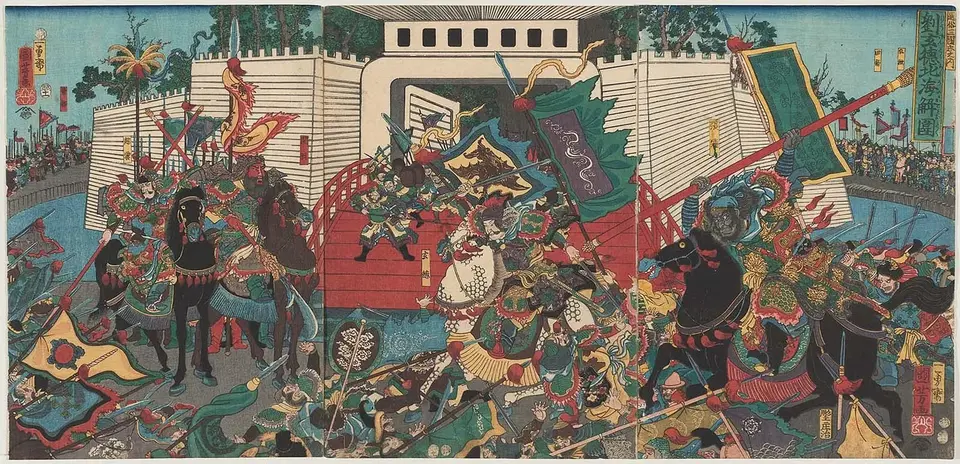
Sun Ce's army advanced to Shenting Ridge. Sun Ce ascended the ridge accompanied by thirteen elite captains, including veteran warriors Han Dang, Song Qian, and Huang Gai, to inspect Liu Yao's dispositions. Learning of this, Taishi Ci mounted his horse, accompanied only by a single cavalryman, and rode up the heights to confront the enemy. Meeting Sun Ce on the ridge, Taishi Ci shouted a challenge and spurred his steed directly toward him. Sun Ce thrust forward with his spear; the two warriors collided, fighting from horseback to the ground in ferocious hand-to-hand combat. In the fray, Taishi Ci seized the short iron halberd from Sun Ce's grasp, while Sun Ce tore the helmet from Taishi Ci's head. As their troops arrived on the ridge, the two warriors separated and galloped back to their camps. In this historic encounter, Taishi Ci's lone duel against thirteen Jiangdong commanders astonished the realm.
Shortly thereafter, Liu Yao's army disintegrated, and Taishi Ci retreated to Wuhu and Jingxian, gathering several thousand regional fighters to establish a fortified camp. In 197 CE (the 2nd year of the Jian'an era), Sun Ce laid siege to Jingxian, breaching the fortifications and taking Taishi Ci prisoner. Admiring his valor, Sun Ce stepped forward personally, drew his dagger to sever the prisoner's ropes, and draped his own embroidered robe over Taishi Ci's shoulders. Grasping his hands, Sun Ce laughed: "Do you remember our duel at Shenting Ridge! Had you captured me then, what would you have done?" Taishi Ci replied with candid humor: "Who can tell!" Sun Ce roared with laughter and appointed him Gate Commander on the spot, forging an enduring bond.
When Liu Yao died of illness in Yuzhang, over ten thousand of his troops were left leaderless. Sun Ce wished to integrate this veteran force, but his officers feared the long march through hostile mountain passes. Taishi Ci volunteered: "Liu Yao has just passed away and his men are disorganized; I am willing to ride alone to Yuzhang to rally them to our banner!" Sun Ce's commanders warned: "Taishi Ci was once Liu Yao's diehard warrior; if he departs like a wild goose across the mountains, he will never return!" Sun Ce hosted a lavish banquet for Taishi Ci and asked: "When shall I expect your return?" Taishi Ci answered: "No more than sixty days!"
Taishi Ci traveled alone into the valleys of Yuzhang to negotiate with the captains. On the sixtieth day, while Jiangdong ministers assumed Taishi Ci had defected, Sun Ce ordered a sundial gnomon erected in his courtyard, declaring: "Ziyi is an honorable gentleman of Qingzhou; he will never break faith with me!" Before the shadow shifted, scout riders announced that Taishi Ci had arrived outside the camp gates, leading over ten thousand troops with flags flying in perfect order. Stunned by his unshakeable fidelity, Sun Ce promoted him to Major Leader of Household Troops.
Following Sun Ce's assassination in 200 CE, his younger brother Sun Quan assumed control of Jiangdong. Regional stability remained threatened by Governor of Jingzhou Liu Biao. Liu Biao's fierce nephew Liu Pan, based in Changsha, launched continuous raids into the border districts of Ai, Xi'an, and Jianchang, repeatedly defeating Eastern Wu border garrisons and threatening the middle Yangtze frontier.
Recognizing that only a commander of supreme martial stature could neutralize the threat, Sun Quan appointed Taishi Ci as Military Commandant of Jianchang. Consolidating the six border districts under his sole authority, Sun Quan granted him extraordinary executive power to command all garrisons from the stronghold of Haihun to repel Jingzhou forces.
Assuming command, Taishi Ci reorganized frontier defenses, constructing fortified outposts and deploying dynamic encirclement tactics. During a campaign against regional brigands, an enemy commander stood upon a fortress parapet shouting insults while grasping a wooden wall timber with his bare hand. From outside the walls, Taishi Ci drew his bow and loosed an arrow at full gallop; the bolt struck the captain's hand, nailing his palm into the wooden timber. The army erupted in cheers, and the terrified defenders surrendered immediately.
Throughout his years commanding Haihun, Taishi Ci crushed Liu Pan's incursions, capturing thousands of prisoners. Awed by his reputation, Liu Pan abandoned his raids, never daring to cross the Jiangdong border again. News of his prowess reached northern China, prompting Cao Cao to send an imperial courier bearing an unsealed diplomatic chest containing only the precious medicinal herb danggui ("ought to return"), subtly urging him to defect to the central government. Taishi Ci smiled, placed the herb upon his desk, and maintained steadfast loyalty to Eastern Wu.
In 206 CE (the 11th year of the Jian'an era), on the eve of the campaign of Red Cliffs, Taishi Ci contracted a fatal illness. Lying upon his sickbed, the general gazed toward the sky and sighed with an immortal lament: "A true man born into this world should bear a three-foot blade to ascend the sovereign's steps and pacify the realm; now my aspirations remain unfulfilled, yet I must die!" With these words, he passed away at the age of forty-one.
Weeping bitterly, Sun Quan personally attended his funeral, decreeing lavish honors and taking his young son Taishi Heng into the palace to raise him. Taishi Ci's matchless archery, battlefield courage, and chivalric fidelity established him as an enduring titan of Chinese martial lore.
Serving as a records clerk in Donglai, Taishi Ci utilized daring cunning to destroy the provincial governor's memorial before the imperial palace in Luoyang, gaining legal victory for his home commandery before fleeing into exile. This event demonstrated his strategic audacity and resourcefulness in high-stakes crises.
To repay Kong Rong's kindness to his mother, Taishi Ci slipped into besieged Douchang alone, lull the enemy through daily archery target practice, and charged out alone to secure three thousand elite cavalry from Liu Bei. Smashed the Yellow Turban host, he exemplified the timeless virtues of filial piety and chivalric gratitude.
At Shenting Ridge, Taishi Ci faced Sun Ce and thirteen veteran commanders with a lone companion. Engaging Sun Ce in hand-to-hand combat, he seized Sun Ce's short halberd while Sun Ce took his helmet. This duel stands as one of the most celebrated individual martial encounters in Chinese historiography, establishing his renown as a premier warrior of the Three Kingdoms.
Commissioned by Sun Ce to rally Liu Yao's defeated army in Yuzhang, Taishi Ci defied widespread cynicism by returning on the sixtieth day at the head of ten thousand veteran soldiers. His punctuality dissolved political suspicion and augmented Eastern Wu's military strength, demonstrating the highest standard of classical fidelity.
Commissioned as Military Commandant of Jianchang, Taishi Ci consolidated the western border, repeatedly defeating Liu Pan and nailing an enemy's hand to a parapet timber with a single arrow. His frontier defense secured the western approaches of Eastern Wu, creating the territorial security that enabled the founding of the dynasty.
FIGURES ASSOCIATED WITH THIS DYNASTY