Birth in Rui'an
Born on the 19th day of the 8th lunar month in Yanxia Village, Pandai Township, Rui'an, Zhejiang.
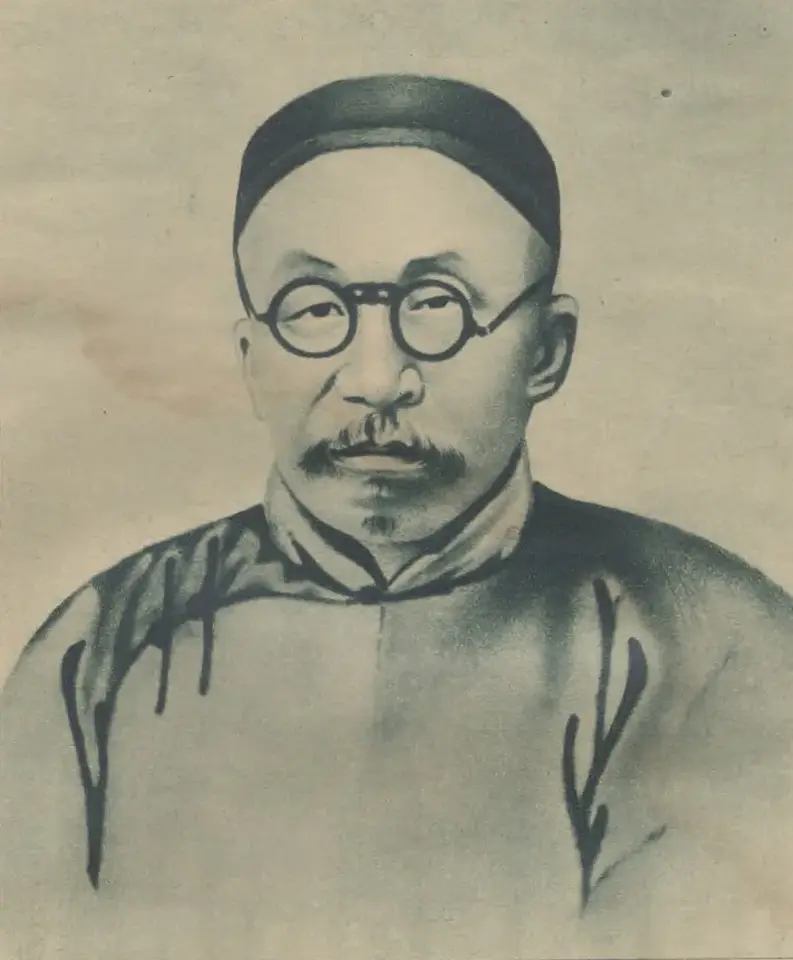
孙诒让
Sun Yirang (1848–1908), courtesy name Zhongrong and art name Zhouqing, was a native of Rui'an, Zhejiang Province. He was an eminent late Qing classical philologist, epigrapher, paleographer, bibliographical textual critic, and pioneer of modern school education in southern Zhejiang. He was acclaimed by modern scholar Zhang Taiyan as an unrivaled intellectual giant of three centuries, praised by Liang Qichao as bringing the…
Sun Yirang (1848–1908), courtesy name Zhongrong and art name Zhouqing, was a native of Rui'an, Zhejiang Province. He was an eminent late Qing classical philologist, epigrapher, paleographer, bibliographical textual critic, and pioneer of modern school education in southern Zhejiang. He was acclaimed by modern scholar Zhang Taiyan as an unrivaled intellectual giant of three centuries, praised by Liang Qichao as bringing the scholarship of the entire Qing dynasty to a resplendent culmination, and hailed by Guo Moruo as a monumental master bridging the ancient past with the modern era. Born into the prominent Pangukou Sun clan of Rui'an, he was the son of Sun Yiyan, an imperial jinshi graduate of 1850 who served as Jiangning Provincial Administration Commissioner and Director of the Court of the Imperial Stud. Tutored under his father from childhood, Sun studied the classics and hundred philosophical masters, excelling in historical phonology, textual collation, semasiology, and bronze-and-stone epigraphy. After earning his juren degree in 1867, he repeatedly failed the metropolitan examinations and abandoned bureaucratic pursuits to devote his life to secluded scholarship. In 1888, his father constructed the Yuhailou library in Rui'an, gathering tens of thousands of rare ancient woodblock volumes where Sun pursued textual research for decades. Sun produced an extraordinary body of scholarship that stood at the zenith of Qianlong-Jiaqing evidential learning. His monumental 86-volume Zhouli Zhengyi (Correct Meaning of the Rites of Zhou), composed over twenty-eight years, synthesized Qing exegetical learning and is revered as the ultimate triumph of traditional evidential philology. His 15-volume Mozi Jiangu (Critical Commentary on Mozi), written over a decade, resurrected pre-Qin Mohist philosophy and sparked a modern Mohist renaissance. His two-volume Qiwen Juli (Examples of Oracle Bone Inscriptions), completed in 1904, was the world's first scientific treatise deciphering Shang dynasty oracle bone script, establishing the bedrock of Chinese oracle bone studies and paleography. Following the First Sino-Japanese War, Sun dedicated himself to patriotic reform and educational modernization in southern Zhejiang, founding modern academies, promoting female education, and reforming curricula. He died in Rui'an in 1908 and was posthumously awarded the brevet rank of Fourth Rank Court Director.
Born on the 19th day of the 8th lunar month in Yanxia Village, Pandai Township, Rui'an, Zhejiang.
As Anglo-French forces attacked Beijing, drafted Guangyun Xingshi Kanwu amidst regional chaos, initiating his career in textual collation.
Acquired Yuan editions of Baihu Tongdelun and Ruan Yuan's bronze rubbings with his father, beginning deep study of archaic bronze script.
Passed the Zhejiang provincial examination as juren, acclaimed for classical archaism and erudite diction.
Began compiling Zhouli Zhengyi in Jiangning, completed Shang Zhou Jinshi Shiyi, and adopted the art name Zhouqing.
Completed Wenzhou Jingji Zhi, drafted a covenant for collecting regional manuscripts, and collated Wu Kuan's hand-copied edition of Mozi.
Collected and analyzed over a hundred Six Dynasties inscribed bricks, composing Wenzhou Gupi Ji in his Baijin Jinglu study.
Sun Yiyan built the Yuhailou library in Rui'an, housing tens of thousands of volumes to facilitate comprehensive research.
Completed the initial draft of Mozi Jiangu after a decade of intensive research, compiling thirty years of reading notes into Zha Yi.
Stirred by the First Sino-Japanese War, co-founded the Rui'an Academy of Mathematics to promote national salvation through modern education.
Wrote to Wang Kangnian urging mass literati petitions for institutional reform, and co-founded agricultural and sericulture institutes with Luo Zhenyu.
Completed the primary manuscript of his monumental 86-volume Zhouli Zhengyi following nearly three decades of labor.
Drafted forty constitutional reform proposals for Sheng Xuanhuai, published in Rui'an under the title Zhouli Zhengyao.
Founded the Rui'an General School, established neighborhood primary schools, and launched public lecture societies and anti-footbinding leagues.
Penned Qiwen Juli, China's first scientific decipherment of Shang dynasty oracle bone script, inaugurating oracle bone studies.
Completed Mingyuan, systematically tracing the morphological origins and structural evolution of Chinese characters.
Established Wenzhou Normal School and passed away in Rui'an on the 22nd day of the 5th lunar month at age sixty-one.
Sun Yirang was born on September 16, 1848, in Yanxia Village, Pandai Township, Rui'an County, Wenzhou Prefecture, Zhejiang Province, into the prominent Pangukou Sun clan of scholar-officials. His father, Sun Yiyan, was an 1850 metropolitan jinshi graduate and Hanlin bachelor who served as Hanlin compiler, prefect, Provincial Surveillance Commissioner of Anhui, Provincial Administration Commissioner of Hubei and Jiangning, and Director of the Court of the Imperial Stud. His uncle, Sun Qiangming, was an 1841 jinshi graduate who served as Hanlin reader-in-waiting and Provincial Education Commissioner of Guangxi. Surrounded by an illustrious scholarly lineage, Sun was immersed in classical learning from infancy.
In 1853, when the Taiping armies established their capital in Tianjing (Nanjing), Sun Yiyan was retained in Beijing as assistant compiler for the Wuyingdian Hall, and young Sun accompanied his family to the capital. Enrolled in private academies, he displayed astonishing memory and intellectual precocity. In 1855, his father was assigned to tutor the sons of Prince Hui, allowing Sun to reside in Chenghuai Garden within the Old Summer Palace for three years, where he read the Four Books, Five Classics, and Rites of Zhou, poring over ancient Han and Wei collections. In 1858, following the Anglo-French capture of Tianjin and his father's appointment as Prefect of Anqing, Sun returned south to study classical poetic meters and Tongcheng prose doctrines.
In 1860, Anglo-French expeditionary forces burned the Old Summer Palace, forcing the Xianfeng Emperor to flee to Rehe. At age thirteen, Sun fled wartime devastation alongside his parents through the rugged valleys of southern Zhejiang. Amidst flight and hardship, he penned the single-volume Guangyun Xingshi Kanwu, mastering historical phonology, rhyme groupings, and bibliographical collation, exhibiting extraordinary scholarly acumen far beyond his years.
In 1863, Viceroy Zeng Guofan of Liangjiang invited Sun Yiyan to his military headquarters in Anqing. Amidst wartime camps, the sixteen-year-old Sun read Jiang Fan's Hanxue Shicheng Ji and the complete Huangqing Jingjie. Electrified by evidential learning, he resolved to follow the footsteps of Gu Yanwu, Dai Zhen, Duan Yucai, and Wang Niansun, dedicating his life to classical exegesis, semasiology, and bronze-and-stone epigraphy.
In 1864, after Xiang Army forces recaptured Tianjing, Sun accompanied his father back to Zhejiang. Passing through the ruins of Jiangning, he purchased a Yuan Dade woodblock edition of Baihu Tongdelun, Ruan Yuan's recension of Xue Shanggong's Zhongding Kuanshi, and a Ming manuscript of Shuixin Bieji. He immersed himself in rare book connoisseurship and archaic bronze inscriptions. In 1865, when Sun Yiyan became director of the Zhejiang Official Printing Bureau and principal of the Ziyang Academy in Hangzhou, Sun assisted his father, completing Baihu Tong Jiaobu and expanding his treatise on the Guangyun.
In 1867, at age twenty, Sun passed the Zhejiang provincial examination as juren, acclaimed throughout Jiangnan for archaic diction and classical profundity. In 1869, his father was promoted to Jiangning Provincial Administration Commissioner, and Sun resided within the administrative yamen in Nanjing. During this period, he traveled frequently between Jiangning, Zhenjiang, and Beijing to collect stone inscriptions. In 1870, he ascended Mount Jin and Mount Jiao to take direct rubbings of the celebrated Crane Inscription (Yihe Ming) and Tang dynasty dharani pillars, authoring commentaries on Eastern Jin and Tang local history.
In the spring of 1871, Sun traveled to Beijing to sit for the metropolitan examinations, befriending scholars Miao Quansun and Tan Xian. He joined nineteen prominent antiquarians, including Zhang Zhidong, Pan Zuyin, Li Ciming, Wang Kaiyun, Wang Yirong, and Zhao Zhiqian, at the Longshu Temple in Beijing to debate bronze epigraphy. That same year, he collated Shao Yichen's twenty-volume commentary on the Siku Quanshu catalogue and drafted bibliographical miscellanies.
In 1872, perceiving that earlier Han and Song commentators had failed to synthesize the overarching governmental system of the Rites of Zhou, Sun began compiling Zhouli Zhengyi in Jiangning and completed Shang Zhou Jinshi Shiyi. Fascinated by ancient bronze seal scripts, he named his study Zhouqing, adopting the sobriquet Zhouqing Xiansheng. He also studied alongside philologist Dai Wang; following Dai's death in 1873, Sun arranged his funeral, preserved his manuscripts, and deepened his own scholarship.
In 1874, Sun returned to Rui'an with rubbings of ancient dharani pillars, composing treatises on Zhou bronze basins and Wu dynasty steles. In 1875, he constructed the Shaoyu Residence in Rui'an, founding his Shujiu Study and completing the five-volume astronomical work Liuli Zhenwei. In 1876, while accompanying his father to Wuchang, he acquired an ancient Zhou bronze vessel in Henan, naming his retreat Yu'an.
In 1877, Sun visited Ding Songsheng's Baqianjuanlou library in Hangzhou, inspecting Wu Kuan's hand-copied edition of Mozi and rectifying numerous textual corruptions. To preserve regional heritage, he published guidelines for collecting Wenzhou writings, completed the catalogue of Han stone steles, and compiled the draft of Wenzhou Jingji Zhi. In 1878, his mother passed away in Jiangning, and Sun returned to Rui'an for ancestral mourning.
During mourning seclusion, Sun searched for regional epigraphic artifacts. In 1879, he acquired a Han dynasty brick inkstone dated to 59 BCE, naming his study Wufeng Zhuanyan Zhai. Over several years, he collected more than a hundred ancient inscribed bricks from the Jin, Song, Qi, Liang, and Chen dynasties, establishing his Baijin Study and authoring Wenzhou Gupi Ji in 1882.
During the Sino-French War in 1884, Sun organized regional defense militias in Rui'an. In 1886, he took his final metropolitan examination in Beijing, utilizing his journey to read translated Western treatises on modern politics, engineering, and natural science. In 1888, his father erected the Yuhailou library in Rui'an, housing tens of thousands of volumes. Huguang Viceroy Zhang Zhidong invited Sun to join his staff, but Sun declined, preferring secluded research in Rui'an.
In 1889, after nearly two decades of labor, the draft of Zhouli Zhengyi was completed. In 1890, he traveled to Wuchang to debate textual nuances with Zhang Zhidong and visited Pan Zuyin's mansion in Beijing to decipher bronze inscriptions. In 1892, he focused entirely on Mozi Jiangu, and in 1893, compiled three decades of reading notes into the twelve-volume textual critique Zha Yi, collating seventy-eight ancient texts.
The outbreak of the First Sino-Japanese War in 1894 and China's catastrophic military collapse shattered Sun's peaceful scholarly world. Managing the Rui'an Defense Bureau, he submitted defense proposals to the Zhejiang Governor. The humiliating Treaty of Shimonoseki devastated him, prompting him to lament that in an era of national peril, scholars could no longer remain secluded within library towers.
In 1895, responding to Kang Youwei and Liang Qichao's memorials, Sun drafted twenty-one regulations for scholarly societies, proclaiming that national strength depended on modern education. That same year, Sun joined eight local gentry members to found the Rui'an Academy of Mathematics, introducing modern mathematics and natural science to southern Zhejiang. In 1896, he expanded the academy into the Rui'an School of Mathematics and Cartography, recruiting modern instructors and supporting reform societies founded by Zhang Taiyan.
In 1897, Sun wrote to Wang Kangnian of the Shiwu Bao, urging national literati to petition the throne for sweeping constitutional reforms. Collaborating with Luo Zhenyu, he founded agricultural societies in Shanghai and sericulture institutes in Rui'an, introducing modern agricultural techniques. During the Hundred Days' Reform of 1898, Sun affirmed his readiness to sign reform petitions regardless of political retribution. The execution of the Six Gentlemen of the 1898 Coup filled him with profound sorrow.
In 1899, Sun co-founded the Ruiping Chemistry Academy and established regional dialect translation schools. Concurrently, his 86-volume Zhouli Zhengyi was largely completed, alongside philological commentaries on the Yi Zhoushu and Da Dai Liji.
Following the Boxer Rebellion and the allied occupation of Beijing in 1900, Sun coordinated local defense leagues in Rui'an, mourning reformers executed after the Hankou uprising.
In 1901, when the Qing court proclaimed the New Policies, imperial minister Sheng Xuanhuai requested Sun to draft institutional reform proposals. Sun produced forty reform essays examining ancient and modern political systems, demonstrating that the functional division of the six ministries in the Rites of Zhou mirrored modern Western constitutional divisions of power. He advocated comprehensive modernization across government structures, finance, taxation, mining, railroads, military defense, and public education. Although Sheng hesitated to submit all proposals due to bureaucratic resistance, Sun published them as Zhouli Zhengyao. When the Imperial University of Peking invited him to serve as Chief Dean of Classical Studies, Sun declined, choosing to focus on rural and elementary education in Zhejiang.
In 1902, Sun merged existing institutes to establish the Rui'an General School, serving as deputy superintendent and head instructor. He abolished rote recitation of the classics, established modern curricula in national literature, arithmetic, foreign languages, and geography, and introduced standard national phonetics. He established four elementary schools across Rui'an, waiving tuition for impoverished students to champion universal education. Sun also studied English under modern instructor Cai Huaqing and adhered to a strict daily regimen: reviewing newspapers and modern books in the morning, attending to local educational affairs in the afternoon, and collating scholarly manuscripts until late at night.
Recognizing that common citizens and women could not read classical script, Sun founded the Rui'an Public Lecture Society in 1902, serving as its president. Meeting twice monthly at the local Confucian Temple, the society attracted hundreds of teachers, farmers, artisans, and women. Sun and fellow instructors delivered lectures in colloquial vernacular on world current affairs, modern science, hygiene, and social customs, actively breaking local superstitions and advancing social enlightenment.
From 1902 to 1907, Sun served as Superintendent of the Wenzhou Prefectural School and Director of Educational Affairs for Wenzhou and Chuzhou. Traversing sixteen counties on foot and boat, he raised educational funds and supervised the establishment of over three hundred elementary, middle, and vocational schools. To resolve the desperate shortage of qualified teachers, he raised funds to establish Wenzhou Normal School in 1908, laying the foundation of modern teacher education in southern Zhejiang.
While actively directing educational modernization, Sun never abandoned paleographic research. In 1899, Wang Yirong first recognized inscribed oracle bones from the Yin ruins of Anyang, but Wang's suicide during the 1900 Boxer Rebellion halted research. In 1903, Liu E published rubbings in Tieyun Cangui, yet scholars viewed them as indecipherable curiosities. In late 1904, Sun examined the book in Rui'an, immediately realizing that these inscriptions represented primordial Shang records and the true origins of Chinese script.
Working through the winter of 1904 at Yuhailou, the nearly sixty-year-old Sun compared the bone inscriptions with Shang-Zhou bronze scripts and Xu Shen's Shuowen Jiezi. In just two months, he completed Qiwen Juli in two volumes. This monumental work was the first scientific treatise in world scholarship to decipher Shang oracle bone inscriptions, classifying them across ten thematic categories: astronomy, divination formulas, state affairs, deities, diviners, official ranks, tributary states, ceremonial rituals, script morphology, and anomalous syntax. In 1905, he published Mingyuan in two volumes, tracing the evolution of character forms from oracle bones and bronzes to seal script, building a vital bridge from traditional philology to modern paleography.
Sun shared his findings with scholar Luo Zhenyu, who was astounded by Sun's breakthroughs and continued the work alongside Wang Guowei. Working in provincial isolation, Sun laid the initial epigraphic foundation for reconstructing Shang civilization. Although later scholars of the Four Eminent Oracle Bone Masters gained broad renown, the global academic community recognizes Sun as the founding father of oracle bone studies.
Decades of relentless educational travel and nocturnal scholarship severely degraded Sun's health. In 1907, the Ministry of Education conferred upon him the brevet rank of Fourth Rank Court Director and appointed him as a senior educational consultant, but Sun declined due to chronic illness, continuing to supervise schools. On June 20, 1908, Sun passed away from exhaustion at Yuhailou at age sixty-one. On the day of his funeral, schools across Wenzhou suspended classes in mourning, and thousands of scholars and citizens lined the roads in grief.
The 86-volume Zhouli Zhengyi represents Sun Yirang's magnum opus and the supreme culmination of Qianlong-Jiaqing evidential exegesis.
The Rites of Zhou, one of the Three Ritual Classics of Confucianism, delineates the governmental institutions, administrative offices, agrarian land systems, and ritual protocols of the Western Zhou across six functional ministries: Heaven, Earth, Spring, Summer, Autumn, and Winter (the Kaogong Ji). Since Han commentator Zheng Xuan and Tang sub-commentator Jia Gongyan, the text had suffered from textual obscurity and contradictory commentaries. Sun viewed the work as the foundational compendium of early Chinese administrative institutions. Initiating research in 1872 and completing the text in 1899, Sun labored for twenty-eight years, producing over two million words of rigorous textual analysis.
Adhering to strict evidential methodology, Sun cross-referenced pre-Qin, Han, and Tang commentaries, bronze inscriptions, and historical annals. The work methodically explicates the six ministries: the Ministry of Heaven detailing court administrative laws; the Ministry of Earth managing agrarian taxation, rural education, and disaster relief; the Ministry of Spring governing ancestral rites, diplomacy, and music; the Ministry of Summer directing military command, chariots, and territorial defenses; the Ministry of Autumn defining penal statutes and judicial reviews; and the Kaogong Ji detailing engineering specifications for chariots, weapons, ritual bronzes, and architecture.
Sun corrected over a thousand errors and omissions in medieval commentaries, providing the definitive institutional guide to Western Zhou civilization. Liang Qichao praised the work in Intellectual Trends in the Qing Period as the final and finest masterwork of Qing classical scholarship, while Zhang Taiyan declared that no scholar throughout history had matched Sun's mastery of the Rites of Zhou.
In non-canonical philosophical studies, Sun's fifteen-volume Mozi Jiangu dismantled centuries of orthodox Confucian neglect, establishing the supreme model for collating and annotating pre-Qin philosophical texts.
Since the Han dynasty, the writings of Mozi had become nearly unreadable due to textual corruptions, archaic syntax, and dense technical vocabularies in logic and science. Mid-Qing philologists like Bi Yuan and Wang Niansun had made preliminary corrections, but none had completed a systematic annotation. Confronted by national humiliation, Sun found immense practical utility in Mohist doctrines of frugality, universal mutual love, tireless labor, and active defense. In 1892, he undertook a comprehensive collation of Mozi, drawing upon classical texts such as Guanzi, Han Feizi, Lüshi Chunqiu, and Zhuangzi.
Sun conducted exhaustive collation across all fifty-three extant chapters of Mozi. Crucially, in deciphering the six notoriously obscure dialectical chapters (the Mojing), Sun applied modern scientific insight to reveal that the Mohists had articulated foundational principles of classical mechanics, geometry, optics (such as camera obscura pinhole image inversion and concave-convex mirror reflection), and formal logic (terms, propositions, explanations, and debate). By demonstrating that ancient Mohist physics prefigured modern Western science, Sun revitalized ancient Chinese science.
Philologist Yu Yue remarked that since the creation of Mozi, no commentary had ever equaled Sun's comprehensive synthesis. Liang Qichao declared that the revival of pre-Qin philosophy spearheaded by Mozi Jiangu was a vital catalyst for modern Chinese intellectual emancipation, making the work a milestone of the late Qing philosophical renaissance.
In paleography, Sun's two-volume Qiwen Juli represents the world's first scientific treatise systematically deciphering Shang oracle bone inscriptions, establishing Sun as the founding pioneer of Chinese oracle bone studies.
In 1903, Liu E published Tieyun Cangui, making oracle bone rubbings accessible, but contemporaries regarded them as unintelligible curiosities. In late 1904, Sun examined the rubbings and brought decades of expertise in bronze inscriptions and archaic seal script to bear on the artifacts, completing Qiwen Juli in two months of secluded scholarship.
Divided into two volumes spanning ten thematic sections, the work established a comprehensive analytical framework: Section 1 ("Sun and Moon") analyzed Shang astronomical calendars and intercalary months; Section 2 ("Divination") deciphered divinatory cracks and standardized formulas; Section 3 ("Divination Affairs") categorized agricultural harvests, rain prayers, military campaigns, hunting expeditions, and epidemics; Section 4 ("Spirits and Deities") mapped the Shang pantheon and ancestral sacrifices; Section 5 ("Diviners") identified historical divination officials and scribes; Section 6 ("Official Ranks") examined royal lineages and bureaucratic titles; Section 7 ("Tributary Regions") documented frontier polities and hostile tribes; Section 8 ("Ceremonies") investigated animal sacrifices and ritual music; Section 9 ("Characters") deconstructed graphic morphology, component radicals, and phonetic loan characters; and Section 10 ("Miscellaneous Cases") reconstructed fragmented inscriptions.
Sun pioneered scientific decipherment methods combining radical analysis, cross-verification with bronze script, and institutional comparison with classical texts, successfully identifying 185 distinct oracle bone characters (nearly half with absolute accuracy). Paleographer Tang Lan noted that Sun's penetrating insights in Qiwen Juli often surpassed later scholarship. Guo Moruo inscribed an epitaph at Yuhailou honoring Sun as the founder of oracle bone studies, celebrating the treatise as the dawn of modern Chinese paleography.
Beyond oracle bone inscriptions, Sun made epochal contributions to bronze epigraphy, ancient brick inscriptions, and the morphological evolution of Chinese characters.
Beginning in the Tongzhi reign, Sun collected and transcribed hundreds of Shang and Zhou bronze vessel inscriptions, authoring the three-volume Guzhou Shiyi and two-volume Guzhou Yulun. He exhaustively collated Ruan Yuan's and Xue Shanggong's epigraphic catalogues, rectifying transcriptions and deciphering challenging inscriptions on national treasures including the Mao Gong Ding, Ke Ding, and Qi Hou Chun Bell.
In 1882, he published Wenzhou Gupi Ji, analyzing over a hundred inscribed bricks dating from the Jin through the Southern Dynasties, examining stylistic transitions in Six Dynasties calligraphy and inaugurating the scholarly study of brick epigraphy.
In 1905, Sun synthesized his lifetime paleographic findings into the two-volume Mingyuan. Arranged into four evolutionary stages—Primordial, Ancient Script, Great Seal, and Small Seal—Sun systematically compared oracle bone characters, bronze scripts, and Xu Shen's Small Seal characters from the Shuowen Jiezi. He mapped the evolutionary trajectory of Chinese characters from pictographic and ideographic roots to phonetic compounding, correcting dozens of etymological errors in earlier dictionaries caused by lack of access to Shang-Zhou artifacts and establishing China's first scientific paleographic lineage.
Following the First Sino-Japanese War, Sun emerged from his study to champion modern education and civic enlightenment across southeastern China, articulating the core principle that national survival depended on universal education.
In educational practice, Sun implemented four foundational principles: First, educational equity and universal schooling. He asserted that modern civic knowledge must be distributed equally among all citizens, formulating tuition-reduction regulations for impoverished farming families and establishing dedicated scholarships to promote female education. Second, character formation and holistic education. He advocated balanced advancement across physical, intellectual, and moral education, emphasizing that character development was the supreme objective of schooling. Third, curricular modernization. He abolished rote recitation of the classics, established modern courses in national literature, compiled localized textbooks in geography and history, and introduced standard national phonetics. Fourth, vocational and normal education. He founded specialized tracks in mathematics, natural sciences, and chemistry, and established Wenzhou Normal School in 1908 to systematically train qualified instructors.
Sun also directed the Anti-Footbinding Association and the Rui'an Public Lecture Society, delivering biweekly vernacular lectures to hundreds of urban and rural citizens on constitutional governance, sanitation, and modern science, establishing over three hundred modern schools across sixteen counties.
Sun's foremost contribution to regional bibliography was the 34-volume Wenzhou Jingji Zhi, compiled over decades of rigorous archival research and recognized as an exceptional model of local bibliographical scholarship.
Modeled on Chao Gongwu's Junzhai Dushu Zhi and Zhu Yizun's Jingyi Kao, the work was structured across the traditional Four Treasuries categories, encompassing Buddhist and Daoist writings, collectanea, and local gazetteers. The catalogue surveyed the entire corpus of writings produced by Wenzhou scholars from the Han dynasty to the late Qing. Sun verified volume counts, editions, extant copies, and colophons, tracing the intellectual biographies and scholarly lineages of authors. His extensive analytical commentaries rectified hundreds of errors in earlier catalogues, providing a clear exposition of the pragmatic statecraft traditions of the Yongjia School since the Southern Song.
Liang Qichao praised the work as an irreplaceable regional masterpiece that subsequent compilers could not surpass, while historical geographer Tan Qixiang lauded Sun for synthesizing Qing classical learning and pioneering modern philology.
Sun dedicated his life to safeguarding Chinese textual heritage and promoting the regional culture of the Yongjia School.
In 1888, his father constructed the Yuhailou library in Rui'an, named after Wang Yinglin's Song dynasty encyclopedia Yuhai and Zhou Xingji's proverb that diving into the sea yields precious jade pearls. Father and son amassed over eighty thousand rare woodblock volumes, with unparalleled holdings of Zhejiang gazetteers and Yongjia writings, establishing Yuhailou alongside Tianyige in Ningbo and Wenlange in Hangzhou as a premier bibliographical sanctuary of eastern Zhejiang. Within Yuhailou, Sun collated rare texts, compiling his famous twelve-volume reading notes Zha Yi, which corrected over a thousand textual errors across seventy-eight ancient texts from the pre-Qin to the Song dynasty.
Additionally, he collated Guo Pu's 4th-century Yongjia Junji, annotated Siling Ji Jianyi, and compiled the Wenzhou Jianzhi Yan'ge Biao, systematically preserving and perpetuating the utilitarian intellectual heritage of southern Zhejiang.
FIGURES ASSOCIATED WITH THIS DYNASTY