Born in Fuchun
Born into the prominent Sun clan of Fuchun, the fourth full son of Sun Jian and Lady Wu.
孙匡
Sun Kuang (dates of birth and death unrecorded in historical annals), courtesy name Jizuo, was a native of Fuchun County, Wu Commandery (modern Fuyang District, Hangzhou, Zhejiang Province). He was a core imperial clan member during the foundation of Eastern Wu, the fourth son of Administrator of Changsha Sun Jian, and the full younger brother of Sun Ce, Sun Quan, and Sun Yi, born to Lady Wu (Empress Wulie). When Sun Jian…
Sun Kuang (dates of birth and death unrecorded in historical annals), courtesy name Jizuo, was a native of Fuchun County, Wu Commandery (modern Fuyang District, Hangzhou, Zhejiang Province). He was a core imperial clan member during the foundation of Eastern Wu, the fourth son of Administrator of Changsha Sun Jian, and the full younger brother of Sun Ce, Sun Quan, and Sun Yi, born to Lady Wu (Empress Wulie). When Sun Jian was killed in battle while attacking Liu Biao, his eldest son Sun Ce was entitled by Han dynastic law to inherit his father's noble title as Marquis of Wucheng. However, Sun Ce was determined to carve out his own empire through military conquest and voluntarily petitioned the Han court to transfer the hereditary title of Marquis of Wucheng to his younger brother Sun Kuang. In 197 (2nd year of the Jian'an era), after Sun Ce formally announced his loyalty to the Han throne against the self-proclaimed emperor Yuan Shu, Emperor Xian officially approved the transfer, confirming Sun Kuang's succession to the marquisate. At the close of 199 (4th year of the Jian'an era), on the eve of the pivotal Battle of Guandu, Cao Cao sought to pacify his southern flank and cement an alliance with the Sun clan by arranging a political marriage, giving his niece (the daughter of Cao Ren or another close clansman) to Sun Kuang as his wife, while Sun Ce wed the daughter of his cousin Sun Ben to Cao Cao's son Cao Zhang. Sun Kuang was renowned for his modesty, filial gentleness, and scholarly restraint. Reaching adulthood, he was recommended as Filial and Incorrupt (Xiaolian) and as a Flourishing Talent (Maocai). However, before he could formally assume governmental office, he fell mortally ill and passed away in his twenties. Regarding the historical controversy found in Yu Pu's Jiangbiao Zhuan, which claimed that Sun Kuang served as Palace Commandant of Established Might and was imprisoned and stripped of his imperial surname after starting a catastrophic brush fire at Dongkou in 222, prominent historian Pei Songzhi proved through rigorous textual analysis that this was a mistaken attribution: the delinquent officer was actually Sun Kuang's younger half-brother Sun Lang (courtesy name Zao'an), as Sun Kuang had died decades earlier without holding military rank. Sun Kuang's son Sun Tai served as Colonel of Changshui and died in battle at the siege of Hefei New City in 234, while his grandson Sun Xiu served as Senior General and Commander of Xiakou before defecting to Western Jin, where he was appointed Senior General of Agile Cavalry and Duke of Kuaiji.
Born into the prominent Sun clan of Fuchun, the fourth full son of Sun Jian and Lady Wu.
Sun Jian died in battle; eldest brother Sun Ce petitioned the Han court to yield the Marquisate of Wucheng to Sun Kuang.
As Sun Ce accepted imperial appointment, the Han court officially enfeoffed Sun Kuang as Marquis of Wucheng.
Cao Cao betrothed his niece Lady Cao to Sun Kuang, cementing a crucial political pact between the Cao and Sun families.
Recommended as Filial and Incorrupt and as a Flourishing Talent; passed away before taking office in his early twenties.
Only son Sun Tai served as Colonel of Changshui and fell in action during the siege of Hefei New City.
Grandson Sun Xiu, Commander of Xiakou, fled Sun Hao's tyranny to submit to Western Jin, made Duke of Kuaiji.
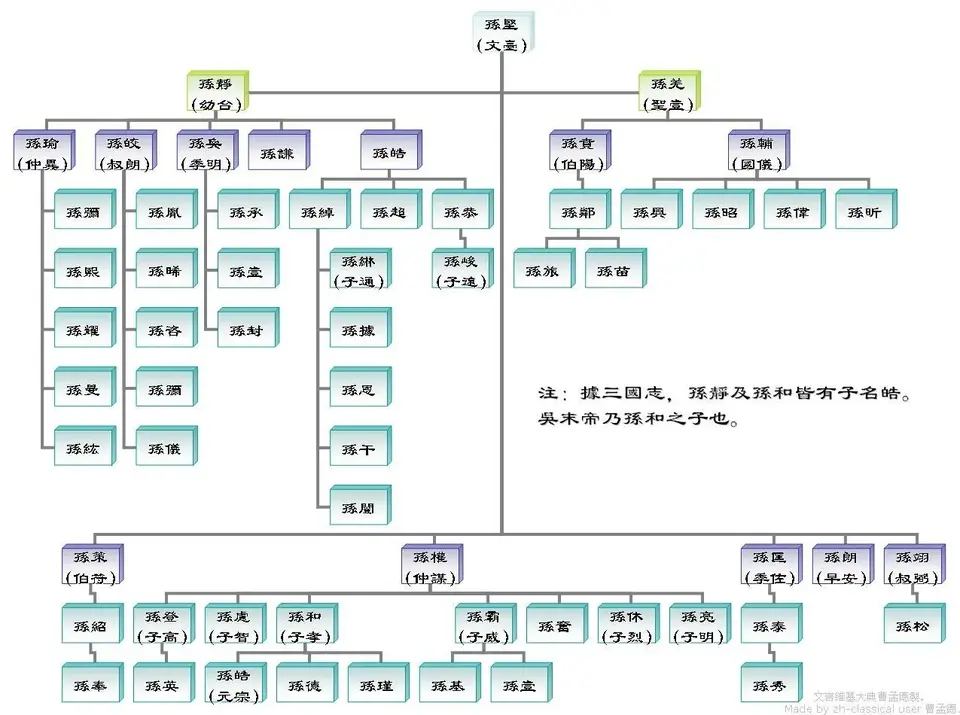
Sun Kuang belonged to the preeminent military lineage of Jiangdong, the Sun clan of Fuchun in Wu Commandery. His father, Sun Jian, was a renowned military commander of the late Han who had achieved martial renown in the campaigns against Dong Zhuo, slaying Hua Xiong and recovering the desolated imperial capital of Luoyang. His mother, Lady Wu (honored posthumously as Empress Wulie), was a wise and discerning matriarch who bore Sun Jian four full sons: the eldest Sun Ce, the second Sun Quan, the third Sun Yi, and the fourth Sun Kuang.
In 191 (2nd year of the Chuping era), Sun Jian was ordered by Yuan Shu to launch an expedition against Liu Biao in Jing Province. While pursuing enemy forces into the bamboo groves of Mount Xian near Xiangyang, Sun Jian was ambushed by Huang Zu's officer Lu Gong and struck down by arrows. Under the laws of the Han dynasty governing hereditary nobility, the title of Marquis of Wucheng should have passed automatically to his eldest son and heir, Sun Ce. However, Sun Ce possessed unbounded martial ambition, resolving to build his own domain with his sword rather than enjoy ancestral honors. He accordingly submitted a formal petition to the imperial court, requesting that his father's noble title as Marquis of Wucheng be transferred to his young brother Sun Kuang.
In 197 (2nd year of the Jian'an era), Yuan Shu committed treason by declaring himself emperor in Huainan. Sun Ce severed relations with Yuan Shu and sent envoys to the imperial court at Xuchang to declare his loyalty. Emperor Xian and regent Cao Cao were delighted by Sun Ce's pacification of Jiangdong and issued an edict appointing Sun Ce as Cavalry Commandant and confirming his succession to the Marquisate of Wucheng. Sun Ce once again yielded the title, whereupon the imperial court created Sun Ce Marquis of Wu and formally ratified Sun Kuang as the legitimate Marquis of Wucheng. In this manner, young Sun Kuang obtained full hereditary marquis status and an esteemed position within the imperial clan.
At the end of 199 (4th year of the Jian'an era), northern China experienced profound strategic convulsions. The powerful northern warlord Yuan Shao crushed Gongsun Zan, consolidating control over the four provinces of You, Ji, Qing, and Bing, and led a massive host of a hundred thousand soldiers south to the Yellow River to confront Cao Cao at Guandu. Cao Cao harbored deep anxieties that while he was locked in conflict with Yuan Shao, the formidable Sun Ce might exploit the defenseless south to sail up the Yangtze and launch a surprise raid on Xuchang. Seeking to secure his rear and placate the Sun family, Cao Cao initiated diplomatic overtures, pressing for an inter-clan marriage alliance.
Under Cao Cao's personal arrangement, his niece (the daughter of General Who Conquers the South Cao Ren or another prominent clansman) was married to Sun Kuang; simultaneously, Cao Cao's son Cao Zhang took the daughter of Sun Ce's cousin Sun Ben as his bride. This high-profile union between northern and southern powerhouses temporarily neutralized active hostilities along the Huai River and transformed Sun Kuang into a vital marital link between the two ruling dynasties.
In his personal conduct, Sun Kuang was gentle, modest, and upright. Living quietly in Wu Commandery, he observed strict moral decorum and immersed himself in classical scholarship. Following Sun Ce's death, Sun Quan governed Jiangdong and treated his younger brother with exceptional affection. Upon attaining adulthood, Sun Kuang's virtues won warm praise from local magistrates; he was nominated as Filial and Incorrupt (Xiaolian) and subsequently summoned as a Flourishing Talent (Maocai). Yet just as he stood on the threshold of public service, he was struck by sudden illness and died in his private residence in Wu Commandery in his twenties, leaving the imperial court and his family in deep mourning.
Regarding Sun Kuang's historical career, prominent Liu Song dynasty historian Pei Songzhi conducted a meticulous investigation to correct a major error found in Yu Pu's Jiangbiao Zhuan.
The Jiangbiao Zhuan had recorded that Sun Jian's fourth son Sun Kuang served as Palace Commandant of Established Might during the naval campaign at Dongkou in 222 (1st year of the Huangwu era), when Eastern Wu forces under Lu Fan repelled the Wei invasion led by Cao Xiu. According to that text, Sun Kuang disobeyed orders and set fire to riverside reeds near his encampment, sparking an uncontrollable blaze that incinerated supplies and disrupted the Wu lines. Enraged, Sun Quan purportedly placed Sun Kuang under lifetime house arrest in Wu Commandery and stripped him and his descendants of the imperial surname, renaming them the "Ding" clan.
In his annotations to Records of the Three Kingdoms, Pei Songzhi pointed out a glaring chronological contradiction in this narrative. Citing Chen Shou's original text in the imperial clan biographies, Pei Songzhi emphasized that Sun Kuang had died as an untried candidate in his twenties during the Jian'an era. The naval clash at Dongkou occurred more than twenty years later in 222; an individual who had already passed away in his twenties could not possibly have commanded troops as a middle-aged general at Dongkou!
Through rigorous cross-referencing of genealogical and administrative records, Pei Songzhi discovered that the commander who served as Palace Commandant of Established Might and caused the fire at Dongkou was actually Sun Lang (courtesy name Zao'an), Sun Jian's fifth son born to a concubine. Because both were younger brothers of Sun Quan and shared similar courtesy names (Sun Kuang was Jizuo; Sun Lang was Zao'an), later Eastern Jin and Southern Dynasties anecdotal texts conflated the two brothers, erroneously attributing Sun Lang's disgrace to the virtuous and long-deceased Sun Kuang. Pei Songzhi's textual critique definitively exonerated Sun Kuang, restoring historical truth to his brief life.
Following Sun Kuang's early death, his widow Lady Cao raised their only son, Sun Tai. Inheriting the valor and loyalty of his family, Sun Tai entered state service in Eastern Wu, winning the trust of his uncle Sun Quan and Crown Prince Sun Deng, and attained the office of Colonel of Changshui.
In 234 (3rd year of the Jiahe era), Sun Quan led a massive army of one hundred thousand troops on a northern offensive against Cao Wei, besieging Hefei New City. Colonel of Changshui Sun Tai led elite assault troops against the fortifications, but was struck down by a stray arrow on the front lines, giving his life in service to the realm.
Sun Tai was survived by his son Sun Xiu, who proved talented and capable, commanding considerable esteem among the imperial clan. When the tyrannical emperor Sun Hao took the throne, he launched bloody purges against meritorious statesmen and royal relatives. Sun Xiu, who was serving as Senior General and Commander of Xiakou guarding the vital river fortifications, fell under deep suspicion, with imperial spies circling his headquarters.
In 270 (2nd year of the Jianheng era), recognizing that execution was imminent, Sun Xiu led several hundred personal retainers out of Xiakou and surrendered to Western Jin. Emperor Wu of Jin (Sima Yan) was overjoyed, viewing Sun Xiu's defection as a powerful omen of Eastern Wu's collapse. He showered Sun Xiu with honors, appointing him Senior General of Agile Cavalry, granting him the privilege of Opening an Office with Equal Three Excellencies, and enfeoffing him as Duke of Kuaiji. Through all the political storms of the Three Kingdoms and the Jin unification, the lineage of Sun Kuang retained aristocratic prominence across the empire.
After Sun Jian's death, his eldest brother Sun Ce renounced the ancestral title in his favor; in 197, the Han court officially recognized Sun Kuang as Marquis of Wucheng.
In 199, Cao Cao betrothed his niece Lady Cao to Sun Kuang, forging a crucial political alliance between the ruling houses of the Central Plains and Jiangdong before the Battle of Guandu.
Distinguished for moral uprightness and scholarly cultivation within the imperial family, he was recommended as Filial and Incorrupt (Xiaolian) and as a Flourishing Talent (Maocai).
Exonerated by Liu Song historian Pei Songzhi, who resolved the centuries-old error in Jiangbiao Zhuan that had confused Sun Kuang with his half-brother Sun Lang regarding the fire at Dongkou.
His only son Sun Tai died heroically for the state as Colonel of Changshui, and his grandson Sun Xiu served as Senior General of Wu and Senior General of Agile Cavalry and Duke of Kuaiji in Jin.
FIGURES ASSOCIATED WITH THIS DYNASTY