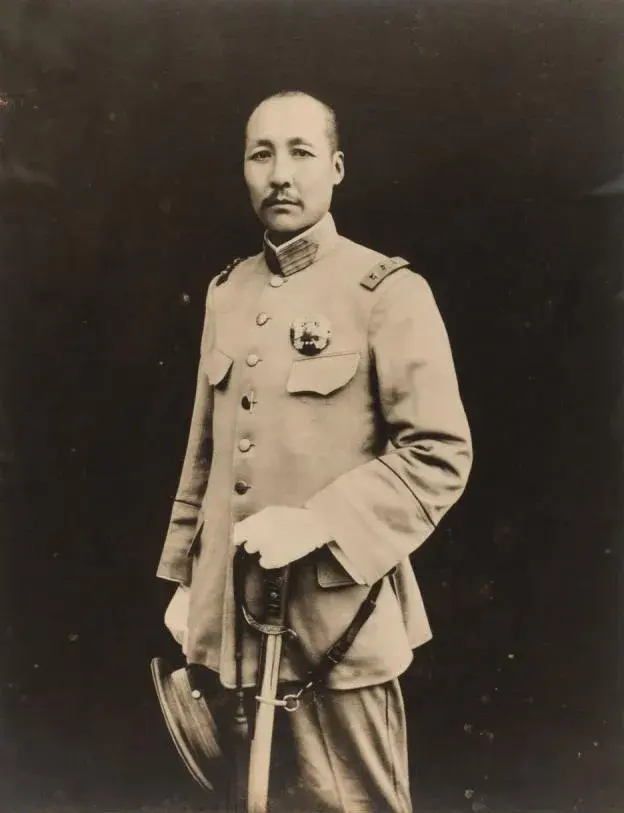
Life and Career
Early Hardships and Studies in Japan
Sun Chuanfang was born into an impoverished peasant family in Tai'an, Shandong Province, in April 1885. His father passed away during his early childhood, leaving the household destitute. Forced to flee regional famines and mistreatment by local relatives, his mother took the young Sun to live with relatives in Jinan and Shanghe. During the Boxer Uprising, the family relocated again. Sun demonstrated intense academic perseverance, studying classical texts and practical learning while working odd jobs.
In 1902, Sun enlisted in the training units of the Beiyang forces through family connections. His literacy, sharp intellect, and physical stamina quickly caught the attention of senior instructors. In 1904, he entered the prestigious Beiyang Army Accelerated School in Baoding, where he received comprehensive training in modern military doctrine. Due to his outstanding performance, he was selected as an official government-sponsored cadet to attend the Imperial Japanese Army Academy in Tokyo, joining the sixth class of infantry cadets. During his five years in Japan, Sun studied modern tactics, operational planning, logistics, and foreign languages. He returned to China in 1909, passed the imperial military examinations for returned students with distinction, and received an appointment as a junior officer in the Beiyang 2nd Division.
Military Career in Hubei and Early Rise
Following his commissioning, Sun Chuanfang was assigned to the Beiyang 2nd Division under the command of Wang Zhanyuan. When the Xinhai Revolution broke out in 1911, Sun accompanied Wang's troops southward to Hubei. Over the subsequent decade, Wang Zhanyuan served as Military Governor of Hubei, and Sun became one of his most trusted subordinates. He exhibited exceptional organizational efficiency, enforcing strict drill standards and administrative competence within his regiment and brigade.
During the Zhili-Anhui War of 1920, the Zhili clique defeated the Anhui faction led by Duan Qirui. Wang Zhanyuan solidified control over Hubei, and Sun Chuanfang was promoted to Commander of the 2nd Division while concurrently assuming the post of Commander-in-Chief of the Upper Yangtze River. In 1921, local uprisings and military mutinies in Hubei led to Wang Zhanyuan's downfall. Sun adroitly allied himself with the paramount Zhili commander Wu Peifu, securing the safety of his troops and earning Wu's high trust as an indispensable field commander in central China.
Expedition to Fujian and Control of Zhejiang and Jiangsu
In early 1923, following the First Zhili-Fengtian War, Wu Peifu directed Sun Chuanfang to lead an expeditionary force south from Hubei into Fujian to eliminate regional militarists aligned with Sun Yat-sen and Duan Qirui. Sun executed an aggressive mountain campaign, capturing Yanping and marching into Fuzhou. His administrative and military grip on Fujian was recognized by Beijing, which appointed him Military Governor of Fujian.
In the autumn of 1924, conflict erupted between Jiangsu Governor Qi Xieyuan and Zhejiang Governor Lu Yongxiang, triggering the Jiangsu-Zhejiang War. Sun seized this strategic opportunity by advancing his troops from Fujian across the mountain borders into Zhejiang. By outflanking Lu Yongxiang's rear defenses and seizing Hangzhou, Sun compelled Lu to abandon Zhejiang. The Beijing government subsequently appointed Sun as Military Governor of Zhejiang. Through calculated maneuvering, Sun established firm dominion over both Fujian and Zhejiang, emerging as a major regional power broker.
Countering the Fengtian Clique and Dominating Five Provinces
Following the Second Zhili-Fengtian War in late 1924, the Fengtian army led by Zhang Zuolin expanded into central China, sending forces under Zhang Zongchang and Shi Congbin to occupy Shanghai and Nanjing. The aggressive encroachment directly threatened Sun's territorial base in Zhejiang. Sun initially feigned acquiescence while secretly coordinating with regional commanders across Jiangsu, Anhui, and Jiangxi.
In October 1925, Sun launched a sudden, sweeping counteroffensive against Fengtian forces along the Shanghai-Nanjing railway. His troops captured Shanghai, liberated Nanjing, and advanced northward along the Tianjin-Pukou railway, capturing Fengtian commander Shi Congbin at Guzhen. In a controversial move to deter future invasions, Sun ordered Shi Congbin's public beheading. By November 1925, Sun had consolidated control over Zhejiang, Fujian, Jiangsu, Anhui, and Jiangxi. He formally established the Coalition Army of the Five Provinces in Nanjing, appointing himself Commander-in-Chief. He enacted fiscal reforms, hired competent civilian administrators like geologist Ding Wenjiang to direct Shanghai municipal planning, and upgraded the local arsenals in Shanghai and Nanjing.
Resisting the Northern Expedition and Strategic Retreat
In July 1926, the National Revolutionary Army launched the Northern Expedition from Guangdong. While Wu Peifu bore the brunt of the Nationalist offensive in Hunan and Hubei, Sun Chuanfang maintained an opportunistic neutrality, hoping that both sides would exhaust each other. However, once Wu's forces collapsed at Tingsiqiao and Heshengqiao, the Nationalist army redirected its full strength eastward into Jiangxi.
Sun mobilized all five provincial armies to defend Jiangxi, leading troops personally to the front lines around Jiujiang and Nanchang. The ensuing battles in October and November 1926 were among the bloodiest of the entire civil war. Despite tactical counterattacks, Sun's armies were outmaneuvered and suffered catastrophic casualties. Sun was forced to abandon Nanchang and retreat toward Nanjing and Zhejiang. Concurrently, revolutionary uprisings in Shanghai and internal rebellions among his subordinate commanders further undermined his hold over the Lower Yangtze.
Alliance with Fengtian and the Battle of Longtan
By early 1927, Sun had lost Jiangxi, Fujian, and Zhejiang, with Nationalist forces converging on Shanghai and Nanjing. Swallowing his past grievances, Sun traveled to Beijing to forge an alliance with his former enemy Zhang Zuolin, integrating his forces into the An'guojun as Deputy Commander-in-Chief. In August 1927, taking advantage of internal political divisions between Wuhan and Nanjing within the Nationalist camp, Sun launched an audacious counterattack.
Leading tens of thousands of elite troops across the Yangtze River under cover of darkness, Sun seized Longtan and severed the Shanghai-Nanjing railway, aiming to recapture Nanjing. In response, Nationalist generals Li Zongren, Bai Chongxi, and He Yingqin concentrated their main forces in a desperate multi-directional counteroffensive. The ensuing six-day Battle of Longtan ended in catastrophic defeat for Sun's army, with over thirty thousand soldiers killed or captured. This decisive battle broke the back of Sun's military power. Sun fled north of the river, and his remaining divisions disintegrated during subsequent Nationalist advances.
Retirement in Tianjin and Preservation of Integrity
Following the complete triumph of the Northern Expedition and the Northeast Flag Replacement in 1928, Sun Chuanfang formally resigned his military posts and went into retirement. He took up residence in the British and Japanese concessions in Tianjin, where he became a devoted lay Buddhist, adopting the religious name Lay Buddhist Zhiyuan. He spent his days chanting sutras, meditating, and financially supporting the Tianjin Buddhist Laymen Society.
After the Mukden Incident in 1931 and the Japanese occupation of Manchuria, Japanese military planners sought prominent former Beiyang figures to legitimize their intended puppet regimes in North China. Japanese intelligence officers, including Yasuji Okamura and Kenji Doihara, made frequent visits to Sun's residence, attempting to lure or coerce him into becoming the civilian head of a collaborationist government. Sun remained completely unmoved, citing his Buddhist vows and steadfastly refusing every Japanese proposal, thereby safeguarding his national dignity during his final years. On November 13, 1935, while participating in a prayer gathering at the Tianjin Buddhist Laymen Society, Sun was shot three times from behind and killed by Shi Jianqiao, the daughter of executed general Shi Congbin, who had spent ten years planning the assassination to avenge her father.
Major Achievements
Dominating Southeast China and Establishing the Coalition Army
During the anti-Fengtian campaign of 1925, Sun launched a rapid, multi-pronged counteroffensive that drove Fengtian armies out of the Lower Yangtze valley. In Nanjing, he established the Coalition Army of Five Provinces (Zhejiang, Fujian, Jiangsu, Anhui, and Jiangxi) and assumed the position of Commander-in-Chief, commanding hundreds of thousands of troops and becoming the preeminent warlord ruler of southeastern China.
Creating the Songhu Commercial Port and Promoting Civil Administration
While administering Jiangsu and Zhejiang, Sun enlisted modern intellectuals such as Ding Wenjiang and military strategist Jiang Baili to direct governance. He created the Songhu Commercial Port Directorate, initiating comprehensive modern urban planning for greater Shanghai, lowered agricultural tax burdens, and maintained strict military discipline, which fostered economic and social stability in the southeastern provinces.
Upholding Integrity by Refusing Japanese Collaboration
In his later years of Buddhist reclusion in Tianjin, Sun faced persistent pressure and lucrative inducements from Japanese military commanders Yasuji Okamura and Kenji Doihara to head puppet administrations in northern China. Sun firmly refused all collaboration, maintaining his personal integrity and patriotic principles until his death.