Biography
Imperial Enfeoffment and Excessive Imperial Favor
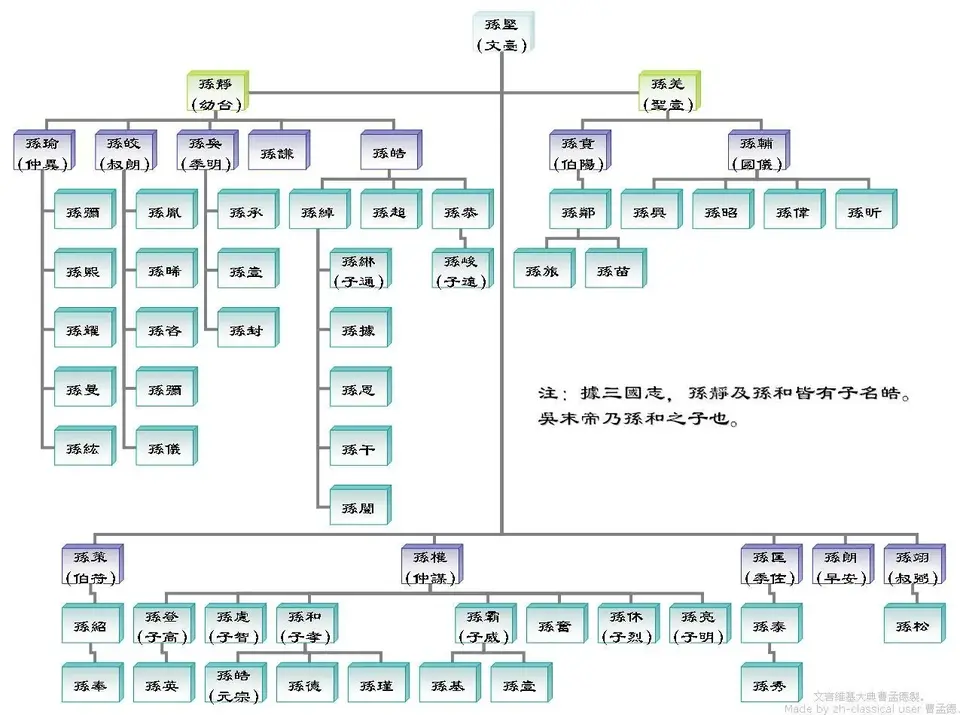
Sun Ba was the fourth son of Sun Quan, the founding Emperor of Eastern Wu, born to the palace concubine Consort Xie. Among Sun Quan's offspring, his eldest son, Crown Prince Sun Deng, commanded immense devotion across the realm, yet tragically passed away in 241 CE at the age of thirty-three. Sun Deng's premature death plunged Eastern Wu into an acute succession crisis. With the second son Sun Lu having died early, Sun Quan elevated his third son, Sun He, to Crown Prince in the first month of 242 CE (the fifth year of the Chiwu era).
In the eighth month of that year, seeking to generously endow his younger sons, Sun Quan enfeoffed fourteen-year-old Sun Ba as the King of Lu. He appointed the venerable Vice Director Shi Yi to serve concurrently as Senior Tutor to the King of Lu, charged with mentoring the prince in governance and classical learning. In his twilight years, Sun Quan doted upon Sun Ba with unrestrained affection, granting him private stipends, ornate carriages, imperial robes, and personal attendants identical—and occasionally superior—to those bestowed upon Crown Prince Sun He.
Initially, Sun Quan enforced no ceremonial distinction between the heir apparent and the vassal prince, permitting Sun He and Sun Ba to reside in the same palace and dine together as equals. Civil ministers and military commanders found it impossible to discern sovereign hierarchy between the two princes. Chancellor Lu Xun, Minister of Ceremonies Gu Ti, and Tutor Shi Yi were profoundly alarmed, submitting repeated memorials to argue that cosmic and dynastic order demanded that the Crown Prince, as the supreme heir, occupy an unassailable station above all feudal princes.
Bowing to ministerial pressure, Sun Quan issued decrees constructing separate residential palaces and establishing distinct secretariats for Sun He and Sun Ba, restoring hierarchical court protocol during state banquets. However, youthful, arrogant, and accustomed to parity with the heir, Sun Ba perceived this separation as a humiliating demotion. He harbored intense resentment against his elder brother Sun He, viewing him as a direct rival to be overthrown.
Forging Factional Alliances and Slandering the Heir
Following the division of palaces, Sun Ba resolved to subvert Sun He's standing and seize the imperial succession. Utilizing the vast financial resources of his princely estate, he opened his gates to literary retainers, military officers, and ambitious aristocrats, personally visiting administrative offices to cultivate influential bureaucrats.
Attracted by Sun Ba's favor, an ambitious political faction formed rapidly around him. Most prominent among them was the prestigious Quan consort clan. Quan Ji, the second son of Grand Commander Quan Cong, alongside clan relative Wu An (grandson of Sun Ce), Palace Secretariat Director Sun Hong, and Attendant Gentleman Yang Zhu, aligned themselves with Sun Ba to safeguard their influence, creating the formidable "King of Lu Faction."
In opposition, prominent senior statesmen including Chancellor Lu Xun, Grand Marshall Zhuge Jin, Minister of Ceremonies Gu Tan, General of Agile Cavalry Zhu Ju, and Minister of Selection Wu Can stood firm on Confucian primogeniture, vigorously upholding Sun He's legitimate succession as the "Crown Prince Faction." From 243 CE onwards, the Eastern Wu court was consumed by the bitter Nan-Lu Succession Struggle.
Aware that direct legal challenges against the legitimate heir would fail, Sun Ba and his allies resorted to clandestine palace intrigues. In 245 CE (the eighth year of Chiwu), when Sun Quan fell seriously ill, Crown Prince Sun He visited the ancestral shrine to pray for the Emperor's recovery, lodging overnight at the nearby residence of his wife's uncle, Zhang Xiu. Princess Sun Luban (Sun Quan's eldest daughter, who detested Sun He's mother Lady Wang) dispatched spies to observe the visit, subsequently reporting to Sun Quan that the Prince was plotting treason with his in-laws, while alleging that Lady Wang exhibited joy over the Emperor's grave condition. Enraged, Sun Quan severely reprimanded Lady Wang, who died of grief and terror, causing Sun He to permanently lose imperial favor.
Escalation of Purges and Ministerial Destruction
With Sun He disgraced, the King of Lu faction intensified its campaign to eliminate the Crown Prince's supporters. Partisans constantly whispered accusations into Sun Quan's ear, fabricating charges to purge key ministers.
Yang Zhu privately urged Sun Quan to depose Sun He and establish Sun Ba as Crown Prince. Moved by his arguments, Sun Quan held a confidential conference with Yang Zhu behind closed doors, tentatively agreeing to the substitution. However, an attendant concealed beneath the bed eavesdropped on the discussion and alerted Crown Prince Sun He. Panicked, Sun He dispatched Lu Yin to Wuchang to seek the intervention of Chancellor Lu Xun. Lu Xun submitted memorials emphasizing the paramount importance of primogeniture and requested permission to return to Jiankang to remonstrate in person.
Furious that confidential imperial deliberations had leaked, Sun Quan arrested Yang Zhu and interrogated him under torture. Yang Zhu falsely accused Lu Yin of treasonous leaks, prompting Sun Quan to dispatch a series of scathing reprimands to Lu Xun at Wuchang. Deeply wounded by the sovereign's unjust suspicions and the devastation of court morale, the venerable Chancellor Lu Xun died of sorrow and indignation in 245 CE.
Following Lu Xun's demise, the King of Lu faction unleashed sweeping inquisitions. Crown Prince supporters Gu Tan and Gu Cheng were banished to the desolate malarial regions of Jiaozhou, where they perished in exile; Minister of Selection Wu Can was imprisoned and executed; and Zhu Ju was demoted. The Eastern Wu court was paralyzed by fear, the civil administration fractured, and the military command severely demoralized.
Dual Deposition and Decreed Death
Sun Ba's relentless machinations ultimately backfired, entirely exhausting Sun Quan's paternal indulgence. As the foremost statesmen of the empire perished and governance broke down, Sun Quan realized that the factional war was no longer a family dispute, but an existential peril threatening the survival of Eastern Wu.
In the autumn of 250 CE (the thirteenth year of Chiwu), the aging and ailing Sun Quan resolved to enact a drastic resolution to terminate the eight-year crisis. To prevent future factional reprisals regardless of who succeeded, the Emperor determined upon the simultaneous deposition of both contending sons.
Sun Quan promulgated an imperial decree deposing Crown Prince Sun He, stripping him of royal rank and exiling him to Guzhang (later enfeoffing him as Prince of Nanyang). Simultaneously, showing no mercy to the instigator of court turmoil, Sun Quan issued a condemning edict rebuking Sun Ba for factionalism, insubordination, and fratricidal plotting, commanding him to commit suicide by poison. Sun Ba took his own life at the age of approximately twenty-two.
Alongside Sun Ba's decreed death, Sun Quan ordered the public execution of the King of Lu faction's chief conspirators, including Quan Ji, Wu An, and Yang Zhu, with Yang Zhu's severed head cast into the Yangtze River. Sun Quan subsequently elevated his youngest son, seven-year-old Sun Liang, to Crown Prince. Sun Ba's ambition to usurp the throne thus ended in his own violent death, the ruin of his partisans, and the destabilization of the Eastern Wu dynasty.
Major Achievements
Royal Enfeoffment and Parity with the Heir
Sun Ba's elevation as King of Lu in 242 CE constituted a structural catalyst for the breakdown of Eastern Wu dynastic governance. By granting Sun Ba royal allocations, retinue sizes, and court protocols identical to those of Crown Prince Sun He, Sun Quan blurred the traditional boundaries of primogeniture.
This miscalculated favoritism generated immense confusion among court ministers, directly fueling Sun Ba's personal ambition. Exploiting his exceptional standing, Sun Ba treated his elder brother as an obstacle to be eliminated, setting the stage for the destructive succession conflict that followed.
Mobilizing the King of Lu Faction
Sun Ba demonstrated significant political skill in assembling an elite coalition around his princely household. He forged an unshakeable alliance with the military-aristocratic Quan clan, winning over influential figures such as Quan Ji, Princess Sun Luban, Sun Hong, and Yang Zhu.
Throughout the eight-year struggle, Sun Ba's faction utilized confidential memorials, palace intelligence, and espionage to undermine the Crown Prince Faction. This factional strife eliminated irreplaceable statesmen like Lu Xun and Gu Tan, severely damaging the political compact between the imperial house and the Jiangdong aristocracy.
The Downfall of Dual Deposition and Suicide
Sun Ba's tragic end in 250 CE represents a classic historical study in the failure of collateral royal usurpation. Confronted with the complete paralysis of the imperial bureaucracy, Sun Quan executed the unprecedented "Dual Deposition," banishing the heir and forcing Sun Ba to commit suicide.
Sun Ba's ambition brought about his own destruction in his early twenties and the extermination of his principal counselors. His downfall left the throne to an infant emperor under the shadow of overmighty regents, accelerating the internal decline of the Eastern Wu state.