Birth in Yokohama
Born on September 28 in Yokohama, Japan, to Cantonese merchant Su Jiesheng and Japanese mother Wakako.
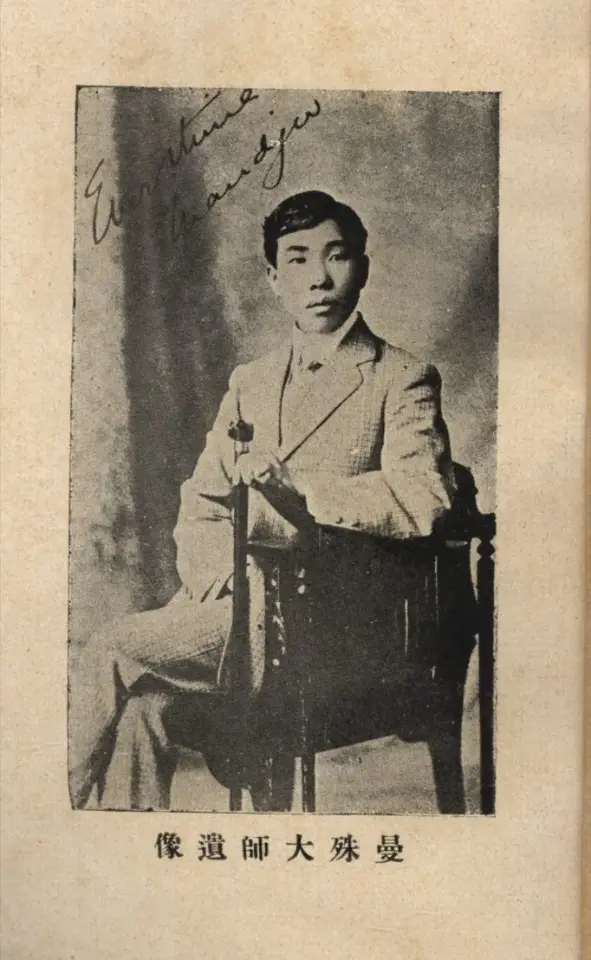
苏曼殊
Su Manshu was an extraordinary writer, poet, translator, painter, and revolutionary activist of the late Qing and early Republican periods, celebrated as one of the core figures of the progressive literary organization Nanshe (Southern Society). Originally named Su Jian, he later adopted the names Zigu, Xuan'ying, and the monastic dharma name Manshu. Born in Yokohama, Japan, to a Cantonese tea merchant and a Japanese mother,…
Su Manshu was an extraordinary writer, poet, translator, painter, and revolutionary activist of the late Qing and early Republican periods, celebrated as one of the core figures of the progressive literary organization Nanshe (Southern Society). Originally named Su Jian, he later adopted the names Zigu, Xuan'ying, and the monastic dharma name Manshu. Born in Yokohama, Japan, to a Cantonese tea merchant and a Japanese mother, his transnational lineage and orphaned childhood instilled in him an intensely sensitive, melancholic temperament, leading contemporaries to remember him as a singular eccentric genius and the foremost "poet-monk" of modern Chinese literature. In his youth, Su studied in Japan at Datong School, the preparatory academy of Waseda University, and the Seijo School in Tokyo. Imbued with early revolutionary consciousness, he joined the Youth Association—the first anti-Qing revolutionary society among Chinese students in Japan—and trained in the Resist-Russia Volunteer Corps, interacting with pioneers including Sun Yat-sen, Liao Zhongkai, He Xiangning, and Chen Duxiu. Returning to China, he taught at Wuzhong Public School in Suzhou and Anhui Public School in Wuhu, and contributed militant articles to revolutionary journals such as Guomin Riribao, Minbao, and Pacific Daily. Following the 1911 Revolution, he penned the famous Anti-Yuan Manifesto against Yuan Shikai's autocratic usurpation, demonstrating unyielding moral courage. In literary and artistic creation, Su was exceptionally gifted across cultural traditions. He pioneered modern Chinese romantic lyrical fiction with his autobiographical masterpiece The Lone Swan (Duanhong Lingyan Ji), composed poignant classical quatrains celebrated as the "Manshu style," and mastered Japanese, English, French, and Sanskrit. He was the first to translate Victor Hugo's Les Miserables into Chinese as Can Shijie and rendered Lord Byron's poetry into classical Chinese verse while compiling seminal Sanskrit reference works. Furthermore, his landscape paintings possessed an aloof, ethereal Chan sensibility. He maintained close intellectual bonds with cultural giants such as Zhang Taiyan, Chen Duxiu, Lu Xun, and Liu Yazi before passing away in Shanghai at the age of thirty-five.
Born on September 28 in Yokohama, Japan, to Cantonese merchant Su Jiesheng and Japanese mother Wakako.
Taken by his father to Lixi Village in Xiangshan, Guangdong, to study at the ancestral hall, separated from his birth mother.
Financed by his maternal cousin, traveled to Japan to attend Datong School, advancing to Waseda University preparatory academy.
Joined the Youth Association in Tokyo, committing to the anti-Qing democratic revolution.
Joined the Resist-Russia Volunteer Corps; after losing funding, was tonsured at a monastery in Huizhou, taking the dharma name Bojing.
Resided in Shanghai, writing for Guomin Riribao and translating Victor Hugo's Les Miserables as Can Shijie.
Invited to teach in Wuhu, rooming with Chen Duxiu and forging a lifelong literary and personal brotherhood.
Re-visited Tokyo, co-founding the Asian Solidarity Society with Kotoku Shusui and planning the literary magazine Xinsheng with Lu Xun.
Traveled to Java to teach at the Chinese Academy, studying Sanskrit and joining the anti-Qing Southern Society from abroad.
Returned to Shanghai after the 1911 Revolution, serializing The Lone Swan in the Pacific Daily to nationwide acclaim.
Penned and published the impassioned Anti-Yuan Manifesto condemning Yuan Shikai's assassination of Song Jiaoren.
Died of gastrointestinal illness at Baolong Hospital in Shanghai on May 3 at age thirty-five; buried beside West Lake in Hangzhou.
Su Manshu was born on September 28, 1884 (the tenth day of the eighth lunar month) in Yokohama, Japan. His grandfather Su Ruiwen had acquired wealth through import-export trade in Guangdong, while his father Su Jiesheng served as a compradore for British merchant firms in Yokohama. Su's biological mother was a Japanese woman named Wakako. Owing to rigid traditional prejudices regarding concubinage and foreign bloodlines, Su was subjected to familial ostracism from his earliest days. Within three months of his birth, Wakako was forced to separate from the child, and mother and son were severed from one another.
When Su was roughly four years old, his father brought him back to his ancestral home in Lixi Village, Xiangshan County, Guangdong (now within Qianshan, Zhuhai), to ensure male lineage representation. He began his early schooling at the Jian ancestral temple, where his tutor Su Ruoquan recognized his innate literary brightness. However, his mixed heritage subjected him to persistent domestic coldness from Su Jiesheng's primary wife, Lady Chen. In 1893, his father went bankrupt in Yokohama, plunging the household into destitution. At the age of thirteen, Su fell gravely ill with high typhoid fever; rather than summoning medical aid, relatives abandoned him in a woodshed to die, where he survived only through the secret charity of compassionate neighbors. This childhood abandonment left him with an enduring psychological melancholy.
In 1896, thirteen-year-old Su left Xiangshan to live with his aunt in Shanghai, where he studied classical Chinese prose and foundational English. In 1898, supported by his cousin Lin Ziyuan, he traveled to Japan to pursue modern studies. Enrolling at the Chinese diaspora Datong School in Yokohama, he studied under Kang Youwei and Liang Qichao's educational framework, building proficiency in Japanese and English.
In 1901, Su entered the higher preparatory academy of Waseda University, subsequently transferring to the military preparatory Seijo School in Tokyo. Throughout his years in Tokyo, his material existence was austere. Surviving on a meager allowance of ten yen per month from his cousin, he lodged in squalid boarding houses, subsisted on coarse rice, and frequently read without lamp oil. Yet his spirit remained fervent. In 1902, eighteen-year-old Su joined the Youth Association, the earliest anti-Qing revolutionary society founded by Chinese students in Japan.
In the spring of 1903, when Tsarist Russia refused to evacuate its forces from Manchuria, Chinese overseas students launched the Resist-Russia Movement. Su enlisted in the Resist-Russia Volunteer Corps, conducting live-ammunition firing exercises at dawn in preparation for armed insurrection. Learning of his radical activism, his cousin Lin Ziyuan threatened to withdraw financial support unless Su abandoned the revolution. Su refused to compromise, prompting his cousin to terminate his tuition and force his return to China.
Returning to China in 1903, Su briefly taught English at Wuzhong Public School in Suzhou, associating with revolutionary intellectuals Zhang Taiyan, Zou Rong, and Zhang Shizhao. When the school was shuttered by authorities following radical student unrest, Su relocated to Shanghai to write for the revolutionary paper Guomin Riribao. Following the imperial crackdown on the Subao newspaper, Su was cast into poverty. Seeking refuge, he traveled to Hong Kong to find Xingzhonghui leader Chen Shaobai, but misunderstanding led to an icy reception. Deeply disheartened, Su journeyed to Guangji Monastery in Haifeng, Huizhou, Guangdong, where he took the tonsure.
Unable to endure monastic isolation, Su absconded after several months with the ordination certificate of a deceased monk named Bojing. Assuming the monastic name Bojing and the style name Manshu, he commenced a wandering life that blurred the boundaries of monk and layman: wearing a frayed indigo cassock while sporting cropped hair, frequenting Buddhist temples alongside teahouses, and indulging in rich foods and sweets.
Returning to Shanghai, Su displayed remarkable literary vigor. Supported by revolutionary companions, he translated Victor Hugo's Les Miserables into Chinese as Can Shijie, published in late 1903. Infusing the translation with his own passionate calls for the overthrow of Qing autocracy and the establishment of an egalitarian society, the book was celebrated by youthful intellectuals including Lu Xun and Chen Duxiu.
In the autumn of 1904, eager to explore the roots of Buddhism and ancient Oriental linguistics, Su traveled to Siam (Thailand) and Ceylon (Sri Lanka). Amid ancient forest shrines, he studied classical Sanskrit and Pali manuscripts, acquiring linguistic foundations that later powered his pioneering dictionaries.
In the summer of 1906, scholar-revolutionary Liu Shipei invited the impoverished Su to Wuhu, Anhui, to teach English and Chinese literature at Wanjiang Middle School and Anhui Public School. Chen Duxiu directed school affairs while coordinating clandestine revolutionary networks. Su and Chen shared living quarters, discussing Chinese societal reform and modern literature night and day. Chen admired Su's unpretentious nature, assisting him in polishing his verses and refining his translations of Lord Byron. In Wuhu, Su also befriended Deng Shenghou, the great-grandson of calligrapher Deng Shiru, forging a lasting artistic alliance.
In 1907, Su traveled to Tokyo for a third time, collaborating with Japanese socialist Kotoku Shusui and Zhang Taiyan to establish the Asian Solidarity Society, advocating international resistance against imperialist expansion. That year, he joined Lu Xun and Zhou Zuoren in planning the revolutionary literary journal Xinsheng.
In 1909, evading Qing surveillance, Su sailed to Java in the Dutch East Indies to teach at the Batavia Chinese Academy. He investigated the hardships of overseas Chinese laborers and studied Sanskrit texts, authoring Nanyang Hua to condemn colonial cruelty. That same year, the anti-Qing literary collective Nanshe was founded in Suzhou; Su joined by sending paintings from Java, becoming one of its most celebrated members.
In October 1911, the Wuchang Uprising toppled the Qing dynasty. Reinvigorated by the news, Su resigned his teaching post in Java and rushed back to China, warmly welcomed by Nanshe founders Liu Yazi and Chen Qubing. He met frequently with revolutionary leaders Song Jiaoren and Yu Youren, accepting the position of literary supplement editor for the Shanghai Pacific Daily.
At the Pacific Daily, Su's creative output reached its zenith. In 1912, he serialized his autobiographical novella The Lone Swan (Duanhong Lingyan Ji). Recounting the heartbreaking romances between the protagonist Sanlang, the Japanese maiden Shizuko, and his Chinese cousin Xuemei, the work expressed lyrical melancholy while rebelling against feudal matrimonial constraints. The novel ignited a nationwide sensation, reprinted across dozens of editions and captivating young readers across the country.
However, the political landscape soon darkened. In the spring of 1913, Yuan Shikai engineered the assassination of Song Jiaoren and launched military campaigns against southern revolutionaries. Outraged by this monarchical betrayal, the melancholic poet became a fierce polemicist. He drafted the famous Anti-Yuan Manifesto, publishing it widely across national newspapers. He denounced Yuan as a butcher who slaughtered innocents and subverted the republic, issuing a solemn warning: "Though we monks dwell in quiet contemplation, we shall rise to strip away your wicked soul!"
Following the defeat of the Second Revolution, Su succumbed to deepening despair. Resigning from journalism, he wandered between Japan, West Lake, and Shanghai. Plagued by chronic neurasthenia, severe gastrointestinal ulcers, and clinical depression, he engaged in reckless eating habits, consuming mountains of sugar and pastries despite intense abdominal agony.
Throughout his illness, Su maintained his childlike idiosyncrasies. He routinely spent friends' donations on confections, selling empty glass jars to buy more candies; once, he groaned through the night after devouring twenty taro cakes and pounds of roasted chestnuts. Yet he remained intensely proud. Visiting Longhua in Shanghai wearing a ragged cassock over a perfumed white silk shirt, he used impeccable English to humiliate an arrogant foreign visitor who had mocked his monastic attire, defending the dignity of Chinese monks.
In the spring of 1918, his condition deteriorated in Shanghai, with severe gastrointestinal hemorrhaging necessitating his transfer to Baolong Hospital. Destitute on his deathbed, his medical expenses were covered by old comrades including Chiang Kai-shek, Wang Jingwei, and Liu Yazi. Shortly before slipping into unconsciousness, he penned his final eight-character epitaph: "All sentient beings are without hindrance" (Yiqie youqing, dou wu gu'ai).
On May 3, 1918, the singular genius died at Baolong Hospital at the age of thirty-five. Mourning his loss, prominent leaders Zhang Taiyan, Chen Duxiu, Sun Yat-sen, and Chiang Kai-shek raised funds for his funeral. In accordance with his wishes to rest beside the Song loyalist poet Lin Bu, his remains were transported to Hangzhou and interred at the foot of Gushan beside West Lake.
Though celebrated as a poet and monk, Su was an early, resolute pioneer of the anti-Qing democratic revolution. As early as 1902, when most overseas students remained enamored with constitutional monarchism, he joined the Youth Association in Tokyo, committing himself to the overthrow of the Manchu autocracy.
In 1903, he enlisted in the Resist-Russia Volunteer Corps, training diligently with rifles at daybreak and withstanding his cousin's financial threats. Returning to China, he wrote inflammatory essays for revolutionary organs such as Guomin Riribao and Minbao. In 1904, he participated in planning the Huaxinghui uprising in Changsha, later attending secret conferences in Shanghai led by Huang Xing. Prior to 1911, he compiled Linghai Youguang Lu to resurrect seventeenth-century Ming loyalist resistance, an effort Lu Xun praised for rekindling historical hatred to aid the revolution. His drafting of the Anti-Yuan Manifesto cemented his status as an uncompromising cultural vanguard.
Su holds a foundational place in the history of modern Chinese fiction. He authored six novellas and stories: The Lone Swan, Tianya Honglei Ji, Jiangsha Ji, Fenjian Ji, Sui Zan Ji, and Feimeng Ji, inaugurating modern Chinese romantic fiction.
His masterpiece, The Lone Swan, was the first modern Chinese autobiographical novella. Dismantling traditional episodic formulas, it incorporated Western first-person psychological introspection and impressionistic natural descriptions. Depicting the tragic wanderings of Sanlang across China and Japan, it offered an unsparing critique of feudal patriarchal morality. Its lyrical elegance not only captured the Republican reading public, but also profoundly influenced the Butterfly School and May Fourth romanticists including Yu Dafu and Xu Zhimo.
In poetry, Su was universally acclaimed as the supreme "poet-monk" of early twentieth-century China. His surviving corpus comprises roughly one hundred classical poems, predominantly seven-character quatrains known as the "Manshu style."
His verse harmonized the introspective melancholy of late Tang poet Li Shangyin with the rebellious spirit of Lord Byron. Expressing personal isolation, anti-Qing patriotism, and spiritual-romantic tensions, his famous lines—such as "Spring rain above the pavilion, the sound of the shakuhachi flute; when shall I return to gaze upon the tides of Zhejiang? In straw sandals and broken begging bowl, unrecognized by men, how many bridges have I crossed through the falling cherry blossoms?"—synthesized Japanese imagery with Chinese loyalist lamentation. Guo Moruo praised his poetry as "immensely fresh and completely free of worldly dust," while Yu Dafu lauded his ability to evoke weeping spirits.
Su was an extraordinary linguist fluent in Japanese, English, French, and Sanskrit. During an era of cultural transformation, he introduced Western progressive literature and philosophy to Chinese intellectuals.
In 1903, he translated Victor Hugo's Les Miserables into Chinese as Can Shijie, marking Hugo's initial entry into the Chinese intellectual consciousness. Employing expressive adaptation, he infused the text with revolutionary messages advocating the overthrow of tyranny. In 1908, he published Selected Poems of Lord Byron in Tokyo, rendering Byron's Romantic verse into classical Sao-style meter, transforming Byron into an icon of anti-autocratic struggle. Furthermore, his Sanskrit studies produced Fanwen Dian and various bilingual lexicons, making him a pioneer of modern Chinese Indology.
In visual art, Su was an exceptional painter inspired by Bada Shanren, Shi Tao, and Ni Zan. He favored sparse landscapes and delicate floral branches executed with dry ink and minimal strokes.
Works such as Mourning Dreams at Fendi, Snowy Mountains Pilgrimage, and Spring Waters and Painted Boats feature figures enveloped by vast, misty mountains, conveying profound existential solitude. Masters Huang Binhong, Chen Shizeng, and He Xiangning praised his paintings for transcendent purity and spiritual composure.
Su's personality reflected the existential fissures of transitional China. Living between monkhood and secularity, China and Japan, he displayed child-like authenticity and wild eccentricity.
He was devoted to fine foods, consuming huge quantities of beef and pastries; he squandered substantial literary earnings instantly, giving funds away to beggars; he loved courtesans with pure platonic devotion, composing verses for the Japanese geisha Hyakusuke while maintaining celibacy; and he challenged foreign racial arrogance in the treaty ports using fluent English. Friends humored his quirks: Ye Chucong locked him in a studio with cigars and chocolates to coax him to paint Mourning Dreams at Fendi, Zhang Qun gifted him chocolates daily for a landscape sketch, and Liu Yazi laughed when Su mistook his young son for a girl and signed a drawing to "Mistress Wugou." This unvarnished sincerity made him a legendary figure of the Republican era.
FIGURES ASSOCIATED WITH THIS DYNASTY