Born in Princely Residence
Born on the nineteenth day of the tenth lunar month in the Gong residence in Lin'an, second son of Zhao Dun and Li Fengniang.
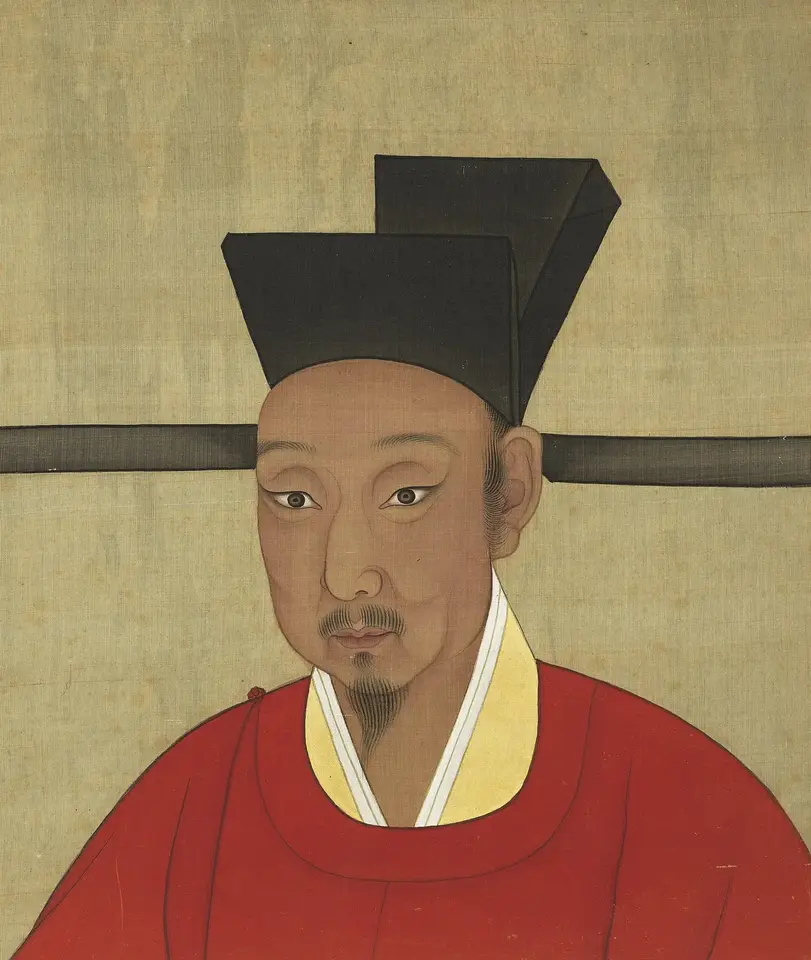
赵扩
Zhao Kuo (赵扩, November 19, 1168 – September 17, 1224), known by his temple name Emperor Ningzong, was the thirteenth emperor of the Song Dynasty and the fourth monarch of the Southern Song. He was the second son of Emperor Guangzong (Zhao Dun) and Empress Ciyi (Li Fengniang). Initially titled Duke of Ying, Prince of Pingyang, and Prince of Jia, he ascended the imperial throne in 1194 through the Shaoxi abdication coup,…
Zhao Kuo (赵扩, November 19, 1168 – September 17, 1224), known by his temple name Emperor Ningzong, was the thirteenth emperor of the Song Dynasty and the fourth monarch of the Southern Song. He was the second son of Emperor Guangzong (Zhao Dun) and Empress Ciyi (Li Fengniang). Initially titled Duke of Ying, Prince of Pingyang, and Prince of Jia, he ascended the imperial throne in 1194 through the Shaoxi abdication coup, reigning for thirty years across the Qingyuan, Jiatai, Kaixi, and Jiading eras. He died at the age of fifty-five and was interred at the Yongmao Mausoleum in Kuaiji. In 1194, when the retired Emperor Xiaozong passed away, Emperor Guangzong suffered from mental derangement and refused to preside over his father's funeral rites, provoking acute dynastic panic and constitutional crisis in the Southern Song capital. Grand Councilor Zhao Ruyu and imperial in-law Han Tuozhou orchestrated a palace coup with the support of Grand Empress Dowager Wu, compelling Guangzong to abdicate and elevating the young Prince of Jia, Zhao Kuo, to the throne. In the early years of his reign, Zhao Kuo relied on Zhao Ruyu and invited the eminent Neo-Confucian philosopher Zhu Xi to lecture at court. Soon afterwards, however, Han Tuozhou ousted Zhao Ruyu and initiated the Qingyuan Partisan Prohibition, designating Neo-Confucianism as False Learning and purging reformist scholars. During the Jiatai and Kaixi eras, Han launched the ill-fated Kaixi Northern Expedition to recover northern territories from the Jurchen Jin dynasty, which collapsed in total disaster due to poor preparation and the betrayal of western commanders. Following the military debacle, Vice Minister Shi Miyuan allied with Empress Yang to assassinate Han Tuozhou at Yujin Garden, sending his severed head to the Jin court and signing the humiliating Jiading Peace Accord. Shi Miyuan thereafter monopolised court power for decades, entrenching ministerial dictatorship in the late Southern Song. Although Zhao Kuo was personally benevolent, frugal, and compassionate toward commoners, his passive temperament left imperial authority vulnerable to dominant ministers. Nevertheless, significant institutional achievements occurred during his reign: he promulgated the Tongtian Calendar, published the Qingyuan Tiaofa Shilei legal compendium, established the Five Mountains and Ten Monasteries ranking for Jiangnan Chan Buddhism, posthumously created Yue Fei the Prince of E, and stripped the reviled appeaser Qin Hui of his noble titles, revising his posthumous name to "Mouchou" (Absurd and Ugly). Because all his biological sons died in infancy, upon his death in 1224, Chancellor Shi Miyuan forged an imperial decree deposing Crown Prince Zhao Hong and enthroning Zhao Yun (Emperor Lizong).
Born on the nineteenth day of the tenth lunar month in the Gong residence in Lin'an, second son of Zhao Dun and Li Fengniang.
Appointed Surveillance Commissioner of Mingzhou and created Duke of Ying; elevated to Prince of Pingyang in 1185.
His father Guangzong ascended the throne; Zhao Kuo was created Prince of Jia, conducting himself with propriety.
Following Guangzong's abdication crisis, Zhao Kuo was elevated to the throne by Zhao Ruyu and Han Tuozhou under Grand Empress Dowager Wu.
Adopted the era Qingyuan; Han Tuozhou framed Chancellor Zhao Ruyu, dismissed Zhu Xi, and banned Neo-Confucianism as False Learning.
Adopted astronomer Yang Zhongfu's calculations to promulgate the Tongtian Calendar, measuring the tropical year with great accuracy.
Changed era to Jiatai, gradually lifting the partisan ban and restoring honors to Zhao Ruyu to heal court divisions.
Posthumously created anti-Jin hero Yue Fei the Prince of E, stripping treacherous minister Qin Hui of his princely rank.
Changed era to Kaixi; authorized Han Tuozhou's northern invasion against the Jin, which collapsed into complete military defeat.
Shi Miyuan and Empress Yang assassinated Han Tuozhou at Yujin Garden, initiating peace negotiations with the Jin dynasty.
Concluded peace with the Jin, addressing the Jin emperor as uncle, increasing annual tributes, and sending Han Tuozhou's severed head.
When Mongol armies invaded Jin and Jin launched southern raids into Song territory, Zhao Kuo stopped tributes and mounted resistance.
Because all biological sons died in infancy, selected royal descendant Zhao Hong as imperial heir, creating him Prince of Jiyang.
Died in Funing Hall in Lin'an on the third day of the intercalary eighth lunar month at age fifty-five; Shi Miyuan enthroned Zhao Yun.
Zhao Kuo was born on November 19, 1168, in the Gong princely mansion in Lin'an. His mother, Empress Li Fengniang, was a notoriously domineering and jealous consort who claimed to have dreamed of the sun dropping into her hands before conceiving. In 1178, at ten years of age, Zhao Kuo was appointed Surveillance Commissioner of Mingzhou and created Duke of Ying. In 1185, he was promoted to Prince of Pingyang. When his father Zhao Dun ascended the imperial throne as Emperor Guangzong in 1189, Zhao Kuo was elevated to Prince of Jia, earning a reputation within the palace for mild manners, personal frugality, and strict adherence to filial rituals.
In June 1194, retired Emperor Xiaozong passed away in the Chonghua Palace. Emperor Guangzong, incapacitated by severe paranoia and manipulated by Empress Li, refused to attend his father's mourning rituals or preside over the imperial funeral, shocking the court and triggering widespread public panic. Recognizing that dynastic stability was in grave peril, Assistant Commissioner of Military Affairs Zhao Ruyu, Court official Zhao Yanyu, and Vice Minister Xu Yi plotted an emergency abdication. They enlisted Han Tuozhou, a relative of Grand Empress Dowager Wu, to deliver secret memorials to the inner court, successfully securing the grand empress dowager's authorization.
On July 24, 1194, as civil and military officials gathered in mourning dress at Chonghua Palace, Grand Empress Dowager Wu presided behind the ceremonial screen and declared Guangzong's abdication, announcing Prince of Jia Zhao Kuo as the new emperor. Terrified by the sudden succession, Zhao Kuo wept, paced around the hall, and protested that he lacked the competence to assume such responsibility. Grand Empress Dowager Wu personally instructed palace attendants to drape the imperial yellow robe over his shoulders and escorted him to the throne to receive ministerial congratulations, concluding the Shaoxi abdication coup.
Upon taking the throne, Zhao Kuo adopted the era name Qingyuan. Expressing deep gratitude for Grand Councilor Zhao Ruyu's leadership during the transition, he appointed Zhao as Right Grand Councilor and welcomed the eminent philosopher Zhu Xi to court as Drafter in the Huanzhang Pavilion and Imperial Lecturer. Zhu Xi delivered rigorous lectures on the Great Learning and the Analects in the private imperial chambers, urging the sovereign to rectify his mind and curb the influence of imperial in-laws. However, palace official Han Tuozhou, who expected a paramount ministerial post in reward for facilitating communications with the grand empress dowager, was sidelined by Zhao Ruyu on the traditional grounds that imperial relatives should not manage executive administration.
Deeply resentful, Han Tuozhou exploited his access to the inner palace to poison the young emperor's mind, fabricating allegations that Zhao Ruyu plotted to usurp the throne as a royal clan member, while accusing Zhu Xi and his followers of factionalism and deceptive scholarship. Vulnerable to manipulation, Zhao Kuo dismissed Zhu Xi after only forty-six days of lectures. Han Tuozhou subsequently directed supervisory officials to impeach Zhao Ruyu, who was banished to Yongzhou and died abruptly in exile.
In 1197, Han Tuozhou expanded his political purge by proscribing Neo-Confucianism as "False Learning." He compiled the Register of the False Learning Faction, blacklisting fifty-nine prominent ministers and philosophers, including Zhao Ruyu, Zhu Xi, Peng Guinian, Chen Fuliang, and Zhou Bida. This partisan ban stifled academic freedom and left Han Tuozhou in unchallenged command of the central bureaucracy for a decade. Only in 1202, when Han required broader literati backing for his planned military campaigns, did Zhao Kuo lift the ban and restore honors to Zhao Ruyu and Zhu Xi.
During the Jiatai era, the Jurchen Jin dynasty was weakened by bureaucratic decay and emerging Mongol incursions from the north. Seeking to legitimize his autocratic authority with a grand military triumph, Han Tuozhou prepared a large-scale northern campaign to reclaim northern territories. Zhao Kuo endorsed this revanchist policy, posthumously creating the famed general Yue Fei the Prince of E in 1204, and stripping traitorous chancellor Qin Hui of his princely rank in 1206, renaming his posthumous title "Mouchou" to ignite public patriotism.
In May 1206, Zhao Kuo formally declared war against the Jin dynasty. Appointed Commissioner of Military Affairs, Han Tuozhou deployed Song armies across eastern, central, and western fronts along the Huai River. However, Song troops were poorly trained, command was decentralized, and planning was inadequate. After minor initial gains around Suzhou, Jin armies mounted fierce counteroffensives, crushing Song forces at Fuli and Zhongli. More catastrophically, Vice Pacification Commissioner Wu Xi defected in Sichuan, proclaiming himself King of Shu and ceding vast western territory to the Jin. The expedition collapsed in utter defeat, and Jin armies crossed the Huai River to threaten the Yangtze frontier.
With northern armies advancing, the Jin court demanded the execution and delivery of Han Tuozhou's head as a precondition for peace. Within Lin'an, anti-war factions mobilized. Vice Minister of Rites Shi Miyuan secretly allied with Empress Yang, utilizing eunuchs to orchestrate a palace conspiracy. On November 24, 1207, as Han Tuozhou travelled to the palace through Yujin Garden, palace guard commander Xia Zhen ambushed and assassinated him on Shi Miyuan's forged orders. His associates were systematically purged.
Faced with the fait accompli of Han Tuozhou's murder, Zhao Kuo accepted the outcome and elevated Shi Miyuan to Right Grand Councilor. In 1208, the Song court signed the humiliating Jiading Peace Accord. Under its terms, the diplomatic status of the Song emperor was lowered from "nephew to uncle" to "nephew to elder uncle," annual silver and silk tributes were raised to three hundred thousand units each, a war indemnity of three million strings was paid, and the severed head of Han Tuozhou was exhumed, preserved in a box, and sent to the Jin capital for public display.
With peace restored, Shi Miyuan established absolute authority over the Southern Song government, monopolising patronage and allying with Empress Yang's family for the next sixteen years. Zhao Kuo retreated further into palace seclusion, leaving state affairs to Shi Miyuan's discretion.
In 1217, following the Mongol conquest of the Jin capital of Zhongdu, the Jin court fled south to Kaifeng. Seeking to compensate for northern territorial losses, Jin armies launched incursions across the Huai River and Xiangyang. Aroused by public fury, Zhao Kuo terminated annual tributes to the Jin and ordered defensive generals, including Meng Zongzheng, to resist northern incursions. Song forces held the Yangtze line, repelling Jin incursions until Jin power waned.
Tragedy dominated Zhao Kuo's personal life: all nine sons born to Empress Han and Empress Yang died in infancy, leaving the Southern Song imperial line without an immediate direct successor.
In 1221, Zhao Kuo adopted Zhao Guihe, a descendant of Emperor Taizu's son Zhao Dezhao, renaming him Zhao Hong and investing him as Prince of Jiyang and imperial heir. However, Prince Zhao Hong possessed an outspoken disposition and resented Chancellor Shi Miyuan's autocratic power, openly remarking that upon his succession he would banish Shi Miyuan to remote frontiers. Terrified by the prospect of retribution, Shi Miyuan located another distant imperial descendant, Zhao Guicheng (later Zhao Yun), grooming him in the capital as an alternative heir.
On September 17, 1224, Emperor Ningzong Zhao Kuo passed away in Funing Hall at the age of fifty-five. While his body lay unburied, Shi Miyuan and Empress Yang executed a rapid palace coup, forging an imperial edict that demoted Crown Prince Zhao Hong to Prince of Jiyang and placed Zhao Yun upon the throne as Emperor Lizong.
During his reign, Zhao Kuo responded to popular sentiment by rehabilitating loyalist heroes and condemning appeasers from earlier eras.
In 1204, he posthumously elevated Southern Song national hero Yue Fei to Prince of E, officially affirming his devotion to dynastic defense. In 1206, during preparations for the northern campaign, he revoked the princely title of peace advocate Qin Hui, changing his posthumous name from "Zhongxian" to "Mouchou" (Absurd and Ugly). These symbolic acts bolstered the patriotic legitimacy of anti-Jin resistance within Southern Song political culture.
In science and astronomy, Zhao Kuo sponsored significant calendrical improvements. Because older calendars had developed noticeable discrepancies in tracking celestial cycles, Zhao Kuo instructed observatory scholar Yang Zhongfu to reform the calendar in 1197.
Promulgated in 1199 as the Tongtian Calendar, this work calculated the tropical year at 365.2425 days. This measurement differed from modern astronomical calculations by only twenty-six seconds, representing the highest peak of pre-modern Chinese astronomical calculation and anticipating the Gregorian calendar of Europe by 383 years.
In jurisprudence, Zhao Kuo oversaw a major codification of Southern Song statutory law. In 1203, Grand Councilor Xie Shenfu and judicial scholars compiled administrative regulations, imperial decrees, and judicial precedents from the Qiandao, Chunxi, and Qingyuan eras into the eighty-volume Qingyuan Tiaofa Shilei.
The compilation arranged imperial statutes by subject matter rather than chronological order, streamlining administrative and judicial application. Surviving volumes remain invaluable primary sources for contemporary legal historians studying Song administrative, economic, and civil law.
Under Zhao Kuo's patronage, the official hierarchy of Jiangnan Chan Buddhist institutions was formalized into the "Five Mountains and Ten Monasteries" system.
The court designated five premier temples—including Jingshan, Lingyin, and Tiantong—as the supreme Five Mountains, alongside ten major secondary monasteries. The imperial court appointed abbots and provided official maintenance, integrating Buddhist monastic networks into the bureaucratic state. This institutional structure was transported to medieval Japan by visiting monks such as Eisai and Dōgen, profoundly shaping Zen architecture and culture in Kamakura Japan.
Zhao Kuo was personally characterized by benevolence, moderation, and fiscal restraint. Throughout his thirty-year reign, he frequently issued tax remissions and opened state granaries during famines. Within his palace, he practiced strict frugality, substituting tin vessels for silver during banquets and wearing simple silk robes.
However, his excessive passivity and lack of political decisiveness proved detrimental to the dynasty. He failed to mediate between court factions early in his reign, allowed Han Tuozhou to launch an unprepared northern war, and surrendered administrative initiative to Shi Miyuan following Han's murder, inaugurating an era of ministerial autocracy that hastened the dynasty's decline.
FIGURES ASSOCIATED WITH THIS DYNASTY