Birth in Lin'an
Born in the imperial palace of Lin'an as eldest illegitimate son of Emperor Duzong and Consort Yang; created Duke of Yue.
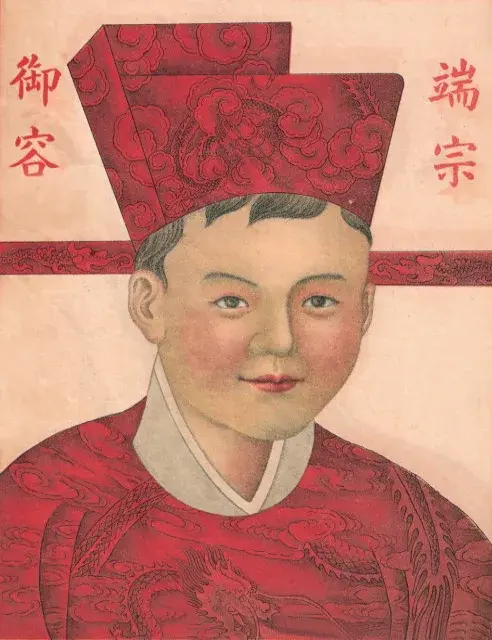
赵昰
Zhao Shi (1269–1278), a native of Lin'an Prefecture (modern Hangzhou City, Zhejiang Province), was the eldest illegitimate son of Emperor Duzong of Song and Consort Yang. He served as the eighth emperor of the Southern Song dynasty and is commemorated in Chinese historiography alongside Emperor Gong (Zhao Xian) and the Last Emperor (Zhao Bing) as one of the "Three Final Emperors of Song." In his youth, Zhao Shi was enfeoffed…
Zhao Shi (1269–1278), a native of Lin'an Prefecture (modern Hangzhou City, Zhejiang Province), was the eldest illegitimate son of Emperor Duzong of Song and Consort Yang. He served as the eighth emperor of the Southern Song dynasty and is commemorated in Chinese historiography alongside Emperor Gong (Zhao Xian) and the Last Emperor (Zhao Bing) as one of the "Three Final Emperors of Song." In his youth, Zhao Shi was enfeoffed successively as Duke of Jianguo and Duke of Yue, subsequently being elevated to Prince of Ji and Prince of Yi upon the accession of his half-brother Emperor Gong. In the second month of 1276, as the grand Mongol Yuan army under Bayan besieged the imperial capital of Lin'an, Grand Empress Dowager Xie and the child emperor surrendered to the invaders. Facing total dynastic annihilation, senior loyalist ministers including Wen Tianxiang, Lu Xiufu, Zhang Shijie, and Chen Yizhong evacuated Zhao Shi and his younger half-brother Zhao Bing southward to Wenzhou under secret imperial instructions. Designating Zhao Shi as Commander-in-Chief of All Armed Forces, loyalist ministers established a court-in-exile in Fuzhou. In the fifth month of 1276, eight-year-old Zhao Shi ascended the imperial throne, proclaiming the era name Jingyan, elevating Consort Yang as Empress Dowager, appointing Zhang Shijie as Vice Commissioner of Military Affairs, and assigning Wen Tianxiang and Lu Xiufu to executive ministries. During Zhao Shi's reign, the Yuan military launched multi-column pursuits, forcing the imperial court into a precarious naval retreat along the southern coastline. Although Southern Song loyalists initially held major strongholds in Fujian, Guangdong, and the mountain fortress of Diaoyu City in Sichuan with over two hundred thousand troops, tactical miscalculations caused the loss of Yangzhou and accelerated naval evacuation across Fuzhou, Quanzhou, Chaozhou, Huizhou, and the waters of Guangzhou. In late 1277, the imperial fleet encountered a catastrophic maritime typhoon near Jing'ao off the Pearl River estuary, during which royal vessels foundered and Zhao Shi fell into the turbulent sea, suffering severe physical trauma and illness. In the fourth month of 1278, the ten-year-old emperor succumbed to trauma and sickness in an island encampment on Gangzhou. Ministers conferred upon him the temple name Duanzong and the posthumous name Emperor Yuwen Zhaowu Minxiao, interring him in the Yongfu Mausoleum.
Born in the imperial palace of Lin'an as eldest illegitimate son of Emperor Duzong and Consort Yang; created Duke of Yue.
Following the death of Emperor Duzong and the accession of Zhao Xian, elevated to Prince of Ji and Prince of Yi.
As Mongol forces surrounded Lin'an, loyalist statesmen evacuated Zhao Shi and Zhao Bing to Jiangxin Temple in Wenzhou.
Crowned emperor in Fuzhou, changing the era name to Jingyan and rallying loyalist forces across southern circuits.
With Yuan armies overrunning Fuzhou, the court evacuated aboard deep-water transports, sailing south to Chaozhou.
Shifted floating headquarters across Huizhou and Kowloon Peninsula, conducting state governance aboard naval vessels.
Following the fall of Guangzhou, retreated to maritime anchorages off Xiushan amid dwindling rations.
Struck by a devastating typhoon at Jing'ao; Zhao Shi fell into the sea, contracting acute illness while forty percent of troops drowned.
Evacuated through Qixing Ocean to the barren island of Gangzhou as the young emperor's condition deteriorated.
Passed away in the temporary island palace at age ten; posthumously honored as Emperor Duanzong and buried at Yongfu Mausoleum.
Zhao Shi was born in 1269 during the fifth year of the Xianchun era under Emperor Duzong in the imperial palace of Lin'an. As the eldest son of Emperor Duzong by his consort Consort Yang, Zhao Shi was favored by his father and granted aristocratic titles as Duke of Jianguo and Duke of Yue. However, his youth unfolded against the backdrop of dynastic collapse. To the north, the Mongol Yuan dynasty under Kublai Khan pressed inexorably southward, capturing Xiangyang after years of grueling siege warfare and breaching the central Yangtze defenses.
In the seventh month of 1274, Emperor Duzong died unexpectedly at age thirty-five. In imperial deliberations over succession, numerous loyalist officials argued that given foreign invasion, the realm required an elder prince to steady public morale, recommending Zhao Shi. However, Grand Councilor Jia Sidao and Grand Empress Dowager Xie insisted upon strict primogeniture, crowning four-year-old legitimate infant Zhao Xian as Emperor Gong. Zhao Shi was promoted to Prince of Ji, and later Prince of Yi, while serving as nominal Governor of Fuzhou.
In early 1276, Yuan commander Bayan converged his armies upon Lin'an. Grand Empress Dowager Xie and the court surrendered the dynastic seal on February 5. Prior to the formal entry of northern troops, the empress dowager instructed loyal officials Lu Xiufu and Su Liuyi to smuggle eight-year-old Zhao Shi and his younger half-brother Zhao Bing out of the capital. Escorted through mountain passes, the princes escaped to Wenzhou, while Emperor Gong and the dowager were transported north to Dadu, ending three centuries of Song reign in Lin'an.
Reaching Jiangxin Temple in Wenzhou, Zhao Shi met patriotic commander Wen Tianxiang, who joined Lu Xiufu, Zhang Shijie, and Chen Yizhong to plot dynastic restoration. Drawing historical inspiration from Emperor Gaozong's southern restoration following the Jingkang Incident of 1127, the loyalist coalition determined to elevate Zhao Shi as dynastic sovereign to rally national resistance.
On June 14, 1276 (first day of the fifth month), the ministers proclaimed eight-year-old Zhao Shi emperor at Fuzhou, inaugurating the Jingyan reign period. Known to history as Emperor Duanzong, the young monarch appointed his mother Empress Dowager Yang as regent. Government portfolios were allocated among prominent loyalists: Chen Yizhong was named Left Grand Councilor, Wen Tianxiang became Right Grand Councilor, Zhang Shijie assumed command of the imperial armada as Vice Commissioner of Military Affairs, and Lu Xiufu was made Signatory of the Bureau of Military Affairs.
At its inception, the Jingyan restoration possessed substantial regional strength. Southern circuits across Fujian, coastal Zhejiang, and Guangdong remained loyal, while general Li Tingzhi held Yangzhou along the lower Yangtze, and the mountain fortress of Diaoyu City resisted in Sichuan. With over two hundred thousand soldiers pledged to the restored banner, the court-in-exile represented a potent focus for Chinese loyalist defiance against Mongol conquest.
Despite patriotic enthusiasm, the leadership of the Jingyan court suffered from strategic paralysis and internal factionalism. Senior Chancellor Chen Yizhong was indecisive in crisis, while naval commander Zhang Shijie rejected Wen Tianxiang's sound proposals to march inland and coordinate guerrilla resistance across Jiangxi. Instead, the court adopted a passive strategy, pinning hopes on the belief that northern Mongol soldiers would withdraw due to subtropical humidity and malaria.
A fatal strategic error occurred when the court ordered Li Tingzhi and Jiang Cai to abandon the impregnable defenses of Yangzhou and march south to reinforce Fuzhou. Once the veteran garrison vacated their ramparts, local traitors opened the gates to Yuan besiegers. Li Tingzhi and Jiang Cai were surrounded, captured, and executed, liquidating the last Song defense network north of the Yangtze and opening all southern approaches.
In the eleventh month of 1276, Yuan generals Arakan and Dong Wenbing pushed into Fujian, capturing Jianning and advancing toward the provincial capital. Realizing Fuzhou was untenable, Zhang Shijie rushed Zhao Shi and Empress Dowager Yang aboard deep-water transports and put to sea. Yuan forces occupied Fuzhou, while the Song fleet sailed toward Quanzhou. There, Arab maritime superintendent Pu Shougeng betrayed the dynasty, closing port gates to the imperial vessels. After Zhang Shijie seized merchant shipping for supplies, Pu massacred thousands of Song imperial clansmen in retaliation. The royal flotilla was forced to resume its hazardous southward journey toward Chaozhou in eastern Guangdong.
Throughout 1277, the Southern Song court operated entirely as a floating maritime administration. While Wen Tianxiang campaigned inland through Jiangxi, liberating several prefectures, Zhang Shijie kept Emperor Duanzong and the central bureaucracy aboard seaworthy vessels. The court shifted anchorages along the Guangdong coastline, sheltering at Jiazimen in Huizhou, the Kowloon Peninsula, and Lantau Island. Enduring cramped shipboard quarters, chronic malnutrition, and raging tropical fevers, civilian families and palace attendants perished in large numbers, eroding troop discipline.
In the ninth month of 1277, Yuan armies took Guangzhou, eliminating mainland logistical support. Zhang Shijie moved the naval encampment west of the Pearl River estuary to the coastal waters of Xiushan. In the twelfth month, Yuan admiral Liu Shen approached with a pursuing fleet, prompting the Song ships to flee toward Jing'ao (modern southern coastal waters of Zhongshan).
During this retreat, a catastrophic typhoon struck the South China Sea. Ferocious gales and monstrous swells tore the crowded fleet apart, smashing dozens of vessels against rocky reefs. Over forty percent of the imperial soldiers and mariners drowned. In the chaos, nine-year-old Zhao Shi fell from his imperial flagship into the surging sea. Although imperial guards dived in and dragged the prince back on board, he swallowed quantities of seawater, inhaled fluid into his lungs, and suffered intense psychological trauma, developing high fevers and delirium.
Capitalizing on the disaster, Yuan commander Liu Shen launched an immediate assault upon the battered survivors. Zhang Shijie engaged the enemy, but the weakened Song forces suffered heavy casualties, losing over two hundred warships. In the desperate melee, Zhao Shi's maternal uncle Yang Liangjie was captured and killed. Zhang Shijie and Lu Xiufu broke through enemy encirclements, shepherding the dying emperor toward the isolated island of Gangzhou.
By early 1278, the court-in-exile had established temporary headquarters on Gangzhou Island. Isolated on the barren outpost without adequate medical provisions or nourishment, the ten-year-old emperor's condition deteriorated rapidly under relentless physical fevers and constant alarms of approaching enemy scouts.
On May 8, 1278 (seventeenth day of the fourth month), the youthful sovereign passed away in his temporary island lodge at the age of ten. The gathered ministers, soldiers, and attendants fell to the ground in overwhelming lamentation. Ministers conferred upon him the temple name Duanzong and the posthumous name Emperor Yuwen Zhaowu Minxiao.
With Mongol naval patrols encircling the surrounding waters, returning the imperial casket to the ancestral imperial necropolis in the Central Plains was impossible. The court constructed a stone tumulus on the mountainous slopes of the island, naming it the Yongfu Mausoleum (historically identified with sites in modern Lantau Island or Jiangmen). Following his burial, loyalist ministers crowned his seven-year-old half-brother Prince of Wei Zhao Bing, proclaiming the Xiangxing era to continue resistance until the final catastrophe of the Battle of Yamen.
Zhao Shi's accession in Fuzhou in the fifth month of 1276 was an indispensable act of dynastic continuity during the Southern Song's final struggle against Yuan conquest. Following the surrender of Lin'an and the captivity of Emperor Gong, the Song state confronted the complete erasure of its political sovereignty.
By crowning Zhao Shi and establishing the Jingyan court-in-exile, Wen Tianxiang, Lu Xiufu, and Zhang Shijie maintained the legal lineage tracing back to dynastic founder Emperor Taizu and the southern restorer Emperor Gaozong. This restoration provided a legitimate imperial banner for loyalist armed forces across southern China, thwarting Kublai Khan's strategy of achieving instantaneous pacification through the capture of Emperor Gong, and extending the formal existence of the Song dynasty by three crucial years.
Following his enthronement, Zhao Shi issued universal amnesties and imperial decrees calling upon provincial commanders to resist foreign conquest. The presence of a recognized sovereign revitalized fragmented resistance movements throughout the empire. Li Tingzhi held fast in the Huai River valley, Wen Tianxiang mobilized provincial volunteer armies across Jiangxi and Fujian, and indigenous leaders like Chen Diaoyan initiated insurgencies in southeastern mountains.
In the southwest, the garrison of Diaoyu City in Sichuan continued their heroic multi-decade resistance upon receiving word of Zhao Shi's coronation. The Jingyan administration provided an ideological anchor for over two hundred thousand soldiers and millions of subjects, transforming the final phase of the Mongol-Song war into an epic testament to dynastic loyalty.
Under persistent pressure from Yuan cavalry and coastal naval units, Zhao Shi's court developed a unique political structure in classical Chinese history: the floating maritime court-in-exile. By boarding thousands of ocean-going junks with central ministries, imperial archives, royal ladies, and palace regiments, the Southern Song government operated without territorial holdings for nearly two years.
From ocean anchorages, Zhao Shi promulgated decrees, conferred official ranks, and organized logistics. This extraordinary reliance on deep-sea navigation demonstrated the maritime capabilities and organizational resilience of medieval Chinese naval engineering, creating an unforgettable chapter in global political exile and naval history.
The Jing'ao typhoon disaster and the tragic passing of Zhao Shi symbolize the extreme pathos of the late Southern Song collapse. Thrust into the position of supreme ruler at age eight, Zhao Shi bore the monumental burden of a crumbling empire.
His fall into the ocean swells at Jing'ao and his lingering death on a desolate island highlighted the brutal convergence of natural catastrophe and military devastation that doomed the loyalist cause. Zhao Shi's life became a poignant cultural symbol in Chinese historiography, celebrated by subsequent generations of poets and historians as an emblem of heroic, tragic loyalty in the face of inevitable dynastic doom.
FIGURES ASSOCIATED WITH THIS DYNASTY