四世班禅
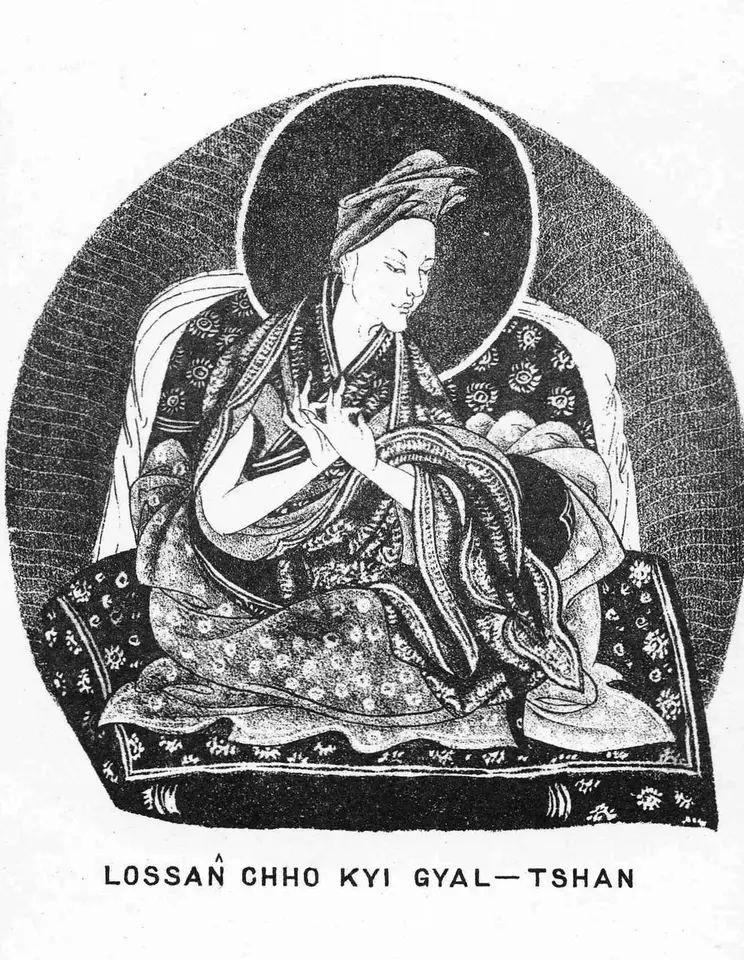
Historical photograph of Lobsang Chökyi Gyaltsen, 4th Panchen Lama
Image creditsWikimedia Commons contributor · Public domainImage source

Historical figure

Fourth Panchen Lama (四世班禅)

四世班禅

The Fourth Panchen Lama (四世班禅, 1570–1662), religious name Lobsang Chökyi Gyaltsen, was a native of Lhaze County in Tsang (Shigatse). He was an outstanding spiritual leader and political statesman of the Gelug (Yellow Hat) School of Tibetan Buddhism, primary tutor to both the Fourth and Fifth Dalai Lamas, and the sixteenth abbot of Tashilhunpo Monastery. Ordained in childhood, he mastered Sutra and Tantra doctrines and guided…

Qing Dynasty

PROFILE

The Fourth Panchen Lama (四世班禅, 1570–1662), religious name Lobsang Chökyi Gyaltsen, was a native of Lhaze County in Tsang (Shigatse). He was an outstanding spiritual leader and political statesman of the Gelug (Yellow Hat) School of Tibetan Buddhism, primary tutor to both the Fourth and Fifth Dalai Lamas, and the sixteenth abbot of Tashilhunpo Monastery. Ordained in childhood, he mastered Sutra and Tantra doctrines and guided Tashilhunpo Monastery for more than six decades, undertaking extensive expansions, enforcing monastic discipline, and elevating the monastery into the paramount seat of Gelug scholarship in Tsang. During the volatile political landscape of sixteenth- and seventeenth-century Tibet, the Fourth Panchen Lama preserved Gelug transmissions and instituted the historic convention wherein the Dalai and Panchen Lamas served as mutual spiritual teachers and ordinators. In 1642, he coordinated with the Fifth Dalai Lama and Gushi Khan of the Khoshut Mongols to overturn the hostile Tsangpa dynasty, laying the institutional foundation for the Ganden Phodrang government. In 1645, Gushi Khan venerated him as Panchen Bogdo, creating the title Panchen. In 1647, the Shunzhi Emperor granted him the official patent of Panchen Erdeni along with a gold seal, establishing legal recognition of the lineage by the Qing central court. Passing away in 1662 at age ninety-three, he was the longest-lived among all historic Dalai and Panchen Lamas.

Native Place
Lhaze County, Shigatse, Tibet
Dynasty
Qing Dynasty
Birth Date
1570 (Fourth Year of Longqing)
Death Date
1662 (First Year of Kangxi)
Age at Death
93
Accurate Identity Positioning
Eminent Religious Leader of the Gelug School of Tibetan Buddhism, Sixteenth Abbot of Tashilhunpo Monastery, First Panchen Lama Officially Invested by the Qing Dynasty

LIFE TIMELINE

Relationship graph

BIOGRAPHY

Chronology

  • 1570 (Fourth Year of the Longqing Reign) | Birth in Tsang | Born in Lhaze County, entered Angon Monastery as a novice monk in youth.
  • 1601 (Twenty-Ninth Year of the Wanli Reign) | Abbot of Tashilhunpo | Ascended as the sixteenth abbot of Tashilhunpo Monastery, expanding academic halls and reviving Gelug monastic vinaya.
  • 1603 (Thirty-First Year of the Wanli Reign) | Tutor to Fourth Dalai Lama | Welcomed the Fourth Dalai Lama from Mongolia to Lhasa, conferring full ordination vows and serving as his root tutor.
  • 1622 (Second Year of the Tianqi Reign) | Recognition of Fifth Dalai Lama | Directed the search and confirmation of the Fifth Dalai Lama Lobsang Gyatso, performing his tonsure and establishing the mutual tutelage precedent.
  • 1642 (Fifteenth Year of the Chongzhen Reign) | Alliance with Gushi Khan | Welcomed Khoshut military intervention against the Tsangpa regime, inaugurating Gelug temporal authority across Tibet.
  • 1647 (Fourth Year of the Shunzhi Reign) | Imperial Investiture | Formally invested by the Shunzhi Emperor of the Qing Dynasty with the title Panchen Erdeni and a golden seal of office.
  • 1662 (First Year of the Kangxi Reign) | Demise at Tashilhunpo | Passed away peacefully at Tashilhunpo Monastery at the age of ninety-three.

Life and Career

Early Monastic Studies and Abbot of Tashilhunpo

The Fourth Panchen Lama was born in 1570 into a devout family in Lhaze County, Tsang. Endowed with profound intellectual acumen, he entered Angon Monastery at age thirteen, taking novice vows under the Dharma name Lobsang Chökyi Gyaltsen. Throughout his youth, he traveled extensively across central Tibet, studying the Great Treatise on the Stages of the Path to Enlightenment (Lamrim Chenmo), Buddhist epistemology (Pramana), and esoteric tantric liturgies under prominent scholars of various traditions, earning high renown across monastic circles.

In 1601, at the age of thirty-two, he was unanimously invited by the sangha to become the sixteenth abbot of Tashilhunpo Monastery. Upon assuming leadership, he reformed monastic discipline, strictly prohibiting monks from engaging in mercantile speculation or factional disputes. He established rigorous disputation curricula and oversaw extensive architectural expansions, constructing grand debate courtyards and assembly halls. Under his guidance, Tashilhunpo grew into a premier scholastic community supporting several thousand monks, cementing Tsongkhapa Gelug traditions throughout Tsang.

Tutelage of Two Dalai Lamas and Institutional Conventions

During the late sixteenth and early seventeenth centuries, Tibetan regional politics were characterized by intense sectarian conflict. The secular Tsangpa regime based in Shigatse patronized the Karma Kagyu tradition and severely persecuted the ascending Gelug school, repeatedly besieging Drepung and Sera monasteries around Lhasa. Navigating this dangerous environment, the Fourth Panchen Lama utilized his spiritual authority to mediate hostilities and avert violent confrontations.

In 1603, the Fourth Dalai Lama Yonten Gyatso arrived in Tibet from Mongolia. The Fourth Panchen Lama welcomed the young pontiff, bestowed full bhikshu ordination upon him, and served as his root spiritual preceptor. Following the untimely death of the Fourth Dalai Lama in 1616, the Fourth Panchen Lama led the confidential identification of his reincarnation, confirming Ngawang Lobsang Gyatso as the Fifth Dalai Lama. In 1622, he personally conducted the Fifth Dalai Lama tonsure at Drepung Monastery and supervised his education. This historic relationship inaugurated the mutual master-disciple ordination and transmission lineage between the Dalai and Panchen Lamas, which became a foundational pillar of Tibetan religious governance.

Alliance with Gushi Khan and Imperial Qing Investiture

To counter sustained military oppression from the Tsangpa rulers, the Fourth Panchen Lama and the Fifth Dalai Lama formed a strategic alliance with Gushi Khan, supreme chieftain of the Khoshut Mongols in Qinghai. In 1642, Gushi Khan led his cavalry into central Tibet, eliminated the Tsangpa regime, and established the unified Ganden Phodrang administration under Gelug religious authority. In 1645, Gushi Khan formally offered Lobsang Chökyi Gyaltsen the title Panchen Bogdo, celebrating him as a great scholar of divine wisdom.

Following the Qing conquest of the Central Plains, the Fourth Panchen Lama and the Fifth Dalai Lama pursued cooperative diplomatic relations with the imperial court in Beijing. In 1647, the Shunzhi Emperor granted Lobsang Chökyi Gyaltsen the official imperial title of Panchen Erdeni (with Erdeni signifying precious jewel in Manchu), conferring a golden seal and imperial diploma. This investiture legally codified the political and spiritual standing of the Panchen Lama under imperial jurisdiction. When the Fifth Dalai Lama journeyed to Beijing in 1652 to meet the Shunzhi Emperor, the Fourth Panchen Lama remained in Shigatse supervising administrative and religious affairs. He passed away at Tashilhunpo Monastery in 1662 at the remarkable age of ninety-three.
Interpersonal Connections

  • Disciple and Spiritual Charge: Fourth Dalai Lama (Yonten Gyatso, received full monastic ordination from the Fourth Panchen Lama)
  • Disciple and Successor: Fifth Dalai Lama (Ngawang Lobsang Gyatso, whose discovery and monastic education were directed by the Fourth Panchen Lama)
  • Protector and Sovereign Patron: Gushi Khan (Founder of the Khoshut Khanate who honored him with the title Panchen Bogdo)

Historical Evaluations

  • The Draft History of Qing (Qing Shi Gao), Biographies of Tibet, recorded: "Lobsang Chökyi Gyaltsen resided at Tashilhunpo Monastery, highly renowned across U-Tsang. After Gushi Khan pacified Tibet, he honored him as Panchen Bogdo. In the Shunzhi reign of Shizu, he was formally invested as Panchen Erdeni with a gold diploma and gold seal, whereupon his renown shone brightly."
  • The Fifth Dalai Lama in his autobiography evaluated: "My root guru Lobsang Chökyi Gyaltsen was like an emanation of Amitabha Buddha appearing in this world, rescuing the Gelug school from peril and enlightening millions across Tibet and Mongolia; his spiritual virtue surpasses Mount Sumeru and runs deeper than the boundless ocean."

Related Entries

  • Fifth Dalai Lama
  • Gushi Khan
  • Sixth Panchen Lama

FIGURES ASSOCIATED WITH THIS DYNASTY

Bibliography

  • Zhao Erxun et al., Draft History of Qing (Qing Shi Gao), Volume 314, Biographies 301: Biography of Tibet.
  • Wei Yuan, Sheng Wu Ji (Military History of the Sacred Dynasty), Volume 5: Pacification of Tibet.