Enfeoffed as Marquis
Created Marquis of Anle Pavilion after the Gaoping Tomb Incident; later made Grandee Remonstrant under Cao Wei.
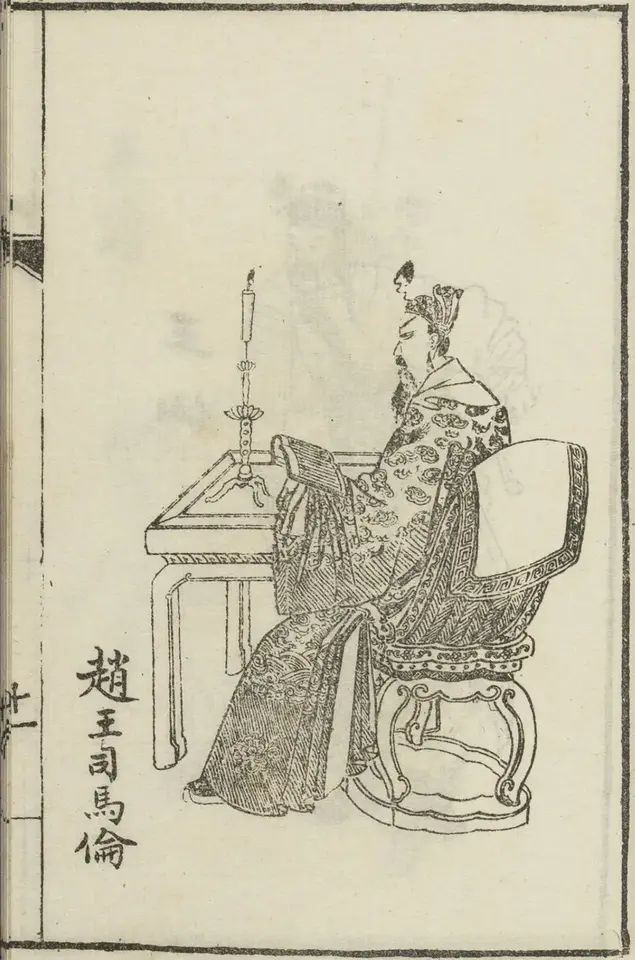
司马伦
Sima Lun (司马伦, died June 5, 301), courtesy name Ziyi, was a native of Wen County, Henei Commandery. He was the ninth son of Sima Yi (Emperor Xuan), the younger half-brother of Sima Shi (Emperor Jing) and Sima Zhao (Emperor Wen), and the uncle of the founding Emperor Wu of Jin (Sima Yan), born to Lady Bai. Sima Lun was a senior imperial prince of the Western Jin Dynasty and the only prince to usurp the imperial throne during…
Sima Lun (司马伦, died June 5, 301), courtesy name Ziyi, was a native of Wen County, Henei Commandery. He was the ninth son of Sima Yi (Emperor Xuan), the younger half-brother of Sima Shi (Emperor Jing) and Sima Zhao (Emperor Wen), and the uncle of the founding Emperor Wu of Jin (Sima Yan), born to Lady Bai. Sima Lun was a senior imperial prince of the Western Jin Dynasty and the only prince to usurp the imperial throne during the devastating War of the Eight Princes. His usurpation shattered the political legitimacy of the Jin court, precipitating the catastrophic collapse of the Western Jin and plunging northern China into centuries of partition and warfare. During the Cao Wei era, Sima Lun was enfeoffed as Marquis of Anle Pavilion. Upon the establishment of the Western Jin, he was created Prince of Langye and later Prince of Zhao. In the early Yuankang reign of Emperor Hui, he was stationed at Chang'an as General Who Conquers the West to govern Guanzhong. His erratic administration and arbitrary punishments provoked a widespread rebellion among the Di and Qiang tribes, causing immense devastation and leading to his recall to Luoyang. Returning to court, he ingratiated himself with Empress Jia Nanfeng and her mother Guo Huai, rising to Senior General of Chariots and Cavalry and Grand Tutor to the Crown Prince. However, his bids to control central executive power were resolutely blocked by eminent statesmen Zhang Hua and Pei Wei. In 299, Empress Jia deposed Crown Prince Sima Yu. In 300, Sima Lun executed a cynical plan devised by his advisor Sun Xiu: allowing Empress Jia to murder the prince to eliminate a capable heir, and then launching a coup under the pretext of avenging the prince. He executed Empress Jia, murdered Zhang Hua and Pei Wei, and seized supreme power as Chancellor of State. In February 301, Sima Lun deposed Emperor Hui, declared himself emperor, and adopted the era name Jianshi. His indiscriminate distribution of nobility gave rise to the proverb "tacking a dog's tail to marten fur." His usurpation prompted Prince of Qi Sima Jiong, Prince of Chengdu Sima Ying, and Prince of Hejian Sima Yong to form a coalition against him. Following sixty days of fighting that claimed nearly one hundred thousand lives, Sima Lun was defeated, deposed, and forced to drink poisoned wine in June 301, while his sons were executed.
Created Marquis of Anle Pavilion after the Gaoping Tomb Incident; later made Grandee Remonstrant under Cao Wei.
Sima Yan founded the Western Jin Dynasty; Sima Lun was created Prince of Langye as an imperial uncle.
Enfeoffed as Prince of Zhao, appointed General Who Pacifies the North supervising military affairs in Ye.
Appointed General Who Conquers the West commanding Guanzhong; his maladministration sparked a major tribal revolt.
Sima Rong replaced him in Guanzhong; Sima Lun returned to Luoyang and was appointed Grand Tutor to the Crown Prince.
Ingratiated himself with Empress Jia to seek executive office, but was repeatedly blocked by Chancellor Zhang Hua.
Encouraged the murder of Crown Prince Sima Yu, executed Empress Jia, murdered Zhang Hua, and became Chancellor of State.
Usurped the throne in February under the era Jianshi; defeated by a coalition of princes and forced to commit suicide in June.
Sima Lun's birth year is not recorded in historical chronicles. He was the youngest son of Sima Yi. In 249, following the Gaoping Tomb Coup, he was enfeoffed as Marquis of Anle Pavilion. Under the newly created five-rank nobility system, he was titled Viscount of Dong'an and appointed Grandee Remonstrant. In 265, when Sima Yan founded the Western Jin Dynasty, Sima Lun was elevated to Prince of Langye. While holding this princedom, he ordered officer Liu Ji to bribe imperial artisans to steal imperial sable robes. When the crime was discovered, Commandant of Justice Du You sentenced Liu Ji to public execution and recommended that Sima Lun be tried as a co-conspirator. Bureaucratic officials argued that Sima Lun was immune as an imperial relative, but Grandee Remonstrant Liu Yi argued that the law must apply equally to noble and humble alike. Emperor Wu pardoned Sima Lun out of kinship, reassigning him as Commander of the East and General Who Manifests Awe.
In 277, Sima Lun was transferred to the Princedom of Zhao and appointed General Who Pacifies the North. In 291, Emperor Hui promoted him to General Who Conquers the West, dispatching him to Chang'an to oversee Guanzhong. Sima Lun governed carelessly, relying on his confidant Sun Xiu and imposing arbitrary punishments and taxes. His harsh measures provoked a major uprising among the local Di and Qiang tribes led by Hao Duyuan, devastating the Guanzhong region and leading to the battlefield death of general Zhou Chu. Alarmed by the unrest, the imperial court replaced Sima Lun with the Prince of Liang, Sima Rong, and recalled Sima Lun to Luoyang.
Upon his return to the capital, Sima Lun escaped punishment and was appointed Senior General of Chariots and Cavalry and Grand Tutor to the Crown Prince. Eager to seize executive control, Sima Lun and his advisor Sun Xiu fawned upon Empress Jia Nanfeng and her mother Guo Huai. Through flattery, he won the empress's favor and sought appointment as Intendant of the Masters of Writing. However, Chancellor Zhang Hua and Supervisor of the Masters of Writing Pei Wei recognized Sima Lun's incompetence and ambition, repeatedly blocking his appointments before the emperor. Sima Lun harbored deep resentment against them.
In 299, Empress Jia fabricated treasonous charges against Crown Prince Sima Yu, deposing him and imprisoning him in Jinyong City before exiling him to Xuchang. Sima Lun was appointed to command the Right Army. Right Guard officers Sima Ya and Chang Meng, outraged by the prince's deposition, secretly approached Sun Xiu, urging Sima Lun to lead a coup to remove the empress and restore the prince. Sun Xiu realized that the intelligent prince would rely on Zhang Hua rather than Sima Lun if restored.
Sun Xiu advised Sima Lun to withhold action while leaking rumors to Empress Jia that court ministers were plotting to liberate the prince. Panicked by the rumors, Empress Jia sent her eunuch Sun Lü to Xuchang in April 300, where he bludgeoned the twenty-two-year-old crown prince to death with a pestle. Sima Lun thus used the empress to eliminate his future rival.
With public fury mounting over the crown prince's murder, Sima Lun and Sun Xiu staged their coup on the night of May 7, 300. Claiming to possess a secret imperial decree avenging the prince, Sima Lun commanded troops of the Right Guard to storm the palace. He directed Prince of Qi Sima Jiong to enter the inner apartments, arresting Empress Jia's relatives and associates, deposing Empress Jia, and banishing her to Jinyong City, where she was soon poisoned.
During the coup, Sima Lun settled personal scores by falsely accusing Zhang Hua, Pei Wei, Jie Jie, and Du Bin of conspiring with the empress. Disregarding court appeals, he executed Zhang Hua and Pei Wei along with three generations of their clans. Sima Lun appointed himself Chancellor of State, Commander-in-Chief of Military Affairs, and Director of the Imperial Secretariat, concentrating total executive and military power in his hands. He appointed his eldest son Sima Fu as Supervisor of Attendants and assigned his other sons command over the imperial guards, while Sun Xiu directed the Secretariat.
Sima Lun's autocratic rule provoked armed resistance. Prince of Huainan Sima Yun launched an assault on the Chancellor's residence with several thousand troops, nearly capturing Sima Lun before guard commander Fu Yin betrayed Sima Yun and struck him down from behind. After executing Sima Yun's clan, Sima Lun accelerated his plans to seize the throne. Sun Xiu concocted prophecies claiming that Sima Yi's spirit demanded Sima Lun's accession.
On February 3, 301, Sima Lun coerced Emperor Hui into abdicating, usurped the throne, and declared the Jianshi era. He proclaimed Emperor Hui Supreme Emperor and confined him to Jinyong City.
To secure support, Sima Lun engaged in reckless political bribery, handing out noble titles and official ranks to palace guards, servants, cooks, and cronies. Official seals were cast in such quantities that the bronze loops wore out before they could be distributed. When the court ran out of marten tails for official caps, officials used dog tails instead, generating the proverb "tacking a dog's tail to marten fur." All administrative decisions were dictated by Sun Xiu, and government edicts changed multiple times a day, alienating the bureaucracy.
Sima Lun's usurpation unified the regional princes against him. In March 301, Prince of Qi Sima Jiong raised an army at Xuchang, joined by Prince of Chengdu Sima Ying at Ye and Prince of Hejian Sima Yong in Guanzhong. Sima Lun mobilized tens of thousands of imperial guards under Sun Hui, Shi Yi, and Xu Chao to defend strategic passes along the Ying River.
Although Sima Lun's forces achieved minor tactical successes, the princely armies overwhelmed them outside Luoyang. In May 301, Left Guard General Wang Yu and other palace officers staged a counter-coup within Luoyang, killing Sun Xiu and his inner circle.
Wang Yu escorted Emperor Hui back to the throne and arrested Sima Lun, who wept into his sleeves, lamenting that Sun Xiu had ruined him. Emperor Hui ordered Sima Lun's sons executed at the court of the Commandant of Justice. On June 5, 301, an imperial envoy delivered poisoned wine to Sima Lun at Jinyong City, ending his hundred-day reign. The sixty-day civil war had claimed nearly one hundred thousand lives, shattering the foundations of the Western Jin dynasty.
In the early Yuankang era, Sima Lun served as General Who Conquers the West supervising military affairs in Guanzhong. Guanzhong was home to substantial Di and Qiang populations, making interethnic relations delicate. Rather than calming regional tensions, Sima Lun and his confidant Sun Xiu levied heavy taxes and arbitrary punishments, driving local populations into open revolt.
The revolt led by tribal chieftain Hao Duyuan devastated the western commanderies and caused the death of general Zhou Chu. This turmoil permanently damaged the Western Jin defensive frontier in the northwest, facilitating the subsequent entry of non-Han tribal regimes into central China during the Sixteen Kingdoms period.
When Empress Jia sought to remove Crown Prince Sima Yu, Sima Lun and Sun Xiu manipulated the factional struggle for their own advantage. When conspirators proposed a coup to restore the prince, Sima Lun deliberately withheld support and leaked news to Empress Jia, prompting her to murder the prince.
Having eliminated the legitimate heir, Sima Lun launched a coup in the name of avenging the prince, executing Empress Jia and her clan. Under cover of this purge, he murdered Zhang Hua, Pei Wei, and other senior officials, destroying the administrative framework of the Western Jin state.
Sima Lun's usurpation transformed palace infighting into a full-scale civil war among regional imperial princes. Earlier rebellions by Sima Liang and Sima Wei had been confined to the capital, but Sima Lun's seizure of the throne broke the taboo against imperial usurpation.
His coup forced Sima Jiong, Sima Ying, and Sima Yong to mobilize large armies against the capital. The resulting sixty-day conflict destroyed the central army and exhausted regional garrisons, initiating a cascade of civil warfare that decimated the Jin imperial house.
Lacking genuine political legitimacy, Sima Lun sought to buy loyalty by granting noble titles to common soldiers and household servants.
The court ran out of authentic sable tails for ceremonial caps, forcing officials to substitute dog fur and creating the enduring Chinese idiom "tacking a dog's tail to marten fur." His administration, guided by superstitious omens and erratic decrees from Sun Xiu, came to represent the height of late Western Jin administrative decadence.
FIGURES ASSOCIATED WITH THIS DYNASTY