Birth
Born into the prestigious Henei Sima lineage during the Zhenguan era of Tang.
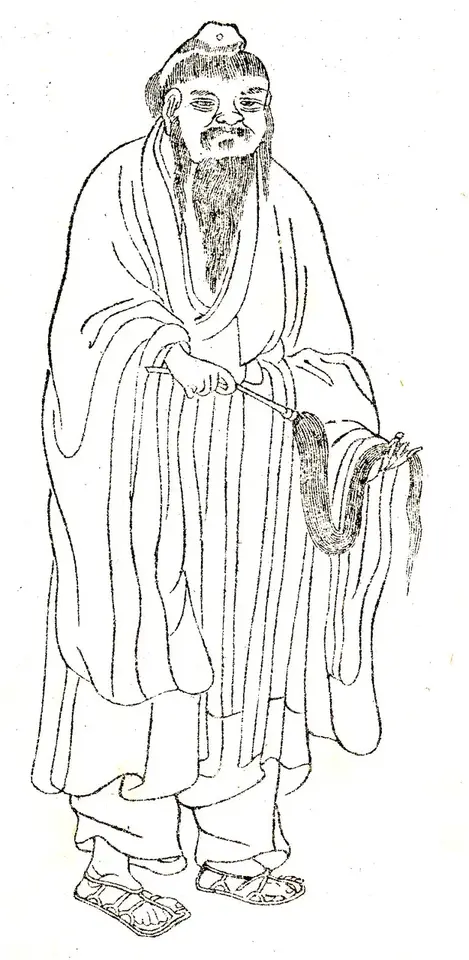
司马承祯
Sima Chengzhen (司马承祯, 639–735), courtesy name Ziwei (子微), religious name Daoyin (道隐), self-styled Baiyunzi (白云子), was a native of Wen County in Henei (modern Wen County, Henan Province). Descended from Sima Lang of the Cao Wei dynasty, he was the preeminent Daoist scholar, philosopher, and calligrapher of the Tang dynasty, revered as the Twelfth Patriarch of the Shangqing (Mount Mao) School of Daoism. Sima…
Sima Chengzhen (司马承祯, 639–735), courtesy name Ziwei (子微), religious name Daoyin (道隐), self-styled Baiyunzi (白云子), was a native of Wen County in Henei (modern Wen County, Henan Province). Descended from Sima Lang of the Cao Wei dynasty, he was the preeminent Daoist scholar, philosopher, and calligrapher of the Tang dynasty, revered as the Twelfth Patriarch of the Shangqing (Mount Mao) School of Daoism. Sima Chengzhen was educated in Confucian classics in his youth, but turned toward the mystical philosophy of Laozi and Zhuangzi. At age twenty-one, he was ordained under Master Pan Shizheng at Mount Song, mastering the esoteric Shangqing scriptures and meditation methods. He later withdrew to Mount Tiantai in Zhejiang, dwelling in solitude on Jade Cloud Peak for over thirty years. His spiritual authority attracted imperial veneration across three successive reigns: Empress Wu Zetian summoned him to Luoyang to inquire on longevity; Emperor Ruizong consulted him on statecraft, to which he replied that "governing the empire lies in non-action (Wuwei) and following natural inclinations"; and Emperor Xuanzong received the Shangqing scriptures from him as an imperial disciple, commissioned him to erect the Yangtai Palace on Mount Wangwu, and ordered him to inscribe the Daodejing in three calligraphic scripts on stone stelae. Sima synthesized Buddhist Tiantai meditation with Daoist contemplation in his masterpiece Zuowanglun (Treatise on Sitting and Forgetting), establishing the theoretical foundation for interior alchemy and Song dynasty Neo-Confucian mental cultivation. He passed away peacefully in 735 at the age of ninety-seven, posthumously honored by Emperor Xuanzong as Grand Master of Silver and Blue Radiance with the title "Zhenyi Xiansheng".
Born into the prestigious Henei Sima lineage during the Zhenguan era of Tang.
Traveled to Mount Song to study under the Eleventh Patriarch Pan Shizheng.
Settled on Jade Cloud Peak at Mount Tiantai, adopting the moniker Baiyunzi.
Invited to Luoyang by Empress Wu Zetian, who praised his transcendent demeanor.
Consulted by Emperor Ruizong on governance, replying with the principle of non-action.
Received by Emperor Xuanzong, who formally took Daoist vows under Sima's guidance.
Memorialized Xuanzong to replace blood sacrifices at the Five Sacred Peaks with Daoist shrines.
Established the Yangtai Palace on Mount Wangwu under special imperial patronage.
Inscribed the text of the Daodejing in seal, clerical, and regular scripts on stone stelae.
Passed away peacefully at Yangtai Palace at age ninety-seven, posthumously titled Zhenyi Xiansheng.
Sima Chengzhen was a direct descendant of the aristocratic Henei Sima lineage, his great-grandfather Sima Yi having served as Governor of Jinzhou under Northern Zhou, and his father Sima Renzui serving as Administrative Assistant in Xiangzhou. Possessing exceptional intellect, Sima Chengzhen mastered the Confucian classics in childhood, yet developed an intense aversion to bureaucratic careers, feeling drawn toward the transcendental doctrines of Daoism.
In 659, at age twenty-one, he climbed Mount Song to seek instruction from Pan Shizheng, the Eleventh Patriarch of the Shangqing School. Impressed by his serene intellect and pure demeanor, Pan Shizheng proclaimed: "I have held the pure transmission of Tao Hongjing for decades; now I have found the vessel to receive it." Sima spent more than a decade at Mount Song, mastering breathing techniques, dietary alchemy, celestial talismans, and inward meditation.
Following the passing of Pan Shizheng, Sima traveled extensively across the sacred mountains of China, eventually selecting Mount Tiantai in Zhejiang as his hermitage. On the remote heights of Jade Cloud Peak, he erected a thatched hermitage named Chengbidi, spending three decades in quiet contemplation and adopting the name Baiyunzi ("Master of the White Clouds").
His fame attracted the greatest literary minds of the High Tang. Poets and statesmen including Chen Zi'ang, Lu Zangyong, Song Zhiwen, Meng Haoran, He Zhizhang, and Li Bai journeyed to Tiantai to converse with him. When his former companion Lu Zangyong—who had utilized hermetic living in the Zhongnan Mountains as a career springboard to high office—pointed to the mountains and called them a shortcut to political power, Sima smiled and remarked: "To my eyes, that mountain is merely a cage of office." When the young Li Bai met Sima, the master praised him as possessing "the bones of an immortal, capable of roaming beyond the eight extremities," forging a lifelong spiritual bond.
In 699, Empress Wu Zetian dispatched imperial emissaries with silk decrees inviting Sima to the eastern capital of Luoyang. The empress questioned him on the cultivation of vitality and longevity, expressing profound admiration for his articulate and serene counsel before bestowing imperial gifts upon his return to Tiantai.
In 711, Emperor Ruizong summoned Sima to the Daming Palace in Chang'an. When Ruizong inquired about the art of governing the state, Sima replied: "Governing the empire follows the identical path as governing the self. Laozi taught: 'Let your mind wander in simplicity, blend your spirit with the vast void, follow the nature of things without self-interest, and the world will be ordered.' If a ruler follows the natural inclinations of the people and exercises non-action, peace arises spontaneously." Ruizong marveled at his insight and had his words recorded in the court annals.
Emperor Xuanzong venerated Sima Chengzhen above all contemporary religious figures. In 721, Xuanzong summoned him to the palace, where the emperor personally knelt to receive the Shangqing scriptures from him. When Sima prepared to return to the mountains, Xuanzong composed a farewell poem, and the court ministers followed with an anthology of commemorative verses.
In 724, Sima advised the emperor to overhaul the state sacrificial system for the Five Sacred Peaks, replacing animal blood sacrifices with Daoist shrines directed toward genuine transcendent divinities. Xuanzong adopted the proposal, cementing Daoism's status in Tang state ideology. In 727, Xuanzong constructed the lavish Yangtai Palace on Mount Wangwu in Henan to provide Sima with a residence close to the imperial capitals.
Sima was a master calligrapher, famed for his archaic seal and clerical scripts. In 730, by imperial decree, he inscribed the entire text of the Daodejing in three calligraphic forms on stone stelae, which were erected across the empire.
In June 735, Sima Chengzhen bathed, dressed in fresh robes, and sat peacefully upon the meditation terrace of Yangtai Palace, passing away into transcendence at the age of ninety-seven. Xuanzong grieved deeply, conferring upon him the posthumous title Grand Master of Silver and Blue Radiance and the posthumous name "Zhenyi Xiansheng".
Sima Chengzhen authored the Zuowanglun (Treatise on Sitting and Forgetting) in seven chapters, which synthesized Buddhist Tiantai mindfulness techniques with classical Daoist contemplation. He outlined seven progressive stages of spiritual development: Respect and Faith, Severing Attachments, Guarding the Mind, Simplifying Affairs, True Contemplation, Great Stillness, and Attaining the Dao. This work shifted Daoist practice away from external chemical alchemy toward internal mental purification, heavily influencing Song dynasty Neo-Confucianism and Quanzhen internal alchemy.
He authored the Comprehensive Atlas of Palaces and Caverns (Tiandi Gongfu Tu), establishing the classical geographical schema of the Ten Great Grotto-Heavens, Thirty-Six Lesser Grotto-Heavens, and Seventy-Two Blessed Lands, which permanently integrated Chinese sacred landscape geography with imperial state ideology.
FIGURES ASSOCIATED WITH THIS DYNASTY