Birth in Hezhong
Born into an official lineage in Yuxiang, immersing himself in classical histories and prosody from early youth.
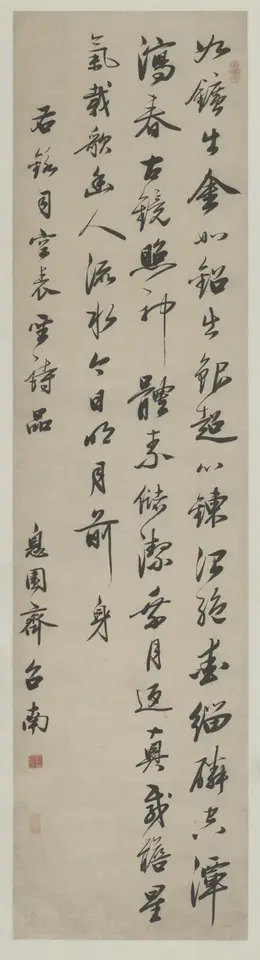
司空图
Sikong Tu (司空图, 837–908), courtesy name Biaosheng, styling himself Zhifeizi (Master Who Knows Errors) and Nairu Jushi (Master Who Endures Humiliation), was a native of Yuxiang in Hezhong (modern Yongji, Shanxi) and one of the most distinguished poets, literary theorists, and critics of the late Tang dynasty. Born into an educated scholar-official lineage, he passed the imperial jinshi examination in 869 under the patronage of…
Sikong Tu (司空图, 837–908), courtesy name Biaosheng, styling himself Zhifeizi (Master Who Knows Errors) and Nairu Jushi (Master Who Endures Humiliation), was a native of Yuxiang in Hezhong (modern Yongji, Shanxi) and one of the most distinguished poets, literary theorists, and critics of the late Tang dynasty. Born into an educated scholar-official lineage, he passed the imperial jinshi examination in 869 under the patronage of Vice Minister of Rites Wang Ning. He sequentially served as Censor in the Palace, Master of the Court of Imperial Entertainments, and Vice Director and Director in the Ministry of Rites. When rebel forces under Huang Chao captured Chang'an, Sikong refused collaboration, walking on foot to Fengxiang to pledge loyalty to Emperor Xizong, who commissioned him as Secretariat Drafter (Zhi Zhigao and Zhongshu Sheren). Disillusioned by endemic warlord insubordination, court factionalism, and the humiliation of the imperial house, Sikong permanently renounced bureaucratic office in 881, retreating to Wangguan Valley in the Zhongtiao Mountains. There, he erected the Xiuxiu Pavilion ("Pavilion of Relinquishment"), devoting himself to rustic hermitage and profound aesthetic exploration. In his mountain sanctuary, he authored the monumental treatise The Twenty-Four Categories of Poetry (Ershisi Shipin), establishing a foundational aesthetic system centered on spiritual resonance beyond literal language. In 908, following Zhu Wen's usurpation of the throne and murder of the deposed Emperor Ai of Tang, Sikong Tu was overcome with grief, starving himself to death as a dynastic loyalist at the age of seventy-two.
Born into an official lineage in Yuxiang, immersing himself in classical histories and prosody from early youth.
Achieved the jinshi degree at age thirty-three under chief examiner Wang Ning, establishing his literary reputation.
Recruited to the staff of Wang Ning in Xuanzhou, overseeing confidential drafting and administrative duties.
Delayed reporting as Censor in the Palace to remain with Wang Ning; demoted to Luoyang where he formed a friendship with Lu Xie.
Promoted to Vice Director and subsequently Director in the Ministry of Rites following Lu Xie's return to the chancellorship.
Huang Chao entered Chang'an; Sikong rejected rebel overtures and fled on foot to Fengxiang, appointed Secretariat Drafter.
Cut off from Emperor Xizong's retreat into Sichuan, he retired to his ancestral estate in Wangguan Valley, vowing never to return to court.
Built the Xiuxiu Pavilion in Wangguan Valley, adopting the styles Zhifeizi and Nairu Jushi to cultivate serene tranquility.
Emperor Zhaozong repeatedly summoned him as Vice Minister of Revenue and Academician; Sikong declined all offices.
Summoned by warlord Zhu Wen as Minister of Rites; feigned extreme infirmity by dropping his court tablet, securing permission to retire.
Received news of Emperor Ai's assassination by Zhu Wen; wept bitterly and starved himself to death at age seventy-two.
Sikong Tu was born in 837 in Yuxiang, Hezhong. His great-grandfather Sikong Shurong, grandfather Sikong Hui, and father Sikong Kai had all served as imperial magistrates. Raised in an atmosphere of rigorous classical scholarship, Sikong Tu demonstrated exceptional literary skill early on, though his quiet, reflective temperament kept him from metropolitan prominence until he caught the attention of Wang Ning, the prefect of Jiangzhou, who treated him as an esteemed family protégé.
In 869, Wang Ning was appointed Vice Minister of Rites and chief examiner of the imperial examinations. Sikong sat for the examinations and passed with highest honors at age thirty-three, his literary reputation rising overnight. When Wang Ning was subsequently demoted to prefect of Shangzhou amidst political strife, other scholars kept their distance, but Sikong demonstrated remarkable loyalty by petitioning the throne to accompany Wang to his remote provincial post as a staff secretary.
In 877, Wang Ning was appointed surveillance commissioner of Xuanshe and invited Sikong to rejoin his staff. The following year, the imperial court appointed Sikong Censor in the Palace. Reluctant to leave Wang Ning, Sikong overstayed his leave, which led to a disciplinary transfer to the minor post of Master in the Court of Imperial Entertainments assigned to Luoyang. During this interlude in the eastern capital, Sikong became an intimate friend of former chancellor Lu Xie, who inscribed a poem on Sikong's study wall praising his peerless integrity.
When Lu Xie resumed the premiership in 879, he promoted Sikong to Vice Director in the Ministry of Rites and subsequently Director. However, in late 880, Huang Chao's insurgent army took Tongguan and entered Chang'an. A servant of Sikong's younger brother who had joined the insurgents urged Sikong to accept a high office in the rebel court. Sikong adamantly refused and fled Chang'an on foot, traveling through bandit-infested territories to reach Emperor Xizong at Fengxiang. Deeply moved by his unswerving loyalty, the emperor commissioned him as Secretariat Drafter (Zhongshu Sheren).
In 881, as rebel forces threatened Fengxiang, Emperor Xizong evacuated toward Sichuan. Cut off by destroyed mountain passes, Sikong was unable to catch the imperial entourage and returned to Hezhong. Disillusioned by regional warlord infighting, court corruption, and the devastation of the empire, he decided to withdraw permanently from public life. He established a mountain retreat in Wangguan Valley within the Zhongtiao Mountains, where clear streams and pine ridges provided an idyllic sanctuary.
In Wangguan Valley, Sikong constructed his celebrated Xiuxiu Pavilion, composing the Record of the Xiuxiu Pavilion to articulate his philosophy of tranquil resignation. Styling himself Zhifeizi and Nairu Jushi, he farmed, tended mountain orchards, and played chess with village elders. During this serene epoch, he composed The Twenty-Four Categories of Poetry, summarizing centuries of poetic aesthetic tradition. When Emperor Zhaozong issued repeated decrees summoning him as Vice Minister of Revenue or Hanlin Academician, Sikong steadfastly refused to leave his valley.
In 904, the warlord Zhu Wen assassinated Emperor Zhaozong and forced the court to relocate to Luoyang. Seeking to legitimize his impending usurpation, Zhu Wen summoned renowned elder statesmen, issuing an ultimatum commanding Sikong Tu to accept the office of Minister of Rites. Coerced by military force, Sikong traveled to Luoyang.
During the formal investiture audience before civil and military officials, Sikong feigned extreme physical and mental decrepitude. While performing the ceremonial prostrations, he allowed his hands to tremble uncontrollably, dropping his official jade tablet onto the palace steps and babbling incoherently. Convinced that the old scholar had lapsed into senility and was useless for statecraft, Zhu Wen's aides permitted him to return to his mountain sanctuary.
In 907, Zhu Wen deposed Emperor Ai and established the Later Liang dynasty. In 908, Zhu Wen secretly poisoned the young deposed monarch in Caozhou. When news reached Wangguan Valley, the seventy-two-year-old Sikong Tu wept inconsolably. Refusing to consume food under the usurper's regime, he began an absolute hunger strike, passing away peacefully after several days of starvation. His death served as an unblemished testament to the moral dignity and dynastic loyalty of the Tang scholarly class.
Sikong Tu's monument in world literature is The Twenty-Four Categories of Poetry (Ershisi Shipin). Utilizing evocative four-character rhymed prose, the work classifies classical Chinese poetic aesthetics into twenty-four distinct modal categories: Grandeur, Tranquility, Exuberance, Gravitas, Antiquity, Elegance, Lucidity, Vigorousness, Splendor, Naturalness, Implicit Reserve, Wild Abandon, Vital Spirit, Density, Rugged Simplicity, Pristine Rarity, Circuitous Nuance, Genuine Reality, Tragic Indignation, Figurative Portrayal, Transcendent Insight, Ethereal Grace, Expansiveness, and Fluid Flow.
Sikong formulated the core doctrine of Chinese lyricism: "Without writing a single word, capture complete poetic elegance" and "Transcend external forms to attain the ring's interior." He argued that true poetry must evoke resonances beyond literal phrasing—the "image beyond images" and the "scene beyond scenes." This text synthesized pre-Tang and High Tang aesthetic traditions, fundamentally shaping Yan Yu's Canglang's Talks on Poetry, Wang Shizhen's "Spiritual Resonance" theory, and Wang Guowei's modern classic Poetic Remarks in the Human World.
As a practicing poet, Sikong Tu produced a body of contemplative verse that stood as a stark contrast to the ornamental, sensual style of late Tang contemporaries like Wen Tingyun and Li Shangyin.
In works such as Five Occasional Jottings and Poems on Mount Zhongtiao, his diction was unvarnished, understated, and steeped in Daoist-Confucian serenity. Capturing misty ravines, rustic stone paths, and seasonal transitions, his verse infused landscape descriptions with subtle dynastic grief and spiritual fortitude, providing an enduring ethical and artistic refuge during an era of imperial collapse.
FIGURES ASSOCIATED WITH THIS DYNASTY