Birth in Jinxian
Born into an esteemed scholarly family in Jinxian, displaying precocious mastery over the Confucian classics.
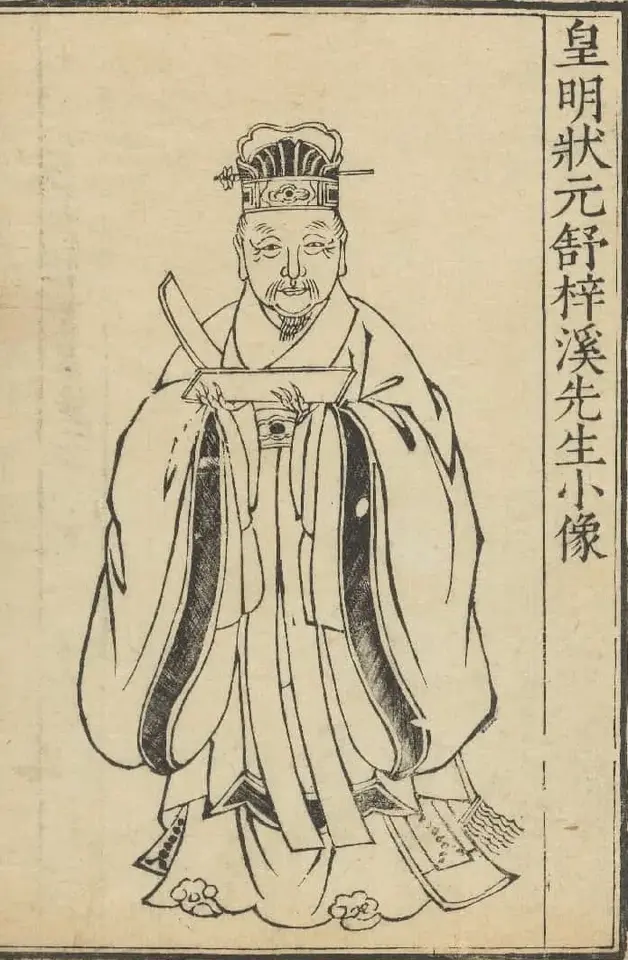
舒芬
Shu Fen (舒芬, 1484–1527), courtesy name Guoshang and pseudonym Zixi, was a celebrated remonstrance official, Neo-Confucian scholar, and the premier optimus (zhuangyuan) of the 1517 dingchou palace examination under the Zhengde Emperor, hailing from Jinxian County, Nanchang Prefecture. Appointed Hanlin Senior Compiler, he attained profound expertise in the Rites of Zhou (Zhouli) and Cheng-Zhu metaphysical philosophy,…
Shu Fen (舒芬, 1484–1527), courtesy name Guoshang and pseudonym Zixi, was a celebrated remonstrance official, Neo-Confucian scholar, and the premier optimus (zhuangyuan) of the 1517 dingchou palace examination under the Zhengde Emperor, hailing from Jinxian County, Nanchang Prefecture. Appointed Hanlin Senior Compiler, he attained profound expertise in the Rites of Zhou (Zhouli) and Cheng-Zhu metaphysical philosophy, renowned across the empire for his uncompromising moral rectitude. In 1519, when the capricious Zhengde Emperor embarked on a frivolous southern tour under the pretext of quelling Prince Ning's revolt, Shu rallied more than ten Hanlin colleagues to prostrate themselves before the imperial palace in tears of remonstrance, resulting in thirty savage blows of court caning (tingzhang) and summary dismissal to commoner status. Following the accession of the Jiajing Emperor in 1521, he was reinstated as Senior Compiler and imperial classic lecturer. During the explosive Great Rites Controversy (Daliyi) in 1524, Shu defended dynastic ritual codes against imperial autocratic desires, leading hundreds of protesting ministers at the Zuoshun Gate. Subjected to a second brutal court caning, he was exiled as Vice Superintendent of Maritime Trade in Fujian, where he succumbed to his injuries and exhaustion in 1527 at age forty-four. He was posthumously honored with the rank of Junior Minister and the revered posthumous title Wenjie.
Born into an esteemed scholarly family in Jinxian, displaying precocious mastery over the Confucian classics.
Placed first in the metropolitan and palace examinations, personally designated Zhuangyuan by the Zhengde Emperor.
Led Hanlin academicians in remonstrating against the emperor's southern tour; suffered thirty blows and stripped of office.
Recalled to the capital by the newly enthroned Jiajing Emperor as Hanlin Senior Compiler and classic lecturer.
Mobilized two hundred court officials in the Great Rites Controversy; endured a second severe caning and exiled to Fujian.
Succumbed to chronic wounds and tropical illness at the Fujian Maritime Office at age forty-four.
Posthumously elevated to Junior Minister of Imperial Sacrifices and conferred the posthumous title Wenjie.
Shu Fen was born in 1484 in Jinxian County, Jiangxi. Imbued with a family tradition of ethical scholarship, he exhibited intellectual brilliance from an early age, reciting the Book of Changes and the Book of Rites by age nine and composing essays by twelve. In his youth, Shu concentrated on the Rites of Zhou, maintaining that this ancient classic contained the foundational blueprint for statecraft, institutional balance, and moral governance.
In 1517, at the age of thirty-three, Shu attended the triennial metropolitan examinations in Beijing. During the palace examination, his response paper analyzed historic cycles of dynastic order and decay, directly castigating the wasteful extravagance of palace favorites and frontier adventurers. Deeply impressed by his classical elegance and civic courage, imperial examiners placed him at the pinnacle of the list. The Zhengde Emperor ratified the decision, appointing him Optimus (Zhuangyuan) and commissioning him as Senior Compiler in the Hanlin Academy to draft official dynastic records.
In the spring of 1519, the Zhengde Emperor, instigated by military favorites Jiang Bin and Qian Ning, resolved to travel south to Yangzhou and Nanjing under the guise of an imperial military expedition to suppress the rebellion of Zhu Chenhao, Prince of Ning. Knowing that Prince Ning's revolt had already been largely contained by Wang Yangming in Jiangxi, the civil bureaucracy recognized the journey as an irresponsible excursion that would devastate regional economies.
Indignant at the court favorites' machinations, Shu organized over a dozen Hanlin colleagues, including Xia Liangsheng and Wang Yingzhen, to submit the Memorial Severely Remonstrating against the Southern Tour. In this memorial, Shu employed unflinching prose to warn the sovereign that exposing his sacred person to reckless adventure disgraced the imperial ancestors. Infuriated, the emperor ordered Embroidered Uniform Guards to arrest Shu and his comrades outside the Meridian Gate, subjecting them to thirty blows of the wooden stave. Battered until his flesh was torn, Shu lapsed into unconsciousness. Following his release from the Imperial Prison, he was stripped of all scholarly ranks and banished home to Jinxian. Observers wept as the bloodstained scholar departed Beijing, hailing him as a true scholar-hero.
In 1521, the Zhengde Emperor died without issue, and his cousin Zhu Houcong arrived from Anlu to ascend the throne as the Jiajing Emperor. Commencing his reign with broad administrative reforms, the young emperor recalled dismissed upright officials. Shu Fen returned to Beijing as Hanlin Senior Compiler and was appointed imperial daily lecturer, expounding Confucian texts directly to the teenage monarch.
Shortly thereafter, the explosive Great Rites Controversy erupted. Emperor Jiajing sought to elevate his biological father, Prince Xian of Xing, to the status of Imperial Father (Huang Kao), asserting sovereign prerogative over dynastic inheritance. Conversely, Grand Secretary Yang Tinghe and Minister of Rites Mao Cheng, supported by the mainstream bureaucracy, insisted that imperial legitimacy required Jiajing to be adopted post-facto as the son of Emperor Hongzhi, thereby maintaining uncompromised ancestral succession. Master of the Rites of Zhou, Shu Fen opposed the imperial demands, submitting rigorous memorials refuting Zhang Cong's accommodating arguments.
On August 14, 1524, when the emperor unilaterally proclaimed the alteration of his parents' titles, more than two hundred civil and military officials, led by Vice Minister of Personnel He Mengchun, Yang Shen, and Shu Fen, prostrated themselves outside the Zuoshun Gate of the Forbidden City. Kneeling in rows, they wailed aloud, beseeching the monarch to preserve the ritual codes. The enraged sovereign ordered eunuchs and guards to arrest Shu and over thirty organizers. The following morning, the emperor commanded a massive public court caning. Shu was beaten a second time before the Meridian Gate, suffering shattered bones and traumatic hemorrhages before being banished into coastal exile as Vice Superintendent of the Maritime Trade Supervisorate in Fujian.
Exiled to the remote coastal port in Fujian, Shu bore his crippling injuries with tranquil stoicism. At the maritime supervisorate, he reformed customs collections, stamping out embezzlement and treating foreign maritime merchants with scrupulous fairness. During his leisure hours, he established classrooms on the seashore, instructing local youths in the Rites of Zhou and the Classic of Poetry.
However, the catastrophic physical trauma inflicted by two court canings, exacerbated by the damp and sweltering subtropical climate, permanently compromised his health. Watching the government fall completely into the hands of factional newcomers like Zhang Cong, Shu suffered profound spiritual grief. In 1527, Shu died in his modest official lodging in Fujian at the age of forty-four. On his deathbed, he instructed his sons: "Preserve the rites and guard your integrity; never surrender your principles for wealth or survival."
Shu Fen's unwavering fidelity was universally admired by the scholar-gentry. During the Longqing reign, the court re-evaluated the martyrs of the Great Rites Controversy, clearing his record and conferring the posthumous title Junior Minister of Imperial Sacrifices. In the early Wanli era, the Wanli Emperor awarded him the posthumous title Wenjie (Cultured and Chaste) and erected a dedicated ancestral shrine in Jinxian.
In scholarship, Shu was renowned as one of the finest ritualists of the Ming Dynasty, authoring the Standard Edition of the Rites of Zhou (Zhouli Dingben), Outline of the Rites of Zhou (Zhouli Gangmu), and Collected Works of Master Shu Wenjie. Huang Zongxi included him prominently in the Records of Ming Scholars, celebrating his life as a quintessential synthesis of classical philology and heroic moral courage.
FIGURES ASSOCIATED WITH THIS DYNASTY