Birth in Ningguo
Born into an aristocratic family of the Xi clan in Ningguo County, Xuanzhou.
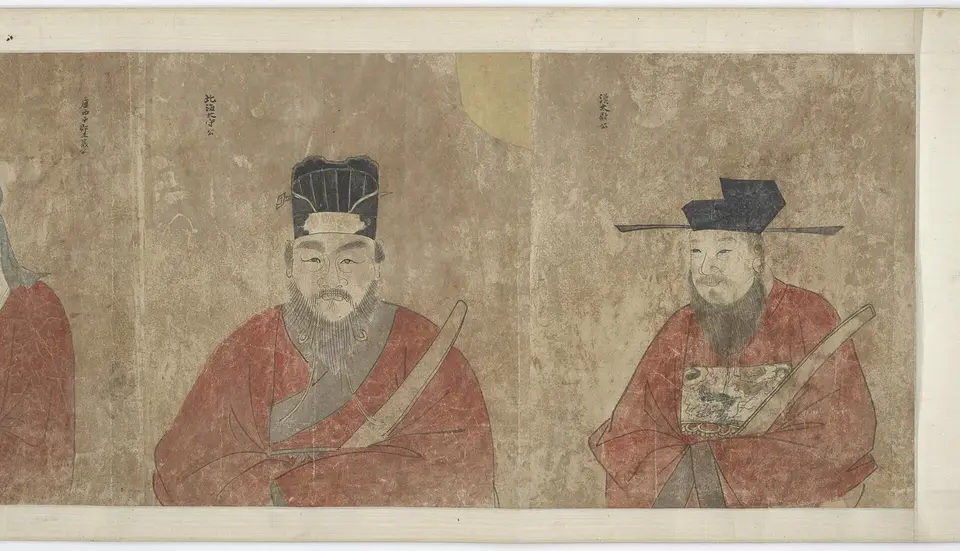
释宗杲
Shi Zonggao (释宗杲, 1089–1163), secular surname Xi, dharma name Zonggao, courtesy name Tanhui, art names Miaoxi and Dahui, was a native of Ningguo in Xuanzhou (modern-day Ningguo, Anhui Province). He was an illustrious Chan Buddhist patriarch of the Southern Song dynasty, the fifth-generation successor of the Yangqi branch of the Linji school, and the abbot of Jingshan Temple in Hangzhou, renowned as the premier monastic…
Shi Zonggao (释宗杲, 1089–1163), secular surname Xi, dharma name Zonggao, courtesy name Tanhui, art names Miaoxi and Dahui, was a native of Ningguo in Xuanzhou (modern-day Ningguo, Anhui Province). He was an illustrious Chan Buddhist patriarch of the Southern Song dynasty, the fifth-generation successor of the Yangqi branch of the Linji school, and the abbot of Jingshan Temple in Hangzhou, renowned as the premier monastic institution under heaven. Bereaved of his father in his youth, Zonggao renounced secular life at the age of seventeen, immersed himself in Buddhist scriptures, and later traveled to the Tianning Wanshou Temple in Bianliang, where he was enlightened and recognized by Master Yuanwu Keqin. Emperor Huizong granted him the purple robe and the honorary title "Master Fori" (Sun of the Buddha). During the Shaoxing era of the Southern Song, Grand Councilor Zhang Jun invited Zonggao to assume the abbacy of Nengren Temple on Mount Jingshan, where over seventeen hundred monks assembled under his spiritual leadership. Because of his moral alignment with anti-peace officials like Vice Minister Zhang Jiucheng and his composition of verse mocking capitulation policies, Zonggao incurred the wrath of powerful grand councilor Qin Hui. Deprived of monastic status and defrocked, he was exiled to Hengzhou and Meizhou for fifteen years. Following Qin Hui's demise, Zonggao was pardoned, restored to monastic orders, and reappointed to Mount Jingshan, receiving the imperial honorific "Zen Master Dahui" from Emperor Xiaozong. In response to the rampant decadence of literati "lettered Chan" and passive "silent illumination Chan", Zonggao pioneered "Kanhua Chan" (investigating the critical phrase or hua tou), directing practitioners to meditate single-mindedly on phrases such as Zhaozhou's "Wu" to cut off conceptual proliferation. This innovation reshaped East Asian Chan meditation across China, Korea, and Japan for more than seven centuries.
Born into an aristocratic family of the Xi clan in Ningguo County, Xuanzhou.
Shaved his hair and took monastic vows at the age of seventeen at Dongshan Huiyun Temple under Master Qigong, adopting the dharma name Zonggao.
Traveled across the Jianghuai region, studying under venerable elders of the Caodong and Yunmen traditions, guided by Baofeng Zhantang Wenzhun.
Entered Tianning Temple in Kaifeng to serve Yuanwu Keqin; attained profound enlightenment, received dharma transmission, and was awarded the title "Master Fori".
Fled south with Keqin following the fall of Kaifeng to Jurchen forces, serving as head monk at Jinshan Temple in Zhenjiang and Yunju Mountain in Jiangxi.
Invited by Grand Councilor Zhang Jun to become the abbot of Nengren Temple on Mount Jingshan, transforming it into the foremost Chan seat in Southeast China.
Slandered by Qin Hui for associating with Zhang Jiucheng and writing patriotic poems; had his ordination certificate revoked and was banished to Hengzhou.
Further exiled to remote, disease-ridden Meizhou in Lingnan, where he compiled the seminal three-volume Chan masterwork Zhengfa Yanzang.
Following Qin Hui's death, imperial amnesty restored his ordination certificate and purple robe; appointed abbot of King Asoka Temple in Mingzhou.
Reappointed by imperial edict to govern Mount Jingshan; summoned to court by Emperor Xiaozong and bestowed the title "Zen Master Dahui".
Passed away peacefully on the tenth day of the eighth month at Mingyue Hall on Mount Jingshan at the age of seventy-five; awarded the posthumous name "Zen Master Pujue".
Shi Zonggao was born into the prominent Xi lineage of Ningguo County in Xuanzhou. Endowed from infancy with extraordinary intellect and a resolute temperament, he exhibited early dissatisfaction with ordinary worldly pursuits. While studying Confucian classics and historical treatises at a village school around the age of twelve, he witnessed a schoolmaster severely chastising a fellow pupil. Deeply stirred by the fleeting nature of worldly achievements, he resolved that an accomplished individual should direct their faculties toward resolving the existential problem of birth and death, rather than squandering a lifetime memorizing texts for administrative honors.
In 1105, during the fourth year of the Chongning era under Emperor Huizong of Northern Song, the seventeen-year-old youth left his ancestral household and sought tonsure at Huiyun Temple on Mount Dongshan, receiving monastic vows from Master Qigong and taking the dharma name Zonggao. He observed monastic precepts scrupulously and received full upasampada ordination at twenty-one. During his initial years in the monastery, he read day and night through the Tripitaka, mastering canonical sutras including the Shurangama Sutra, Vimalakirti Sutra, and Diamond Sutra, while comprehending the doctrinal nuances of the Tiantai and Yogacara traditions.
Yet Zonggao remained keenly aware that textual mastery alone could not resolve inner delusion or liberate the mind from the cycle of rebirth. Convinced that true realization required personal awakening under enlightened guidance, he packed his meager belongings during the Zhenghe era and embarked on an itinerant pilgrimage that lasted over a decade.
Zonggao journeyed through the Jianghuai river basins, calling upon venerable masters of the five principal Chan lineages. He first studied under Master Shimen Yuanyi of the Caodong school, gaining complete mastery over its delicate dialectical formulations of polarity and integration. However, he sensed that relying on rigid structural schemata risked trapping seekers within dead conceptual phrases. He then climbed through the peaks of Jing'an in Hongzhou to pay homage to Master Baofeng Zhantang Wenzhun of the Yunmen lineage.
Zhantang Wenzhun was deeply impressed by Zonggao's sharpness and verbal agility, retaining him as an attendant. Nevertheless, Zhantang repeatedly delivered severe verbal and physical shocks to dismantle his intellectual pride, warning him that intellectual comprehension merely constitutes a cognitive obstacle. On his deathbed, Zhantang solemnly instructed Zonggao that if he wished to attain ultimate realization, he must seek out Master Yuanwu Keqin of the Yangqi branch of Linji.
In 1124, Emperor Huizong invited Yuanwu Keqin to preside over the Tianning Wanshou Chan Temple in Bianliang. Upon hearing the news, Zonggao immediately hurried to the capital to join Keqin's assembly. In the abbot's quarters, Keqin tested him through rapid-fire koan dialogues. Under Keqin's incisive probing, Zonggao's residual doubts vanished in an instant, and he attained thorough enlightenment. Delighted that the authentic seal of the patriarchs had found an inheritor of vast capacity, Keqin conferred upon him the orthodox Linji transmission and appointed him to share the lecture dais to instruct fourfold assemblies. Emperor Huizong granted Zonggao the purple robe and the honorific title "Master Fori".
During the Jingkang incident when Jin armies captured Kaifeng, Zonggao followed his teacher southward, dwelling at Tiger Hill in Suzhou and Mount Yunju in Jiangxi as head monk, offering spiritual solace to both clergy and displaced gentry amid wartime turmoil.
In 1137, during the seventh year of the Shaoxing era under Emperor Gaozong of Southern Song, Grand Councilor Zhang Jun, who held supreme military command as Bureau of Military Affairs commissioner, petitioned the throne to invite Zonggao to assume the abbacy of Nengren Chan Temple on Mount Jingshan near Hangzhou. Although Jingshan was an ancient sacred mountain, its monastic compound had fallen into neglect. Upon arrival, Zonggao reformed monastic regulations and revitalized the Linji tradition.
When Zonggao ascended the dharma throne, his sermons were delivered in vivid, accessible language, punctuated by lightning-like repartee that penetrated directly to the core of the human mind. Within a few short years, monastic pilgrims converged on Mount Jingshan from across China, swelling the assembly to over seventeen hundred monks. Jingshan Temple rose to become the undisputed premier Chan monastery of Southern Song China, while Zonggao was revered as the spiritual giant of his age.
Zonggao was not merely a monastic contemplative; he was also a man of uncompromising moral integrity who cared deeply about the suffering of the Chinese people under northern occupation. He held profound disdain for the appeasement and capitulation policies pursued by Grand Councilor Qin Hui, maintaining intimate friendships with patriotic scholar-officials such as Vice Minister of Rites Zhang Jiucheng.
In the fifth month of 1141, Zhang Jiucheng visited Mount Jingshan to discuss Buddhist philosophy. During their conversations, Zhang recounted General Han Shizhong's development of the powerful "Kedi" divine crossbow intended for northern counteroffensives. Moved by righteous fervor, Zonggao composed a poem praising the penetrating power of the weapon, allegorically celebrating the triumph of justice over barbaric invaders. Qin Hui's spies reported this exchange. Fearing that Zonggao's vast monastic following and intellectual stature would coalesce into formidable political opposition, Qin Hui fabricated charges of slandering state policies. The court rescinded Zonggao's ordination credentials, stripped him of his clerical robes, and banished him into penal exile at Hengzhou in Hunan.
During his decade of exile in Hengzhou, living under constant surveillance in humble quarters, Zonggao remained unshakably composed, continuing to instruct seekers who secretly visited him. In 1150, Qin Hui's faction intensified their persecution, exiling Zonggao even further south to Meizhou in Guangdong. Meizhou was a malarial and impoverished border outpost ravaged by epidemics. Zonggao endured these hardships with serene contentment, utilizing this period of extreme isolation to compile his monumental three-volume Chan treatise, the Zhengfa Yanzang.
In the tenth month of 1155, Qin Hui died, and two months later an imperial amnesty was declared. Zonggao was permitted to return north. In the spring of 1156, Emperor Gaozong formally restored his clerical status, returning his purple robe and ordination certificate, and appointed him abbot of King Asoka Temple in Mingzhou.
In 1158, Emperor Gaozong issued an edict commanding Zonggao to reassume the abbot's seat at Mount Jingshan. Disciples and lay followers gathered once again in huge numbers, restoring Jingshan to its former grandeur with over a thousand resident monks. Following Emperor Xiaozong's ascension to the throne, the new emperor, who possessed a profound interest in Buddhist philosophy and admired Zonggao's integrity, summoned the master to imperial audiences. Delighted by Zonggao's concise spiritual guidance, Xiaozong bestowed upon him the imperial honorific "Zen Master Dahui".
In his final years, Zonggao retired to Mingyue Hall on Mount Jingshan, devoting his days to reading sutras and guiding disciples. On the tenth day of the eighth month of 1163, Zonggao felt minor illness and wrote his final verse: "Life is just thus, death is just thus; with a verse or without a verse, what is all the fuss?" Dropping his brush, he entered parinirvana at the age of seventy-five, having spent fifty-eight summer retreats as an ordained monk. The court bestowed the posthumous name "Zen Master Pujue" and designated his funerary stupa as Baoguang.
Shi Zonggao's most revolutionary achievement in East Asian Buddhist history was the formal establishment of Kanhua Chan (investigating the critical phrase or hua tou) as a rigorous contemplative methodology, effectively halting the creeping formalistic degeneration of the Chan tradition.
By the late Northern Song dynasty, Chan monasticism was plagued by two dangerous extremes. On one hand, "lettered Chan" seduced practitioners into treating ancestral dialogues and koans as decorative poetic literature, reducing spiritual practice to intellectual wit and rhetorical display. On the other hand, certain practitioners of the Caodong lineage promoted "silent illumination Chan", which risked devolving into inert, passive sitting divorced from dynamic awakening. Zonggao argued that both tendencies betrayed Bodhidharma's foundational principle of directly pointing to the human mind.
Zonggao instructed practitioners to focus their awareness relentlessly upon a single enigmatic phrase that defied conceptual reasoning, such as Zhaozhou's famous answer "Wu" to the question of whether a dog has Buddha-nature. Practitioners were urged to hold this hua tou uninterruptedly during all daily activities, prohibiting intellectual deduction and scriptural quotation until their existential doubt accumulated into an impenetrable mass. When this mass suddenly shattered, conceptual delusions collapsed, revealing original nature. Because of its directness and accessibility, Kanhua Chan became the mainstream meditative framework across China, Korea, and Japan throughout subsequent centuries.
During his agonizing exile in Meizhou, Shi Zonggao transcended sectarian divisions to compile the three-volume canonical treasury titled Zhengfa Yanzang (Treasury of the True Dharma Eye).
The work systematically gathered six hundred and sixty-one crucial dialogues and encounter passages spanning from the twenty-eight Indian patriarchs and the six Chinese ancestors down to Song dynasty masters of the five houses and seven lineages. Zonggao stated that he selected these materials regardless of sectarian lineage, incorporating any teaching possessing genuine insight capable of facilitating awakening.
Appended to each case were Zonggao's penetrating critiques and illuminating commentaries, which purged distortions and false interpretations accumulated over generations. The publication of this work provided contemporary and future practitioners with an authoritative touchstone to distinguish between authentic realization and delusion, cementing its status as one of the most respected compendiums in Chan intellectual history.
Although an accomplished literary stylist himself, Shi Zonggao demonstrated extraordinary courage by taking drastic action against the intellectual idolatry that threatened the spiritual vitality of his own monastic lineage.
During his era, literati and young monks avidly memorized the Blue Cliff Record (Biyan Lu), compiled by his venerated teacher Yuanwu Keqin, utilizing its eloquent commentaries as social capital to curry favor with the cultural elite. Genuine inward inquiry was rapidly supplanted by competitive recitation. Recognizing that this textual obsession was suffocating spiritual enlightenment, Zonggao made the bold decision to destroy the printing blocks of the Blue Cliff Record that he could collect.
This decisive act delivered a profound wake-up call to contemporary seekers, reminding the Buddhist community that the true Dharma resides within one's own direct realization rather than on printed paper. By sacrificing a literary masterpiece created by his own master, Zonggao rescued Chan from degenerating into a purely aesthetic pastime, reaffirming its nature as a fierce spiritual discipline.
In the realm of socio-cultural influence, Shi Zonggao transformed austere monastic philosophy into a practical spiritual reservoir for Confucian scholar-officials coping with severe political and existential crises, thereby spearheading the flourishing of lay Buddhism.
Zonggao carried on extensive correspondence with Southern Song statesmen, which was subsequently compiled into the renowned collection Dahui Shu (Letters of Dahui). He consistently reminded his correspondents that practicing Chan did not necessitate abandoning civic responsibility to hide in mountain hermitages; rather, managing state affairs, displaying filial devotion, and demonstrating unwavering loyalty were themselves sacred grounds of meditation. He encouraged them to overcome fear and worldly vanity through Buddhist detachment, forging an unyielding moral spine in the face of national peril.
Guided by Zonggao's teachings, prominent figures such as Grand Councilor Zhang Jun, Vice Minister Zhang Jiucheng, and scholar Wang Zao maintained steadfast moral integrity amid political purges and foreign aggression. By infusing Confucian civic duty with Buddhist fearlessness, Zonggao made an enduring contribution to the ethical resilience of the Southern Song scholar-official class.
FIGURES ASSOCIATED WITH THIS DYNASTY