Imperial Birth
Born in the Prince of Jingjiang Mansion in Guilin, Guangxi, as a Ming imperial descendant named Zhu Ruoji.
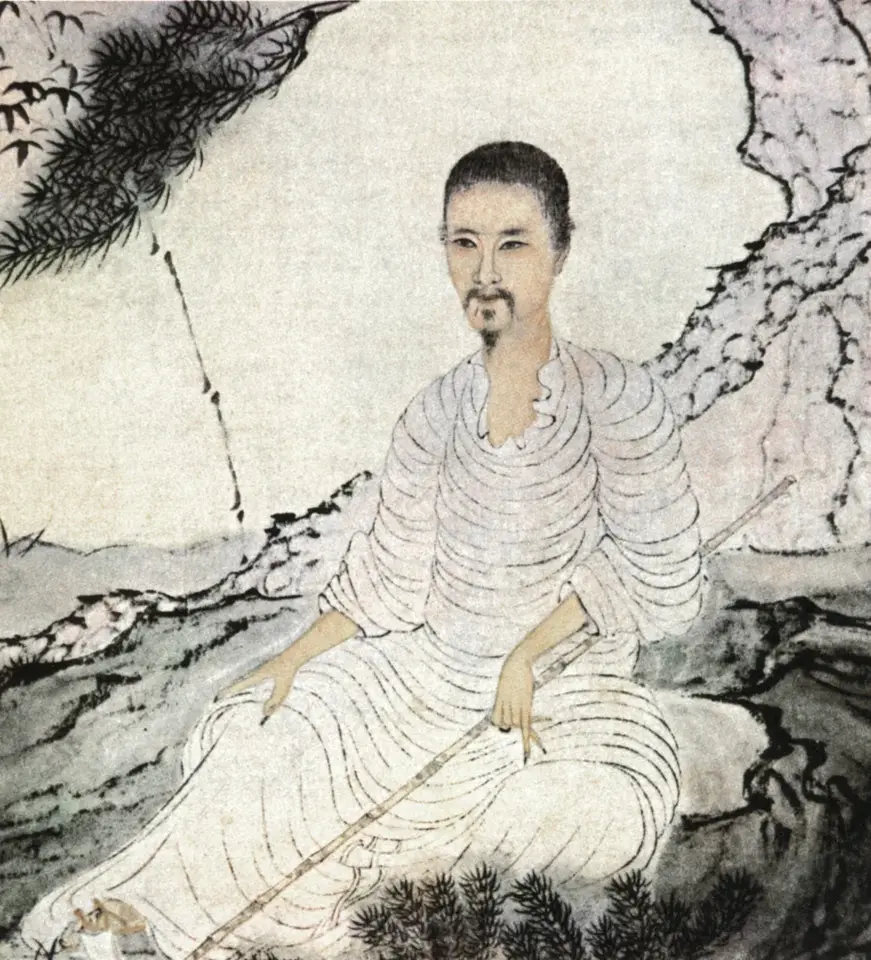
石涛
Shi Tao was one of the most innovative and influential painters, calligraphers, garden designers, and art theorists in Chinese history. Alongside Hong Ren, Kuncan, and Zhu Da (Bada Shanren), he is celebrated as one of the "Four Monk Masters of the Early Qing," spearheading an artistic revolution against sterile imitation. Born Zhu Ruoji, he was an imperial scion of the Ming dynasty, descending from Zhu Shouqian, the Prince of…
Shi Tao was one of the most innovative and influential painters, calligraphers, garden designers, and art theorists in Chinese history. Alongside Hong Ren, Kuncan, and Zhu Da (Bada Shanren), he is celebrated as one of the "Four Monk Masters of the Early Qing," spearheading an artistic revolution against sterile imitation. Born Zhu Ruoji, he was an imperial scion of the Ming dynasty, descending from Zhu Shouqian, the Prince of Jingjiang and grand-nephew of the dynastic founder Zhu Yuanzhang. Following the fall of the Ming and the execution of his father Zhu Hengjia in 1645, the infant prince was rescued by a loyal palace eunuch and disguised as a Buddhist novice at Xiangshan Monastery in Quanzhou, Guangxi, taking the monastic name Yuanji and the style name Shi Tao, later assuming sobriquets such as Monk Bitter Melon (Kugua Heshang), Dadizi, the Elder of Qingxiang, and the Blind Venerable (Xia Zunzhe). Shi Tao lived a peripatetic life marked by emotional turmoil and artistic discovery. After spending his youth in Wuchang and Mount Lu, he resided in Xuancheng, Anhui, for fifteen years, where he formed a profound friendship with painter Mei Qing, frequently ascended Mount Huang, and internalized the boundless vitality of nature. In middle age, he settled at the Yizhigat Pavilion of Changgan Monastery in Nanjing, engaging with Jiangnan literati and kneeling twice to welcome the southern inspection tours of the Kangxi Emperor. He later traveled to Beijing seeking aristocratic patron-client recognition, but experiencing disillusionment with official circles, he returned south to settle permanently in Yangzhou. There, he abandoned monastic vestments, grew his hair, built the Dadizi Thatched Hermitage, supported himself through professional painting, and maintained a legendary correspondence of mutual reverence with Bada Shanren. Shi Tao's artistic practice and aesthetic theory fundamentally reshaped Chinese painting. Violently opposed to the slavish copying of ancient masters that dominated orthodox circles, he advocated "borrowing from antiquity to pioneer the present," proclaiming "I use my own method" and "searching all odd peaks to make draft sketches." His dynamic compositions broke classical spatial rules through dramatic close-up croppings, while his inkwork integrated scorched dry rubs with moisture and "countless wicked ink dots." His seminal theoretical treatise, Kugua Heshang Huayulu (Treatise on Painting by Monk Bitter Melon), centered on the concept of the "Single Stroke" (yihua), synthesizes Daoist and Chan philosophy to establish an enduring cornerstone of modern Chinese aesthetics.
Born in the Prince of Jingjiang Mansion in Guilin, Guangxi, as a Ming imperial descendant named Zhu Ruoji.
His father Zhu Hengjia proclaimed Regency in Guilin and was executed; an attendant smuggled the infant to Xiangshan Monastery to be tonsured.
Amid persistent warfare in Guangxi, escaped north to Wuchang, studying Buddhist texts, classical poetry, and painting.
Painted the Landscape and Flower Album in Wuchang at age sixteen, mastering Song-Yuan linear outline methods.
Traveled through Jiangsu and Zhejiang to Xuancheng, residing at Guangjiao Monastery and bonding with painter Mei Qing.
Scaled the high peaks of Mount Huang multiple times, transforming his brushwork from fine draftsmanship to bold spontaneity.
Moved to the Yizhige Pavilion at Changgan Monastery in Nanjing, actively joining literary gatherings with Kong Shangren and Dai Benxiao.
Welcomed the Kangxi Emperor on his first southern tour at Changgan Monastery, composing commemorative poems.
Greeted Kangxi during his second tour at Pingshantang in Yangzhou, receiving personal imperial acknowledgment and inspiring a northern journey.
Resided in the capital at Qiehanzhai and Ciyuan Monastery, socializing with prince Bordu and orthodox master Wang Yuanqi.
Disheartened by court patron-client politics and the dominance of orthodox copyists, left Beijing by boat to return to Yangzhou.
Erected the Dadizi Thatched Hermitage in Yangzhou, grew his hair, donned Daoist robes, and corresponded with Bada Shanren.
Penned the philosophical treatise Kugua Heshang Huayulu at Qinglian Pavilion in Yangzhou.
Passed away in his Yangzhou residence at age sixty-six; buried at the foot of Shugang near Pingshantang.
Shi Tao was originally named Zhu Ruoji, with the childhood name A'chang. He was an eleventh-generation descendant of Zhu Shouqian, the first Prince of Jingjiang and great-grandson of the elder brother of the Ming founder Zhu Yuanzhang. His family lineage had maintained their princely fief in Guilin, Guangxi, across the entire Ming dynasty. In 1642, during the final years of the Chongzhen reign, Shi Tao was born within the princely palace of Guilin.
In 1645, Qing armies swept south, capturing Nanjing and terminating the Southern Ming Hongguang regime. In Guilin, Shi Tao's father, Prince Zhu Hengjia, declared himself Regent (Jianguo) and raised troops to resist the Qing while asserting imperial authority. His bid ended in disaster when rival Southern Ming forces led by Ding Kuichu and Qu Shisi marched on Guilin. Defeated and captured, Zhu Hengjia was transported to Fujian and put to death. The princely residence was confiscated, and royal descendants were targeted for liquidation. Four-year-old Zhu Ruoji was saved by a loyal palace eunuch later known as Hetao, who carried the boy through military blockades into the remote mountains of Quanzhou, Guangxi. Taking sanctuary at Xiangshan Monastery, the eunuch had the boy tonsured as a Buddhist novice to conceal his imperial identity, bestowing upon him the dharma name Yuanji and the style name Shi Tao.
After several years of concealment, persistent warfare between Southern Ming remnants and Qing forces prompted Hetao to flee Guangxi with young Shi Tao around 1651. Traveling through Hunan, they sought refuge in Wuchang, Hubei. Over more than a decade in Wuchang, Shi Tao lived in Buddhist temples, studying Buddhist scriptures alongside the Confucian classics and ancient treatises on calligraphy and painting. At age fourteen, he diligently copied Zhao Mengfu's double-contour orchid and bamboo paintings, and at sixteen, he completed his earliest known dated work, the Landscape and Flower Album, revealing a prodigious artistic sensibility. The trauma of losing his family and ancestral dynasty instilled in him lifelong sorrow, while the majestic waterways and crags of the central Yangzi basin forged an untrammeled creative spirit.
In the early Kangxi reign, in his twenties, Shi Tao resolved to leave the middle Yangzi and journey eastward through Jiangnan. Traveling by river, he visited Mount Lu, lingered at Kaixian Monastery, and explored Suzhou, Hangzhou, and Songjiang. In 1666, he arrived in Xuancheng, Anhui, a celebrated cultural center of southern Anhui, taking up residence at Guangjiao Monastery, Jinlu Hermitage, and Xianyun Hermitage along the slopes of Mount Jingting. In Xuancheng, Shi Tao spent fifteen tranquil and immensely productive years that formed the golden foundation of his early development.
Xuancheng was home to distinguished scholars and painters. Shi Tao met the preeminent local cultural leader, Mei Qing, widely celebrated as the Giant of Mount Huang. Nearly twenty years Shi Tao's senior, Mei Qing immediately recognized the young monk's extraordinary genius. The two formed an intimate friendship, spending days discussing painting aesthetics, writing poetry, and collaborating on scrolls. Mei Qing's ethereal, idiosyncratic brushwork left a deep impression on Shi Tao. During this period, Shi Tao repeatedly scaled the peaks of Mount Huang with companions, sleeping amidst crags on Tiandu Peak, Lotus Peak, and Shixin Peak to observe pines, rocks, billowing sea clouds, and cascading cataracts.
The primeval majesty of Mount Huang shattered Shi Tao's deference to ancient models. He declared in an impassioned verse: "Mount Huang is my master, and I am the companion of Mount Huang. Among all things my heart desires, Mount Huang possesses everything!" Guided by nature's living energy, his painting shifted rapidly from delicate linear precision toward moist, untrammeled vigor and dynamic inventiveness. In 1667, twenty-six-year-old Shi Tao created the monumental monochrome work Sixteen Luohans (later expanded into a hundred-leaf album) at Mount Jingting, featuring fluid, sinuous line work that earned comparisons to the Song dynasty master Li Gonglin. His fifteen years in southern Anhui completed his evolution into an independent master.
In 1680, at the age of thirty-nine, Shi Tao moved to Nanjing at the invitation of the Xitian Daoist Cloister on Mount Zhong, soon taking up residence at the Yizhige Pavilion of Changgan Monastery south of the city. As the former southern capital of the Ming dynasty, Nanjing was the prime gathering place for Ming loyalist intellectuals and Jiangnan scholars.
At Yizhige, Shi Tao flourished within this intellectual environment, cultivating close associations with prominent cultural figures including Gong Xian, Dai Benxiao, Cheng Sui, Zha Shibiao, Qu Dajun, and playwright Kong Shangren. Gathering frequently at his pavilion and along the Qinhuai River, they drank wine, exchanged verses, and critiqued the rival merits of the Jinling and Xin'an painting schools. Access to private collections owned by local connoisseurs allowed Shi Tao to scrutinize genuine works by Dong Yuan, Juran, Ni Zan, and Huang Gongwang, enriching his command of classical ink wash. During his decade in Nanjing, he produced masterpieces including Clear Sounds of Hills and Waters and the Autumn Sounds Ode Scroll, pioneering his signature technique of applying "countless wicked ink dots."
Yet as an orphaned scion of the Ming royal house, Shi Tao was plagued by inner turmoil. Caught between sorrow for his fallen dynasty and reluctance to endure lifelong monastic obscurity, he departed from strict loyalist reclusion. In 1684, when the Kangxi Emperor visited Nanjing during his first southern tour and inspected Changgan Monastery, Shi Tao joined the monastic assembly in kneeling by the roadside to welcome the emperor, shouting long life to the monarch. In 1689, during Kangxi's second southern tour, Shi Tao traveled to Pingshantang in Yangzhou to greet the imperial procession a second time, receiving a direct personal inquiry from the emperor. These imperial encounters stimulated his ambitions, prompting him to compose court-flattering verses and resolve to travel north to the imperial capital in pursuit of secular recognition.
In the autumn and winter of 1689, at age forty-eight, Shi Tao journeyed north with financial support from aristocratic patrons, arriving in Beijing in the spring of 1690. In the capital, he stayed at Qiehanzhai, the residence of Prince Bordu, and later resided at Ciyuan and Haichao monasteries outside Xuanwumen.
During his three years in Beijing, Shi Tao gained considerable celebrity. Manchu nobles, imperial ministers, and Han scholars competed to entertain the Jiangnan painter-monk. Shi Tao frequented grand aristocratic mansions, exchanging verses with grand secretaries such as Xu Qianxue and Sun Yueban, and interacting with orthodox court painter Wang Yuanqi. In 1691, at a salon hosted by Bordu, Shi Tao painted ink bamboo while Wang Yuanqi added rocky slopes, an event celebrated as a rare collaboration between the southern individualist and northern orthodox traditions. While in the capital, Shi Tao painted his masterpiece Searching All Peaks for Draft Sketches, introducing the northern Great Wall into a classical landscape scroll with unprecedented structural vigor.
However, reality soon shattered his illusions. In the eyes of Manchu aristocrats and orthodox scholar-bureaucrats, Shi Tao remained merely a talented itinerant painter-monk. While nobles enjoyed collecting his paintings for prestige, they had no intention of granting official court rank to a tonsured monk. Furthermore, the capital's art world was dominated by the orthodox Four Wangs school, whose conservative adherence to ancient models led them to view Shi Tao's wild, expressive brushwork as eccentric and uncultivated. Suffering neglect and financial strain, Shi Tao wrote poignantly: "Monk Bitter Melon begs for food on all sides; in bustling Chang'an, who truly asks after him?" Realizing the vanity and callousness of the capital, fifty-one-year-old Shi Tao boarded a boat on the Grand Canal in the autumn of 1692, severing all ambitions of court patronage to return to Yangzhou.
Returning to Yangzhou, Shi Tao completed a decisive process of psychological emancipation and artistic purification. In 1696, at age fifty-five, he constructed his permanent residence, the Dadizi Thatched Hermitage, in northeastern Yangzhou. Casting aside the monastic habit he had worn out of political necessity for five decades, he grew his hair, donned the robes of a Daoist scholar, and assumed the style name Dadizi ("The Cleansed One"), expressing his resolve to wash away decades of worldly dust, political illusions, and moral compromises.
During his final fifteen years in Yangzhou, Shi Tao supported himself as a professional artist, selling paintings to wealthy salt merchants and literati patrons who eagerly competed for his calligraphy and paintings. In this period, he developed a profound spiritual kinship with Zhu Da (Bada Shanren), an imperial Ming prince living in Nanchang. Though the two royal scions never met face-to-face, they exchanged frequent letters, collaborated on flower and rock scrolls, and celebrated each other's artistic genius. When Shi Tao erected his hermitage, he wrote to Bada Shanren requesting a painting of the Dadizi Thatched Hermitage, onto which Shi Tao reverently inscribed poetic colophons upon its arrival.
In his final years, Shi Tao's art attained transcendent mastery. Residing at Qinglian Pavilion, he completed his aesthetic treatise Kugua Heshang Huayulu around 1700. Though aging, frail, and plagued by illness—laments of physical decline appear in his late inscriptions—his brushwork grew increasingly robust, saturated, and profound. In the winter of 1707, the visionary master passed away in his Yangzhou hermitage at the age of sixty-six. He was buried by his followers at the foot of Shugang near Pingshantang, leaving an enduring monument in the history of Chinese art.
Shi Tao's most revolutionary contribution to Chinese painting was demolishing the stifling practice of slavishly copying ancient models, establishing instead an empirical aesthetic grounded in sketching directly from nature. By the early Qing period, Dong Qichang's theory of the Southern and Northern Schools had ossified into rigid dogma, with orthodox artists considering the imitation of Song and Yuan models the only legitimate path, divorcing landscape painting from the vital experience of nature.
Countering this decline, Shi Tao declared in the colophon of his 1691 masterwork Searching All Peaks for Draft Sketches: "Search all odd peaks to make draft sketches!" He asserted that to create compelling art, painters had to leave their libraries, immerse themselves in the cosmos, explore sacred mountains and deep gorges, and internalize the living atmosphere of nature as the raw material for creative synthesis. Having traveled thousands of miles across Mount Lu, Mount Huang, Mount Tiantai, and the Great Wall, every work he produced was an emotional projection of actual topography. This doctrine emancipated Chinese landscape art from formulaic replication, inaugurating a modern era centered on observational freshness and natural vitality.
Beyond his creative output, Shi Tao was a philosophical theorist of the highest order. Composed during his late seclusion in Yangzhou, his eighteen-chapter treatise Kugua Heshang Huayulu (also known as the Huayulu) represents the most logically rigorous and philosophically profound work of art theory in imperial China.
At the heart of the treatise lies the doctrine of the "Single Stroke" (yihua). Drawing upon the Daoist principle from Laozi that "the One gave birth to the Two, the Two to the Three, and the Three to the myriad things," Shi Tao established the Single Stroke as the ontological foundation of artistic creation. He proclaimed: "The Single Stroke is the origin of all existence, the root of myriad phenomena." It represented the primordial touch of ink upon paper, the unfolding vital energy of the universe, and the instant of spiritual fusion between the artist's consciousness and external reality. From this foundation, he derived celebrated axioms such as "borrowing from antiquity to pioneer the present," "I use my own method," and "having no fixed method is the supreme method." The treatise elevated Chinese art theory from technical connoisseurship into a profound epistemology of artistic individualism.
In technique and formal language, Shi Tao was a bold innovator who shattered conventional spatial rules. He abandoned the traditional "three distances" perspective (high, deep, and level distance), introducing dynamic close-up views and dramatic compositional croppings.
He frequently isolated dramatic topographical fragments—a jagged precipice, an isolated peak piercing clouds, or an angled crag—employing vast negative spaces to create spatial tension. In brushwork, he rejected the polite elegance of academic painting, inventing the audacious technique of "countless wicked ink dots" (wandian emo) and sweeping wet washes (tuoni daishui cun). Using dark, scorched, and overnight ink, he applied dots with the intensity of torrential rain, creating dense, textured surfaces. His fluid, uninhibited brushwork liberated the brush from mere realistic representation, transforming the medium into a dynamic vehicle for channeling personal agony, existential tension, and creative triumph.
As the paramount leader of the individualist "Wild and Untamed School" (Yeyi Pai), Shi Tao stood alongside the orthodox Four Wangs as the contrasting summit of early Qing art. While the Four Wangs represented imperial prestige and courtly decorum, Shi Tao embodied the independent intellectual spirit of unyielding dissent and creative autonomy.
His breakthroughs directly inspired the Eight Eccentrics of Yangzhou. Zheng Xie (Zheng Banqiao) claimed he had studied Shi Tao for twenty years to capture a fraction of his spirit, while Li Shan, Huang Shen, and Gao Xiang openly emulated his dynamic brushwork. In the twentieth century, Shi Tao's philosophy served as a beacon for the modernization of Chinese painting. Master artists including Wu Changshuo, Qi Baishi, Huang Binhong, Pan Tianshou, Fu Baoshi, and Li Keran revered him as their supreme model. Zhang Daqian grounded his early career in masterly copies of Shi Tao's works, Fu Baoshi authored a comprehensive chronological biography of the master, and modern painter Wu Guanzhong declared: "When did modern Chinese art begin? I consider Shi Tao to be the starting point." His commitment to expressing the self through ink continues to animate contemporary Chinese art.
In addition to brush and ink, Shi Tao was an extraordinary master of garden architecture and stone rockeries, occupying a celebrated place in Chinese landscape design. During the Ming and Qing dynasties, Jiangnan scholars cultivated private urban gardens; Shi Tao applied a landscape painter's compositional vision to three-dimensional garden spaces.
While residing in Yangzhou, he designed several private gardens for wealthy salt merchants and literati, the most famous surviving example being the Pianshi Shanfang (now part of the He Garden complex). Using massive Taihu and Huangshi rocks against surrounding courtyard walls, Shi Tao constructed rising ridges, precipitous crags, and hollow grottoes that condensed majestic mountain vistas within a small urban courtyard. Most brilliantly, he aligned a sunken pool and viewing window with the rockery so that visitors looking through a moon gate observed a luminous reflection of the moon on the water, creating an enchanting play of void and solid. As Li Dou recorded in The Painted Boats of Yangzhou: "Monk Shi Tao, named Yuanji, was skilled at landscape painting and adept at piling rocks. The rockeries constructed by Shi Tao in the gardens of Yangzhou were all miraculous and peerless."
FIGURES ASSOCIATED WITH THIS DYNASTY