Born in Fujian
Born into a prominent military family in Jinjiang, Fujian; studied classics, jurisprudence, and martial arts.
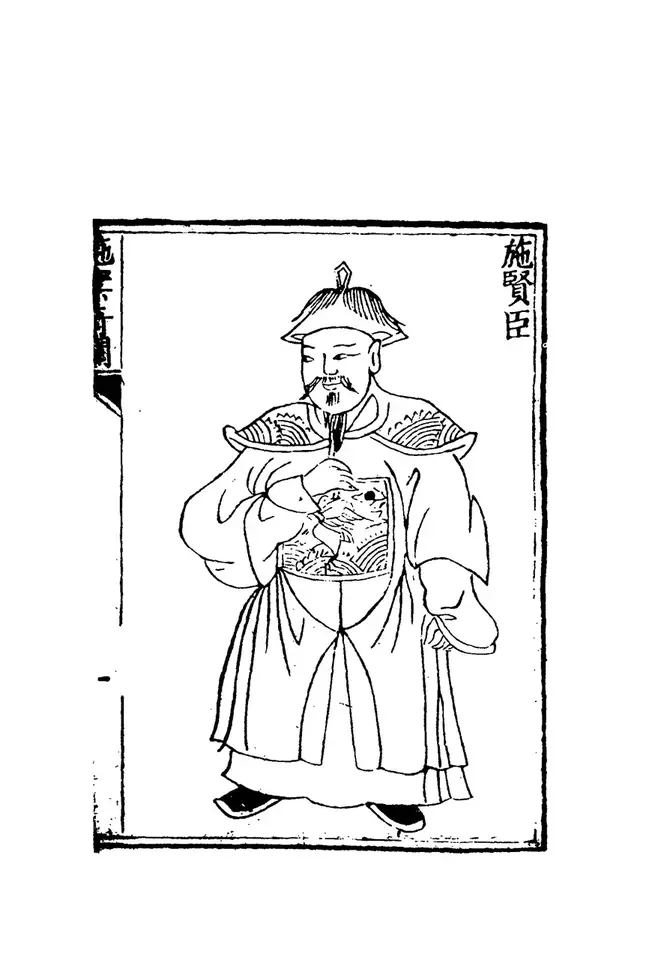
施世纶
Shi Shilun (施世纶, 1659 – July 3, 1722), courtesy name Wenxian (文贤), art name Xunjiang (浔江), was a native of Jinjiang, Fujian Province, enrolled in the Bordered Yellow Banner of the Han Military Banners. He was the second son of Marquis Shi Lang, the conqueror of Taiwan. After accompanying his father in naval campaigns during the annexation of Taiwan, Shi was appointed Magistrate of Taizhou in 1685 through hereditary privilege.…
Shi Shilun (施世纶, 1659 – July 3, 1722), courtesy name Wenxian (文贤), art name Xunjiang (浔江), was a native of Jinjiang, Fujian Province, enrolled in the Bordered Yellow Banner of the Han Military Banners. He was the second son of Marquis Shi Lang, the conqueror of Taiwan. After accompanying his father in naval campaigns during the annexation of Taiwan, Shi was appointed Magistrate of Taizhou in 1685 through hereditary privilege. Renowned for incorruptibility, fearless judicial fairness, and protection of the peasantry, he was promoted successively to Prefect of Yangzhou, Prefect of Jiangning, and Prefect of Suzhou. The Kangxi Emperor repeatedly commended his administrative rectitude, honoring him with the celebrated title "Foremost Clean Official of Jiangnan." Shi subsequently served in high metropolitan offices including Governor of Shuntian Prefecture, Senior Vice Censor-in-Chief, and Vice Minister of Revenue. In 1715, he was appointed Director-General of Grain Transport, headquartered at Huai'an. In this role, he systematically eradicated longstanding corruption throughout the Grand Canal grain logistics system, outlawed illegal fee extraction by lock officials, standardized measuring vessels, and personally supervised flood defense along the Yellow and Huai rivers to guarantee grain shipments to Beijing. He passed away in office in 1722 at sixty-four. His widespread folk reputation as a brilliant judge inspired the famous late Qing judicial detective novel The Cases of Judge Shi (Shi Gong An).
Born into a prominent military family in Jinjiang, Fujian; studied classics, jurisprudence, and martial arts.
Accompanied his father Shi Lang on the naval conquest of Penghu and Taiwan, composing victory poetry after the victory.
Appointed Magistrate of Taizhou through hereditary privilege, abolishing predatory levies and resolving backlogged court cases.
Promoted to Prefect of Yangzhou after Taizhou citizens blocked roads to petition for his retention; commended by the Kangxi Emperor.
Transferred to Jiangning and later Suzhou; suppressed municipal extortion by powerful families and protected commoners.
Promoted to Governor of Shuntian Prefecture; enforced strict laws across the capital region and curbed banner abuses.
Appointed Senior Vice Censor-in-Chief; submitted memorials fearlessly criticizing imperial bureaucratic inertia.
Named Vice Minister of Revenue, auditing state treasuries and preventing fraudulent tax deductions.
Commissioned Director-General of Grain Transport, reforming the logistics network across eight provinces.
Personally directed river reinforcement along Lake Hongze and the Huai River, securing unhindered barge transit.
Died in office on July 3 at the age of sixty-four; mourned deeply by citizens throughout the canal corridor.
Shi Shilun was born in 1659 in Yakou Village, Jinjiang County, Quanzhou Prefecture, Fujian Province. His father, Shi Lang, was the foremost naval commander in southeastern China, later created Marquis of Jinghai for leading the expedition that integrated Taiwan into the Qing Empire. Raised amidst coastal battles and naval maneuvers, Shi Shilun demonstrated early academic diligence, mastering classical jurisprudence, history, and poetry alongside archery and tactical leadership.
In 1682, when the Kangxi Emperor ordered Shi Lang to lead the naval campaign against the Kingdom of Tungning, the twenty-four-year-old Shi Shilun joined his father's flagship headquarters. During the decisive naval battle of Penghu, he participated in operational logistics under heavy artillery fire. Following the surrender of Zheng Keshuang, Shi Shilun composed classical poems such as Expedition to Penghu, expressing patriotic pride in the pacification of the maritime frontier and the reunification of the realm.
Following the pacification of Taiwan, Shi Shilun received civil magistrate status under hereditary privilege. In 1685, he was commissioned Magistrate of Taizhou in Jiangsu. Upon arriving, he pledged never to accept a coin of bribery, never to bow to noble influence, and to govern with utter impartiality. Confronting entrenched corruption where local runners extorted peasants through unauthorized taxes, Shi abolished all unofficial surcharges, heard court petitions in person, and cleared convoluted legal backlogs with exceptional perspicacity.
In 1689, during the imperial administrative triennial evaluation, Shi's exemplary record earned him an appointment to an exterior prefecture. When word spread, thousands of Taizhou citizens prostrated themselves along the roads to beg for his retention. Coinciding with the Kangxi Emperor's second southern inspection tour at Yangzhou, the emperor learned of Shi's immense popularity and issued a special decree promoting him directly to Prefect of Yangzhou.
In Yangzhou, a bustling trading hub dominated by wealthy salt merchants and arrogant banner aristocrats, Shi enforced the law without fear. When noble retinues assaulted commoners, Shi arrested and punished the culprits according to statutory law without hesitation. During his 1699 southern tour, the Kangxi Emperor granted Shi a personal audience, proclaiming to the court that his incorruptibility placed him first among all imperial officials, designating him "The Foremost Clean Official of Jiangnan." Shi went on to serve as Prefect of Jiangning and Suzhou, earning the enduring public honorific "Shi Qingtian" (Clear Sky Shi).
In 1701, in recognition of his judicial achievements, Shi was summoned to Beijing to take office as Governor of Shuntian Prefecture (Shuntian Fuyin). Administering the capital district was notoriously hazardous due to the prevalence of imperial clansmen and corrupt retainers. Shi established rigorous enforcement standards, cracking down on municipal bullies and fraudulent litigators. Whenever banner households illegally seized civilian lands or stores, Shi investigated the deeds and enforced restitution.
In 1704, Shi was elevated to Senior Vice Censor-in-Chief in the Censorate. From this judicial station, he submitted incisive memorials exposing bureaucratic waste and treasury deficits. In 1710, he transferred to Vice Minister of Revenue, overseeing tax revenue remittances and strictly prohibiting clerks from demanding customary kickbacks from provincial treasury escorts.
In 1715, as chronic delays and embezzlements crippled imperial grain logistics along the Grand Canal, the Kangxi Emperor appointed Shi Shilun Director-General of Grain Transport (Caoyun Zongdu), concurrently holding the rank of Vice Minister of War and Vice Censor-in-Chief, headquartered at Huai'an. The canal network was the imperial artery supplying Beijing with four million dan of grain annually from eight provinces. Transport crews had long suffered from extortion by lockmasters and robbery by local bandits.
Shi conducted undercover inspections along canal ports and docks to uncover systemic malpractice. To prevent grain theft and dilution with river mud, he mandated standardized, cast-iron measuring vessels on every barge, sealing grain holds with stamped official labels verified upon delivery at Tongzhou. He strictly banned lock officials from demanding bribes under the guise of "water fees," ordering the immediate dismissal of corrupt supervisors. Furthermore, he prohibited commercial freight on grain barges to accelerate travel speed.
In 1720, continuous downpours inundated the Huai and Yellow river junctions, swelling Lake Hongze to dangerous flood stages and trapping thousands of grain barges south of Huai'an. Disregarding his advanced age and failing health, Shi traveled by small boat across high-risk embankments at Gaoyan and Qingkou, directing crews day and night to reinforce dikes and dredge silt bars. Through his hands-on leadership, the grain fleets crossed the flooded Yellow River safely and delivered several million dan of grain to the capital on schedule.
On July 3, 1722, Shi passed away from exhaustion in his official residence at Huai'an at the age of sixty-four. His personal estate contained only a few cases of books and plain cotton robes. Citizens across Huai'an and Yangzhou wept openly in the streets, mourning the passing of an immortal model of public virtue.
Throughout his magistracies in Taizhou, Yangzhou, and Jiangning, Shi resolved thousands of legal disputes with investigative rigor and moral courage. In imperial China, commoners faced overwhelming disadvantages when confronting aristocratic adversaries who routinely fabricated false evidence. Shi personally examined physical evidence, interrogated witnesses in open court, and prevented court clerks from altering trial transcripts.
In Taizhou, when local despots colluded with clerks to dispossess a widow of her patrimony through forged deeds, Shi cross-examined the witnesses, uncovered the documentary fraud, and returned the property while imprisoning the conspirators. In Yangzhou, when an imperial clansman's drunken servant murdered a civilian and claimed extraterritorial banner immunity, Shi refused political interference, convicted the perpetrator, and ordered his execution according to statutory law. These real-life courtroom triumphs inspired extensive folk songs and oral story cycles celebrating his integrity.
As Director-General of Grain Transport, Shi confronted an entrenched bureaucratic syndicate that had siphoned immense wealth from canal logistics. Prior to his administration, massive quantities of grain were routinely stolen, replaced with sand, or ruined by dampness during prolonged transit. Shi implemented three systemic institutional reforms:
First, he enforced standardized iron grain measures and tamper-evident hold seals, holding convoy commanders personally liable for discrepancies upon arrival in Tongzhou. Second, he abolished unauthorized lockage tolls across canal locks in Jiangsu, Shandong, and Zhili, requiring lockmasters to open gates without delay upon the arrival of grain fleets. Third, he banned private commercial freight on state grain barges, eliminating overloading and ensuring that convoys met tight navigation schedules. These measures stabilized grain supplies to Beijing and eased the brutal burdens borne by canal boatmen.
Despite descending from the noble house of Marquis Shi Lang, Shi Shilun maintained the ascetic simplicity of an austere Confucian scholar. While serving as Prefect of Yangzhou, he wore plain cloth garments and consumed simple grains, maintaining an unpretentious official residence without personal attendants. During imperial inspection tours, when regional officials paraded luxurious carriages, Shi appeared with only a single servant carrying his luggage, earning the deep respect of the Kangxi Emperor.
When promoted to Shuntian Governor, thousands of Yangzhou citizens gathered to present farewell gifts, which Shi steadfastly declined. He posted a public notice stating: "I have served here through your indulgence. If I take a single copper coin upon departing, I shall have betrayed everything I have lived for." His moral purity became legendary in the annals of Qing governance.
FIGURES ASSOCIATED WITH THIS DYNASTY