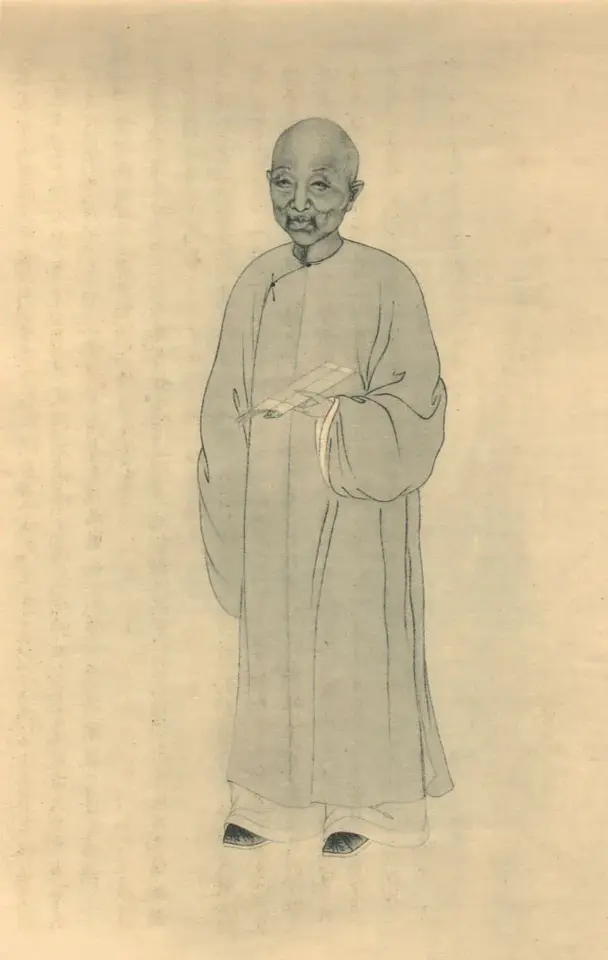
Biography
Ancestral Lineage and Early Diligence
Shi Runzhang was born on January 6, 1619, in Shuangxi, Xuancheng, Ningguo Prefecture, Jiangnan. His family was renowned for generations as a paragon of pristine Neo-Confucian rectitude, celebrated throughout the district as an illustrious household of moral philosophy. His forebears had produced scholars and officials who preserved classical traditions across generations.
In 1626, at the tender age of nine, Shi encountered his first great tragedy when his father Shi Cha passed away. Left an orphan in impoverished circumstances, the young boy's upbringing was undertaken entirely by his paternal uncle, Shi Yu. Shi Yu treated him as his own child, devoting boundless affection and rigorous educational oversight to his development.
Under his uncle's meticulous planning, Shi pursued classical learning with relentless fervor. At thirteen, he became a student of the distinguished scholar Liu Boyang, studying under him for six years. He subsequently traveled to Shuiyang to study with Wang Nianzu and to Jingxian under Zhang Xiancheng, braving freezing winter nights beneath lamplight despite delicate health.
In 1634, at sixteen, Shi married Lady Mei. Though household responsibilities weighed heavily upon him, his determination never wavered. He traveled widely to study under Shen Gengyan and Zhou Luxi. Zhou remarked with astonishment that Shi's classical elegance would surely surpass his contemporaries, establishing Shi's early fame across Jiangnan.
The Dynastic Transition and Metropolitan Laurels
In the final years of the Chongzhen era, rebellions convulsed northern China, culminating in the fall of Beijing and the Qing advance into the Yangtze delta in 1644. Confronted with profound societal rupture, Shi remained in scholarly seclusion, upholding personal moral integrity and sustaining classical scholarship amidst widespread chaos.
In the early Shunzhi years, the Qing regime re-established civil examinations to integrate southern gentry elites. In the spring of 1649, thirty-one-year-old Shi traveled to Beijing, successfully attaining the jinshi degree in the palace examination and receiving an appointment as a probationary secretary in the Ministry of Justice. His uncle Shi Yu wept with joy upon receiving the news.
During his probationary service in the Ministry of Justice, Shi was mentored by senior scholars including Liu Zefang. He mastered administrative statutes and historical penal jurisprudence. Shortly thereafter, exhausted by intense study, he secured medical leave to return to Xuancheng, where he deepened his mastery of Song Neo-Confucian thought and statecraft.
Diplomatic Mission to the Contested Southwest
In the spring of 1651, having recovered his health, Shi returned to the capital to assume formal duties as Secretary in the Ministry of Justice. At that juncture, armed fighting raged across southwestern China, where Southern Ming commanders Li Dingguo and Sun Kewang fielded massive armies against Qing general Kong Youde across Hunan and Guangxi.
The Qing court resolved to dispatch an imperial envoy to Guilin to proclaim imperial amnesty. Yet the journey spanned thousands of treacherous miles across active war zones; metropolitan officials recoiled from the perilous assignment. Recognising Shi's resolute composure and moral integrity, the ministry appointed him as sole imperial envoy.
Shi embarked upon the mission in autumn 1651, sailing west along the Yangtze, crossing Dongting Lake, and ascending the Xiang River. Roadways were infested with brigands, supplies were scarce, and the court imposed a strict one-year deadline. Shi pushed forward through hostile territory, composing moving verses that captured frontline suffering.
In 1652, Shi arrived in Guilin and delivered the imperial edicts to Prince Kong Youde. Soon afterward, Li Dingguo's forces besieged the city. Shi maintained calm in the midst of bombardment, safeguarded the imperial regalia, and successfully navigated through enemy lines back to the north, earning profound imperial appreciation.
Educational Governance and Scholarly Reform in Shandong
In September 1655, Shi was confirmed as Secretary in the Huguang Department of the Ministry of Justice and promoted to Assistant Department Director. In 1656, the Shunzhi Emperor assembled metropolitan officials for a special imperial evaluation. Shi placed first with brilliant classical essays, earning high monarchical commendation.
Emperor Shunzhi immediately elevated him to Assistant Surveillance Commissioner of Shandong serving as Provincial Education Intendant. Arriving in Jinan, Shi observed that examination writing had degenerated into superficial, flowery clichés. He determined to overhaul the academic atmosphere by demanding classical elegance and practical utility.
Throughout his five-year administration, Shi conducted examinations behind locked doors, rejecting all private solicitations from high-ranking Manchu princes and provincial governors. Scholars from across Shandong flocked to his academy; Shi instructed them patiently. His fair assessments elevated hundreds of talented, impoverished scholars to public prominence.
In Jinan, Shi personally financed restorations of the Confucius Temple in Qufu, the Mencius Temple in Zou County, and the Minzi Shrine in Jinan. He also dredged and restored the famous Baotu Spring, revitalizing regional cultural life and establishing a disciplined, uncorrupted scholastic standard throughout Shandong.
Administration in Huxi and Acclaim as the Living Buddha
In 1661, following his administrative success in Shandong, Shi was promoted to Assistant Administration Commissioner of Jiangxi, overseeing the Huxi Circuit (covering Linjiang, Yuanzhou, and Ji'an). The region had been devastated by recent warfare; farmland lay abandoned, tax registers were chaotic, and garrison troops harassed the populace.
Assuming his post, Shi disciplined corrupt underlings and curtailed government expenditures. He traveled into rural hamlets, composing documentary poems including Song Exhorting Citizens to Public Zeal and Ballad of Huxi. Confronted with crushing tax arrears on displaced populations, he successfully petitioned the governor for sweeping remissions.
In judicial administration, Shi exhibited profound compassion. Local prisons held hundreds of innocent peasants falsely accused of treason during wartime turmoil. Shi scrutinized case files night and day, exposing fraudulent testimonies and liberating hundreds of prisoners, reuniting broken families.
Whenever violent lineage disputes erupted over boundaries, he climbed hills in person to survey waterways and mediated with ethical persuasion, transforming generational feuds into peaceful concord. Moved to tears by his boundless benevolence, the populace revered him as 'Shi the Living Buddha'.
Judicial Insight and the Trial of the Mandarin Ducks
During his service as Education Intendant in Shandong and Circuit Intendant in Jiangxi, Shi Runzhang adjudicated numerous intricate and contested criminal cases. Among these, the most celebrated in popular lore was his exoneration of an innocent couple in the 'Trial of the Mandarin Ducks.' A young betrothed couple from impoverished households had been delayed in marrying due to destitution; a wealthy local tyrant sought to seize the maiden, bribing corrupt magistrates to falsely charge the youth with robbery and condemn them both to death.
Detecting discrepancies in the case documents, Shi conducted a personal retrial. Dismissing local clerks, he meticulously interrogated witnesses regarding the timeline and physical evidence, exposing the conspiracy. He reprimanded the corrupt bailiffs, summarily dismissed the guilty clerks, liberated the young couple, and donated personal funds to permit them to celebrate their lawful wedding, winning thunderous acclaim across Jiangxi.
Shi insisted upon examining physical crime scenes rather than relying on confessions extracted under torture. While investigating a disputed homicide in the mountains, he trudged through drenching rain over dozens of miles to examine tracks and mud traces personally, capturing the true assailant. His relentless pursuit of judicial equity brought clear, uncorrupted justice to three prefectures.
Elevating Underprivileged Scholars and Inscribing Rhymes
While presiding over civil examinations in Shandong, Shi combined institutional rigor with deep compassion for impoverished scholars. While patrolling examination sheds in Jinan during a freezing winter night, he observed an ill-clad youth shivering in the biting gale. Beside his examination paper, the desperate student had drafted a melancholy lyric expressing grief over poverty and uncertain destiny.
Shi read the sorrowful verses silently. Rather than penalizing the student for unofficial writing, Shi lifted his brush and inscribed a compassionate rhyming stanza beside the text, encouraging the youth to preserve lofty aspirations through adversity. When results were posted, the young scholar had passed. Learning of the examiner's secret midnight encouragement, the youth prostrated himself in gratitude, vowing lifelong dedication to uncorrupted learning.
Throughout his five years in Shandong, Shi frequently used his personal salary to fund academies and provide travel stipends for impoverished scholars journeying to the capital. He urged scholars to prioritize self-cultivation over seeking patronage from the powerful, transforming the regional academic climate into one of profound integrity.
Unbending Courage and Defiance of Aristocratic Influence
Though inherently gentle and courteous in personal demeanor, Shi exhibited unshakeable courage when defending statutory justice. During his tenure as Shandong Education Intendant shortly after the dynastic conquest, Manchu banner commanders and provincial governors frequently attempted to exert influence, dispatching confidential letters demanding examination degrees for favored merchants or relatives.
Confronted with these imperious solicitations, Shi sealed and returned the missives, rebuffing powerful patrons to their faces. When a haughty governor threatened him with adverse personnel evaluations, Shi replied with serene resolve: 'The court institutes academic intendants to uncover authentic virtue, not to traffic in private favors. My head may fall, but the scholarly standards of the realm shall never be degraded!' Stunned by his fortitude, the magnates retreated.
In Jiangxi, when imperial garrison soldiers exploited their military status to extort commercial boatmen under the guise of hunting rebels, Shi held court immediately, ordering the guilty troopers exposed in the cangue and sending stern reprimands to their commanding generals. Confronted by his unyielding legal justice, garrison troops ceased their depredations.
Refusing to Publish Spurious Sayings and Pure Practice
Deeply versed in Song and Ming philosophy, Shi despised the late Ming practice wherein thinkers abandoned practical governance to lecture on abstract metaphysical doctrines. Contemporary scholars routinely compiled volumes of their own conversational jottings (yulu) to cultivate superficial celebrity. When disciples assembled Shi's lectures and petitioned to publish them, Shi reacted with stern indignation.
He reprimanded his followers: 'The teaching of the sages resides in diligent moral practice, not in loquacious vanity. Ancient worthies established their moral way through concrete deeds, never through empty discourse. My only anxiety is that my actions fall short of my principles; how dare I publish recorded sayings to deceive the world!' He consigned the transcripts to the flames, directing his students to focus on practical statecraft.
In his daily life, Shi practiced rigorous self-examination. In his official lodgings, his desk held only classics, local gazetteers, and administrative ledgers, devoid of luxury. His bedding was fashioned from simple homespun cotton, washed until pale yet never discarded. This unity of knowledge and action commanded reverent awe across scholarly circles.
Retirement in Xuancheng and the Xuancheng Poetic Circle
In 1667, when the Qing court abolished circuit intendancies to consolidate provincial administration, Shi stepped down from office. When news of his departure spread, thousands of citizens lined the streets weeping, escorting his carriage across hundreds of miles to the Yangtze shores.
To preserve his virtuous memory, local citizens funded the construction of the Longgang Academy and renamed the river beside his government seat the 'Lord Shi River.' Shi sailed home to Shuangxi in Xuancheng, adopting the art names Kuiluo Jushi and Huozhai, commencing twelve years of secluded scholarly retirement.
During this period, Shi focused upon literary writing and classical philosophy. He formed an intimate literary brotherhood with local landscape painter Mei Qing, poet Mei Geng, mathematical astronomer Mei Wending, and scholar Shen Mi, holding regular poetic assemblies around Mount Jingting and founding the renowned Xuancheng Poetic School.
Shi's renown spread across the empire. Northern poetic leader Song Wan sent verses establishing a lifelong alliance, while Wang Shizhen revered Shi as a supreme master. When philosopher Huang Zongxi journeyed through Jiangnan, he visited Shi's thatched cottage, engaging in deep dialogues on Song and Ming philosophies.
The Erudite Literatus Examination and Directing Ming History
In 1678, with the pacification of the Sanfan Rebellion underway, the Kangxi Emperor convened the prestigious Erudite Literatus Examination (Boxue Hongci) to recruit preeminent scholars into imperial service. Leading ministers unanimously recommended Shi as the foremost literary figure of the era.
In March 1679, sixty-year-old Shi attended the court evaluation in the Hall of Preserving Harmony. His profound dissertations impressed Emperor Kangxi, who ranked him among the top laureates and appointed him Hanlin Lecturer. He was assigned to the Ming History Institute alongside Xu Qianxue and Ye Fang'ai to direct the compilation of the standard History of Ming.
Shi undertook monumental historiographical responsibilities, directing the biographies of literary figures, Confucian scholars, and late Ming loyalists. Adhering to strict empirical neutrality, he gathered private archives, gazetteers, and local epigraphy, establishing rigorous standards of factual verification that defined the standard history.
In 1681, Shi served as Associate Chief Examiner for provincial and metropolitan examinations, selecting leading talents. In 1683, he was promoted to Hanlin Reader. Exhausted by ceaseless editorial labors, he passed away in Beijing on October 20, 1683, at age sixty-five, mourned by scholars throughout the empire.
Major Achievements
Educational Rectification and the Mentorship of Pu Songling
Shi Runzhang's educational administration in Shandong established an enduring standard of equity and integrity in local governance. Recognising that talent formed the bedrock of the realm, he categorically rejected all private entreaties from Manchu nobles and provincial governors, banishing corruption from the civil examination system.
In administering licensing examinations, Shi bypassed traditional gentry lineages to seek out underprivileged talent. In 1658, nineteen-year-old Pu Songling of Zichuan sat for the examinations as an impoverished student without influential patrons. Scrutinizing Pu's essays, Shi was captivated by the youth's brilliant originality.
Shi personally inscribed high commendations upon Pu's paper, remarking that his talent surged like wind across water, achieving effortless literary grace. He ranked Pu first across county, prefecture, and provincial tests. While Pu faced subsequent examination failures, Shi's recognition remained the emotional cornerstone of his creative career.
Beyond Pu Songling, Shi promoted hundreds of impoverished scholars across Shandong, many of whom became distinguished officials and historians during the Kangxi and Qianlong reigns. His institutional curricula transformed the intellectual climate of Shandong into one of rigorous classical research.
Poetic Leadership and the Alliance of South Shi and North Song
Shi composed over four thousand poems, anthologized in fifty volumes of Xueyutang Shiji and his critical treatise Huozhai Shihua. Anchoring his aesthetic doctrines upon classical Confucian principles, he asserted that poetry must embody moral gravity and genuine human empathy.
In Huozhai Shihua, Shi insisted that authentic poetry required foundational learning and concrete substance, opposing abstract philosophical disquisitions, superficial imitation of the High Tang, and the eccentric trivia of late Ming schools. He sought pure harmony, classical dignity, and natural cadence.
Wang Shizhen praised Shi's verse in Chibei Outan for its gentle reserve, profound resonance, and ancient poetic spirit, joining Northern master Song Wan with Shi as 'Shi of the South and Song of the North.' Later critics also grouped him with Wang Shizhen as 'Shi and Wang,' establishing him as the foremost poetic mentor of the early Qing.
His mature five-character regulated verse, modeled upon Wang Wei and Meng Haoran, achieved serene, ethereal perfection. The Xuancheng Poetic School he established around Mount Jingting guided early Qing literature away from the ruins of late Ming artificiality into noble, grounded clarity.
Reconciling Han and Song Scholarship and the Yushan School
Endowed with deep ancestral learning in Cheng-Zhu philosophy, Shi maintained an exceptionally broad intellectual vision. Following the Ming collapse, contemporary scholars reflexively blamed Wang Yangming's School of Mind for national destruction, inflaming fierce factional divisions. Shi, however, offered a reconciliatory synthesis.
In his philosophical essays, Shi argued that Cheng-Zhu Neo-Confucianism and the Lu-Wang School of Mind shared identical moral foundations, differing merely in pedagogical emphasis. He contended that late Ming decay was caused by irresponsible disciples rather than by Yangming's core doctrine of intuitive moral knowledge.
Founding the Yushan School in Xuancheng, Shi fused moral introspection with empirical philology and evidential research, rejecting empty speculative talk in favor of practical statecraft. He instructed students to master institutional geography, water conservancy, and taxation, transforming philosophy into an instrument of public service.
Complementary Gazetteer Historiography and Ming History Contributions
Shi was both a literary giant and an innovative historiographical theorist. Through decades of local governance, he recognized the unique documentary value of regional gazetteers, personally directing the compilation of official gazetteers for Yuanzhou, Linjiang, and Anfu, as well as revising the gazetteer of Mount Lu.
In his analytical prefaces, Shi formulated the seminal historiographical thesis that local gazetteers and national standard histories are complementary aspects of a single record. He showed that local records preserve vital data concerning agrarian productivity, taxation, and regional biographies that standard dynastic histories omit.
He established rigorous methodology for gazetteer research, emphasizing concise compilation, geographically verifiable data, and reliable local testimonies. Within the Ming History Institute, he applied these local evidential methods to imperial standard biographies, making enduring contributions to Chinese historical science.
Exemplary Incorruptibility and Popular Heritage
Shi's career spanned the Shunzhi and Kangxi eras across judicial, educational, and administrative offices, during which he maintained simple cotton robes and absolute personal incorruptibility. In judicial matters, he overturned hundreds of wrongful convictions, relying on evidence rather than torture.
In Jiangxi, confronted by post-war devastation, he repeatedly petitioned the throne for sweeping tax remissions on behalf of the common people, refusing to levy illicit surcharges even when living in personal austerity. Corrupt magnates feared his unyielding uprightness, while commoners venerated him as Shi the Living Buddha.
When he left office, he possessed only a few book cases and worn bedding, leaving behind an untarnished legacy. Communities founded the Longgang Academy and renamed waterways in his honour. His synthesis of administrative integrity, intellectual brilliance, and deep compassion has commanded admiration for centuries.
Dredging Scenic Waterways and Cultural Heritage Preservation
Shi maintained an acute sense of historical stewardship, devoting substantial energy to the restoration of ancient cultural monuments. In Shandong, he surveyed Jinan and discovered that the celebrated Baotu Spring had become choked with centuries of silt, its historical pavilions collapsed and littered with debris.
Shi allocated his personal integrity allowance and mobilized local gentry to undertake comprehensive dredging. After months of excavation, accumulated debris was removed, stone parapets were erected, and ancient viewing pavilions were rebuilt, restoring the majestic sight of three torrents leaping into the air. Shi composed commemorated verses that remain celebrated to this day.
Furthermore, Shi directed the restoration of the Confucius Forest in Qufu, the Mencius Forest in Zou County, and the Minzi Shrine in Jinan. Throughout these restorations, he insisted upon strict fidelity to ancient architectural records, forbidding modern modifications and preserving invaluable pre-Qin Confucian cultural monuments.
Master of Unadorned Classical Prose and Archival Precision
Beyond his poetic preeminence, Shi stood as an acknowledged master of classical prose, anthologized in twenty-eight volumes of Xueyutang Wenji. Early Qing prose master Wei Xi acclaimed his writing for its serene spirit and unadorned purity, comparing his lucidity to Ouyang Xiu and Su Shi.
Shi's prose corpus encompasses over five hundred treatises, administrative memorials, gazetteer prefaces, epitaphs, and travel journals. In philosophical dissertations, his reasoning was incisive and free of pedantic straining; in statecraft memorials, he addressed urgent administrative reforms with concise precision.
His biographical epitaphs demonstrated consummate historiographical artistry. Shi adhered strictly to truthful recording, celebrating courageous officials, filial sons, and impoverished scholars with understated dignity, pioneering an unembellished prose style dedicated to authentic moral transmission.
Theoretical Architecture of Huozhai Shihua and Poetic Prosody
Shi's critical monograph Huozhai Shihua represents a landmark in early Qing literary theory. Synthesizing decades of creative experience, the work analyzed the historical evolution of Chinese verse, providing a clear path out of the sterile archaism that had crippled late Ming literature.
Shi articulated a comprehensive aesthetic framework: poetry must possess foundational learning, authentic emotion, comprehensive vitality, and harmonious musicality. He emphasized that genuine poetry was an organic overflow of human nature, requiring experiential grounding rather than artificial contrivance, advocating a broad aesthetic appreciation across Han, Wei, Tang, and Song models.
Regarding prosody and tonal phonology, Shi applied deep musical knowledge to resolve long-standing disputes concerning tonal alternations in ancient verse and regulated forms. He opposed sacrificing expressive meaning for rigid prosody, championing structural rigor infused with natural musicality. Huozhai Shihua became an indispensable textbook for generations of poets.
Historiographical Innovation in Compiling the History of Ming
During his tenure in the Ming History Institute, Shi introduced major methodological innovations into the compilation of imperial biographies. Confronted by contradictory private memoirs and fragmented Ming records, he pioneered a rigorous method of mutual corroboration, checking official palace archives against local gazetteers and epigraphic rubbings.
In chronicling the officials who perished during the dynastic catastrophe of 1644, Shi recorded their heroic sacrifices with unvarnished historical honesty, neither concealing flaws nor obscuring loyalty. In his compilation of the literary biographies, he broke past conventional bureaucratic prejudices to include unranked, impoverished scholars of monumental talent.
Director-General Xu Qianxue frequently consulted Shi on complex historical cruces. Shi cited archival precedents from memory with flawless accuracy, hailed by fellow academicians as a living archive of the Ming dynasty. His uncompromising empirical standard helped establish the History of Ming as a preeminent masterpiece among the standard histories.