Born in Xiangcheng
Born into an illustrious gentry-scholar family in Xiangcheng; named Zhou, courtesy name Qi'nan, reflecting ancestral virtue.
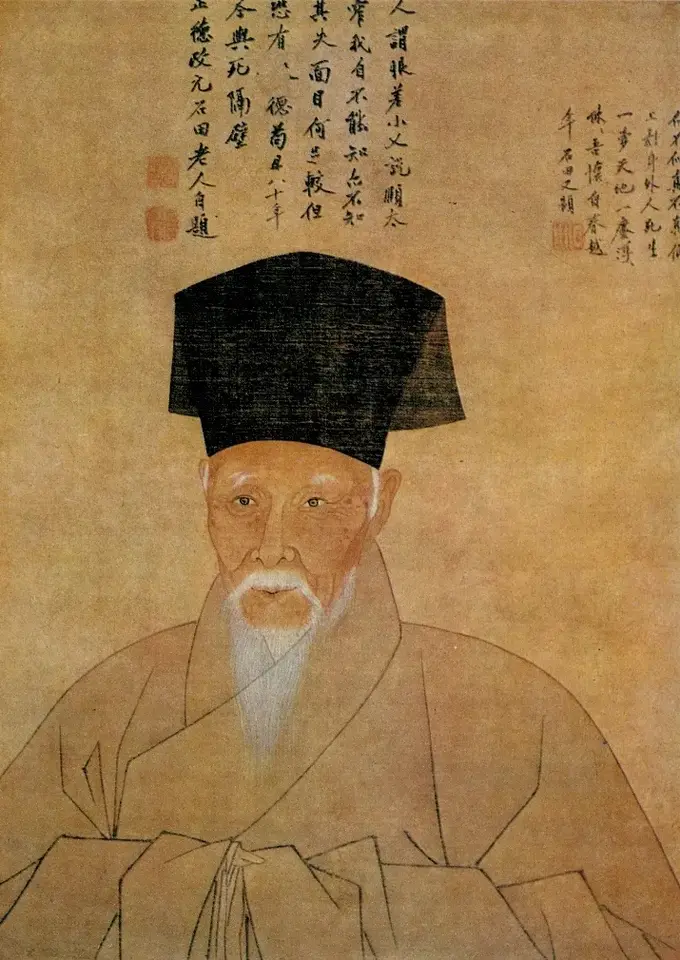
沈周
Shen Zhou (沈周, 1427–1509), courtesy name Qi'nan, literary name Shitian, in his later years Baishi Weng, respectfully called Master Baishi by contemporaries, a native of Changzhou, Suzhou (modern Xiangcheng, Suzhou, Jiangsu), was a celebrated painter, calligrapher, essayist, and poet of the middle Ming dynasty, the founding patriarch and spiritual leader of the Wu School of Painting, and foremost among the "Four Masters of…
Shen Zhou (沈周, 1427–1509), courtesy name Qi'nan, literary name Shitian, in his later years Baishi Weng, respectfully called Master Baishi by contemporaries, a native of Changzhou, Suzhou (modern Xiangcheng, Suzhou, Jiangsu), was a celebrated painter, calligrapher, essayist, and poet of the middle Ming dynasty, the founding patriarch and spiritual leader of the Wu School of Painting, and foremost among the "Four Masters of Ming" (Shen Zhou, Wen Zhengming, Tang Yin, and Qiu Ying). Shen Zhou emerged from an illustrious family of scholar-recluses in Xiangcheng; his uncle Shen Zhen and father Shen Heng were erudite literati accomplished in poetry, painting, and calligraphy. Possessing precocious intellect, Shen Zhou studied classics and literature under renowned scholar Chen Kuan from youth, producing extraordinary essays. In 1441, he traveled to Nanjing on behalf of his ailing father, composing the monumental Song of the Phoenix Terrace (Fenghuang Tai Ge) before Ministry of Revenue officials, who marveled at his genius and exempted his father from arduous tax-collector duties. In 1454, when Suzhou Prefect Wang Hu recommended him for official recruitment as "Worthy and Upright," Shen Zhou consulted the Book of Changes and drew Hexagram Dun (Retreat); taking this as a cosmic sign, he declined office, resolving to remain an independent commoner recluse to care for his aging mother and cultivate poetry, painting, calligraphy, and the zither. Artistically, Shen Zhou grounded himself in the Southern School landscape lineage of Dong Yuan and Juran, thoroughly assimilating the Four Great Masters of the Yuan (Huang Gongwang, Wang Meng, Ni Zan, and Wu Zhen) while synthesizing Tang and Song classical techniques into an expansive, moist, and tranquil style. His career divided into the "Fine Shen" and "Coarse Shen" periods: prior to forty, he favored meticulous, dense compositions, while after sixty he adopted bold, sweeping calligraphic brushwork influenced by Wu Zhen and Song masters, creating monumental yet relaxed landscapes with moist ink and expressive dotting. Concurrently, he revolutionized ink-wash bird-and-flower painting, capturing everyday vegetables, fruits, fowl, and insects with vivid, life-affirming spontaneity. In calligraphy, he mastered the vigorous, angular style of Huang Tingjian; his poetry was collected in Shitian Ji. Universally beloved for his benevolence, he treated high officials and common peddlers with equal kindness, readily painting for the poor and even inscribing authentic poems onto fraudulent copies of his work to help destitute forgers pay debts. He presided over the Suzhou cultural circle for decades, mentoring Wen Zhengming and Tang Yin. Passing away in 1509 at age eighty-three, he remains celebrated as the supreme embodiment of moral virtue and literati art in Ming history.
Born into an illustrious gentry-scholar family in Xiangcheng; named Zhou, courtesy name Qi'nan, reflecting ancestral virtue.
Began studies at age seven under Wu scholar Chen Kuan, mastering classical literature and soon outstripping his tutor.
Traveled to Nanjing on behalf of his father; composed the brilliant Song of the Phoenix Terrace, winning tax exemption.
Trained under his uncle Shen Zhen and father Shen Heng, copying Song and Yuan masterworks in the family collection.
Prefect Wang Hu recommended him for office; Shen Zhou divined Hexagram Dun (Retreat) and resolved to remain a lifelong commoner.
Painted the monumental hanging scroll Lofty Mount Lu for Chen Kuan's seventieth birthday, marking the maturity of his "Fine Shen" style.
After sixty, evolved into his signature "Coarse Shen" style, employing bold, expansive brushwork and rich wet ink.
Mentored young Wen Zhengming and nurtured Tang Yin, gathering the cultural elite of southeastern China.
Painted Night Sitting with a philosophical colophon, reflecting on self-cultivation and enlightenment.
Passed away at his Xizhuang estate in Changzhou at age eighty-three, mourned by scholars across the empire.
Shen Zhou was born on December 9, 1427, in Xiangchengli, Changzhou County, Suzhou Prefecture (modern Xiangcheng District, Suzhou). The Shen clan was one of the most prominent families in Wu. His great-grandfather Shen Liangchen was an affluent scholar who amassed vast collections of paintings and books, maintaining close ties with Yuan master Wang Meng; his grandfather Shen Cheng was an erudite recluse gifted in poetry; his uncle Shen Zhen and father Shen Heng were celebrated literati painters who built the "Bamboo Retreat" (Zhuju), hosting renowned poets and artists like Du Qiong and Liu Jue. When Shen Zhou was born, his elders named him Zhou, courtesy name Qi'nan, derived from the Odes of Zhou and the South in the Classic of Poetry, symbolizing moral cultivation and cultural harmony.
In 1433, seven-year-old Shen Zhou began classical studies under Chen Kuan, son of the late Yuan scholar Chen Ji. Shen Zhou was exceptionally gifted, reading widely across the Confucian canon; within years, his essays and verses displayed such elegance that Chen Kuan openly acknowledged his pupil's superior talent.
In 1441, fifteen-year-old Shen Zhou exhibited extraordinary courage and poetic brilliance. His father served as county grain tax-collector, and corrupt local officials created pretexts to extort him while Shen Heng was ill. Shen Zhou stepped forward, traveling alone to the Ministry of Revenue in Nanjing to present a petition. Faced with sharp interrogation from Director Cui Gong, the youth submitted a long poem in one hundred rhymes. Astounded by its maturity, Cui Gong suspected fraud and demanded an on-the-spot composition on "The Phoenix Terrace." Shen Zhou took up his brush without hesitation, composing the magnificent Song of the Phoenix Terrace. Cui Gong applauded, comparing him to Wang Bo and Li Bai, and immediately granted his petition, exempting his father from the burdensome tax post.
From 1442 onward, Shen Zhou studied painting under his father and uncle. The family collection held authentic masterworks from Song and Yuan painters, and Shen Zhou studied Dong Yuan, Juran, Huang Gongwang, and Wang Meng day and night. Gentle and magnanimous, he disdained official honors, prizing filial piety above all. When his father died in the early Jingtai era, Shen Zhou observed mourning with deep grief. Concluding that his mother was growing old, he vowed never to enter officialdom and to remain by her side.
In 1454, newly appointed Suzhou Prefect Wang Hu, learning of Shen Zhou's learning and moral character, officially recommended him to the throne as "Worthy and Upright," writing personal letters urging him to accept imperial office. Confronted by official pressure, Shen Zhou remained composed. Lighting incense, he consulted the yarrow stalks of the Book of Changes, drawing Hexagram Dun (Retreat), whose fifth line reads: "Admirable retreat; perseverance brings good fortune." Smiling, Shen Zhou remarked: "Heaven decrees that I withdraw in rectitude; my path is chosen!"
Citing the hexagram, Shen Zhou declined Prefect Wang's nomination, resolving to spend his life as a commoner. Over subsequent decades, successive governors attempted to recruit him, but he consistently declined on grounds of caring for his mother. Expanding his Youzhu Ju (Bamboo Dwelling) and Xizhuang retreat in Xiangcheng, he spent his days farming, reading, composing poetry, and painting in idyllic serenity.
Throughout his rural life, Shen Zhou made nature his inexhaustible source of inspiration. Adventurous and spontaneous, he loved exploring scenic spots across Suzhou, often traveling by small skiff with brushes and paper to Tiger Hill, Mount Tianping, Mount Zhixing, Mount Lingyan, and the vast waters of Lake Tai. Wherever he encountered breathtaking landscapes, he painted outdoors and inscribed poems on the spot.
Shen Zhou's magnetic personality attracted the foremost scholars of the realm to Xiangcheng. Wu Kuan, top-ranking zhuangyuan and Minister of Rites, remained his lifelong confidant, exchanging poetry and paintings for decades. Elder artists Du Qiong and Liu Jue served as cherished mentors and friends. Rising talents including Zhu Yunming, Xu Zhenqing, Du Mu, and Yang Xunji gathered at Youzhu Ju to brew tea, debate art, and compose poetry, forming a vibrant literati community that made Suzhou the artistic capital of the Ming empire. During this period, Shen Zhou created masterworks including Night Sitting, Album of the Eastern Villa, and Travels in the Western Hills, synthesizing nature with philosophical contemplation.
Shen Zhou's artistic trajectory divides into two distinct stylistic phases: the "Fine Shen" of his early years and the "Coarse Shen" of his later maturity.
Around age forty, Shen Zhou followed Wang Meng and Huang Gongwang, employing dense, meticulous brushwork and delicate color washes to capture layered mountain textures. The supreme monument of this phase is Lofty Mount Lu (Lushan Gao Tu), executed in 1467 for Chen Kuan's seventieth birthday. Standing nearly two meters high, the hanging scroll depicts the soaring cliffs of Mount Lu as a metaphor for his teacher's towering virtue, utilizing Wang Meng's entangled hemp-fiber strokes with breathtaking precision.
However, around age sixty, Shen Zhou achieved an artistic breakthrough. Incorporating the bold simplicity of Song master Li Tang and Yuan master Wu Zhen, he broke away from intricate layering, pioneering his renowned "Coarse Shen" style. Utilizing sweeping lateral strokes, heavy dark ink, and prominent moss dots, he created expansive compositions that combined monumental strength with effortless spontaneity.
In bird-and-flower painting, he executed another revolution. Reviving the ink-wash tradition of Xu Xi and Muqi, he created spontaneous sketches of common vegetables, fruits, poultry, and fish. His depictions of cabbages, loquats, chicks, and crabs celebrated the humble warmth of rural life, dramatically broadening the subject matter of Chinese literati painting.
In calligraphy, he mastered the expansive, angular style of Northern Song master Huang Tingjian, whose dramatic diagonal strokes complemented his coarse-brush paintings. As a poet, his free-spirited verse was collected in Shitian Ji, uniting poetry, calligraphy, and painting into a harmonious whole.
Shen Zhou enjoyed profound moral veneration not only among elite literati, but also among the common artisans and rural poor of Changzhou, who hailed him as a living bodhisattva and elder statesman of virture. Dedicated to benevolence and aiding the vulnerable throughout his life, Shen Zhou lived with unpretentious grace. When an incoming county magistrate failed to recognize Shen Zhou's name and mistakenly conscripted him into menial yamen corvée, friends urged him to petition high officials for exemption. Shen Zhou merely laughed, observing that serving local governance was the civic duty of any subject without distinction of rank; he reported calmly to the yamen and swept the courtyard without complaint until Governor Zhou Chen discovered him and apologized in shock.
Toward destitute painters who forged his work to survive, Shen Zhou showed boundless compassion. When a poor painter forged Shen Zhou's paintings to buy grain for his ailing mother but could not sell them without authentic colophons, the artisan desperate and weeping visited Shen Zhou's house to confess. Shen Zhou inspected the paintings, praised the brushwork, unhesitatingly inscribed authentic poetry and affixed his seals, and provided extra silver for his mother's care. Whenever community projects arose—building charity granaries, operating free ferries, or repairing roads and bridges—Shen Zhou led donations, dedicating long handscrolls to be sold for public welfare.
Among the Ming literati class, Shen Zhou was revered across the empire as much for his warm humility and generous spirit as for his artistic supremacy. Free of sectarian prejudice, he fulfilled artistic requests from high dignitaries, wandering monks, street vendors, and common laborers alike with authentic warmth.
In his later years, Shen Zhou served as the universally acclaimed patriarch of the Suzhou cultural world. When young Wen Zhengming struggled with repeated civil examination failures, Shen Zhou accepted him as an inner disciple without fee, guiding him toward Song and Yuan orthodoxy and shaping him into an enduring master; the brilliant but volatile Tang Yin likewise studied ink painting under his tutelage. Under Shen Zhou's visionary founding and generous mentoring, the Wu School of Painting flourished, supplanting the rigid court Zhe School and dominating Chinese painting aesthetics for centuries. On September 15, 1509 (Zhengde 4), Shen Zhou passed away peacefully at his Xizhuang residence in Xiangcheng at age eighty-three. Disciples Wen Zhengming and Tang Yin donned mourning attire, and subsequent generations across China celebrated him as the consummate paradigm of unified artistic genius and saintly character.
Shen Zhou stands as the monumental founder of the Wu School of Painting, which redirected the course of Ming art.
In the early Ming, the decorative Zhe School dominated court circles, but gradually degenerated into formulaic mannerisms. Rooting himself in the literati culture of Suzhou, Shen Zhou revitalized the Yuan literati tradition, fusing poetry, calligraphy, and painting into cohesive masterpieces. The Wu School supplanted the Zhe School, establishing the dominant literati aesthetic that guided Chinese painting through the Ming and Qing dynasties.
Shen Zhou's technical innovations expanded the expressive range of Chinese art.
His early "Fine Shen" style took Wang Meng's dense textures to sublime heights, while his late "Coarse Shen" style introduced bold calligraphic strokes and expressive wet ink. In bird-and-flower painting, he bypassed formal academy outlines, pioneering ink-wash depictions of rural flora and fauna that celebrated ordinary life and inspired later masters such as Xu Wei, Bada Shanren, and Qi Baishi.
Shen Zhou's refusal of official office following his divination of Hexagram Dun established him as an enduring exemplar of literati moral independence.
Living in a commercialized era marked by fierce pursuit of rank, he preserved his integrity as a commoner, caring for his mother and pursuing art in harmony with nature. His life offered scholars an inspiring model of spiritual freedom independent of state power.
As an educator and cultural leader, Shen Zhou nurtured the talents that sustained Suzhou's golden age.
Teaching without sectarian bias, he trained Wen Zhengming into the heir of the Wu School and offered steady mentorship to Tang Yin. His generosity created a golden age of arts in Suzhou that flourished for over a century.
FIGURES ASSOCIATED WITH THIS DYNASTY