Birth in Xuancheng
Born into a scholar-gentry lineage in Xuancheng; trained in classical military treatises and equestrian arts.
沈有容
Shen Yurong (沈有容, 1557–1627), courtesy name Shihong, pseudonym Ninghai, was an illustrious military commander, naval strategist, and national hero of the late Ming dynasty. Hailing from a distinguished gentry lineage in Xuancheng, South Zhili, Shen excelled in both classical military texts and mounted weaponry from his youth. In 1579, he passed the Nanjing provincial military examinations in fourth place and enlisted in the…
Shen Yurong (沈有容, 1557–1627), courtesy name Shihong, pseudonym Ninghai, was an illustrious military commander, naval strategist, and national hero of the late Ming dynasty. Hailing from a distinguished gentry lineage in Xuancheng, South Zhili, Shen excelled in both classical military texts and mounted weaponry from his youth. In 1579, he passed the Nanjing provincial military examinations in fourth place and enlisted in the northern frontier garrison of Ji Town, earning early renown and patronage under the legendary strategist Qi Jiguang. He subsequently served in Liaodong as chief firearms instructor, joining Li Chengliang in deep cavalry raids into the steppe to defeat nomadic incursions. From the middle of the Wanli era onward, Shen Yurong transitioned to maritime defense along the southeastern coastline, commanding garrisons at Haitan and Kinmen while pioneering naval tactical doctrines and artillery operations. In the winter of 1602, Shen led twenty-one warships across the tempestuous Taiwan Strait to attack Japanese pirate bases in southern Taiwan, annihilating the raiders and liberating captives; this expedition inspired scholar Chen Di to author the seminal ethnographic treatise Record of the Eastern Barbarians. In 1604, when Dutch East India Company commander Wybrants van Waerwijck seized the Penghu Islands to demand fortified trade, Shen boldly boarded the Dutch flagship alone, presenting sovereign imperial warnings that compelled the Dutch to withdraw peacefully without bloodshed. In 1617, Shen ambushed an invading Japanese fleet in the Dongsha waters, capturing the commander Michitomo. During the Tianqi reign, he was appointed Regional Commander of Denglai under Grand Coordinator Yuan Keli, dominating the Bohai Sea to recapture strategic fortresses on the Liaodong Peninsula and rescuing over one hundred thousand refugees fleeing Later Jin aggression.
Born into a scholar-gentry lineage in Xuancheng; trained in classical military treatises and equestrian arts.
Ranked fourth in the Nanjing provincial military examinations and enlisted in the northern frontier guard.
Led cavalry to rescue his commanding officer at Liujiakou, receiving commendation from Commander-in-Chief Qi Jiguang.
Transferred to Liaodong under Grand Coordinator Gu Yangqian as general instructor of imperial artillery units.
Accompanied Li Chengliang across the steppe to rout thirty thousand nomadic horsemen, earning promotion to Guard Commander.
Participated in the siege of Yehe; charged the southern gate, had three horses shot under him, and fought through severe leg wounds.
Joined the expeditionary staff under Song Yingchang during the Imjin War, later returning home to care for elderly parents.
Recruited by Grand Coordinator Jin Xuezeng to assume command of the forward naval garrison at Haitan.
Spearheaded twenty-one war galleons across the Taiwan Strait, eliminating Japanese pirate bands entrenched in southern Taiwan.
Met Dutch admiral Wybrants van Waerwijck at Penghu in a solitary boat, securing peaceful Dutch evacuation.
Ambushed Japanese invasion vessels off Dongsha, capturing fleet commander Michitomo.
Appointed Assistant Regional Commander of Wenzhou and Chuzhou, fortifying coastal island garrisons.
Promoted to Regional Commander of Denglai under Yuan Keli, constructing a maritime fortress cordon across the Bohai Gulf.
Coordinated amphibious strikes to retake southern Liaodong fortresses and evacuated over one hundred thousand displaced refugees.
Resigned from active military service due to age and illness, returning to his native Xuancheng.
Passed away peacefully at his ancestral estate at the age of seventy-one.
Shen Yurong was born in 1557 in Honglinqiao, Xuancheng County, South Zhili. His family was an eminent regional clan noted for both literary culture and civic service. From childhood, Shen displayed athletic agility and intellectual independence, voraciously studying the classical military writings of Sun Tzu and Wu Qi while mastering horsemanship, archery, and swordsmanship. Uninterested in provincial civil sinecures, he yearned to serve the Ming realm on its threatened frontiers.
In 1579, at the age of twenty-two, Shen competed in the provincial military examinations held in Nanjing. Demonstrating mastery in equestrian archery, heavy artillery theory, and administrative strategy, he placed fourth among hundreds of candidates. Spurning ornamental palace appointments, Shen enlisted on the northern border, entering the headquarters of Ji Town along the Great Wall.
At the time, the legendary strategist Qi Jiguang was serving as Commander-in-Chief of Ji Town, reforming tactical doctrines through the deployment of combined arms, hollow watchtowers, and coordinated musket battalions. Stationed as a squad commander under Qi's direct supervision, Shen meticulously studied field fortification, artillery drill, and tactical logistics, assimilating the rigorous command philosophy that shaped his future career.
In the autumn of 1582, a force of over a thousand nomadic horsemen under Chang'ang pierced the defenses at Liujiakou in Ji Town, trapping the local Ming patrol commander in a rugged valley. Shen volunteered to spearhead the relief mission, leading twenty-nine mounted warriors straight into the swarming enemy lines.
Exploiting his familiarity with the rocky mountain terrain, Shen ordered his archers to envelop the enemy flanks while he personally charged the hostile vanguard with a heavy lance. In the swirling melee, his horse was struck down by three arrows, but Shen continued fighting on foot with a double-edged saber, inflicting heavy casualties and inspiring his men to break the encirclement. Qi Jiguang inspected the battlefield, marvelled at Shen's wounds, and publicly awarded him silver ingots and an imperial mount, promoting him to an independent field command.
In 1585, Grand Coordinator of Liaodong Gu Yangqian requested Shen's transfer to the northeastern front to establish modern firearm regiments. Commissioned as Chief Firearms Instructor of Liaodong, Shen inspected artillery fortresses across Liaoyang and Guangning, training infantry battalions in flintlock volleys, counter-recoil artillery, and wagon fortifications.
In early 1586, thirty thousand nomadic horsemen under Ikekhui threatened the city of Liaoyang. Shen joined General Li Chengliang on an arduous winter counter-raid. Advancing over two hundred li through heavy snow and gales, the Ming cavalry surprised the nomadic encampment at Kekemulin. Shen directed rapid firearm volleys into the panicked camp, securing over nine hundred severed heads and capturing thousands of mounts, which earned him elevation to Guard Commander.
In 1588, the Haixi Jurchen Yehe tribe under beile Buzhai and Narimbulu expanded their power, attacking friendly border tribes and defying Ming authority. Liaodong Grand Coordinator Gu Yangqian and General Li Chengliang organized an expedition into northern Kaiyuan to besiege the twin strongholds of Yehe, with Shen serving as an operational vanguard officer.
Arriving before the East Fortress of Yehe, which was perched atop steep cliffs and surrounded by stone walls and dual lines of wooden palisades, Ming forces encountered stubborn resistance under intense rock and arrow bombardments. Shen was assigned to assault the heavily defended southern entrance. Charging toward the palisades under concentrated archery fire, Shen had three warhorses shot down from beneath him in rapid succession. During the close assault, a barbed arrow pierced his right leg, crippling his mobility.
Noticing his gleaming armor, enemy warriors threw iron grappling hooks to drag Shen into the fortress to strip his equipment. At that critical moment, Ningyuan Vice Commander Zu Chengxun charged forward with elite cavalry, severed the grappling ropes, and extracted Shen from danger. Despite severe blood loss, Shen continued directing artillery batteries against the gatehouse until the enemy chieftains submitted, sealing a major victory that further cemented his military prestige.
When Toyotomi Hideyoshi invaded Korea in 1592, the Ming court dispatched an expeditionary army under Vice Minister of War Song Yingchang. Shen was appointed to Song's personal staff, overseeing headquarters security and supply logistics across the Yalu River. However, observing that Song relied on superstitious divination and tolerated factional disputes among officers, Shen prudently tendered his resignation under the pretext of ill health to care for his aging mother in Xuancheng, where he remained for three years.
In 1597, Hideyoshi resumed hostilities while Japanese corsairs raided the southeastern Chinese coast. Grand Coordinator of Fujian Jin Xuezeng initiated extensive naval recruitments to fortify maritime defenses. Learning of Shen's reputation, Jin dispatched an emissary with gifts to invite Shen to Fuzhou. Although initially hesitant after observing disorganized coastal forces, Shen was won over by Jin's earnest dedication and accepted appointment as commander of the forward naval station at Haitan.
Haitan Island guarded the outer approaches to Fujian. Shen immediately cashiered corrupt officers, recruited veteran fishermen, and redesigned patrol ships to incorporate Western-style swivel guns and heavy incendiary arrows. He drilled his squadrons through tempestuous open-water maneuvers, creating an elite maritime force that cleared the sea lanes of piracy.
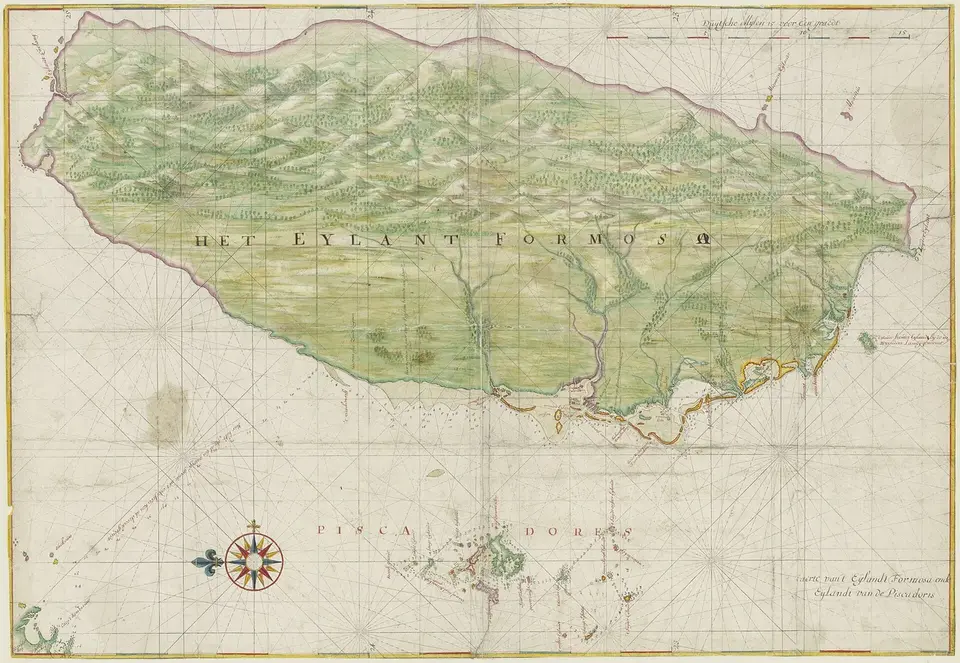
In the winter of 1602, a pirate fleet led by Shen Ce was battered by Ming coastal squadrons and fled southward across the Taiwan Strait, establishing a fortified encampment at Tayouan (modern Anping, Tainan) in southern Taiwan. The pirates pillaged coastal merchant vessels, enslaved local indigenous populations, and extorted protection money from fishing fleets.
Recognizing that regional commanders feared navigating the tempestuous currents of the Black Ditch, Shen volunteered to eliminate the pirate sanctuary. Mobilizing twenty-one ocean-going war galleons, Shen embarked from Kinmen into winter typhoons.
Arriving off the shores of Tayouan, Shen directed his galleons into the shallow pirate anchorage under heavy wind, bombarding their ships and coastal stockades with incendiary artillery. Six pirate vessels were set ablaze and sunk, dozens of corsairs were beheaded, and Shen Ce was slain during hand-to-hand boarding combat. The surviving raiders were annihilated, and Shen secured the liberation of several hundred abducted merchants and indigenous villagers.
Grateful for their deliverance, the indigenous islanders offered livestock and provisions in honor of the Ming fleet. Scholar Chen Di, who had accompanied Shen on the flagship, conducted thorough field investigations of the indigenous society and geography, publishing Record of the Eastern Barbarians, the earliest systematic historical account of Taiwan. Shen's expedition firmly asserted Ming imperial sovereignty across the maritime frontier.
In July 1604, Dutch East India Company commander Wybrants van Waerwijck arrived at the Penghu Islands with two heavily armed iron-plated warships. Seeking to compel the Ming Empire to grant fortified trading posts, the Dutch disembarked at Mazu Palace, commencing construction of stone bastions.
Alarmed by the heavy broadside firepower of the Dutch warships, provincial officials in Fuzhou vacillated between military appeasement and costly mobilization. Shen argued passionately that allowing foreign expansionists to entrench themselves in Penghu would permanently imperil imperial sovereignty. He received authorization to negotiate the crisis as imperial envoy.
On November 18, 1604, Shen sailed to Penghu and boarded the Dutch flagship with a handful of unarmed attendants. Facing armed Dutch musketeers, Shen presented an uncompromising exposition of Ming maritime law and sovereignty, informing Waerwijck that thousands of coastal war junks were prepared to sever their maritime supply routes. Confronted by Shen's fearless composure and the undeniable geopolitical reality of their isolated position, Waerwijck acquiesced and agreed to evacuate the archipelago.
By mid-December 1604, the Dutch dismantled their coastal fortifications and sailed away from Penghu without a single casualty on either side. To commemorate Shen's diplomatic triumph, local islanders erected a stone stele at the Penghu Tianhou Temple bearing the inscription "Shen Yurong Admonishes the Red-Haired Barbarian Wybrants and Others to Withdraw," which remains the oldest extant historic monument in Taiwan.
In 1616, the Nagasaki magistrate Murayama Toan dispatched an invasion fleet of three thousand warriors to seize footholds on Taiwan and raid Fujian. Appointed Vice Regional Commander, Shen anticipated that Japanese flotillas navigating southward would anchor around Dongsha Island near the Matsu Archipelago to await tidal currents.
In April 1617, an advance squadron under commander Michitomo appeared off Dongsha. Shen launched an amphibious ambush with coordinated fire ships, destroying the enemy vessels and capturing Michitomo alive alongside dozens of raiders, completely foiling the Japanese invasion plan.
In 1621, following the fall of Shenyang and Liaoyang to Nurhaci's Later Jin armies, the Ming court appointed Yuan Keli as Grand Coordinator of Denglai to construct an offensive naval front across the Bohai Sea. Yuan vigorously petitioned for Shen's appointment as Regional Commander of Denglai.
Arriving in Shandong, Shen rebuilt the naval yards of Penglai and Lushun, commissioning hundreds of heavy warships and outfitting them with long-range cannon. He coordinated amphibious strikes alongside Mao Wenlong's island garrisons, liberating the vital peninsular strongholds of Jinzhou and Lushun while severing the Later Jin's access to the sea.
During this period, over one hundred thousand civilian refugees fled across southern Liaodong to escape slaughter. Shen transformed his naval squadrons into an emergency humanitarian flotilla, braving winter squalls and enemy cavalry patrols to rescue over one hundred thousand displaced refugees across the Bohai Strait, transporting them safely to Shandong farmlands provided by Yuan Keli.
In 1624, after more than four decades of continuous military service, the sixty-eight-year-old commander petitioned for retirement due to chronic illnesses. His departure from the northern garrison was mourned by thousands of soldiers and rescued civilians who lined the roads to bid farewell.
Returning to Xuancheng, Shen lived out his final years in scholarly seclusion at Honglinqiao. Leading scholars and statesmen across Fujian, Zhejiang, and Shandong assembled an extensive anthology of celebratory writings and historical records documenting his four decades of service, titled Words of Praise from the Fujian Seas. Shen passed away peacefully at his residence in 1627 at the age of seventy-one.
Shen Yurong's naval expedition to pacify Dongfan in the winter of 1602 constitutes a landmark milestone in Chinese maritime defense history. Following the strict maritime trade prohibitions imposed during the early Ming period, imperial administrations had primarily conducted periodic patrols rather than establishing permanent deep-sea garrisons in the Taiwan Strait. By the late sixteenth century, pirate syndicates and Japanese corsairs exploited this gap, utilizing Tayouan in southern Taiwan as a sanctuary for smuggling and pillaging. The corsairs oppressed indigenous inhabitants, plundered Fujian merchant craft, and severely disrupted cross-strait maritime commerce.
Confronting perilous winter storms across the treacherous waters of the Black Ditch, Shen led twenty-one large war galleons into the outer ocean. Executing a coordinated incendiary attack with the wind, Shen's fleet set ablaze and sank six corsair vessels, eliminated the pirate encampments, and personally dispatched the chief pirate Shen Ce. This decisive engagement liberated hundreds of abducted civilians and earned the heartfelt gratitude of local indigenous communities, demonstrating the protective reach of imperial authority.
Scholar Chen Di accompanied the expedition and produced the groundbreaking ethnographic text Record of the Eastern Barbarians, documenting indigenous culture, social organization, and geographic topography. Shen's victory marked the first resolute military expulsion of foreign pirate forces from Taiwan, formally affirming imperial sovereignty and establishing an enduring precedent for subsequent maritime defense and cross-strait governance.
In 1604, Shen Yurong's solitary boarding of the Dutch flagship to secure their peaceful withdrawal from Penghu established an exemplary model of diplomatic deterrence in the face of early European colonial expansion. During the early seventeenth century, the Dutch East India Company aggressively expanded throughout Southeast Asia, seeking fortified footholds along the Chinese coast. Commander Wybrants van Waerwijck seized the Penghu Islands with two heavily armed galleons, constructing stone bastions and demanding exclusive trading privileges.
While provincial civil and military authorities were paralyzed by the formidable firepower of Dutch broadsides, Shen recognized that the Dutch squadron was isolated at the end of extended supply lines and vulnerable to naval blockade. Rejecting appeasement, Shen volunteered to sail alone to Penghu to confront Waerwijck directly aboard the Dutch flagship.
In tense bilateral negotiations, Shen articulated Ming territorial sovereignty over Penghu dating back to the Yuan dynasty, sternly warning that imperial war fleets were prepared to interdict all drinking water and food supplies. Confronted by Shen's unyielding resolve and the reality of their unsustainable tactical position, the Dutch agreed to dismantle their coastal redoubts and evacuate without armed engagement. The commemorative stele erected by islanders at the Penghu Tianhou Temple stands today as China's earliest material monument recording successful resistance against Western maritime encroachment.
The naval ambush at Dongsha in 1617 demonstrated Shen Yurong's mastery of strategic deception and open-water tactics. In 1616, the Nagasaki magistrate Murayama Toan gathered three thousand troops to invade Taiwan and raid the southeastern coast. Facing renewed threats to maritime security, Shen correctly predicted that Japanese squadrons sailing south from Ryukyu would anchor near Dongsha Island off the Min River estuary to await favorable tides.
Shen positioned capital warships of the Fujian fleet within hidden coves and island straits. When the Japanese vanguard under Michitomo sailed into the designated zone, Shen triggered a coordinated ambush, disabling the enemy ships with concentrated cannon fire before leading boarding assaults that captured Michitomo alive and decimated the hostile force. This decisive victory thoroughly crushed the early Tokugawa shogunate's designs on Taiwan and restored stability across the southeastern maritime frontier.
During his tenure as Regional Commander of Denglai in the early Tianqi reign, Shen established a comprehensive maritime defensive cordon across the Bohai Sea, demonstrating his capability as a theater-level naval commander. Partnering with Grand Coordinator Yuan Keli following the catastrophic fall of Shenyang and Liaoyang, Shen built a formidable northern fleet comprising hundreds of heavy warships, projecting power across the Bohai Strait to recapture Jinzhou and Lushun while severing maritime access for Later Jin armies.
Equally significant was Shen's humanitarian achievement in rescuing over one hundred thousand civilian refugees fleeing Jurchen oppression. Shen organized continuous naval convoys that operated through severe winter gales to extract displaced families stranded along the Liaodong coastline, transporting them safely to Shandong where they received land and sustenance under Yuan Keli's administration. This remarkable endeavor preserved human capital and earned Shen the lifelong devotion of northern communities.
Shen Yurong's four decades of border and maritime service inspired extensive literary and strategic reflection among late Ming intellectuals. Scholars and statesmen across southeastern China compiled the multi-volume anthology Words of Praise from the Fujian Seas, collecting hundreds of commemorative poems, official despatches, and biographical accounts celebrating his pacification of Taiwan, expulsion of the Dutch, and humanitarian rescue of refugees. This monumental compendium remains an indispensable source for the study of late Ming naval warfare and maritime policy.
In terms of military doctrine, Shen moved beyond passive coastal defense, championing proactive deep-sea interdiction, combined arms coordination between warships and firearms, and humane treatment of civilian populations. His tactical innovations in warship construction, artillery integration, and strategic leadership exerted a lasting influence on subsequent maritime figures, including Koxinga and Shi Lang, establishing him as an enduring national exemplar of maritime sovereignty.
FIGURES ASSOCIATED WITH THIS DYNASTY