Birth in Wulin
Born into a distinguished family in Renhe, Hangzhou; father Shen Rui was a prominent statesman.
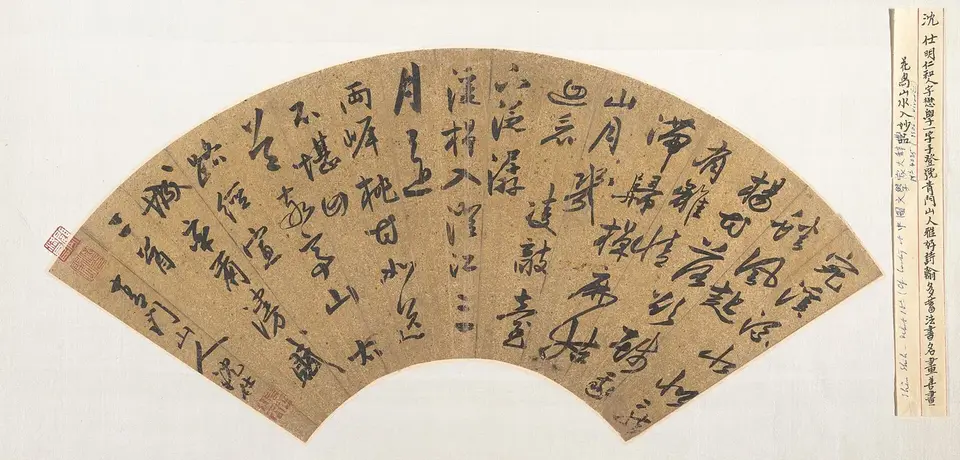
沈仕
Shen Shi (沈仕, 1488–1565), courtesy names Maoxue, Zideng, and Yejun, art names Qingmen Shanren and Donghai Mihuolangxian, was a native of Renhe County, Hangzhou Prefecture, Zhejiang (modern Hangzhou, Zhejiang). He was a distinguished mid-Ming sanqu lyricist, painter, calligrapher, and art connoisseur, celebrated as the founding master of the influential "Qingmen Style" (Qingmen Ti) in classical Chinese sanqu poetry. Born…
Shen Shi (沈仕, 1488–1565), courtesy names Maoxue, Zideng, and Yejun, art names Qingmen Shanren and Donghai Mihuolangxian, was a native of Renhe County, Hangzhou Prefecture, Zhejiang (modern Hangzhou, Zhejiang). He was a distinguished mid-Ming sanqu lyricist, painter, calligrapher, and art connoisseur, celebrated as the founding master of the influential "Qingmen Style" (Qingmen Ti) in classical Chinese sanqu poetry. Born into an eminent official family, his father Shen Rui served as Right Vice Minister of Justice in Nanjing, recognized for judicial integrity during the Hongzhi and Zhengde reigns. In his youth, Shen Shi possessed handsome elegance and agile wit, initially pursuing examination studies before abandoning the rigid civil service trials to live a life of leisure amidst lakes and mountains, amusing himself with poetry, musical lyrics, and painting. Benefiting from extensive family collections of ancient rubbings, paintings, and bronzes, he immersed himself in daily connoisseurship, attaining mastery in landscape and bird-and-flower painting marked by ethereal literati brushwork. In literature, he was celebrated for sanqu lyrics, founding the celebrated "Qingmen Style." Characterized by sumptuous diction, tender lyricism, and intricate musical phrasing, contemporaries likened his verses to those of Late Tang master Wen Tingyun and the Huajian school, providing vital inspiration to late-Ming dramatists like Liang Chenyu. Tang-Song School literary leaders Wang Shenzhong and Mao Kun held his talent and integrity in high esteem. He passed away in 1565 at age seventy-eight. His major collections include the sanqu anthology Tuochuang Rong and poetry collection Qingmen Ji.
Born into a distinguished family in Renhe, Hangzhou; father Shen Rui was a prominent statesman.
Disappointed in early provincial examinations, abandoned bureaucratic ambitions to live by West Lake.
Amassed classical calligraphy and paintings, studying Song and Yuan brush methods and archaic rubbings.
Gained empire-wide fame in sanqu composition, creating the ornate and melodic Qingmen style.
Forged close friendships with literary titans Wang Shenzhong and Mao Kun, exchanging poems and paintings.
Executed ink masterpieces such as Plantain Lilies and Rocks, displaying pristine literati brushwork.
Passed away in Hangzhou at age seventy-eight; essayist Mao Kun composed five elegiac songs in his honor.
Shen Shi was born in 1488 in Renhe County, Hangzhou Prefecture, Zhejiang. The Shen clan was an illustrious lineage of Hangzhou enjoying substantial material prosperity. His father, Shen Rui, served successively as Transmission Office Participant, Left Administration Commissioner, and Right Vice Minister of Justice in Nanjing, widely celebrated for judicial fairness. Growing up in this cultured aristocratic household, Shen Shi received an impeccable education in Confucian classics and poetry from childhood.
In his youth, Shen Shi was handsome, refined, and exceptionally eloquent. While versed in canonical histories, he had an expansive, uninhibited temperament that yearned for creative artistic freedom, regarding civil examination drills as stifling constraints. After participating in early district and provincial examinations, he found the rigid eight-legged essay suffocating. Shen Shi boldly renounced official pursuits, telling relatives: "Why should one labor as a slave to dusty ledgers and bureaucratic fame?" He retreated permanently to the retreats of Hangzhou, finding solace in wine, poetry, music, and painting.
Having turned his back on officialdom, Shen Shi utilized his family's wealth and refined discernment to gather classical calligraphy, Song and Yuan scrolls, and ancient bronzes across Jiangnan. His residence, named "Qingmen," was bright and airy, its walls lined with ancient scrolls. There he burned incense, rolled out masterworks, and meditated upon Wei-Jin calligraphic models and Song-Yuan brush techniques.
Through decades of study and practice, Shen Shi achieved profound mastery in painting and calligraphy. His landscapes drew upon Yuan masters Huang Gongwang and Ni Zan, featuring sparse, untrammeled compositions and moist, archaic ink tones. His monochrome ink-wash flowers and birds were especially dynamic, executed with light spontaneity free from the mechanical stiffness of professional artisan studios, embodying the pure delight of literati ink play. Scholars across Jiangnan sought out his works, which he gave freely to kindred spirits; his surviving masterpiece Plantain Lilies and Rocks is preserved as a classic of mid-Ming monochrome flower painting.
Beyond painting, Shen Shi poured his creative energy into classical poetry and sanqu song lyrics. During the Jiajing reign, driven by the commercial prosperity of Jiangnan market towns and urban entertainment culture, sanqu performance flourished across Jiangsu and Zhejiang. Endowed with acute musical sensitivity, Shen Shi composed numerous lyric suites and independent songs.
Breaking with the rustic directness that characterized earlier Yuan composers, Shen drew upon the ornate sensory elegance of Late Tang poets Li Shangyin and Wen Tingyun, alongside the Five Dynasties Anthology from Among the Flowers (Huajian Ji). Emphasizing lush diction and melodic fluidity, he established the celebrated "Qingmen Style." When his lyric collection Tuochuang Rong was published, it swept through Jiangnan entertainment quarters and literati gatherings, sung by performers and scholars alike.
His literary brilliance won warm acclaim from leading conservative literary figures of the mid-Ming. Wang Shenzhong, an eminent Tang-Song School master from Jinjiang, penned a special preface for him entitled Preface on Seeing Off the Poet Shen Qingmen in Zunyan Ji, extolling him as "a supreme poet of the common world" possessing independent literary character. Prose master Mao Kun formed a close friendship with Shen Shi, boating frequently with him across West Lake in shared poetic reverie.
In 1565, Shen Shi passed away peacefully in his residence by West Lake at the age of seventy-eight. Grief-stricken by his death, his close companion Mao Kun composed Five Elegies for Master Qingmen, mourning the passing of a lyric master.
Shen Shi occupies an independent and foundational position in the development of Ming sanqu poetry as the creator of the celebrated "Qingmen Style."
His sanqu lyrics were characterized by ornate elegance, deep romantic sentiment, and musical melodiousness, synthesizing Wen Tingyun's poetic vocabulary with the delicate meters of Qiao Ji and Zhang Kejiu. He excelled at depicting the nuanced romantic sentiments of lovers and the gentle atmosphere of Jiangnan waterways. His musical compositions established a fresh aesthetic in mid-Ming musical literature, earning him the contemporary moniker "The Wen Tingyun of Sanqu."
Shen Shi's sanqu lyrics and aesthetic theories exerted direct influence upon late-Ming musical drama.
Liang Chenyu, a pioneer of the Kunshan musical reform, was deeply influenced by Shen Shi's Qingmen Style. Liang's celebrated lyrical suite Jiangdong Boshu drew heavily upon the prosodic structures of Shen's Tuochuang Rong; Liang even composed a suite titled Zhuyunfei: Miscellaneous Songs Emulating Shen Qingmen's Tuochuang Rong Style in homage to the master. The romantic elegance championed by Shen provided a literary foundation for the transformation of late-Ming chuanqi plays into refined desk drama.
As a mid-Ming literati artist, Shen Shi's painting transcended the rigid conventions of professional craftsmen, embodying an untrammeled, secluded spirit.
His surviving paper hanging scroll Plantain Lilies and Rocks demonstrates sparse, balanced composition, utilizing dry, charred ink to outline the jagged transparency of Lake Tai garden rocks, while using pale ink washes to capture the soft fragrance of plantain lily petals and leaves. Harmonizing softness with strength, the painting reflects the cultivated taste of Jiangnan literati and remains a treasured museum piece.
Wang Shenzhong recorded in Zunyan Ji (Volume 11, Preface on Seeing Off the Poet Shen Qingmen): "Shen Maoxue is an accomplished poet of the common world. From youth he cast aside mundane dust, immersing his mind in brush and scroll; both his paintings and poetry display an unworldly detachment, unbound by vulgar rules."
Ming essayist Mao Kun mourned in Mao Kun Ji (Volume 9, Five Elegies for Master Qingmen): "The immortal companion of Qingmen grew old amidst mist and vines, his romantic brushstroke poured into grand songs. As the rain of willow catkins falls on closed windows, no visitor caresses West Lake as he did."
Modern sanqu historian Ren Erbei wrote in his colophon to Tuochuang Rong: "Master Shen Qingmen's sanqu possesses charming grace, forming an independent school in Ming poetry; the refinement of his brush and richness of his color represent the finest new melodies of southern music during the Jiajing reign."
FIGURES ASSOCIATED WITH THIS DYNASTY