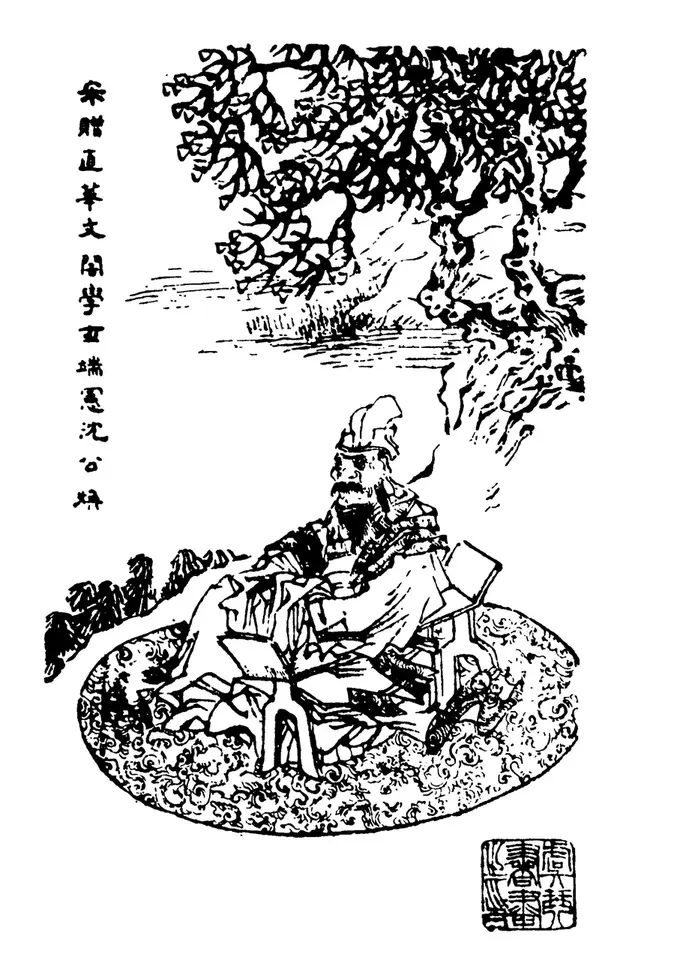
Biography
Classical Upbringing and Mentorship under Lu Jiuling
Shen Huan was born in 1139 in Dinghai County, later moving his family to Yin County in Ningbo. The Shen family was an established gentry house in eastern Zhejiang, and his father instilled strict Confucian disciplines within the home. Displaying exceptional intellect, Shen Huan explored the core tenets of the canonical classics from early adolescence, dedicated to discovering the metaphysical essence of moral self-cultivation.
In the final year of Emperor Gaozong's reign, the twenty-four-year-old Shen Huan traveled to the southern capital at Lin'an to enroll in the Imperial Academy. There he encountered Lu Jiuling, an eminent scholar from Jinxi and elder brother to philosopher Lu Jiuyuan. Revered for combining profound metaphysical insight with practical self-discipline, Lu Jiuling accepted Shen Huan as his foremost disciple. During his residence in Lin'an, Shen Huan also formed lifelong intellectual bonds with local scholars Shu Lin, Yang Jian, and Yuan Xie. Devoted to illuminating orthodox Confucian sagehood and revitalizing moral culture, the quartet formed the core alliance that would be celebrated across Chinese intellectual history as the "Four Masters of Siming."
Magisterial Offices and Pedagogical Integrity
In 1169, Shen Huan passed the imperial civil service examination, attaining his jinshi degree. His initial appointment was Sheriff of Yuyao in Shaoxing Prefecture. Charged with law enforcement, Shen Huan organized village watchmen networks, rigorously suppressed predatory outlaws, and instituted village compacts (xiangyue), fostering social order throughout the coastal district.
He was subsequently promoted to Instructor of Yangzhou. In this war-ravaged frontier metropolis, where scholarly culture had withered, Shen Huan discarded empty memorization of examination rhetoric, instructing students in moral embodiment and practical governance. His success prompted his appointment as Collator in the Imperial Academy in Lin'an. At the national university, Shen Huan upheld unyielding moral integrity, refusing to pander to executive councilors. Resented by sycophantic colleagues who envied his popularity among academy students, Shen Huan was slandered and demoted to Instructor of Gaoyou. Unshaken by misfortune, he embraced simple living, convening daily seminars on the nature of mind and principle that attracted scholars across Jianghuai.
Humane Governance in Wuyuan and Shuzhou
In 1183, Shen Huan assumed office as Magistrate of Wuyuan in Huizhou. Wuyuan was a rugged mountainous district plagued by clan feuds and unequal corvée taxation. Shen Huan traversed remote valleys to survey land registries, equalizing tax burdens and abolishing predatory local surcharges. He renovated the district academy, personally lecturing monthly to encourage moral dispute resolution, leaving Wuyuan without a single pending lawsuit within years.
In 1189, Shen Huan was elevated to Vice Prefect of Shuzhou (modern Anqing, Anhui). Assisting the regional governor in civil administration, he audited military grain depots and restrained wealthy landlords from predatory land enclosures. When severe droughts struck the region, he opened public granaries to distribute relief grain, preserving thousands of peasant families. His benevolent administration won deep admiration throughout the middle Yangtze valley.
Harmonizing the Zhu and Lu Traditions at Dingchuan
Despite heavy administrative burdens, Shen Huan never ceased philosophical inquiry. In his middle years, he established his academy at Dingchuan, inaugurating the Guangping Dingchuan School. He maintained an extensive correspondence with Neo-Confucian luminary Zhu Xi, exchanging tens of thousands of characters in intense debate. While defending the School of the Heart's premise that moral nature is inherently complete within oneself, Shen Huan rejected speculative intuitionism that neglected rigorous textual analysis. Conversely, he challenged Zhu Xi's dualism between mind and principle, arguing that excessive external intellectualization fractured the living spirit of sagehood.
While disciples of the Zhu and Lu factions engaged in vicious partisan attacks, Shen Huan maintained a balanced philosophical stance, advocating that "nurturing the fundamental mind must be integrated with the rigorous investigation of things." His synthetic vision was celebrated across the Southern Song as the supreme philosophical bridge reconciling the competing currents of Neo-Confucian thought.
Passing in Shuzhou and Posthumous Canonization
In 1191, worn down by tireless administrative labor, Shen Huan passed away in his official residence in Shuzhou at the age of fifty-three. Disciples and local populations wept in grief, and his lifelong friend Yuan Xie composed his definitive biographical account (Shen Gong Xingzhuang). Disciples privately honored him with the posthumous title Master Wenxian.
Shen Huan was buried in his ancestral grounds in Dinghai. In 1226, recognizing his monumental contributions to Confucian thought and his unblemished official record, Emperor Lizong issued an edict posthumously granting him the rank of Auxiliary Academician of Huawen Pavilion and the posthumous title Duanxian. His preserved tomb stands today in Zhenhai, Ningbo, revered by generations of scholars.
Major Achievements
Founding the Guangping Dingchuan School
Shen Huan was the founder of the Guangping Dingchuan School, one of the primary pillars of the Siming School alongside Shu Lin, Yang Jian, and Yuan Xie. Shen Huan articulated the doctrine: "Mind contains no external objects; principle is entirely immanent within the self; practice must be grounded, empirical, and daily." His teachings prevented the School of the Heart from degenerating into quietist Chan Buddhist speculation. Famous scholars Quan Zuwang remarked that "Shen's learning was grounded and deep, surpassing even Yang and Yuan." His sons and disciples, including Zhu Danian and Shu Yan, transmitted his pragmatic methodology, laying the cornerstone for the flourishing of Eastern Zhejiang practical scholarship (Zhedong shixue).
Harmonizing the Cheng-Zhu and Lu Schools
Shen Huan's foremost theoretical legacy was his role as the master conciliator between the rationalism of Zhu Xi and the intuitive idealism of Lu Jiuyuan. During decades of written dialogue with Zhu Xi, Shen Huan defended the ontological primacy of intrinsic mind while embracing Zhu Xi's disciplined methods of canonical textual investigation. By dismantling sectarian factionalism, Shen Huan constructed a holistic Neo-Confucian framework that directly anticipated Wang Yangming's later synthesis of intuitive knowledge and practical action.
Exemplary Local Governance and Humanitarian Practice
Embodying the Confucian ideal of inner sageliness and outer kingliness, Shen Huan achieved renown in Yuyao, Yangzhou, the Imperial Academy, Gaoyou, Wuyuan, and Shuzhou. He demonstrated that metaphysical philosophy must directly translate into tax relief, judicial mercy, and educational revival, leaving an enduring model of the scholar-official dedicated to the welfare of the common populace.