Birth in Huating
Born along the Rihe River in Huating County, Songjiang Prefecture; dedicated himself to classical study and brushwork from youth.
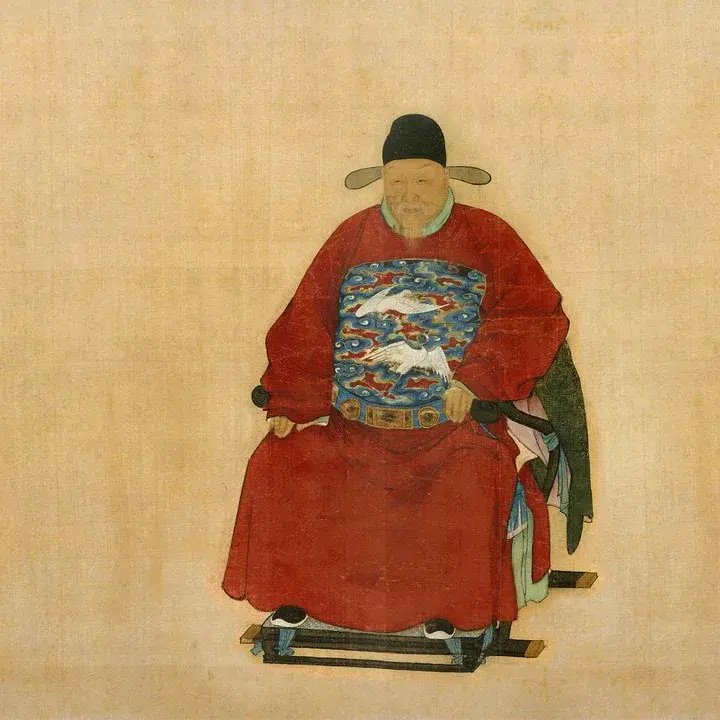
沈度
Shen Du (沈度, 1357 – November 22, 1434), courtesy name Minze, art name Zile and reverently called Master Zile, was a native of Huating County, Songjiang Prefecture (modern Jinshan District, Shanghai). He was an eminent Hanlin scholar-official and calligrapher of the early Ming dynasty, rising to the office of Academician Lecturer of the Hanlin Academy and conferred the rank of Grand Master for Governance. Together with his…
Shen Du (沈度, 1357 – November 22, 1434), courtesy name Minze, art name Zile and reverently called Master Zile, was a native of Huating County, Songjiang Prefecture (modern Jinshan District, Shanghai). He was an eminent Hanlin scholar-official and calligrapher of the early Ming dynasty, rising to the office of Academician Lecturer of the Hanlin Academy and conferred the rank of Grand Master for Governance. Together with his younger brother Shen Can, who also served the inner court with distinction, they were celebrated as the Senior and Junior Academicians or the Two Shens of Yunjian. During the Hongwu reign, Shen was recommended for literary office but did not accept, subsequently suffering exile to Yunnan due to implication in an administrative case, where he served on the staff of Zhu Pian, the Prince of Min. Following the accession of the Yongle Emperor, imperial edicts summoned the finest calligraphers of the realm to court. Shen Du placed first, receiving appointment as Hanlin Sub-annalist and later advancing to Junior Compiler and Senior Compiler, participating in the compilation of the Veritable Records of Ming Taizu and hand-transcribing the Biography of Empress Xiaoci and Biographies of Exemplary Women. His regular script, derived from Jin and Tang models, possessed balanced elegance, round fullness, and solemn dignity, winning immense admiration from the Yongle Emperor, who praised him as the Wang Xizhi of our dynasty. Consequently, all precious gold and jade investiture tablets, sacrificial prayers, and diplomatic edicts to tribute states were drafted by his brush. He continued to enjoy supreme imperial favor under the Hongxi and Xuande emperors, with Xuande granting him the rare privilege of drawing his full salary without administrative duties or mandatory morning audiences. Shen Du's standardized, refined small regular script founded the Taige (Cabinet) calligraphic style, shaping official calligraphic conventions throughout the Ming and Qing dynasties.
Born along the Rihe River in Huating County, Songjiang Prefecture; dedicated himself to classical study and brushwork from youth.
Recommended for literary talents during the Hongwu reign; soon implicated in a legal case and exiled to Yunnan, serving as secretary to the Prince of Min.
Assigned to northern military forces under Commander Qu Neng, maintaining his disciplined calligraphic practice despite wartime instability.
Selected first in the nationwide imperial examination for master calligraphers, appointed Hanlin Sub-annalist to brush state documents.
Participated in compiling the Veritable Records of Ming Taizu; advanced to Hanlin Compiler and received imperial woven-gold robes.
Hand-transcribed the entire Buddhist canon of over 230,000 characters in immaculate small regular script for the casting of the great Yongle Bell.
The Hongxi Emperor honored his decades of service, granting him a paid leave of absence to visit his ancestral home.
Promoted by the Xuande Emperor to Academician Lecturer of the Hanlin Academy and Grand Master for Governance, excused from routine audiences.
Passed away at his residence in Beijing on November 22 at seventy-eight; the Xuande Emperor suspended court and financed his burial in Huating.
Shen Du was born in 1357 along the banks of the Rihe River in Huating County, Songjiang Prefecture. His family lived in modest frugality for generations. From an early age, Shen was quiet, disciplined, and passionate about historical literature, maintaining an austere lifestyle. In his youth, he found delight in classical zither playing and inkstone study, meticulously modeling his brushwork on ancient masters such as Zhong Yao, Wang Xizhi, Yu Shinan, and Zhao Mengfu, achieving remarkable skill in small regular script, clerical script, and running script.
During the Hongwu era of Emperor Taizu, Shen was recommended by local magistrates under the literary talents category. Disinclined toward political competition, he declined formal appointment. Shortly thereafter, he was unjustly implicated in an administrative legal case and sentenced to penal exile in distant Yunnan. In the malaria-ridden borderlands, Shen harbored no resentment, continuing his scholarly routines. His broad learning won the deep respect of Zhu Pian, the Prince of Min, who engaged him as private secretary and drafting consultant. During the Jianwen era, Shen accompanied the military retinue of Regional Commander Qu Neng to Beiping. Throughout wartime dislocations, he preserved a serene literati disposition, adopting the art name Master Zile.
In 1402, following the Jingnan civil war, the Yongle Emperor ascended the throne. Seeking to standardize imperial administrative decrees, the emperor decreed a nationwide competition to select supreme calligraphic masters. After rigorous evaluations, Shen Du, alongside Teng Yongheng of Wu County and Chen Deng of Changle, was selected into the Hanlin Academy, receiving appointment as Hanlin Sub-annalist.
At that time, the Hanlin Academy was filled with brilliant minds: Senior Grand Secretary Xie Jin excelled in cursive script, Hu Guang was famed for running script, and Liang Qian and Wang Lian were celebrated across the capital. Yet the Yongle Emperor favored Shen Du's dignified, rounded, and serene regular script above all others. The emperor remarked that Shen's brushwork possessed not only strict structural discipline, but also reflected the harmonious majesty of a prosperous empire, praising him as the Wang Xizhi of our dynasty. Thenceforth, all imperial jade and gold tablets, ancestral temple prayers, palace archives (including the Veritable Records of Ming Taizu and Biography of Empress Xiaoci), as well as foreign diplomatic edicts to tribute states, were brushed exclusively by Shen Du.
Shen rose steadily through the Hanlin ranks, advancing to Junior Compiler and Senior Compiler. His younger brother Shen Can was likewise summoned to court for his skill in cursive and draft cursive script, eventually rising to Vice Minister of the Court of Judicature and Revision. The Yongle Emperor showered both brothers with favor, bestowing four-rank woven-gold robes and having their names inscribed in gold on ivory court tablets, while conferring posthumous titles on their parents and dispatching them home to perform ancestral sacrifices, creating an enduring legend in Songjiang literati circles.
In 1424, the Hongxi Emperor ascended the throne, promoting benevolent rule and treating the veteran court scribe with deep consideration. Feeling the infirmities of old age, Shen petitioned several times to retire; the emperor declined to let him go, granting him extended paid leave to visit his hometown.
When the Xuande Emperor ascended the throne, the new monarch, himself an accomplished painter and patron of arts, held deep affection for the elder scholar. Xuande recalled Shen to the capital and promoted him to Academician Lecturer of the Hanlin Academy, concurrently granting him the honorific rank of Grand Master for Governance. Because Shen was over seventy and plagued by chronic respiratory ailments, the emperor granted him an unprecedented exemption: drawing full ministerial salary without administrative chores, excused from the rigorous daily court audiences, and called into the palace only when vital imperial texts required consultation.
In his final years in Beijing, Shen named his study The Place for Zither and Books, spending his days playing the zither, burning incense, and chanting poetry in profound tranquility. On November 22, 1434, Shen passed away peacefully at his Beijing residence at seventy-eight. Deeply grieved, the Xuande Emperor suspended court sessions, provided imperial funds and official transport, and commanded the Ministry of Works to build an honorable tomb, interring the master calligrapher in his beloved native Huating.
Shen Du occupies a pivotal place in the history of Chinese calligraphic aesthetics. When the Yongle Emperor established Beijing as the imperial capital, the unified empire required an official script that projected majesty, order, and harmonious authority. Drawing upon the core elegance of Wang Xizhi, Yu Shinan, and Zhao Mengfu, Shen synthesized a standardized regular script characterized by balanced symmetry, rounded strokes, and serene elegance, known as the Taige (Cabinet) style.
Shen's regular script featured concealed brush tips, level entries, rounded corners with hidden firmness, and spacious, balanced character structures, eschewing eccentric distortion. This style aligned perfectly with the ideological aspirations of the early Ming court for stability, harmony, and imperial prestige. It was established as the mandatory standard for imperial edicts, civil examination papers, and dynastic compilations. Shen Du single-handedly concluded the erratic calligraphic trends of the late Yuan, institutionalizing the orthodox calligraphic aesthetic for three centuries of Ming and Qing bureaucratic life.
Shen Du's most monumental artistic feat was hand-transcribing the complete Buddhist scriptures cast upon the giant Yongle Bell in Beijing. To pray for national peace and commemorate victims of the dynastic civil war, the Yongle Emperor ordered the casting of a colossal forty-six-ton bronze bell. The inner and outer surfaces of the bell were covered with Chinese and Sanskrit Buddhist sutras, totaling 230,184 characters.
The emperor commanded Shen Du to write the entire Chinese inscription alone in small regular script. Working continuously for several years at his writing desk, Shen completed the colossal task with astonishing discipline and focus. Across more than 230,000 characters, each stroke was balanced and precise as if stamped from a single mold, yet infused with subtle vitality and spiritual serenity. Now preserved at the Great Bell Temple in Beijing, the inscriptions on the Yongle Bell are celebrated globally as a supreme intersection of metallurgical casting and calligraphic art.
In calligraphic transmission, Shen Du and his brother Shen Can were celebrated as the Two Shens of Yunjian, leading the national calligraphic scene. While elder brother Shen Du dominated the empire with his solemn, orderly cabinet regular script, younger brother Shen Can was celebrated for his dynamic, wild cursive and clerical scripts, their complementary styles transforming Huating into the premier calligraphic hub of the early Ming.
Shen's calligraphic methods were perpetuated across bureaucratic institutions, with his son Shen Zao and students like Teng Yongheng carrying on his mantle as prominent court masters. In his Collected Works of Dongli, Grand Secretary Yang Shiqi praised Shen Du's small regular script as the finest in the empire, unrivaled in fame. Although the rise of the Wu School under Zhu Yunming and Wen Zhengming in the mid-Ming offered alternative expressive avenues, the Taige style pioneered by Shen Du remained the foundational bedrock for official documents and formal scholarly writing throughout imperial China.
FIGURES ASSOCIATED WITH THIS DYNASTY