Gathering in the Bamboo Grove
Joined his uncle Ruan Ji in Shanyang, consorting with Ji Kang and Shan Tao as one of the Seven Sages of the Bamboo Grove.
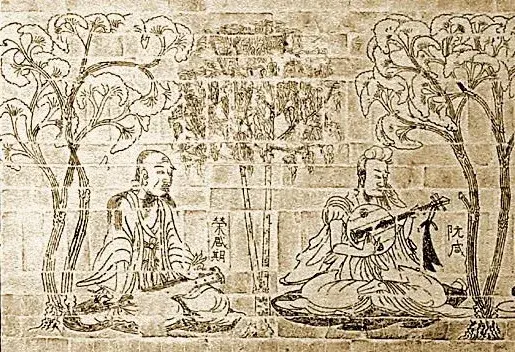
阮咸
Ruan Xian (dates unknown), courtesy name Zhongrong, was a native of Weishi County, Chenliu Commandery (modern Weishi, Henan Province). He was an illustrious scholar-gentry intellectual, Daoist philosopher, and musical genius during the Cao Wei and Western Jin dynasties. Descended from a prominent literary clan, his grandfather was Ruan Yu, one of the Seven Masters of Jian'an, and his uncle was Ruan Ji, the renowned literary…
Ruan Xian (dates unknown), courtesy name Zhongrong, was a native of Weishi County, Chenliu Commandery (modern Weishi, Henan Province). He was an illustrious scholar-gentry intellectual, Daoist philosopher, and musical genius during the Cao Wei and Western Jin dynasties. Descended from a prominent literary clan, his grandfather was Ruan Yu, one of the Seven Masters of Jian'an, and his uncle was Ruan Ji, the renowned literary master and fellow philosopher. Ruan Xian and Ruan Ji shared an intimate kinship and identical intellectual disdain for artificial ritualism, earning them the historical moniker "The Elder and Younger Ruan." Together with Ji Kang, Shan Tao, Xiang Xiu, Liu Ling, and Wang Rong, Ruan Xian was celebrated as one of the legendary Seven Sages of the Bamboo Grove. Renowned for his untrammeled eccentricity and contempt for rigid etiquette, Ruan Xian became famous for shocking social conventions, including airing coarse loincloths on bamboo poles during festival days, drinking unceremoniously from communal wine vats alongside pigs, and riding a donkey in mourning garb to reclaim his beloved Xianbei maidservant. Possessing near-miraculous musical discernment, he perfected the design of the circular, straight-necked ancient lute. Although recommended for high personnel office by Shan Tao, Emperor Wu of Jin declined to appoint him due to his bohemian lifestyle. When Ruan Xian accurately detected that Palace Court Director Xun Xu's court pitch pipes were excessively sharp, Xun Xu grew jealous and engineered Ruan Xian's exile to become Administrator of Shiping, earning him the enduring literary title "Ruan Shiping." Centuries later, during the reign of Wu Zetian, an ancient round copper lute matching his design was excavated and officially christened the "Ruanxian" (now commonly called the ruan), making him the only historical figure in Chinese history after whom a traditional musical instrument is permanently named.
Joined his uncle Ruan Ji in Shanyang, consorting with Ji Kang and Shan Tao as one of the Seven Sages of the Bamboo Grove.
Entered service under the late Cao Wei court, serving as Cavalier Attendant Gentleman while dedicating himself to acoustics and classical pitch theory.
Following the founding of the Western Jin, Minister of Personnel Shan Tao recommended Ruan Xian to oversee imperial appointments; Emperor Wu declined.
Pointed out that Xun Xu's newly tuned imperial music was sharp and aggressive; slandered by Xun Xu and exiled as Administrator of Shiping.
A Zhou dynasty jade ruler excavated in Henan proved that Xun Xu's tuning pipes were indeed short by one grain of millet, vindicating Ruan Xian's divine pitch discernment.
Passed away peacefully while serving as Administrator of Shiping; his sons Ruan Zhan and Ruan Fu inherited his philosophical fame.
Ruan Xian was born into one of the most culturally revered gentry lineages of northern China. His grandfather, Ruan Yu, had served Cao Cao as Chief Clerk of the Granary and achieved immortality as one of the Seven Masters of Jian'an; his father, Ruan Xi, served as Administrator of Wudu; and his uncle, Ruan Ji, was a towering philosophical giant of early medieval China. Growing up in this intellectual environment, Ruan Xian absorbed the Confucian classics while demonstrating a transcendent sensitivity to acoustic harmonics and instrumental performance. Disdaining the hypocrisy of contemporary court etiquette, Ruan Xian developed an eccentric, free-spirited disposition identical to Ruan Ji's, leading contemporaries to celebrate them as "The Elder and Younger Ruan."
During the middle of the third century, Ruan Xian joined his uncle in the peaceful groves of Shanyang, participating in the immortal gatherings of the Seven Sages of the Bamboo Grove alongside Ji Kang and Shan Tao. Amidst the perilous political transitions of the Wei-Jin era, the group sought spiritual sanctuary in Daoist naturalism, wine, and stringed instruments.
In an aristocratic society dominated by social ostentation and hypocritical morality, Ruan Xian's daily life was marked by provocative acts of nonconformity. The Ruan lineage in Weishi was divided into northern and southern branches. The Northern Ruans were wealthy officials who flaunted their luxury, while the Southern Ruans, including Ruan Xian, lived in modest austerity. On the Seventh Day of the Seventh Month, traditional custom required households to air their winter wardrobes in the courtyard to prevent moth damage. The Northern Ruans filled their verandas with shimmering brocades, embroidered damasks, and gauze silks. Ruan Xian, amused by this display of vanity, hoisted a coarse, threadbare pair of cloth loincloths onto a long bamboo pole in his courtyard. When neighbors laughed in bewilderment, Ruan Xian waved his horsetail whisk and laughed: "One cannot escape vulgar customs entirely; I am merely doing my share!" This incident originated the immortal Chinese idiom "Unable to Escape Vulgarity" (Wei Neng Mian Su).
On another occasion during a clan gathering, Ruan Xian discarded formal wine goblets. Instead, the family placed large earthenware basins filled with rich liquor on the ground, sitting in a circle to scoop wine directly with wooden ladles. When a herd of wandering piglets trotted into the courtyard attracted by the aroma, Ruan Xian prevented the servants from driving them away. Laughing heartily, he leaned over the vat and shared the wine directly alongside the animals, demonstrating complete indifference to human pretension.
His defiance of rigid mourning rules was equally notorious. During the mourning period for his mother, Ruan Xian's aunt was scheduled to relocate following her marriage. Ruan Xian had long been romantically involved with a beautiful Xianbei maidservant in his aunt's retinue. Although his aunt had initially promised to leave the maid behind, she took the girl when she departed. Hearing the news during a funeral gathering, Ruan Xian borrowed a mourning visitor's donkey without taking off his white hemp mourning garments, mounted the beast, and galloped dozens of li along the post road. Upon overtaking the party, he hoisted the Xianbei girl onto the saddle and rode back with her in plain view of shocked travelers. While dogmatic moralists condemned his conduct as scandalous, Ruan Xian remained utterly untroubled; this Xianbei consort subsequently gave birth to Ruan Fu, who rose to become Minister of Personnel in the Eastern Jin dynasty.
During the closing years of Cao Wei and the rise of the Sima family, Ruan Xian served as Cavalier Attendant Gentleman. After Emperor Wu (Sima Yan) founded the Western Jin in 265, Minister of Personnel Shan Tao sought capable talent to oversee imperial personnel selection. Recognizing Ruan Xian's profound discernment and incorruptible detachment, Shan Tao submitted a memorial: "Ruan Xian is pure, austere, and devoid of greed. He understands the purity and corruption of the world, and material wealth cannot sway his mind. If appointed to administer official selections, his impartiality will be unmatched in the realm."
However, Emperor Wu prioritized external moral orthodoxy and viewed the Bamboo Grove scholars with suspicion. Sima Yan rejected the petition on the grounds that Ruan Xian was excessively fond of wine and exhibited frivolous personal habits. Ruan Xian accepted the emperor's rejection with tranquility, retiring to his quarters to study musical theory and drink with friends.
During the Xianning era, Central Secretariat Director Xun Xu was entrusted with supervising court sacrificial music. Xun Xu considered himself an unmatched authority on classical acoustics, meticulously tuning bells and pitch pipes for imperial ceremonies, earning praise from courtiers as a master of intuitive musical knowledge. However, Ruan Xian was gifted with transcendent acoustic hearing, hailed by peers as having "divine musical insight."
Whenever the court performed Xun Xu's ceremonial suites, Ruan Xian observed in silence that the tones were excessively high and harsh, lacking the gentle, harmonious cadence of classical antiquity. Xun Xu, aware that Ruan Xian privately found his musical tuning flawed and recognizing that Ruan Xian's acoustic genius far surpassed his own, was overcome with jealousy. Utilizing his influence over Emperor Wu, Xun Xu engineered Ruan Xian's demotion and transfer out of the imperial capital to serve as Administrator of Shiping, a remote commandery in the Guanzhong region.
As Administrator of Shiping, Ruan Xian governed with benevolent simplicity, causing no disruption to the local populace. His banishment became an enduring cultural archetype of righteous scholars cast out by court sycophants. Decades later, southern poet Yan Yanzhi celebrated Ruan Xian in his Poems on Five Gentlemen, lamenting his unmerited exile.
Years after Ruan Xian's arrival in Shiping, an ordinary farmer tilling a field in Henan unearthed an ancient jade measuring ruler dating to the Western Zhou dynasty. The court verified that this ruler was the authentic standard once used by ancient kings to calibrate weights, measures, and the lengths of the twelve musical pitch pipes. Xun Xu immediately brought the Zhou jade ruler to examine his carefully cast court bells and pitch pipes.
To Xun Xu's mortification, every single pitch pipe he had manufactured was shorter than the ancient standard by exactly the width of one grain of millet. Because the pipes were short, the pitch of his music was naturally shrill and discordant, precisely as Ruan Xian had discerned by ear years earlier. Confronted with physical evidence, Xun Xu conceded that Ruan Xian's acoustic perception was an unapproachable divine gift. Ruan Xian spent his remaining years in Shiping, playing the lute, composing melodies, and enjoying wine with his nephew Ruan Xiu, passing away peacefully in his official residence.
Ruan Xian was an epochal figure in Chinese organology and musical theory. In addition to authoring the theoretical treatise Lu Yi (Treatise on Acoustics), he modified the ancient four-stringed, circular-bodied, straight-necked Han-Qin lute, adjusting its frets to produce a rich, mellow, and contemplative timbre. During the reign of Wu Zetian in the Tang dynasty, an ancient bronze lute matching his design was excavated from a Sichuan tomb; scholar Yuan Dandan identified it as Ruan Xian's creation, leading the court to name the instrument "Ruanxian." Today, the ruan remains an indispensable family of traditional Chinese plucked instruments.
In the famous tuning controversy against Xun Xu, Ruan Xian demonstrated unprecedented acoustic discernment. Without the aid of archaeological measurement tools, he diagnosed a microscopic error of one millet grain solely through his ear, establishing an extraordinary milestone in ancient Chinese acoustic science.
Ruan Xian's provocative life choices—from hanging his underwear in defiance of wealthy relatives to dining with livestock and rescuing his foreign maidservant—represented a profound philosophical rebellion against the hypocrisy of the Sima regime's filial posturing. His unpretentious sincerity and commitment to natural feeling contributed profoundly to the aesthetics of early medieval Chinese intellectual freedom.
FIGURES ASSOCIATED WITH THIS DYNASTY