Birth in Xiangshan
Born into a modest rural household in Nanping Village; enrolled in the Morrison School in Macao at age seven.
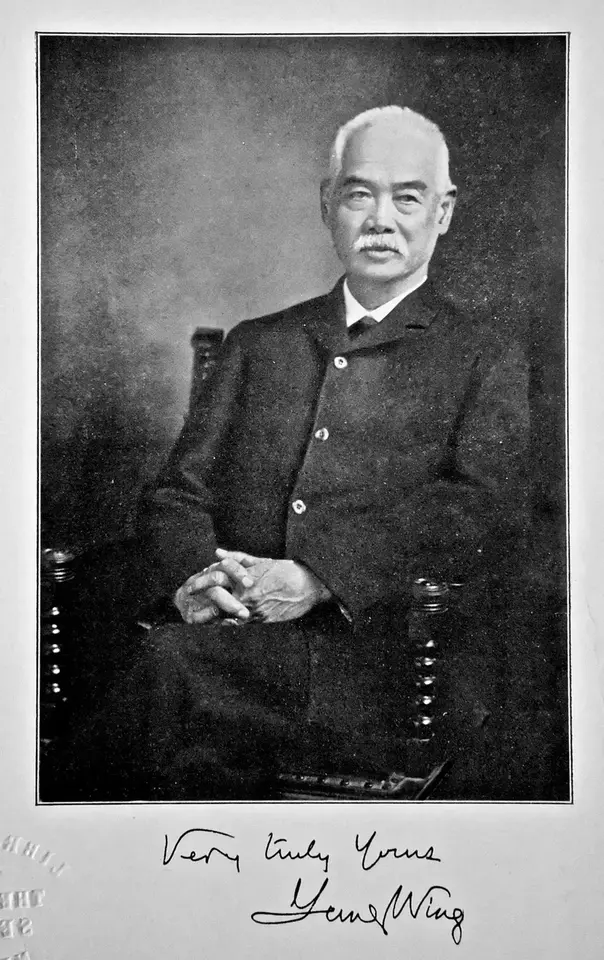
容闳
Rong Hong (容闳, 1828–1912), widely known in the West as Yung Wing, courtesy name Chunfu, was a pivotal educator, diplomat, and statesman of late imperial China. Hailing from Nanping Village in Xiangshan County, Guangdong, he attended the Morrison Education Society School in Macao and traveled to the United States in 1847. Graduating from Yale College in 1854, he made history as the first Chinese student to earn a degree from…
Rong Hong (容闳, 1828–1912), widely known in the West as Yung Wing, courtesy name Chunfu, was a pivotal educator, diplomat, and statesman of late imperial China. Hailing from Nanping Village in Xiangshan County, Guangdong, he attended the Morrison Education Society School in Macao and traveled to the United States in 1847. Graduating from Yale College in 1854, he made history as the first Chinese student to earn a degree from an American university. Returning to China, Yung Wing joined the Self-Strengthening Movement under Viceroy Zeng Guofan, traveling to the United States to purchase advanced industrial machinery that catalyzed the founding of the Jiangnan Machine Manufacture General Bureau in Shanghai. In 1872, he successfully persuaded the Qing imperial court to launch the Chinese Educational Mission (Chuyang Youtong Yiyeju), sending 120 young Chinese students to study in New England, nurturing transformative leaders such as railway engineer Zhan Tianyou and Premier Tang Shaoyi. Later in life, Yung Wing supported the Hundred Days' Reform of 1898 and ultimately embraced Sun Yat-sen's republican revolution, making profound contributions to China's transition to modernity.
Born into a modest rural household in Nanping Village; enrolled in the Morrison School in Macao at age seven.
Accompanied the American missionary Samuel Robbins Brown to the United States, enrolling in Monson Academy in Massachusetts.
Graduated with a Bachelor of Arts from Yale College, becoming the first Chinese graduate of an American university.
Returned to his homeland with a lifelong mission of educational modernization, working as a translator in Guangzhou, Hong Kong, and Shanghai.
Visited Zeng Guofan's military headquarters in Anqing, proposing the establishment of a centralized industrial machine-tool plant.
Procured over one hundred advanced machine tools from American factories, enabling the founding of the Jiangnan Arsenal in Shanghai.
Dispatched the first detachment of thirty government-sponsored young boys to study in New England as Deputy Supervisor of the Mission.
Appointed Associate Minister to the United States, Spain, and Peru; led an investigative mission to Peru that successfully ended the coolie trade.
Collaborated with Kang Youwei and Liang Qichao in Beijing; his private residence served as an organizational hub for the reform movement.
Elected President of the Chinese Parliament in Shanghai, coordinating support for Tang Caichang's Self-Reliance Army uprising.
Provided enthusiastic financial and strategic support to Sun Yat-sen's provisional republic; died in Hartford on April 21 at age eighty-four.
Rong Hong was born into an agrarian family in Nanping Village, Xiangshan County, Guangdong Province. Situated in close proximity to the trading enclave of Macao, his father appreciated the strategic value of Western literacy. In 1835, at age seven, Yung Wing was enrolled in the Morrison Education Society School operated by Western missionaries in Macao, receiving foundational instruction in the English language and elementary sciences.
In 1847, the school's headmaster, Samuel Robbins Brown, returned to the United States due to health issues. Yung Wing, accompanied by fellow students Huang Kuan and Huang Sheng, sailed aboard the commercial vessel Huntress to the United States.
Upon arrival, he entered Monson Academy in Massachusetts to complete his secondary preparatory education. In 1850, Yung Wing successfully matriculated into Yale College. At Yale, he immersed himself in English literature, moral philosophy, international law, and political economy, while closely observing the institutional mechanics of American constitutional governance and industrial manufacturing.
In 1854, Yung Wing was awarded a Bachelor of Arts degree from Yale College, establishing a historic precedent as the first Chinese citizen to graduate from a premier Western university. Reflecting upon his graduation, he recorded a lifelong personal pledge in his memoirs: to ensure that the civilizing benefits of modern Western education were extended to future generations of his countrymen, guiding China toward strength and enlightenment.
Returning to China in late 1854, Yung Wing encountered a country convulsed by internal rebellion and foreign incursion. Over the ensuing decade, he worked as a translator for the United States Consulate in Guangzhou, the Supreme Court of Hong Kong, and the Imperial Maritime Customs in Shanghai, while engaging in private commercial trade in raw silk and tea to understand domestic commerce.
In 1863, Zeng Guofan, Viceroy of Liangjiang and preeminent leader of the Self-Strengthening Movement, sought modern technical expertise at his military headquarters in Anqing. Recommended by mathematicians Li Shanlan and Xu Shou, Yung Wing traveled to Anqing for an interview with Zeng.
During their conferences, Yung Wing persuasively argued that purchasing finished European rifles and steamships was inadequate; China required a centralized "mother factory" equipped with foundational machine tools capable of manufacturing all forms of modern machinery domestically. Impressed by this strategic vision, Zeng commissioned Yung Wing as official purchasing envoy, allocating sixty-eight thousand taels of silver to procure industrial equipment in the West.
Arriving in the United States in 1864, Yung Wing purchased over one hundred precision industrial machine tools—including lathes, planers, milling machines, and drilling apparatus—from manufacturing centers in New York and New England. Delivered to Shanghai in the autumn of 1865, these machines were merged with Li Hongzhang's local ordnance works to establish the Jiangnan Machine Manufacture General Bureau, China's foremost early modern industrial arsenal.
While advancing defense manufacturing, Yung Wing maintained that industrial progress was impossible without institutional modern education. He formulated a systematic proposal to select gifted young Chinese boys for long-term study in American preparatory schools and universities.
In 1870, in the aftermath of the Tianjin Incident, Yung Wing presented his plan to Zeng Guofan and Li Hongzhang. The two senior statesmen endorsed the initiative and jointly memorialized the throne, securing imperial sanction for the Chinese Educational Mission (Chuyang Youtong Yiyeju).
In the summer of 1872, the first contingent of thirty government-sponsored boys sailed from Shanghai for San Francisco, establishing mission headquarters in Hartford, Connecticut. Chen Lanbin was appointed Chief Commissioner, with Yung Wing serving as Deputy Commissioner. Between 1872 and 1875, four detachments totaling 120 Chinese youths arrived in New England.
Yung Wing placed the students with reputable American host families and enrolled them in regional academies and prominent universities such as Yale, Harvard, and Columbia. The students excelled academically and assimilated into American community life, later producing foundational leaders of modern China, including rail pioneer Zhan Tianyou, premier statesman Tang Shaoyi, and foreign minister Liang Dunyan.
In 1881, conservative imperial bureaucrats led by Wu Jiashan denounced the mission, alleging that the students were discarding Confucian customs and adopting foreign religion. The Qing court abruptly recalled the students, halting the formal program. Nevertheless, Yung Wing's initiative had introduced the vital tradition of modern international study to China.
In 1875, the Qing government appointed Chen Lanbin and Yung Wing as joint diplomatic ministers to the United States, Spain, and Peru. Yung Wing established residence in Washington, D.C., managing bilateral relations.
During this period, thousands of Chinese indentured laborers ("coolies") were subjected to brutal enslavement in Peru's coastal guano deposits and sugarcane plantations. Responding to international outcry, the Qing court dispatched Yung Wing as special commissioner to conduct a formal field investigation in South America.
Yung Wing traveled extensively through Peruvian plantations and mines, gathering firsthand testimonies, documenting instances of physical abuse, and photographing mutilated laborers. Armed with incontrovertible evidence, he confronted Peruvian authorities with the norms of international law.
His comprehensive Report on the Condition of Chinese Laborers in Peru forced the Peruvian government to conclude a formal bilateral treaty guaranteeing civil protection for Chinese laborers and terminating the indentured contract-labor trade, safeguarding the basic human rights of thousands of overseas Chinese.
Following China's disastrous defeat in the First Sino-Japanese War (1894–1895), Yung Wing recognized that mechanical modernization without constitutional reform could not preserve the empire. He submitted comprehensive proposals for national banking systems, postal networks, and railroad construction to Governor-General Zhang Zhidong.
During the Hundred Days' Reform of 1898, Yung Wing's residence in Beijing became a crucial meeting ground for reform leaders Kang Youwei, Liang Qichao, and Tan Sitong. Yung Wing actively petitioned Emperor Guangxu in support of constitutional monarchy.
Following the conservative coup d'état orchestrated by Empress Dowager Cixi, Yung Wing fled to the foreign concessions of Shanghai. In 1900, he co-founded the Chinese Parliament in Shanghai with Tang Caichang and Yan Fu, serving as its elected president and supporting the armed Self-Reliance Army rebellion against Manchu autocracy.
Facing imperial arrest warrants following the rebellion's collapse, Yung Wing escaped into permanent exile. Abandoning monarchical reform, he allied with Sun Yat-sen's revolutionary republican movement, utilizing his American network to solicit funds and military arms for the Tongmenghui.
Upon the founding of the Provisional Government of the Republic of China in Nanjing in 1912, President Sun Yat-sen sent urgent telegrams inviting Yung Wing to return to serve as presidential advisor. Prevented by advanced age and failing health from undertaking the voyage, Yung Wing passed away in Hartford, Connecticut, on April 21, 1912, at the age of eighty-four.
Yung Wing's foremost historic legacy was the conceptualization, negotiation, and implementation of the Chinese Educational Mission.
Overcoming deep bureaucratic xenophobia and isolationist dogma, he engineered the first state-sponsored overseas study program in Chinese history.
By dispatching 120 young scholars to the United States, he bypassed the antiquated imperial civil service examination system, systematically cultivating China's first generation of professional civil engineers, naval officers, telegraph directors, and modern diplomats who spearheaded China's early modern industrialization.
As an early architect of the Self-Strengthening Movement, Yung Wing transformed Chinese military manufacturing philosophy.
Rather than relying on ad-hoc imports of foreign weapons, he advocated the establishment of a domestic machine-tool foundation, traveling abroad to purchase the industrial plant that created the Jiangnan Machine Manufacture General Bureau.
The arsenal became the largest industrial facility in East Asia, fostering early machine tooling, modern naval architecture, technical schooling, and translation bureaus that introduced Western natural sciences to the Chinese intellectual world.
In his diplomatic career, Yung Wing set an early precedent for Chinese state intervention in defense of overseas citizens.
His hazardous investigative mission to Peru documented systematic corporate brutality against indentured Chinese laborers, using international treaties and public documentation to force diplomatic concessions.
His efforts dismantled the abusive coolie trade in South America, demonstrating acute legal competence and humanitarian resolve in nineteenth-century international relations.
In a formal eulogy honoring Yung Wing, Sun Yat-sen remarked: "Mr. Yung Wing was deeply patriotic, opening the path of modern international education. Dedicating his entire life to national revolution, his historic service to the Republic stands as an enduring model for our party."
Cai Yuanpei evaluated his contribution to Chinese culture: "Single-handedly directing the axis of state reform and establishing the hundred-year tradition of American study, Master Chunfu stands preeminent among those who cleared the path for modern Chinese civilization."
Liang Qichao recorded in his collected writings: "The historical transmission of Western learning to the East found its true pioneer in Yung Wing of Xiangshan. Armed with profound scholarship from Yale College, he devoted his energies to industrial self-strengthening and political reform, remaining unyielding through a lifetime of peril."
Modern historians venerate Yung Wing as an extraordinary bridge between Chinese civilization and Western modernity, whose moral integrity, educational vision, and relentless quest for national renewal helped shape the contours of modern China.
FIGURES ASSOCIATED WITH THIS DYNASTY