Birth
Ren Renfa was born in Qinglong Town, Songjiang, studying Confucian classics and hydraulic calculations from youth.
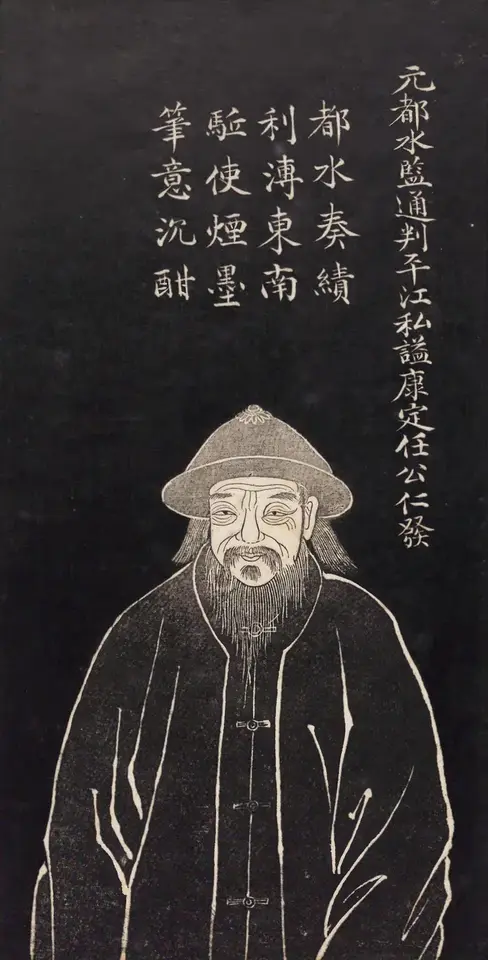
任仁发
Ren Renfa (任仁发) was an outstanding hydraulic engineer, court dignitary, and master painter of the Yuan Dynasty. Born into an eminent family in Qinglong Town, Songjiang, he passed the provincial civil examination in 1267 during the Southern Song. Entering Yuan service on account of his expertise in arithmetic, geography, and hydraulic engineering, he held key positions including Vice Commissioner for Waterways and Agricultural…
Ren Renfa (任仁发) was an outstanding hydraulic engineer, court dignitary, and master painter of the Yuan Dynasty. Born into an eminent family in Qinglong Town, Songjiang, he passed the provincial civil examination in 1267 during the Southern Song. Entering Yuan service on account of his expertise in arithmetic, geography, and hydraulic engineering, he held key positions including Vice Commissioner for Waterways and Agricultural Fields, Junior Director of the Waterways Directorate, and Vice Pacification Commissioner of Zhedong, reaching the rank of Grand Master for Forthright Counsel. Ren dedicated his life to major water conservancy projects, directing the dredging and regulation of the Wusong River, the water systems of Lake Tai, and the Tonghui River in the capital Dadu. His engineering accomplishments safeguarded vast agricultural regions, while his ten-volume treatise Collection on Water Conservancy stands as a foundational classic in Chinese technological history. In art, Ren shared equal fame with his lifelong contemporary Zhao Mengfu, excelling in equestrian and figure painting. Emulating Tang masters Cao Ba and Han Gan alongside Northern Song master Li Gonglin, his brushwork was meticulous and dignified, earning imperial patronage from Emperor Renzong. His surviving masterworks, including Five Drunken Princes Returning on Horseback and Two Horses, are acclaimed as global treasures.
Ren Renfa was born in Qinglong Town, Songjiang, studying Confucian classics and hydraulic calculations from youth.
At age fourteen, he passed the Southern Song provincial examination, winning early scholarly renown.
Recruited into Yuan administrative service for his technical expertise in water management.
Directed major hydraulic works along the Wusong River, clearing sea channels and protecting farm lands.
Summoned to manage waterways in Dadu, improving the navigability of the Tonghui Canal.
Retired with the rank of Vice Pacification Commissioner of Zhedong, constructing Laiqing Tower in his hometown.
Passed away at his residence in Qinglong Town at age seventy-three, buried at Gaojiatai in Qingpu.
Ren Renfa was born east of Qinglong Town in Songjiang Prefecture. His father Ren Xun served as Prefect of Gaoyou, leaving a rich heritage of classical learning. Ren demonstrated precocious talent from childhood, mastering Confucian canonical texts while displaying keen aptitude for astronomy, mathematics, cartography, and hydraulic engineering. In 1267, at the youthful age of fourteen, he participated in the provincial examinations and obtained the degree, gaining early prominence across Jiangnan.
Following the Mongol conquest, the Yuan court sought talented administrators across the south. Recognizing Ren's practical mastery of waterways and surveying, imperial authorities appointed him to the Directorate of Waterways and Agricultural Fields, launching four decades of administrative and technological service.
Because the Yuan capital Dadu relied entirely on southern grain transport, maintaining the water network around Lake Tai and the Wusong River was vital to the empire. The mouth of the Wusong River suffered from chronic siltation, causing frequent catastrophic flooding. Entrusted with resolving the crisis, Ren surveyed the terrain in person, formulating a comprehensive plan to dredge ancient riverbeds and divert floodwaters through controlled sluices. He directed several large-scale dredging projects, constructing sturdy stone weirs that effectively drained Lake Tai and restored tens of thousands of hectares of submerged farmland.
In addition to southern water conservancy, Ren was summoned north to direct improvements along the Tonghui River connecting Dadu to the Grand Canal. He surveyed water sources, reinforced locks, and improved grain barge navigability, earning imperial commendations. Synthesizing decades of practical experience, Ren compiled the ten-volume Collection on Water Conservancy, systematically documenting flood control, canal design, seawall maintenance, and sluice construction, providing an indispensable manual for future generations.
Alongside his demanding administrative duties, Ren enjoyed celebrated fame as a painter. Gentle and refined in character, he practiced calligraphy in the forceful style of Tang master Li Yong and specialized in painting horses and historical figures. Rather than following the prevailing trend toward dry literati monochrome sketches, Ren pursued the classical monumental style of Tang painters Cao Ba and Han Gan, employing fine iron-wire line drawing and rich mineral pigments.
Upon ascending the throne, Emperor Renzong admired Ren's artistic skill and issued an imperial decree commissioning him to paint Heavenly Steeds of Wowa and Spring Steeds. When presented to the throne, the magnificent horses prompted imperial admiration, and the emperor ordered the scrolls preserved within the secret palace archives. Contemporary scholars praised his meticulous brushwork as matching that of Zhao Mengfu.
In his later years, Ren advanced to Junior Director of the Waterways Directorate and Grand Master for Forthright Counsel, concluding his career as Vice Pacification Commissioner of Zhedong. Retiring in honor during the Taiding era, he returned to Songjiang, building Laiqing Tower and Lanhui Pavilion along the Qinglong River, where he entertained scholars with poetry and music.
In the winter of 1327, Ren passed away peacefully at his residence at the age of seventy-three. In 1953, archaeologists in Qingpu, Shanghai, uncovered his official tombstone, whose inscription verified his recorded biography and confirmed his extraordinary dual legacy as engineer and artist.
Ren Renfa occupied a pioneering position in Chinese technological history. He successfully solved the flood problems of the lower Yangzi delta, while developing a systematic hydraulic theory. His ten-volume Collection on Water Conservancy compiled historical waterway records, engineering blueprints, sluice construction standards, and official memorials, providing an invaluable historical record of medieval Chinese civil engineering.
Ren was the supreme master of horse painting during the Yuan Dynasty. His celebrated scroll Five Drunken Princes Returning on Horseback depicts the future Tang emperor Xuanzong riding home in inebriated merriment with his royal brothers. Executed with fine lines and elegant colors, each horse moves with dignified vitality, free from vulgarity. Another masterpiece, Two Horses (preserved in the Palace Museum in Beijing), depicts a sleek, well-fed horse alongside an emaciated, neglected mount, using subtle pictorial allegory to critique bureaucratic corruption and commend incorruptible service.
FIGURES ASSOCIATED WITH THIS DYNASTY